Archives » Eric Brown

I Remember Pallahaxi by Michael Coney

Drugstore Indian Press, 2014, 283 p plus vi p Introduction by Eric Brown.

 I Remember Pallahaxi cover

Michael G Coney was a writer of the 1970s and 1980s whose work I remember most fondly. Despite winning a BSFA Award for best novel for Brontomek! he never achieved the wide success and readership he deserved perhaps because his novels tended to focus on the dilemmas and relationships of his characters rather than any SF ideas they might contain. In this regard his influence on the work of Eric Brown (who provides the introduction to this volume) is unmistakable.

Never published in the author’s lifetime, I Remember Pallahaxi is a sequel of sorts to Coney’s 1975 novel Hello Summer, Goodbye but is set hundreds of years after the events of that book. Here we are among the stilk, a humanoid race, inhabiting an unnamed Earth-like planet orbiting a sun called Phu with a giant planet named Rax dominating the system’s celestial mechanics. The stilk inherit their ancestors’ memories up to the moment of their own conception, boys only their father’s line, girls only their mother’s. The resulting hierarchy means those who can trace these memories back furthest become manchief or womanchief of their respective villages. Inheritance therefore falls to the youngest son or daughter – the ones with the most such memories. Gender roles are also rigidly demarcated as are the living arrangements. There are no nuclear families; association of mothers and fathers beyond their initial sexual encounter is looked upon as unnatural. Boys are taken into the men’s house on coming of age, girls remain in the women’s.

The book starts at a time when the crops of Yam village are beginning to fail, the animals the men hunt scarcer, and the chiefs have to make a journey to the fishing village of Noss to borrow food for the winter against future crops. The crude boat young Yam Hardy, nephew of Yam’s manchief, has taken along on the trip for adventure begins to sink under him and he is rescued by Noss Charm, the most eligible girl in Noss. They form an instant attraction to each other despite the long-standing mutual prejudices of each village. The sinking wasn’t an accident though. They find a hole in the upturned boat. A mystery then, along with the SF elements. Subsequently, Yam’s food situation gets no better as the crops fail again and the animals become ever fewer. When Hardy’s father Bruno is murdered on another supplicant trip to Noss Hardy realises he is in danger.

All this is almost by the way to what is really the main driver of the book, the importance of “stardreaming” (the accession to those ancestral memories,) the mysterious creatures called lorin (with apparent telepathic abilities) and the casual discarding of the stilk by the humans, who arrived after the time in which Hello Summer, Goodbye was set, in order to exploit the planet’s resources – albeit with treaty obligations – as humans do.

I note that by the end the conceit that Hardy is relating this to a human (his narrative makes frequent references to this and compares both races’ backgrounds) does not quite stand up. Not that it matters. In most respects the stilk we are shown might as well be human. They behave in the way we would expect humans to. Barring the living arrangements (which in the novel are beginning to break down and are found in some human societies anyway) they have the same flaws, strengths and idiosyncrasies as humans. Most crucially, Coney makes the reader care about them. Along the way he takes a wide swipe at religion and the fervour it can induce, the mask it can provide.

Quite why this novel took so long to be published is a mystery to me. It is quintessential Coney which makes it very good indeed.

Pedant’s corner:- various USianisms and spellings (no doubt Coney hoped for US publication when he was writing this,) “‘What’s you name?’” (your,) “trying the race the motorcart” (trying to race,) “what was going on it my mind” (in my mind,) “and from time to time and drank deeply” (from time to time drank deeply,) “as boiler ran out of steam” (as the boiler,) “ten, eleven generations ago” (on next page is “ten, eleven years ago”,) inclintions (inclinations,) “much older that Dad” (than Dad,) “‘you’d rather to show me around’” (rather show me around,) womn’s (women’s,) “‘she’s an easy women to let go of’” (woman,) “the lay of the rocks” (the lie,) “‘Come one’” (Come on,) a missing quote mark at the start of a paragraph of direct speech, “a small group of trees were shaking violently” (a small group was shaking,) “and finally spoke words that seem to crackle like ice” (seemed.) “His audience were not so familiar,” (his audience was not,) Browneyes’ (Browneyes’s,) “one of Stance’s huntsman” (huntsmen,) “not having their parents memories” (parents’,) “‘it was never mean to be opened’” (meant.)

Reunion on Alpha Reticuli II by Eric Brown

Part Three: The Telemass Quartet, P S Publishing, 2016, 80 p.

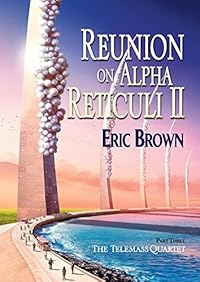
 Reunion on Alpha Reticuli II cover

In this third instalment of Brown’s ‘Telemass Quartet’ Matt Hendrick is still following one step behind his ex-wife, Maatje, and the sleep pod containing his dead daughter Samantha, this time landing on the resort world of Tourmaline, now awaiting the imminent arrival of a starship despatched long before the days of telemass and whose inmates in suspended animation coldsleep are blissfully unaware of what will greet them. On landing he is rescued from the clutches of one (poor) telepath in Maatje’s employ by another (better) one not so encumbered. This is Mercury Velasquez, who volunteers her help in Hendrick’ s quest.

Unlike in the previous instalment the plot this time is more centred on Hendrick’s pursuit of his daughter. Maatje and her new lover Horvath have engaged the services of a Zuterainian effectuator. who may be able to restore Samantha to life. Velasquez’s telepathic ability reveals the dangers in the procedure. However, no full resolution is achieved (Part Four is still to come after all) and Maatje, Horvath and the insensate Samantha give him the slip again.

No weird religion this time but at least two types of strange alien to be going on with. If I have a criticism it is that the ending (involving arrival of the starship) is perhaps overly sentimental. But Brown has always emphasised human considerations.

Pedant’s corner:- In the cover – and internal – blurb; “all is not as it seems” (not all is as it seems.) Otherwise: “‘None of us like our private thoughts made public’” (ought to be “none of us likes”, but it was in dialogue, so may be true to the character,) an albino girl is described as having silver pupils (pupils? Not irises? And don’t albinos have pink irises anyway?) “‘pre-Telemass, pre-Expansion, prealmost everything we take for granted’” (to fit with the other two that should be pre-almost everything,) a missing comma at end of a speech quote, “‘Vizzek would have gone through the charade’” (through with the charade,) “‘Maatje’s might still be on’” (Maatje might still be on,) “‘I read you pain’” (your pain,) “Hendrick hitched himself onto high seat” (onto a high seat,) “him and his fellows humans” (him and his fellows; or, him and his fellow humans,) last line, difficultly (difficulty,) “he might have been able to accept it easier than” (‘he might have been able to accept it more easily than’ is the more natural form,) “Hendrick saw the saw the weapon” (only one ‘saw the’ needed,) “tears roll down her cheeks” (rolled.)
Time interval later count: 6 (though one was a sneaky “a little later”) plus one “minutes elapsed”.

Strange Visitors by Eric Brown

Imaginings 8, NewCon Press, 2014, 158 p.

I ought again to point out that the author is well-known to me: is, indeed, a friend. I hope that this does not colour any appreciation – or lack thereof – of his output nor get in the way of any judgements or comments I make about his work.

 Strange Visitors cover

In any case in his introduction to this collection its publisher Ian Whates relays “stalwart of the British SF community” and former owner of Birmingham’s much-lamented Andromeda bookshop Rog Peyton’s opinion that Brown is our greatest living SF writer – as much for the author’s concentration on the humans in his stories as for anything else. Whatever, Strange Visitors contains an excellent body of stories displaying Brown’s range and it is striking here how often those which reflect humanity and its foibles most directly are the most successful and satisfying. Many of Brown’s perennial concerns are evident (religion surprisingly excepted) but their handling shows Brown’s assurance as a writer.

In Life Beyond…… 1 Brown pays effective homage to SF writer Clifford D Simak. An ageing writer faced with losing his recently orphaned grand-daughter to an adoptive family has a close encounter with a book-collecting alien.

Steps Along the Way2 is set thirty thousand years into the future where humans are effectively immortal, have spread all through the galaxy and can Enstate and Enable people from history.

Brown’s affection for the work of Michael G Coney shines through The Sins of Edward Veron3 where the titular Veron is an artist who has lost his ability to produce good work. Then an alien art collector from Mintaka V arrives at Sapphire Oasis. (SPOILER ALERT. There is a slight flaw in this story in that Veron seems to have been able to leave the Oasis the day after his wife died without engendering either suspicion or investigation.)

In Myths of the Martian Future4 Olinka and Tem, two crab-like cave dwellers on a far-future Mars, set out on their initiation rite on the surface. What they meet encompasses both the past of their species and a description of its future. There is a certain stiltedness in the narration, characteristic of all stories such as this.

The Scribe of Betelgeuse V5 is a tongue-in-cheek account of the invasion of Earth by octopods from Betelgeuse V, whose first act is to cause an episode of mass writers’ block. It manages to name check a couple of Brown’s writer friends as well as poke fun at the publishing industry.

The Rest Is Speculation6. Two and a half billion years into the future representatives of every sentient race that ever existed on Earth are gathered together by the Effectuators to witness its last days.

The Tragic Affair of the Martian Ambassador7 is a Sherlock Holmes pastiche wherein the great detective is invited to investigate the murder of the Martian ambassador at Mars’s London embassy, where the two human employees are a certain Herbert Wells and Miss Rebecca West.

In Bukowski on Mars, With Beer8 Brown imagines how Charles Bukowski would cope after being brought back to life – along with all the greats – on a future Mars. The beer helps.

People of Planet Earth9 is an alien invasion story where the method of body snatching is exceedingly unusual, to say the least.

In P.O.O.C.H.10 Michael is punished for electronically stealing from the rich (but relaying the proceeds to charity) by being given his own Personal Omni-Operational Correction Hound; a robot which mimics a real dog in all respects.

Pedant’s corner:- A total of 20 occurrences of “time interval later” plus one “within seconds”. Each story has its title as a header on odd-numbered pages except The Tragic Affair of the Martian Ambassador appears for both its own story and for The Rest Is Speculation and People of the Planet Earth appears for People of Planet Earth. Otherwise; 1USian spellings – disheveled, defense, etc; but…. manoeuvre. “of legion of thinkers” (of a legion; or, of legions.) “What if they alien” (the alien,) “I am loathe to give them up” (loth, or loath,) 2“men whose contribution to history were steps along the way” (contributions.) 3“accused her of having affair” (an affair,) “the piece in which I had tried to imbue” (the piece which I had tried,) back-peddling (back pedalling,) 4Barington (Barrington.) 5Carstairs’ (Carstairs’s,) stared at MS (the MS,) the BBC were on hand (the BBC was,) “I wil l-” (I will-,) Hemmings’ (Hemmings’s,) “‘I demanded reparations’” (demand.) 6a missing comma before a piece of dialogue, “this absence, this lacunae” (lacuna,) disk x 3 but disc x 1, “‘And they?’ I Kamis asked.” (‘And they?’ Kamis asked.) 7Wells’ (Wells’s,) “‘Was he is the habit….’” (in the habit,) “The slightest frowned marred” (frown,) “‘For a little short for six months’” (of six months,) Madame Rochelle’s (appears as Madame the first twice but subsequently as Madam, but this may have been an authorial distinction between that lady’s establishment and her person,) “‘if any of your ladies in the habit’” (are in the habit,) St Pauls (St Paul’s,) 8“A guy a silver suit” (in a silver suit,) “That last I remembered” (The last?) anther beer (anther beer sounds like great stuff but another beer was meant,) “to keep in breathable” (it breathable,) “and the all fucking” (and all the fucking.) 9the throes delirium (of delirium,) ‘Ladies and gentlemen, Speaker of the House’ (when starting a speech in Parliament the form is, ‘Mr Speaker, honourable members.’) 10”to answer to summons” (the summons,) descendent (descendant,) miniscule (minuscule,) you commands (your,) busses (buses.) Thirty minute (minutes,) banks accounts (banks’ accounts.)

I’m on the Map!

Literally.

Despite me not having a piece of fiction published for a few years – and only ever one novel – I’ve been included on this map of British SF and Fantasy writers. (If you click on the map it will lead you to its creator’s website, where copies can be purchased):-

Science Fiction and Fantasy Literary Map

I’m humbled by this. Imagine me being on the same map as Alasdair Gray, Iain (M) Banks, Ken MacLeod, Ian McDonald, Eric Brown, Arthur C Clarke, J G Ballard, George Orwell et al. Not to mention J Leslie Mitchell (Lewis Grassic Gibbon.)

Murder at the Loch by Eric Brown

Severn House, 2016, 208 p.

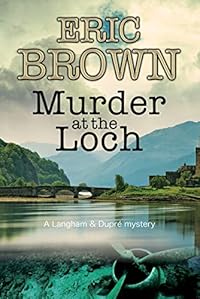
 Murder at the Loch cover

If you want an example of how character can be established with economy look no further. Brown does this with facility. Witness how much we learn about Gabriel Gordon from the reactions of Sophie, living in an artists’ commune in London, to Maria Dupré seeking him out. This, in the third of Brown’s Langham and Dupré mysteries, is in part of the narrative where Maria is looking into Gordon’s background while Don Langham is investigating an attempted murder at a hotel in the Scottish Highlands. Langham’s wartime comrade, private detective Ralph Ryland, enlisted his aid when their wartime commanding officer Major Gordon, who now owns the hotel, called for assistance after he and a guest were shot at while they were involved in work on a project to raise the wreck of a German Dornier aeroplane which had crash landed in the nearby loch in February 1945.

The inhabitants of the hotel, not only Gabriel Gordon but also Hungarian emigré Renata Káldor, the German Ulrich Meyer – an expert on World War 2 aircraft – a Professor Hardwick (who is delving into the hotel’s history of paranormal phenomena) and Major Gordon’s ward Elspeth Stuart (with whom Gabriel had a fling before the Major put a stop to it) provide plenty of scope for suspicion.

The splitting of Langham and Dupré is a device Brown has employed before and is a useful tool when background information has to be sought from different locations many miles apart. It also handily allows both to be placed in jeopardy separately. Here the fifties setting yields a benefit to raising tension in that communication between the pair has to be by an unreliable telephone connection. The book also sees the welcome return of Langham’s literary agent, Charles Elder, released from jail, where he made a new friend. (It remains to be seen whether this will be a wise liaison.)

This isn’t quite a locked room mystery (though a winter snow storm makes it more or less a hotel in lock-down one.) However, the actual murder when it occurs – with which another years previously is connected – comes close to the classic scenario. And there is nothing gratuitous here. Brown adheres pretty closely to the template and feel of the stories he is echoing. If at times his Langham and Dupré mysteries may seem to have a soft edge that isn’t necessarily a drawback. Those fifties crime stories were primarily entertainment and still are.

Pedant’s corner:- Inverness is described as a “little town.” In the 1950s? “Soon they were tooling along,” (tootling?) “economical with the truth” (in dialogue – but was it in use in the 1950s?) “a crack at the Bosch!” (Boche,) “a Hungarian who had fled her homeland when the Nazis invaded” (I think the Nazis already had a presence there and so took over rather than invaded, but they certainly occupied the country in an attempt to prevent it changing sides as Romania had just done,) jerry-rigged (jury-rigged,) Camus’ (Camus’s,) “it appeared as first glance” (at,) primeval (I prefer primaeval,) “She said It was unlikely” (insert quote marks or make “it” lower case,) of the Loch Corraig Castle (of Loch Corraig Castle,) “drawing is revolver” (his.) Plus sixteen instances of “time interval later” (but two of these were in dialogue and another two not very glaring.) Also one “within minutes.”

Cove, Berwickshire

As its name suggests the village of Cove in Berwickshire – just over the A1 from Cockburnspath where my friend Eric Brown lives – is near to a cove.

This cove:-

Cove

Harbour at Cove

Cove Harbour Walls

The path down to the actual cove goes past this memorial which commemorates the women and children left by the fishing disaster of 14th October 1881 when 189 fishermen were lost off this coast. Cove lost 11 out of 21 fishermen.

Cove Fishermen's Memorialmemorial

The path goes through a tunnel cut through this bluff; the cove itself is therefore very secluded:-

Cove, Berwickshire

On the harbour wall there are bollards for boats to tie up to. They show interesting accretions of rust:-

Rust, Cove

More Cove Rust

Murder at the Chase by Eric Brown

Severn House, 2014, 214 p.

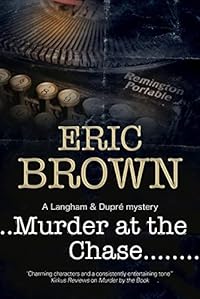
 Murder at the Chase cover

The second of Brown’s Langham and Dupré stories this one promises to be a locked room mystery but the locking is cleared up very quickly. Donald Langham’s acquaintance Edward Endicott is the one who has disappeared. His son, Alasdair fears he has been harmed as he had fallen under the influence of a man claiming to be Victorian Satanist Vivian Stafford.

Retracing the possible path along which Endicott’s dog returned, Lanham, Dupré and former Hollywood actress Caroline Dequincy come upon a body. It is not Endicott’s though, but Stafford’s. The web of connections Brown then constructs involves most of the leading characters. I note here the appearance of artist, Haverford Dent, not the first time an artist has appeared in Brown’s fiction. The unwinding of the circumstances leading to Stafford’s murder and to the death of the local village’s vicar, Marcus Denbigh, involves a lot of toing and froing – not to mention sipping of pints. The hesitancies of the relationship between Langham and Dupré do take up quite a bit of the book’s time, though.

Though there are some sharp edges Brown again emulates well the cosiness of the classic detective story. However, a few of his characters seem more free-minded than might perhaps be expected of his 50s setting.

Pedant’s corner:- A “time interval later” count of 33 plus one instance of “a little later.”
“The bells of the neighbouring churchyard peeled” (that should be pealed – which was used for the same bells further into the book,) medieval, “the latter forbore the attention” (“bore the attention” makes more sense,) vol-au-vents (I still think the plural should be vols-aux-vents; I’m obviously in the minority here,) “aware of the sadness in actress’s words” (the actress’s words,) I thought there was a continuity error when Langham says to Maria “On top of the brandy?” – she’d been drinking only tonic water previously, registry office (Register office,) “Her smiled faltered” (smile,) veniality, (this means easily excused or forgiven; pardonable: I think venality, the condition or quality of being venal; openness to bribery or corruption was intended,) curb (kerb.)

Sacrifice on Spica III by Eric Brown

The Telemass Quartet II, PS Publishing, 2014, 81 p.

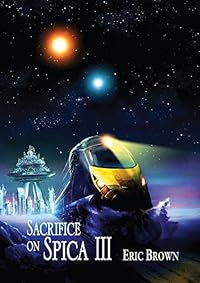
 Sacrifice on Spica III cover

Still in search of his wife and daughter, Matt Hendrick has arrived on Kallithea, a planet with an eccentric orbit around its two primaries which leads to a five year long winter, but before he even steps off the Telemass platform Hendrick is sidetracked by a chance meeting with Ed Miller, a former colleague in the Amsterdam Police, into tracking down Katerina Nordstrom, wanted for the murder of her lover back on Earth. Nordstrom just happens to have been Hendrick’s first real love, when he was a tyro detective twenty years ago. Also on the trip are Acolytes of the Ice, members of a bizarre cult inspired by Kallithea’s native culture, whereby devotees give themselves up to death in the freezing wastes.

A weird religion, past traumas, a private life tangled up with the mission at hand, are all typical Brown tropes. Once again it is the changes he rings on the ingredients that provide the impulse to keep reading. The details of the immolation cult are strange and Brown renders them well.

In the context of the Telemass Quartet it is perhaps a drawback that Hendrick’s personal quest is a sideshow to this novella’s plot, though. It causes him to take his eye off the greater ball and so his wife and daughter evade him. No spoiler really as of course this serves Brown’s purposes, as Telemass III and IV are still to come.

Pedant’s corner:- as its swung away (it,) epicentre, “I wouldn’t have through Kat” (thought,) the beneficent gaze His Holiness (gaze of His,) what as right (what was right) and a fair few instances of “time interval” later.

Famadihana on Fomalhaut IV by Eric Brown

The Telemass Quartet 1, P S Publishing, 2014, 88 p

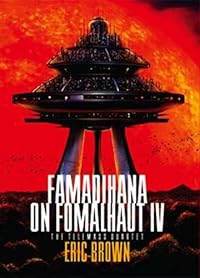
 Famadihana on Fomalhaut-IV cover

This is the first of four novellas presumably centred round the beam-me-across-space technology Brown has dubbed Telemass and which, as I recall, made its first appearance in the author’s Meridian Days many moons ago.

Here, Matt Hendrick, a detective from Amsterdam, arrives by Telemass on the planet Avoel (Fomalhaut-IV) to seek his wife and the daughter she took with her when she left him. Once there he becomes embroiled with Tiana Tiandra, a woman whose girlfriend Lalla has also disappeared into the interior. The events of the novella are related to the goings-on of a strange cult inspired by the indigenous Avoeli who have a ritual similar to the famadihana of Madagascar from where most of the humans on Avoel originally derived. This involves the apparently dead being brought back to life. The story is mostly told in third person but small fragments from Tiana’s viewpoint are rendered in italics.

Brown does this sort of thing so well. His readers will be familiar with a protagonist not in a relationship at the story’s start or else getting over a failed one, a religion with a degree of bizzarrerie, a lost spouse or family member, strange aliens and may even expect a love interest to be encountered along the way. The entertainment comes with the twists he applies to these building blocks. In this novella the Avoel are perhaps a little too undeveloped, Hendrick’s relationship with Tiana is a bit precipitate and the resolution also feels a trifle rushed. Yet the whole thing is engaging, if perhaps lacking some of the warmth of Brown’s previous quartet for PS, Starship Seasons. But we’re only one story in. Time enough.

Pedant’s corner:- is a valued members of my congregation (member,) attempting to keep the irritation from her voice” (his voice makes more sense,) peered around it mass (its mass,) bears a passing a passing resemblance, not to hate met (me,) “He heard her breathing at her side (his.) And a fair sprinkling of instances of “time interval” later.

Jani and the Greater Game by Eric Brown

Solaris, 2014, 384 p.

This book is dedicated to Jack and Katrina Stephen. Those of you who know me will realise how pleased that makes me.

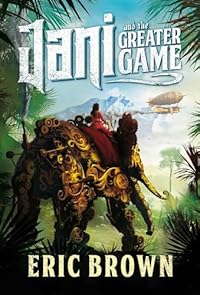
 Jani and the Greater Game cover

Janisha Chatterjee, daughter of an Indian Father and (deceased) English mother, is on her way back from England – where she is training in medicine – to her father’s deathbed when the airship in which she is travelling is brought down by Russian artillery fire. For this is India in 1925, and the Great Game is still afoot. Even though the Great War of our era does not seem to have happened the Russia contesting with the British Empire is Communist. China is also involved though only in the background here.

The Greater Game of the title concerns the prisoner on the airship, a creature known as a Morn, who saves Jani from the Russians mopping up after the attack. He gives her a coin and her entanglement in the plot follows. Other viewpoint characters are Durga Das, a priest of Kali, who is searching out the coin for reasons of his own, and Lieutenant Alfie Littlebody of the British Army, tasked by his superiors to spy upon Jani.

Echoes of Brown’s Bengal Station trilogy are never far away, this is India after all. But this is also steampunk. The wonder material Annapurnite not only powers superfast trains and airships but also weapons to keep the Russians and Chinese at bay; in a James Bond film-like touch Littlebody is given a photon blade and a Visual Camouflage Amplifier, both of which come in handy. There is also a mind-reading device. Oh and a Mechanical Man and even bigger mechanical elephant. And this is before we get beyond steampunk to the parallel worlds and the threat to humanity from the Khell.

The pleasure of this is in the journey. The author piles on the jeopardy and the intrigue and handles the politics of the British presence in India well – from both sides. Despite the steampunk trappings this comes out as a very Eric Brown type of story, if not quite reaching the heights of his The Kings of Eternity then less pulpy then the Bengal Station series. If Littlebody is a bit of a twit and Jani’s childhood companion Anand perhaps too cloying, Jani is engaging enough. And there is ample scope for a sequel (which I understand is in the works.) I’ll look forward to it.

free hit counter script