Murder at the Loch by Eric Brown
Posted in Eric Brown, Reading Reviewed at 12:00 on 16 June 2016
Severn House, 2016, 208 p.
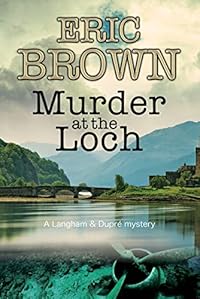
If you want an example of how character can be established with economy look no further. Brown does this with facility. Witness how much we learn about Gabriel Gordon from the reactions of Sophie, living in an artists’ commune in London, to Maria Dupré seeking him out. This, in the third of Brown’s Langham and Dupré mysteries, is in part of the narrative where Maria is looking into Gordon’s background while Don Langham is investigating an attempted murder at a hotel in the Scottish Highlands. Langham’s wartime comrade, private detective Ralph Ryland, enlisted his aid when their wartime commanding officer Major Gordon, who now owns the hotel, called for assistance after he and a guest were shot at while they were involved in work on a project to raise the wreck of a German Dornier aeroplane which had crash landed in the nearby loch in February 1945.
The inhabitants of the hotel, not only Gabriel Gordon but also Hungarian emigré Renata Káldor, the German Ulrich Meyer – an expert on World War 2 aircraft – a Professor Hardwick (who is delving into the hotel’s history of paranormal phenomena) and Major Gordon’s ward Elspeth Stuart (with whom Gabriel had a fling before the Major put a stop to it) provide plenty of scope for suspicion.
The splitting of Langham and Dupré is a device Brown has employed before and is a useful tool when background information has to be sought from different locations many miles apart. It also handily allows both to be placed in jeopardy separately. Here the fifties setting yields a benefit to raising tension in that communication between the pair has to be by an unreliable telephone connection. The book also sees the welcome return of Langham’s literary agent, Charles Elder, released from jail, where he made a new friend. (It remains to be seen whether this will be a wise liaison.)
This isn’t quite a locked room mystery (though a winter snow storm makes it more or less a hotel in lock-down one.) However, the actual murder when it occurs – with which another years previously is connected – comes close to the classic scenario. And there is nothing gratuitous here. Brown adheres pretty closely to the template and feel of the stories he is echoing. If at times his Langham and Dupré mysteries may seem to have a soft edge that isn’t necessarily a drawback. Those fifties crime stories were primarily entertainment and still are.
Pedant’s corner:- Inverness is described as a “little town.” In the 1950s? “Soon they were tooling along,” (tootling?) “economical with the truth” (in dialogue – but was it in use in the 1950s?) “a crack at the Bosch!” (Boche,) “a Hungarian who had fled her homeland when the Nazis invaded” (I think the Nazis already had a presence there and so took over rather than invaded, but they certainly occupied the country in an attempt to prevent it changing sides as Romania had just done,) jerry-rigged (jury-rigged,) Camus’ (Camus’s,) “it appeared as first glance” (at,) primeval (I prefer primaeval,) “She said It was unlikely” (insert quote marks or make “it” lower case,) of the Loch Corraig Castle (of Loch Corraig Castle,) “drawing is revolver” (his.) Plus sixteen instances of “time interval later” (but two of these were in dialogue and another two not very glaring.) Also one “within minutes.”
Tags: Crime fiction, Eric Brown, Langham and Dupre
