Archives » Derby

Flemington by Violet Jacob

In Flemington and Tales from Angus, Canongate, 2013, 291 p, including 16 p introduction, 1 p each Acknowledgements, Note on the Text and Author’s Note, 14 p Notes and 6 p Glossary.

Another from the 100 Best Scottish books list. Again from a local (well, 9 miles away) library. The novel was first published in 1911.
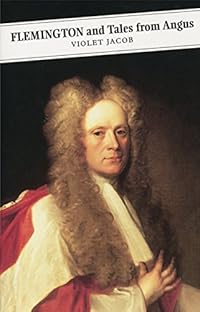
 Flemington and Tales from Angus cover

As soon as the years in which this is set, 1745-6, are discovered certain expectations might arise, a focus on Bonnie Prince Charlie or his entourage, following the rising tide of his fortunes from the standard raising at Glenfinnan through his initial triumphs to Edinburgh and on down to England before the fatal loss of nerve at Derby and thence to his downfall. Jacob, however, is more subtle than this. The events of that last Jacobite rebellion are present here, to be sure, (the Battle of Prestonpans – here rendered as Preston Pans – the advance to and retreat from Derby, the Battles of Falkirk and of Drummossie Moor, otherwise known as Culloden, the bloody and vengeful aftermath of that final battle on British soil) but they occur offstage. Jacob’s focus is relentlessly on individuals, not the broad sweep of history or “great events”. Though the Duke of Cumberland does appear in Flemington’s pages as a character (and not in a flattering portrait) the Young Chevalier never does, except as the driving force for the dilemma into which our titular protagonist falls. The action takes place exclusively in the county of Angus and specifically in the area linking the towns of Forfar, Brechin and Montrose. It is in Montrose harbour that the sole military engagement described in the book – a fictionalisation of a very minor naval incident in the ’45 rebellion – takes place.

To prevent his mother compromising Prince Charlie, protagonist Archibald Flemington’s father was badly used by the Old Pretender in exile at St Germain. Archie was subsequently orphaned and put in the care of his grandmother who, due to those earlier experiences, is now a full supporter of the Hanoverian dynasty. Flemington is a painter but also a government spy trying to discern the plans of the rebel James Logie; to which end he turns up at the door of Logie’s brother, a retired judge. While Flemington is still undercover Logie reveals to him a personal confidence – unrelated to any Jacobite sympathies. This engenders in Flemington a sympathy for Logie which he will not thereafter compromise and so the central tragedy of the story unfolds.

The novel is full of well-drawn and memorable characters: Flemington; his grandmother; Skirlin’ Wattie, the no-legged bagpiper who travels about on a cart drawn by dogs; Callander, the Government Army officer who is dutiful to a fault. Despite his confidence granted to Flemington, James Logie is a shadowier character, though his brother Balnillo is portrayed in all his preposterousness. Wattie is the only one who speaks broad Scots. The context provides clarity enough but the glossary is there if needed.

One chapter begins, “April is slow in Scotland, distrustful of her own identity, timid of her own powers. Half dazed from the long winter sleep, she is often bewildered, and cannot remember whether she belongs to winter or to spring.” How true – especially redolent when reading it in Scotland, in April, and the passage is characteristic of Jacob’s writing which is especially strong on landscape description.

Flemington is an illustration on an individual human scale of the dislocations and traumas, the disruptions, which a Civil War brings in its train and of how character can both resist circumstances and be a victim of them.

I took the precaution of not reading the introduction before the story. Wisely, as the usual spoilers in such things were present.

Pedant’s corner:- I found the reference to English parents strange in a passage contrasting the thoughts of a Scots woman who had spent a long time in France with those who hadn’t. Also mentioned were English dragoons at Culloden. (I haven’t checked. Any dragoons may have been English, though certainly a large part of Cumberland’s army was Scots.) Dulness with one ‘l’?

Melton Mowbray (i)

We spent the first night away from home in a hotel just outside Derby. On our way there from the motorway we travelled along Brian Clough Way, a nondescript, even dowdy, dual carriageway. Surely there’s a better way to commemorate the man. In the morning we drove into Derby but didn’t know of any suitable parking space so gave up after a drive around the inner ring road and skedaddled back along Mr Clough’s memorial road, taking a right towards the South at Nottingham. (A curiosity was we came across two roundabouts that had roads through their middles, something I’ve never seen before. Is it a Derbyshire/Nottinghamshire thing?)

We stopped at Melton Mowbray, “the Rural Capital of Food.” (Well, 3 years ago we went to Bakewell.) Unfortunately it was market day and the place was heaving. As a result I couldn’t get a photograph of the Pork Pie shop (there was a stall in the way) but we did buy a pie and very nice it was too. Enough for lunch that day and the next. We passed on the Stilton cheese though.

What I didn’t expect was Art Deco. The place is liberally strewn with it. Remarkable for a relatively small town.

The first thing I saw on leaving the car park was the brick side of what looked like a school building but is (now, at any rate,) the King Street Building of Brooksby Melton College.

A bit rectilinear but nice iron work protecting the small windows flanking the entrance. The fan light above the door is good as is the frieze on the portico. Amazingly the windows don’t seem to have been mucked about with.

The next building along is also Deco! The Regal Cinema is a stunner. The decoration on it is sublime. It’s still a working cinema.

See more here.

Superb!

Chesterfield and More

On our recent trip I seem to have passed through, or close to, a fair few towns in England that have or had teams in the Football League, which gave me some idea of their geographic proximity. Starting with Sheffield, we went on through Derby, bypassed Mansfield, then headed back up to Chesterfield where I photographed the famous crooked spire which lends the nickname Spireites to the local side.

Chesterfield Parish Church 1
Chesterfield Parish Church 2

Cheterfield had a large street market on the go the morning we were there. It made the place seem thriving though whether it truly is or not I have no idea.

After that it was up north through Huddersfield and Halifax on our way to Haworth again.

Yet in all these travels I caught sight of not one single football stadium – though I had seen a road sign for Brammall Lane in Sheffield.

The reason for going to Haworth this time was we hadn’t seen as much of it as we would have liked when we were there before.

This certainly wasn’t there in the Bronté’s time. It’s now a stop on the Keighley and Worth Valley Railway – one of those preservation railways which reflect the British love of nostalgia but are an important reminder of our industrial heritage.

Haworth Railway Station

We didn’t do the Bronté Parsonage this time but explored the old street more. There were more shops open this time including the old style sweetie shop where we bought something called Yorkshire Tablet – as sweet as Orkney Fudge but a bit softer – and had a browse round two second hand bookshops we don’t recall from two years ago. The good lady bought three books and I got a hardback of Tricia Sullivan’s Lethe; goodness knows when I’ll get round to reading it.

I’ve Been Away

So that means photographs.

And Art Deco.

This was a Deco house just off the A6 as you enter Derby from the direction of Matlock. Frustratingly, the closest I could get was the main road.

Art Deco House

You get exactly the same view if you type 404 Duffield Road, Derby into Google Maps and do the zoom-in and a 180 degree turn, where you can see the porthole window I got in this next one. That’s also the closest Google Maps gets.

Porthole Window

As far as I could/can tell the house is up a side road called The Close but it’s barred by a high security gate behind which are some scary dogs.

We didn’t actually stop in Derby except to take these pictures.

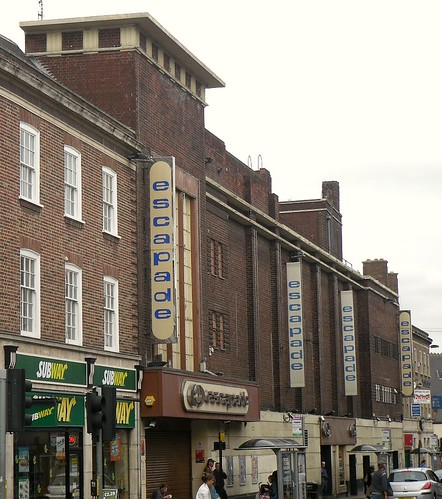
The next day we travelled up to Chesterfield and this was the closest thing to Art Deco in the town centre. In Cavendish Street, it’s now a night club called Escapade.

Possible Deco building in Cavendish Street, Chesterfield

free hit counter script