Archives » David Keenan

Xstabeth by David Keenan

White Rabbit, 2020, 172 p

The book is prefaced with a biography of one David W Keenan who committed suicide in 1995, lists his interest in occult matters, his published pamphlets relating to his home town of St Andrews and that he self-published one novel in his lifetime, Xstabeth by David W Keenan, Illuminated Edition with Commentary, reproduced in full thereafter – including various commentaries (as by diverse academics) interpolated between the narrative chapters.

With this I found myself in Russia again, seemingly in the immediate post-Soviet era, though this time St Peters (not for some reason St Petersburg) rather than Moscow where narrator Aneliya is the daughter of a famous musician, who is friends with one “even famouser,” Jaco, though the story later transfers itself to St Andrews.

Jaco is not the type a respectable girl ought to be getting mixed up with. He drinks and frequents strip clubs. But Aneliya is drawn to him nonetheless, with the consequences we might expect. During one of their encounters, in which Aneliya describes one of Jaco’s sexual kinks, she has the disturbing thought that Jaco had performed similar deeds on her mother.

The mysterious Xstabeth enters the story when an impromptu performance by her father in a club is secretly recorded on an old reel-to-reel recorder by one of the staff who is so besotted by it he determines to release it pseudonymously. The music has a force all to itself which is mesmeric but an acquired taste.

The transition to St Andrews is somewhat surprising but gives Keenan an opportunity to display his knowledge of the town. The street known as The Scores – thought to be named after golfing record cards – is said to be a place to pick up prostitutes (think about it) but little evidence is given for this in the text. Nevertheless, the famous golfer – never actually named but sufficiently accomplished to be tied for the lead in the tournament ongoing in the town – Aneliya has met at the hotel asks her to attempt to ply the trade there. It is only he (the famous golfer, who opines that Russian whores are the most desirable,) who obliges himself though.

Aneliya tells us “Naivety gets me every time. Knowledge can be cynical. It just gets used to undermine things. Sarcasm and irony are horrible. Naivety is the deepest form of belief. It’s closer to reality. To wonder. Plus it has more love in it” and “Writing is always starting from scratch. On the blank sheet. Always beginning again. Even when you think you’ve cracked it.”

David W Keenan’s Xstabeth is a strange but compelling confection. The narrative parts are written in short sentences. Sometimes broken up. Into even shorter ones. The effect is as if we are listening to someone speaking to us in staccato fashion. The addition of the commentaries makes David (without the W) Keenan’s Xstabeth even more idiosyncratic. Like the music it is named for, Xstabeth is a genre of one.

Pedant’s corner:- famouser (why Keenan chose to employ this for some while rather than the more familiar ‘even more famous’ is obscure,)  “the lay of the land” (x 3. It wasn’t a tune. The correct phrase is ‘the lie of the land’,) neck-in-neck (it’s neck and neck,) confectionary (confectionery.)
Reelin’ in the Years 216: For the Good Times

Just because it provided the title for the David Keenan book I reviewed earlier this week.

Como really did have a mellifluous voice.

Surprisingly this wasn’t a hit for him in the US. Maybe it wasn’t a single there. It made no 7 in the UK in 1973, though.

Perry Como: For the Good Times

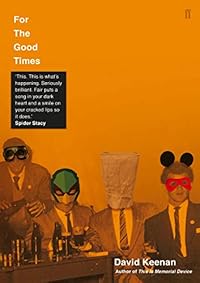
For the Good Times by David Keenan

Faber and Faber, 2019, 358 p.

How do you follow up a novelistic debut such as This is Memorial Device, a book about an imaginary rock band told from a kaleidoscope of multiple viewpoints? Keenan’s answer is to write about something totally divorced from that. 1970s Northern Ireland. “The best decade what ever lived.” (Except for the lack of oral sex.)

For the Good Times is another odd concoction, though. Larded with “Irish” jokes, it is essentially the story of three laddies, Tommy, Barney and narrator Samuel, held together by a linked love for the songs of Perry Como whom they have been told is absolutely clean-living, and who slip into nationalist activism almost by accident.

Their first project is to carry out a shooting and they narrowly avoid capture, running a roadblock with Tommy on the car roof spraying gunfire while singing For the Good Times. Their second is to recover an old arms stash, their third to kidnap the wife of a comic book store owner who they are told owes The Boys money. Her name is Kathy and she disappears leaving only her high heels behind. Sammy later sees her dancing in a bar, pursues her to the toilets where, unbidden, she fellates him. He can’t decide whether or not the relationship they then enter is because she wants to protect her husband from retribution but goes along with it, meeting her after her work in the Europa Hotel. The three lads take over the book shop in lieu of the supposed debt. Cue various riffs on comic books and superpowers.

This is Belfast as a surreal place. One of the characters is nicknamed Miracle Baby. He is “a retard” but one who knows the truth of everything. Kathy’s husband turns out to look exactly like Tommy. The three each imagine themselves as a different superhero. The most potent power? Invisibility; “being invisible is the greatest power you could ever have in Ireland,” a cloak which IRA membership conforms on them.

There is some stark realism. Local IRA boss Big Mack when the lads are joking about a bomb he’s demonstrating, tells them not to act like clowns, adding, “‘see if the IRA could dispense with Irishmen altogether, we’d be one fuck of a formidable fighting unit.’” Joining The Boys was motivated by “protection, resentment, ambition, revenge, honour, sex, money, style, class,” plus a history of violence “that ran through our veins and (let’s face it) was one of the only things holding the generations together,” and moments of recognition. “In Ireland history isn’t written. It’s remembered.” As it is in all sad countries.

Eventually escape becomes necessary. “Fucking Glasgow, my friend, it’s just like Belfast, the same rivalries, the same segregated pubs, the same flags, the same halls, the same murals, the same fucking teams; a friendly city once you get to know it. Plus you’re just as likely to get stabbed for your colours as back home, so as you know where you stand as soon as you’re off the boat. …. It was just like being back in the Ardoyne only with blow jobs aplenty.” But even life in Glasgow becomes too hot.

However nothing in this world is as it seems. Even Kathy. “It’s a web of lies we were all caught in. It’s the default position of the Irish. If in doubt, lie; if asked, make it up; if questioned deny it … tell them fucking nothing.”

In a passage that might be true to the book’s milieu but could equally well be there because Keenan thinks he ought to say it, Sammy tells us, “that was the one thing we never did: we never asked ourselves any questions, in fact we lied. We lied to ourselves more than we did to anyone else. You had to. How else do you do this stuff, day in day out? If you had a working brain you would be finished.” He says he “realised that Belfast is full of ghosts, that Belfast is haunted in the daytime and that nobody pays attention to any of them.” It’s the perfect place to indulge in mayhem. “If you were a daemon where would you go to do your work? Belfast.”

The novel partly comes across as a kind of cross between Michael Chabon’s The Amazing Adventures of Kavalier and Klay and, in its observation of casual violence, Graeme Armstrong’s The Young Team. It is, though, made problematic by its illustrations of violence (admittedly difficult to avoid in any novel dealing with this subject) and flawed by some overblown passages rendered in italics illustrating the adventures of the superheroes the three have imagined for themselves. It also contains an aside on the erotic connotations of the ladies’ silk handkerchief.

Pedant’s corner:- The epigraph attributes the song It’s Impossible to Perry Como. (He did sing it but the English lyric was written, as noted in the Acknowledgements, by Sid Wayne, Spanish words and music by Armando Manzanero.) Otherwise; “a beautiful delicate labia” (labia is the plural, no ‘a’ then,) “a flappy disk” (floppy disc, but this may have been trying to convey the speaker’s argot.) “‘Does that not gives you a shiver?’” (give,) “a dice” (x 3, dice is plural; one of them is a die,) fit (fitted,) “lay low” (several times; lie low,) “so as” (frequently; used where ‘so’ would be sufficient,) “faraway lochs” (I know Keenan is Scots but the narrator is Irish, shouldn’t that be ‘faraway loughs’.)

Best of 2017

Fifteen novels make it onto this year’s list of the best I’ve read in the calendar year. In order of reading they were:-

The Amazing Adventures of Kavalier and Clay by Michael Chabon
His Bloody Project by Graeme Macrae Burnet
A Man Lies Dreaming by Lavie Tidhar
The Panopticon by Jenni Fagan
The Stornoway Way by Kevin MacNeil
The Sea Road by Margaret Elphinstone
The Untouchable by John Banville
Swastika Night by Katherine Burdekin writing as Murray Constantine
Spaceman of Bohemia by Jaroslav Kalfař
The Power by Naomi Alderman
Imagined Corners by Willa Muir
This is Memorial Device by David Keenan
The Underground Railroad by Colson Whitehead
Kalpa Imperial by Angélica Gorodischer
Psychoraag by Suhayl Saadi

That’s six by women and nine by men. Six were SF or Fantasy, counting in The Underground Railroad, (seven if the Michael Chabon is included,) seven were by Scottish authors.

This Is Memorial Device by David Keenan

An Hallucinated Oral History of the Post-Punk Scene in Airdrie, Coatbridge and Environs 1978-1986

Faber and Faber, 2017, 302 p.

 This Is Memorial Device cover

To say this is an imaginary history of the music scene in the Airdrie area in the post-Punk era would be true. It would also be a bit like saying War and Peace is about domestic affairs in Moscow during the Napoleonic era. It is a picture of Airdrie and its music at the time but is also much more. The line on the back cover (also found in the text) “It’s not easy being Iggy Pop in Airdrie,” stands in for all those towns in the West of Scotland – and I dare say beyond – where expectations were/are crabbed, hopes frustrated, ambitions crushed – and all before the attempts to overcome that deficit were made. “… back then anything seemed possible, … back then being … the glory years. ….But really that would be untrue because back then everything seemed impossible.”

The text is made up of twenty-six different reminiscences, interviews, letters, conversations, emails, transcripts of telephone calls (in other words various forms of device encapsulating memory) from people either involved in or connected, however tangentially, to the legendary band around which the novel revolves, a band which captured the sound of Airdrie. But, “The thing about Memorial Device was that you always had the feeling that it was their last gig ever, like they could fall apart at any moment.”

Keenan’s tale builds up as a mosaic of all these contributions. (Among them is a wonderful rant about the extreme shortcomings of Kilmarnock as a town which is all the funnier for being written by someone from Airdrie.) Keenan is himself using the mosaic as a device for chronicling life in a Scottish industrial town in the mid-1980s. In the book’s first line the supposed assembler of these testimonials – one Ross Raymond – tells us that in compiling the book he “did it for Airdrie.” He “did it because later on everyone went off and became social workers and did courses on how to teach English as a foreign language or got a job in Greggs.” Because, then, of those crushed hopes, those impossible dreams, because of the compromises people make with their younger selves as they grow older. If you like, this is Albert Hammond’s Free Electric Band in reverse. But what a glorious reversal it is. The line, “I would talk about the new groups and encourage people to drop out and go see the world, all the while living at my mum’s house in Airdrie,” sums up the contrast between the aspiration and the reality.

The conceit that this is an actual set of true reminiscences is bolstered by no less than four Appendices: A; a Memorial Device Discography (- self explanatory,) B; A Necessarily Incomplete Attempt to Map the Extent of the Post-Punk Scene in Airdrie, Coatbridge and Environs 1978-1986 – relating the interconnections between the various bands mentioned in the book (the names of the wheelchair bound members of the group calling themselves The Spazzers are brilliant,) C; This is Memorial Device (- short descriptions of the characters in the book,) and D; A Navigational Aid (ie an index.)

There are some longueurs but Keenan ventriloquises the voices of his “contributors” well; each of the twenty-six chapters is internally consistent. (One is excessively fond of brackets.) Another, in a vigorous West of Scotland demotic – the only piece that isn’t rendered in a kind of “standard” English – explores philosophy, “ma existence wus closer tae a state o suspended animation, a series a frozen gestures caught between the impossibility uv the future and the improbability uv the past,” creativity, “Ah became obsessed wae the idea o automating, o inventing a form o music that wid play itsel and wid form its inspiration fae itsel … a form o spontaneous birth that held within itsel the DNA that wid facilitate endless versions and restatements o itsel,” and a disquisition on the amniotic night, “wur just seeing things the wrang way roon, the fervent dream that we ur, but then I began to see the dream as a computation, the specifics o the dream as distinct variables what could be slotted intae reality, as intae a circuit board that would then send the whole thing aff on a different trajectory althegether.” A third asks of The Who, “Has there ever been a more depressing vaudeville take on rock n roll to this day?” The personal interests the contributions reveal are many and varied. I particularly enjoyed the aside on the lack of merit of a certain translation of Bulgakov’s The Master and Margarita (Michael Karpelson’s) as compared to another (that of Diana Burgin and Katherine O’Connor.) Others celebrate their existence, “thank God we have many headcases in Scotland, many headcases in Airdrie,” others their universality, “We all live out our unhappiness on different scales,” a metaphor which manages to be both dimensional and musical.

Then we have, “I had grown up in the sternest, most backwards, illiterate, repressed motherfucking viper pit in the west of Scotland.” (There’s competition for that title I can assure you.) “I fell in with the music scene. The art scene was up itself. The fashion scene was vacuous. The book scene was going on behind closed doors.” (The book scene always does.) “You have to understand that when you’re talking about a local scene you’re talking about an international scene in microcosm….It fostered belief. It encouraged you to take the music and lifestyle at its word.” An invitation to disappointment.

Though there is not really much about music in it (music and its emotional effects are of course notoriously difficult to describe in prose) This is Memorial Device is by turns funny, mordant, poignant, profound and elegiac; an attempt to convey the elusive. It is a hymn to music and youth, a threnody for the passing of time, a celebration of a spirit as relevant to the world as it is to Airdrie – and Scotland.

Pedant’s corner:- burglarising (the book is not set in the US. The word is burgling,) ass (ditto, the British usage is arse,) lip-syncers (lip-synchers surely?) “the first summer after I graduated from high school” (there is no graduation ceremony in Scottish schools and therefore no graduating; if they are old enough and wish to leave pupils just get their teachers to sign their leavers’ forms – and go,) a wee tin solider (soldier methinks,) no siree (sirree,) ambiances (ambiences.)

“It’s Not Easy Being Iggy Pop in Airdrie”

The above is the first line of the back cover blurb (and a line in the text) of the novel I’ve just started reading.

The second line of the blurb reads, “The year is 1983 and Memorial Device are the greatest band that never existed.”

The book, This Is Memorial Device by David Keenan, claims to be “An Hallucinated Oral History of the Post-Punk Scene in Airdrie, Coatbridge and Environs 1978-1986.” Who could resist reading that?

free hit counter script