Posted in English Football Grounds at 12:00 on 4 January 2026
We visited Carlisle on the way down to Barrow-in-Furness, mainly to have a look at a second hand book shop in the town centre. As I recall I didn’t buy any books.
As we travelled on to south Cumbria we passed Brunton Park, home of Carlisle United FC, and I stopped to photograph it – or what I could gain access to. (There was some work going on at the ground.)
External view of stands:-

Statue outside club shop on Warwick Road:-

The plaque on the statue commemorates 100 years of the club:-

View of stands from the road round the side of the stadium:-

Pitch and stands (photographed through a fence):-

Further round I was able to get a less obstructed view of the pitch and stands:-


At the time the club was still in the English Football League but it has since been relegated to the National League.
Maybe I’m a jinx.
No Comments »
Posted in Architecture, Art Deco, Trips at 12:00 on 21 December 2025
Ulverston in Cumbria, is the nearest biggish town to Barrow-in-Furness, about ten and a half miles further north. It was the birthplace of Stan Laurel of Laurel and Hardy fame. There is a Laurel and Hardy museum in the town which we didn’t visit and a statue of the pair in the town centre.

The statue stood outside this fairly impressive building:-

Just across the road was this building:-

The Tesco’s in the town was in a minor Art Deco style. Its upper windows are completely ruined:-

Detail:-

No Comments »
Posted in Architecture, Trips at 12:00 on 16 December 2025
Furness Abbey is a former monastery located in the north of Barrow-in-Furness. It was once the second wealthiest Cistercian monastery in England and it held large tracts of land in Cumbria and Lancashire. It was of course disestablished in the Dissolution of the Monasteries. Nowadays it’s a ruin – or several ruins but it’s certainly worth going to see if you’re near Barrow.


Part of what remians is reinforced by steel supports:-


A stream runs under this bit:-


No Comments »
Posted in Architecture, Trips at 12:00 on 7 September 2022
Brampton is a small town in Cumbria near Hadrian’s Wall east of Carlisle. We visited it in April since an elderly friend ours was brought up there.
Looking east along main street:-

Looking west:-

Town centre showing Moot Hall:-

Moot Hall closer view:-

Looking west from Moot Hall:-

A lane in Brampton:-

Buildings near Moot Hall:-


Buildings:-

On our wanderings round the town we came upon this statue of the Emperor Hadrian:-

No Comments »
Posted in Architecture, Trips at 20:00 on 3 November 2019
The Mull of Galloway is Scotland’s most southerly point.
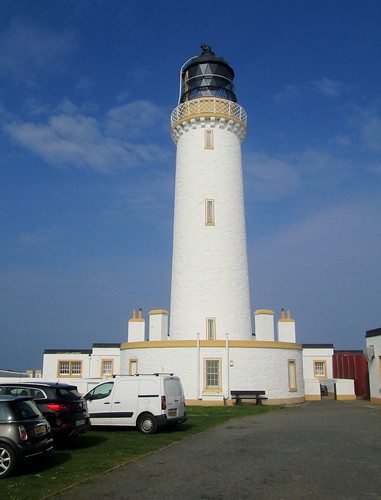
The Mull of Galloway Lighthouse is situated at the very tip of the Rhinns of Galloway Peninsula.
Lighthouse from car park:-

From approach path:-
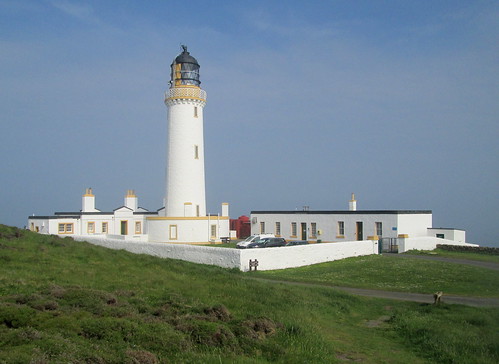
The Lighthouse is one of the Stevenson family lighthouses and was designed by Robert Stevenson grandfather of the writer Robert Louis Stevenson.
Information Board:-

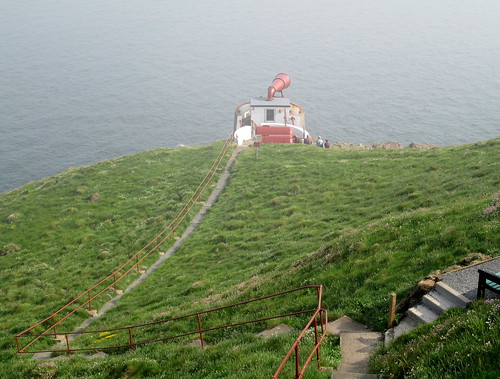
Foghorn from lighthouse:-

It’s quite a steep way down to the foghorn via the path:-
On a good day you can see from the lighthouse not only Cumbria and Ireland but also the Isle of Man. It wasn’t a good day – as you can see from this photo of the nearby rocks:-

No Comments »
Posted in Architecture, Art Deco, History, Trips at 12:00 on 12 March 2019
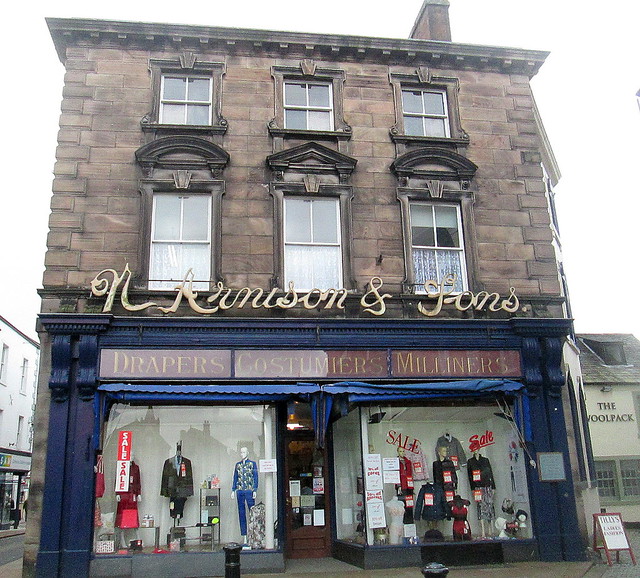
Penrith, Cumbria, is remote enough from major population centres to have retained some elements of ye good olde days.
Just look at this Drapers, Costumiers and Milliners. Not to mention Furriers, Dressmakers, Shirt Specialists:-

And Carpet, Curtain and Linoleum Furnishing Warehouse:-

A High Class Drapers no less – and a Silk Mercers, Hosiers and Glovers, Irish Household and Fancy Linen Warehouse:-

A real throw-back. Not that most of those trade lines will still be ongoing I’d have thought.
You can see from this the shop front faces on to a square of sorts:-
A bit further on in the town lies this Chemist’s. Cowper’s. 1930s style lettering. I can’t quite decide if the whole is deco or not:-

In St Andrew’s Churchyard lie a good many graves, including the “Giant’s Tombstone”. This is supposedly the grave of Owen Caesarius, king of Cumbria between 900 and 937 AD:-

Giant’s grave stones:-

Giant’s Tombstone in Penrith, Viking hogback stones:-

No Comments »
Posted in Trips, War Memorials at 20:18 on 24 April 2013
From Whitehaven we moved on to the town of Egremont where there was no Art Deco but it does have a very dignified War Memorial. Its statue of a soldier dominates one end of the main street. Pity about the street light behind it.
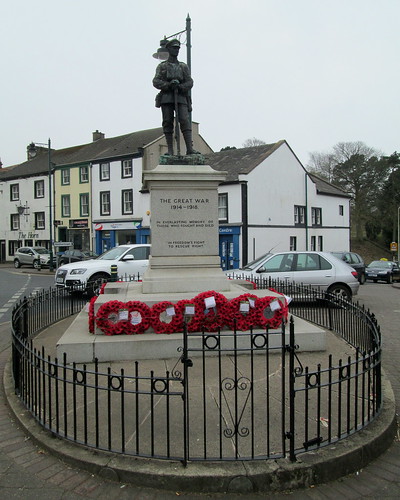
The Great War names are set round the upper portion. WW2 names are on plaques either side.
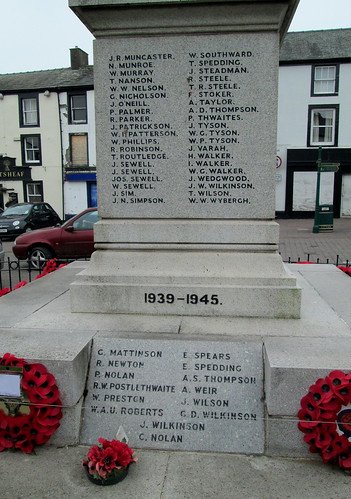
The WW2 plaque on the opposite side unusually contains the name of a woman – who I thought may perhaps have been a nurse but it seems Grace Cummings was a Wren, (WRNS.)

No Comments »
Posted in Architecture, Art Deco, Trips at 21:00 on 23 April 2013
Whitehaven appeared a bit more prosperous than Maryport or Workington, less industrial certainly, and with a lot of sailing yachts in the harbour.
But more Art Deco, not just the Bus Station.
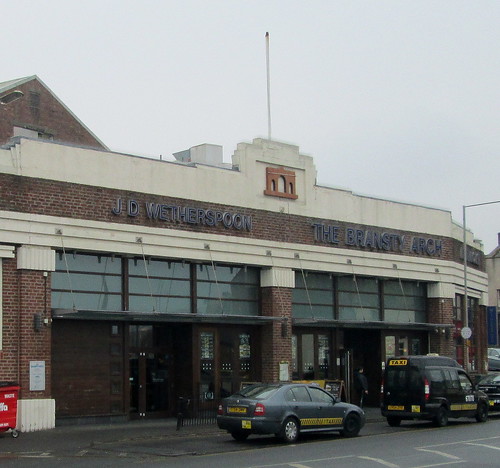
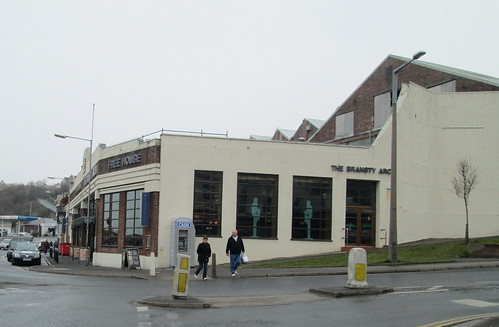
Only separated from the old Bus Station by one building is this pub, the Bransty Arch, now a Wetherspoons.

Here’s the frontage in more detail. Good stuff on the roofline and the Arch motif.
Here’s the side view looking back towards the old Bus Station.
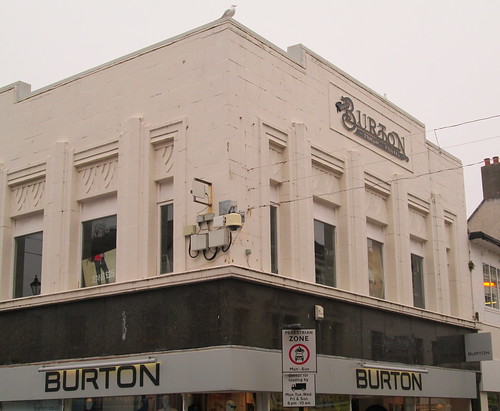
Further into the town I found a Burton’s.
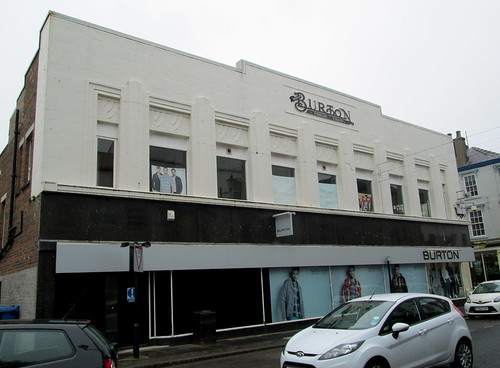
This is typical of 30s Burton’s style. Pity about the wires and other guff in the way in this other view in which I also seem inadvertently to have photographed a gull on the roof!
We found a large second-hand book shop in the town, very nook and cranny-like. Sadly none of the books grabbed my interest sufficiently to buy any. Ones I might have bought I already had! The good lady managed one purchase, though, and also browsed one she had been thinking of buying from the internet but decided she wouldn’t like it.
No Comments »
Posted in Architecture, Art Deco, Trips at 21:00 on 22 April 2013
After Harrington and the surprise of Heathfield another surprise awaited us further down the coast in Whitehaven; a fantastic Art Deco Bus Station, sadly no longer in use. To show the full extent this is a stitch of two photos.

As you can see I took the above from Tesco’s car park!
Here’s a closer view of the entrance to the ex-Bus Station.

The photo below shows the curve of the entrance.

The entrance is not only fenced off in the lower part but netted above.
This is the first of the two photos I stitched:-

And this is the second:-
 >
>
In do hope someone can find a use for this brilliant building – or at least put something behind the facade.
No Comments »
Posted in Architecture, Art Deco, Trips at 20:30 on 21 April 2013
On the way south out of Workington we passed through Harrington (a suburb?) and the good lady spotted the house pictured below. Luckily there was an easy place to park for me to nip out and photograph it.

Heathfield has all the Art Deco hallmarks; flat roof, rounded wall edges, white rendering. Note the long window and the stepped frontage. All the eyes are poked out, though.

The above is the first view I took. The least interesting.

This last photo shows the rounded canopy over the entrance door.
Apart from the modernised glazing this house seems to have been maintained very much in keeping with its origins. It’s still imposing.
No Comments »
