Archives » Chemistry

The Elements RIP Tom Lehrer

The songwriting satirist Tom Lehrer has died. He kind of gave up on performing after 1960, though, going back to teaching mathematics.

To Chemistry teachers (one of which I was once) his listing of the contents of the Periodic Table of Elements to the tune of Gilbert and Sullivan’s Major General’s Song was of course an absolute gift.

Here’s Tom performing the song live in Copenhagen, with an addition – and addendum.

Tom Lehrer: The Elements

His satire is more in evidence on this anti-nuclear war piece, presumably from the same performance as above.

Tom Lehrer: We Will All Go Together When We Go

He had a sly humour.

Tom Lehrer: I Got it From Agnes

Thomas Andrew (Tom) Lehrer: 9/4/1928 –  26/7/2025. So it goes.

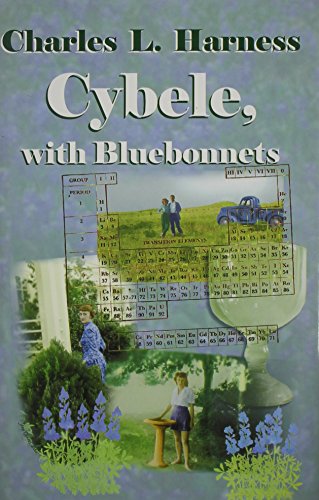
Cybele, with Bluebonnets by Charles L Harness

The NESFA Press, 2002, 155 p.

How could I resist a novel with an illustration of the Periodic Table on its front cover? Still less “a book for chemists who might appreciate magical realism” as the publisher’s prefatory lines have it. It could have been designed for me.

Don’t let that put you off though; it’s also a very powerful and intricate novel exploring those eternal themes of love, sex and death – with a very unusual ghost.

Charles L Harness is one of my favourite SF writers of the last century but due to the fact that it’s quite rare I only bought this book recently. It was, then, a little disconcerting that in the first page we find narrator, Joe Barnes, mentally undressing his female Chemistry teacher Miss Wilson (Miss Cybele Wilson) down to nothing but stockings, garters and low-heeled shoes as she enters class. Adolescent male fantasy no doubt but a bit much for page one.

There is a plot strand relating to a cup said to be the Holy Grail (the “real” one was lost in the Atlantic in its evacuation from Europe during the Great War.) Joe takes a job modelling for artists and recognises, though the face is turned away, one of the pictures the tutor rotates on the studio’s walls as being a nude Cybele holding the cup. A mystery about the cup’s disappearance from the religious institution where it is held is resolved by Joe’s knowledge of the refractive index of borosilicate glass.

Cybele becomes the love of his life and a major influence on it, her characteristic scent of bluebonnets (the State Flower of Texas apparently) coming to him at significant turning points. She inspires him with a love of Chemistry and encourages his thirst for knowledge.  She is a strong character but her prognostications about the future invite suspicion from the school authorities. It is not until well after he has left school, however, that they get together and that not for long as she has cancer. Here Harness inserts Joe’s thoughts on his loss. “And life goes on. It goes, but it doesn’t go anywhere. We begin, and end, in the middle.” At this point there is still half the book to go with many more opportunities for Cybele to affect Joe’s progress through life.

Joe was growing up in the 1930s and there is a lot of incidental detail about life in small town US in those times. Cybele’s background was unconventional, her mother was a madam in a local house of ill repute whose activities are policed by arrangement of times to raid the premises. A fair amount of Chemistry adorns the pages but I’m sure the details will not faze the average reader.

All of this is interspersed with incidents of what can only be termed magical realism. Young Joe’s discovery of a millions of years old skimming stone which skips from the river into a cave where something spooks him as he goes to retrieve it, the panther which saves his brother from a snake, the voice which he hears warning him to run from a lab accident, the unusual circumstances surrounding his daughter’s birth.

Almost innocent at times, Cybele, with Bluebonnets is a wonderful book; insightful, humane, knowledgeable, rueful. Here is a human life in all its glory and pain.


Pedant’s corner:- “into the gaping white maw of the snake” (maws do not gape, they are stomachs,) clear is used as a synonym for colourless (it isn’t, clear means ‘see-through,’ which many coloured things are,) barring one, all chemical formulae in the text are rendered correctly – even the subscripts are correct – however bicarbonate is given as having the formula -HCO (bicarbonate – now known as hydrogencarbonate – is actually HCO3,) focussed (focused,) “Munch’s The Shriek” (usually known, at least nowadays, as The Scream,) miniscule (several times, minuscule,) “a unisex washroom” (in the 1930s I wondered? Apparently separate toilets only came into being in the US in the 1920s as a response to more women entering the workplace,) “a few less bullets” (a few fewer bullets,) spit (USianism for ‘spat’,) cartilege (cartilage.)

Fire in Free-Fall

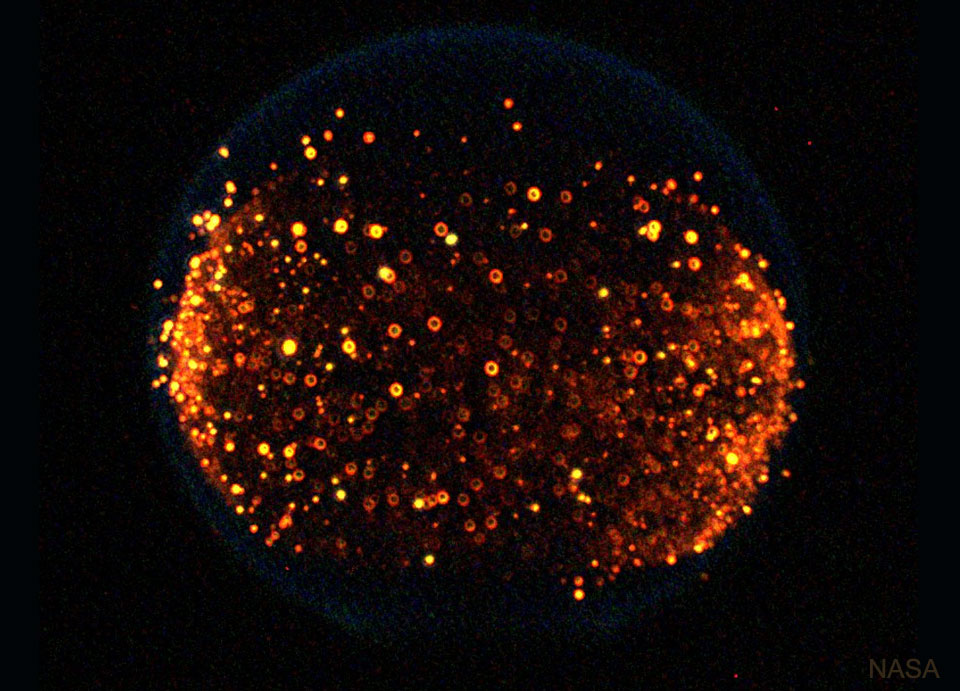
Fire is an odd, complicated chemical phenomenon. When in orbit round Earth it becomes even odder.

In a gravity well gravity shapes the flame to the familiar cone-like contours we can see flickering, ushering oxygen to the bottom of the fire, the product gases rising from the flame due to their lower density.

In orbit, when bodies are in free-fall (not “weightless”: the gravity is still there, only cancelled out by forward movement round the Earth, the link calls that situation microgravity) there is no bottom to the flame; oxygen is attracted from all sides and the fire becomes spherical.

Thsi image is from Astronomy Picture of the Day for 10/8/21.

Fire in space

I wouldn’t have liked to try that out, even if it is in a controlled environment. Fire in a spaceship must be like one on a sea-going vessel; the crew’s worst nightmare.

Bookshelf Travelling for Even More Insane Times

Bookshelf Travelling for Insane Times was started by Judith and is now hosted by Katrina at Pining for the West.

The main thrust of this week’s post is to focus on books by Primo Levi.

The times Levi lived through were even more insane than these. An Italian Jew, he was rounded up in February 1944 and transported to Auschwitz, where his experience as a Chemist allowed him to gain a position as assistant in an I G Farben laboratory there. Ironically he was saved from almost certain death by being ill with scarlet fever and in the camp hospital when, on the approach of the Red Army, the SS evacuated the camp and forced the prisoners on a death march further away from the front.

He translated his experiences into a very readable series of books, nine of which are on these shelves (ten if you count This is a Man and The Truce as two.)

Primo Levi Books

Levi’s death forty years later was ruled a suicide by the coroner but he may have fallen from his flat as a result of dizziness.

This photo also shows Peter Høeg’s Miss Smilla’s Feeling for Snow, a Graham Greene omnibus, Mary Somerville‘s personal recollections in Queen of Science (which is the good lady’s and I have not yet read) plus Isabel Allende’s House of the Spirits.

Where Elements Come From

I just love this.

Then again, as a chemist you would expect me to.

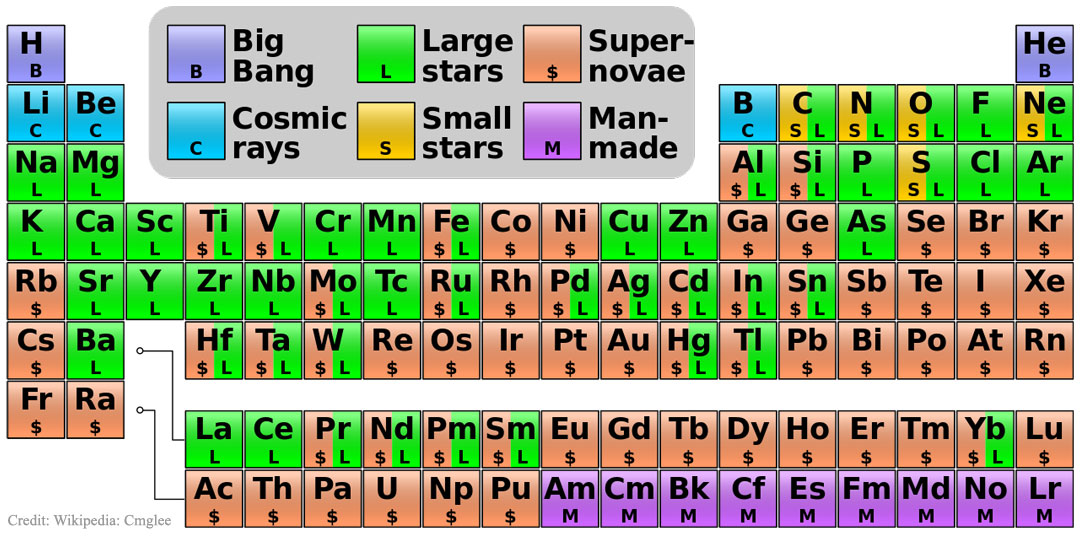
I got to this Periodic Table via Astronomy Picture of the Day (APOD) for 9/8/20. It shows the origins of the chemical elements as percentages of how the total number of each elements’ atoms were formed.

Periodic Table of Elements' Origins

Those parts in blue were formed in the Big Bang or by nuclear fusion in stars, green came from dying low mass stars, pink from cosmic ray fission, yellow from the explosions of massive stars, purple from neutron stars merging, light grey in exploding white dwarf stars.

There are areas of darker gray. The elements these refer to are mostly not found naturally – Technetium (Atomic Number 43,) Promethium (Atomic Number 61) and all the transuranics (Atomic Numbers greater than 92) can be made artificially in particle colliders or nuclear bombs and reactors, though I note that Neptunium (93) and Plutonium (94) seem to be produced by merging neutron stars. All elements with Atomic Numbers greater than 82 are radioactive and so decay away over time which is why the transuranics are not found on Earth and only some atoms of elements 82-92 are.

Quite why the version of this table that appears on APOD also has elements numbered 84-89 plus 91 in dark gray puzzles me a bit.

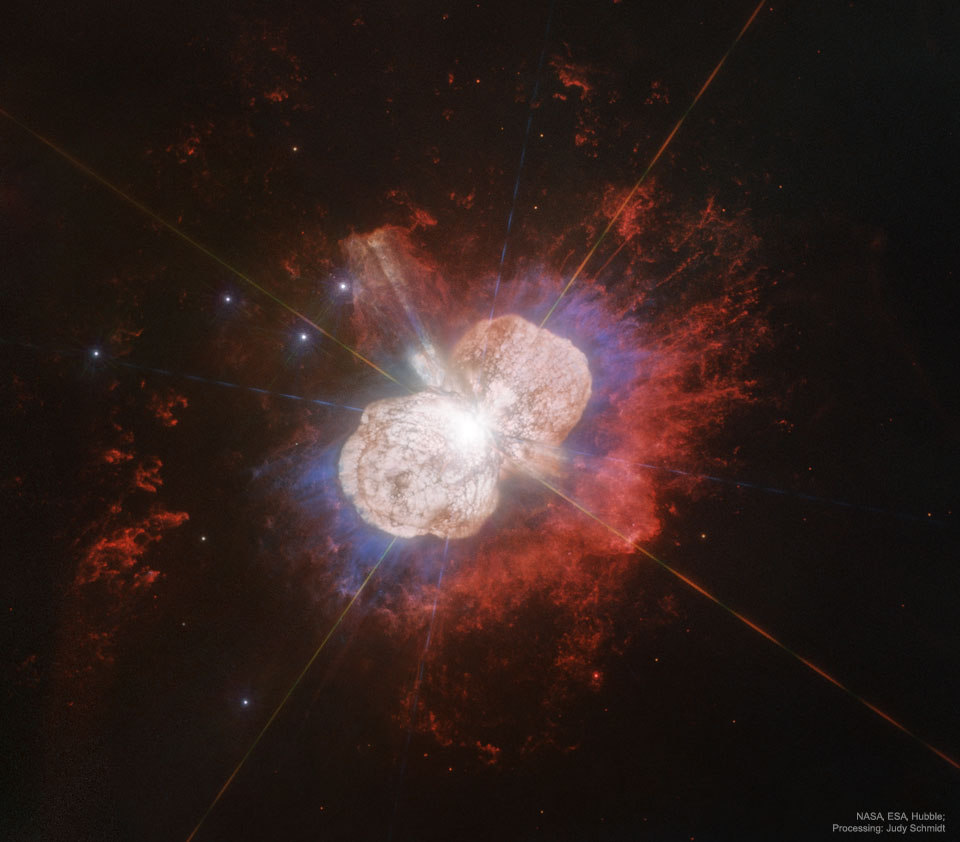
Star Eta Carinae

This is from Astronomy Picture of the Day for 20/2/19.

Eta Carinae is set to explode in a supernova – sometime.

Eta Carinae

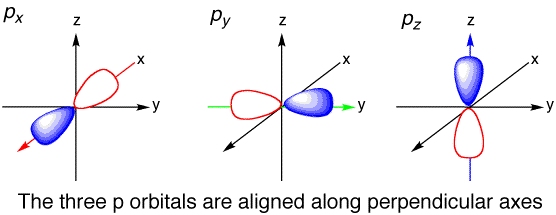
The unusual nebula that surrounds it puts me in mind of a one of the sets of atomic orbitals wherein electrons occur round the nucleus of an atom. Specifically a p orbital.

p orbital

The Origins of Atoms

Here’s a Periodic Table with a difference.

Yes, it lists the elements in the usual way but the information within the boxes is distinctive. It tells where the atoms of each element first came into being whether it was in the big bang – for hydrogen and hydrogen alone – or, for most elements, in stars of varying types, or else by human activity.

From Astronomy Picture of the Day for 25/1/16:-

APOD 25/1/16

Edit:- I’ve just noticed the table has helium also being produced by the big bang. I’m sure it’s made by fusion in stars, though.

Periodic Tales by Hugh Aldersey-Williams

The Curious Lives of the Elements, Viking, 2011, 428 p.

The first thing to say is that, despite its title(s), this is not a Chemistry book. In its index there are eight references to Shakespeare (only one fewer than for the chemist Jöns Jacob Berzelius and more than for any individual scientist barring Humphry Davy, Carl Scheele, William Ramsay, Marie Curie and Dmitri Mendeleev) – four to Goethe, three each to Wagner and Van Gogh. Other seemingly unlikely name checks are given to Wilfred Owen and Barbara Hepworth, not to mention Hunter S Thompson’s novel Fear and Loathing in Las Vegas.

What it is, is a book about how Chemistry permeates our lives, not just in the biological sense – for without Chemistry our bodies could not work – but in the cultural sphere, in our day-to-day existence. (There is even a reference to Irn Bru! – in a frankly bizarre context.) As such the book ought to appeal to the general reader rather than just Chemists. But the importance of Chemistry in painting, sculpture, opera, poetry, fiction, even architecture ought not to surprise. As the back of the book reminds us, “Everything is made of them [the elements,] from the furthest reaches of the universe to this book you are holding in your hands, including you.” English words for white (apart from snow) are bound up with the compounds of calcium they embody, marble, alabaster, chalk, ivory, bone, teeth. (I object, here, that the “White Cliffs of Dover” are anything but; unless seen from a distance.) The Latin calx yields the Italian calcio for what Aldersey-Williams calls soccer, perhaps because a goal is scored by the ball crossing a chalked line. The word for railway in nearly every language except English reflects the iron from which it is constructed, chemin de fer, Eisenbahn, ferrovia, vía fería, järnväg, tetsudou. Akin to gold in its chemical unreactivity, the valuation of platinum – the only element first isolated by pre-Columbian Americans – over gold is a cultural choice; not due to rarity but snobbishness.

The book contains photographic illustrations every so often but they can at times be a little indistinct as they are reproduced only in monochrome.

Like his Swedish compatriot Carl Scheele (who has a fair claim to have discovered oxygen) Jöns Jacob Berzelius is all but forgotten – despite pioneering laboratory staples like filter paper and (the now superseded) rubber tubing for connecting laboratory equipment together, first using the words catalysis and protein, inventing chemical symbology and coming up with the idea that elements combined in fixed proportions and hence chemical formulae. If his name had been attached to these as Bunsen’s was to his – admittedly splendid – invention that might not be the case. But it seems the Swedes were/are reticent about blowing their trumpets. Due to their chemists’ wielding of an essential piece of technology – the blow-pipe – no less than seven elements – ytterbium, yttrium, terbium, erbium, holmium, scandium and tantalum – were identified from ores that came from a single mine near the town of Ytterby but there is now no trace of the mine nor is there a visitor’s centre. The Swedes may be missing a trick there.

Discovery of “new” elements has always to an extent depended on available technology. Better furnaces and higher temperatures explain the historical progression of metal extraction through the Bronze and Iron Ages and the isolation of zinc in India by the 13th century, the alkali metals, highly reactive and thus resistant to chemical extraction, were only torn from their compounds by the greater power of electricity – not harnessed till just before 1800 – the spectroscope enabled elements to be inferred from the incursion of additional lines in the resultant spectra, transuranics could only be synthesised when atom–colliding machines became available. New liquefaction techniques allowed William Ramsay in the 1890s to conjure new elements out of thin air. (Well, since it was liquefied, I suppose it was really thick air.) Ramsay populated a whole previously unknown Periodic Table Group, the noble gases – neon et al – using this method.

Aldersey-Williams has a tendency to employ the words light or heavy instead of low/high density respectively and to refer to an element when strictly it is the presence of its compounds, atoms or ions that is under discussion. Plus he infers ozone is bonded in a triangle. Its atoms may be arranged in a triangle but its bonds are not. He also says “sodium is now the colour of the city at night” as well as “our principal means of knowing this element.” My local street may be “lit from above by the sodium lamps,” but these have been largely replaced by the blueish white of mercury vapour lights on main roads.

He has however written an interesting and informative, at times quirky, book.
The Criterion for Phenomena

I’ve just watched the third of mathematician Marcus du Sautoy’s television series Precision: The Measure of All Things on BBC 4.

There’s a lot been going on at Son of the Rock Towers over the past week or two (details may be forthcoming in due course) so I missed the first two episodes, Time and Distance and Mass and Moles – which is a pity as the second at least will have been about Chemistry – and I don’t know if I’ll get the chance to catch up on them.

Tonight’s last in the series was titled Heat, Light and Electricity and discussed how ways to measure these phenomena have been developed and extended over time.

du Sautoy irritated me though by using the word phenomena as if it were singular. I now quote Wikipedia:-

Phenomena are observable events, particularly when they are special.

A single observable event is of course a phenomenon.

The same distinction applies to the word criterion – like phenomenon, based on Greek – and its plural where too many people, especially news reporters, refer to a criteria. It makes me cringe.

In sum, the only criterion for using the word phenomena is that more than one event is involved. If there’s only a single event then it’s a phenomenon.

Dogs Teaching Chemistry

Just because.

Thanks to my son for pointing me in the direction of the first of these two videos.

free hit counter script