Archives » Chemistry

New Supernova

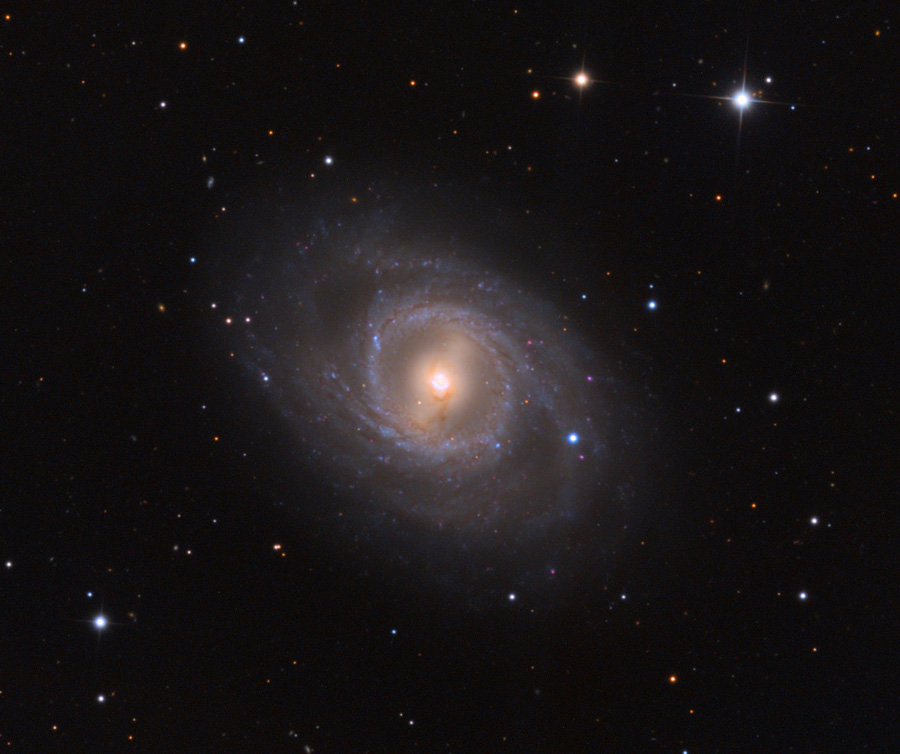
This was Astronomy Picture of the Day on 22/3/12.

Supernova

It is a picture showing the recently observed supernova in the galaxy which is known as M95, 38 million lightyears away. The supernova therefore occurred 38 million years ago and we’re just seeing its light now. The supernova is the really bright spot towards the edge of the galaxy.

A supernova is just about the biggest explosion imaginable and occurs when a massive star reaches the end of its life. It is in supernovae like this that the universe’s (and therefore Chemistry’s) heavy elements are formed as it is only under such conditions of tempertaure and pressure that smaller atomic nuclei can fuse together to form the largest ones.

This is a video (from vimeo) which contrasts the supernova with M95’s appearance before the star exploded.

Supernova 2012aw in M95 from Adam Block on Vimeo.

Rocket Science?

There are two interesting posts over at Ian Sales’s blog.

The first is an attempt to (re)define “hard” SF. As far as he sees it – and I largely agree – this is SF that is bound, more or less, by known physical laws, by the restraints inherent in, for example, Physics and Chemistry.

In this regard any use of the trope of, for example, faster than light travel is – despite decades of convention and use in what might otherwise be considered hard SF stories – not hard SF in the strictest sense, as, to our best knowledge, the speed of light is an insurmountable barrier.

This is not to decry other types of SF (which are perfectly legitimate) merely to say that they go beyond the bounds of the known and, in the case of Space Opera in particular, which cleaves the paper light years with carefree abandon, actually tend towards wish-fulfillment. Though of course there is the necessity of getting characters from here to there in a reasonably efficient, non-boring manner.

It is amusing to recall here what is perhaps the most famous phrase in Science Fiction – certainly in its dramatic form, “Ye cannae change the laws of Physics, Captain.” This from a TV programme which made a habit, nay a virtue, of portraying just that.

Ian makes a distinction between hard sciences (Cosmology, Physics, Chemistry) and softer ones such as Psychology, Archaeology and Anthropology. While agreeing that the term is most often interpreted this way I wouldn’t myself say that stories featuring these could not be hard SF.

The second of his posts is an announcment that he will be editing an anthology of… hard SF; to be called Rocket Science.

No need to rush. Submissions will not be accepted till 1st August.

Rocket Science is itself a term that has often irritated me as it is most often heard in the phrase, “It’s not rocket science, is it?” as if rocket science was at the cutting edge, inherently incomprehensible. As Ian points out in his post, the science of rocketry – as opposed perhaps to some of its technological aspects – has, due to its basis in chemical reactions whose energetic outcomes are limited and, moreover, fixed – not evolved much in a century.

I know it’s use is as much metaphorical as anything else but I’ve always felt tempted to respond to anyone who trots out the, “It’s not rocket science,” line, that rocket science isn’t rocket science.

Rocket Science, however, may be.
The Company I Keep (On Occasion)

Remember that short story I sold a while back?

Well, an unexpected package was delivered by the Post Office on Friday. (Actually the postie left a card and I had to pick it up at the sorting office.)

As I say I had no idea what it was (I hadn’t bought anything from eBay or Amazon for quite a while – and it’s nowhere near my birthday or anything.)

When I retrieved it I saw it was from PS Publishing.

What it contained was the traycased, signed edition of The Company He Keeps, aka Postscripts 22/23, which contains that story, Osmotic Pressure.

As an artefact The Company He Keeps is a thing of beauty, sumptuously produced. The traycase is lined with velvet and comes with green silk ribbon. The dust jacket is sensuously smooth, the hard cover has both back and front illustrations incorporated into it, the paper smells delightfully creamy. (I know another author who always assesses a book’s quality by its paper’s aroma.) I have never before been published in such a beautiful manner.

This is of course the de luxe, collector’s edition but I have no reason to suppose the “ordinary” hardback will be any less carefully produced.

There are several well-known names on the contents page (better known than mine certainly.) These include Lucius Shepard, Eric Brown, Steve Rasnic Tem and Darrell Schweitzer, to name only some.

I’m chuffed beyond measure to be appearing in said company.

In the information bit preceding the story I say, “I had always wanted to write a story with a two word title that was also a scientific concept, preferably Chemistry related. Osmotic Pressure is the result.”

I’€™m delighted it found a publisher.

(Osmotic pressure is the hydrostatic pressure produced by a difference in concentration between solutions on the two sides of a surface such as a semipermeable membrane.)

Partly my inspiration came from James Blish’s Surface Tension, which also has a two word scientific concept as its title.

I must emphasise that I do not claim that my story stands any comparison at all with Surface Tension – which is one of the early classics of Science Fiction – only that Blish’€™s story was one of the influences on its genesis.

In Common Time Blish wrote another famous story with a two word title. So celebrated is Common Time that Damon Knight once published a critique extolling it as an extended sexual metaphor – told in reverse. The metaphor begins (ends?) with a pun. The title, so Knight suggested, is actually Come On Time. His critique was longer than the original story.

Now, if anyone can give me an idea for a story to be called Dielectric Constant; or even Dipole Moment …..

Glasgow’s Art Deco Heritage 1. The University Chemistry Building

This was where I spent the better waking part of seven years of my life; four as an undergraduate (though there were only one lab per week and one lecture per day in 1st year; with an extra lecture and lab per week in 2nd) and three as a research student doing my Ph. D..

The building is in three main parts, oriented like three wheel spokes radiating out from a central hub. This is to reflect the fact that there were three main branches of Chemistry when it was built, Organic (chemistry of carbon compounds,) Inorganic (all other compounds,) and Physical (things to do with properties like melting point, boiling point, dipole moments, dielectric constants etc.)

There are two main entrances, situated between the central and the flanking blocks. This is one of them.

Here’s a close up on the above doorway so that you can see that officially it’s called The Institute Of Chemistry.

This is a (now disused I think) doorway on the end of a block.

This is part of one of the blocks.

Here’s a view from the rear of the building. As I recall the wooden bit at the top is a later addition.

Slightly to the left of this you can see up to the research labs.

Note the gas cylinders kept outside for safety reasons.

There’s a lovely curved end to the building’s frontage on University Avenue. This section is given over to medical research.

The railings separating this side of the building from University Avenue are nice too.

Editorial note:-
I have already featured the Glasgow buildings the Luma Factory, the Beresford Hotel, the Kelvin Court Flats and the Ascot Cinema under the title Scotland’s Art Deco Heritage since they are such iconic structures.

Edited to add an explanation of the designation, The University Chemistry Building:-
The venerable degree conferring institution which I attended titles itself The University, Glasgow. (When it was founded there was no other in the city, nor would there be for hundreds of years.)

Watching The Electrons

You’ve all heard of electrons I assume. Particles within atoms that, among other things, determine the sorts of chemical reactions those atoms can take part in but more importantly without which much of modern life – and the mysteries of the world wide web and internet through which you are reading this missive – could not take place.

They are usually represented as moving in circles around an atom’s nucleus (see some of the pictures here.)

They don’t. The circles are just an easy way to picture how far away from a nucleus they are and how much energy they have.

More accurately they occupy certain volumes of space (orbitals) around the nucleus. Which is to say that the probability of their being in that volume is more than 99%.

This is an outcome of quantum mechanical calculations on electrons and their properties.

One of the ramifications of Heisenberg’s Uncertainty Principle was that you could never know simultaneously both the position and velocity of an electron. If you knew one’s speed you did not know its position, if you determined its position you couldn’t know its speed.

One of my lecturers when I was a student thought that this was unlikely and called the Uncertainty Principle, “the Phlogiston Theory of the Twentieth Century.”

Well, it seems that physicists are now able to watch electrons moving in real time.*

Though the details are quite dense (and probably incomprehesible to anyone without a background in Chemistry or Physics) it’s a measure of how sad I am that I found this information irrationally exciting. It deals more with movement of electrons between orbitals of different energy than of electrons within their orbitals. It doesn’t violate the Uncertainty Principle.

* Thanks to Guthrie at his blog for bringing this to my attention.

Sulphur Again

I was checking my blog’s stats earlier this week.

It never fails to amaze me that a high number of visits to this blog seem to arise from my post about Mary Campbell Smith’s poem The Boy In The Train.

There are lots of hits for Art Deco too, which actually tend to predominate.

However what caught my eye this time was someone looking for the spelling of sulphur.

I accessed the search page they’d used and found this blog entry. Its last line is a beauty.

I do hope Jon Edwards from the RSC has looked at it (and at my reply to his comment on my take on the subject here.)

I note also that I was 22nd equal in the general blog category in the Scotblog Awards and 67th equal overall. Four votes plus a panel nomination was all that took. (I’ll need to tout for votes next year.)

free hit counter script