Archives » Cairo trilogy

Sugar Street by Naguib Mahfouz

Black Swan, 2013, 309 p. Translated from the Arabic Al-Sukkariyya by William Maynard Hutchins and Angele Botros Samaan.

Sugar Street cover

Originally published in 1957, this third part of Mahfouz’s Cairo Trilogy has al-Sayyid Ahmad abd al-Jawad entering old age and so dwells more on the younger members of his family. His children reflect that their youngsters seem to know it all and do not listen to their words of wisdom. ’Twas ever thus. The book takes place in the run up to and during the Second World War so mirrors the First World War setting of Book 1, Palace Walk.

While political events of the times tend to happen in the background, it seems that in this respect Egypt doesn’t change much; indeed one character reflects that tyranny is the nation’s most deeply entrenched malady. Here, hope is raised when King Faruq takes over from his father Fuad, but disillusionment soon sets in. Politicians sell out their principles for power and inspire contempt. The group named herein as the Muslim Brethren (nowadays that “Brethren” is translated as Brotherhood) have become active in the political arena. According to them all answers are to be found in the Qu’ran. “We attempt to understand Islam as God intended it to be: a religion, a way of life, a code of law and a political system.” This is immediately subject to the rejoinder, “Is talk like this appropriate for the twentieth century?” – which is a good question; and more so in the twenty-first. There is also mention of girls in the family not being educated beyond the elementary certificate – not that that was a specifically Egyptian failing in those times.

To illustrate the darker undercurrents at play Mahfouz has a Copt say, “in spite of everything we’re living in our golden age. At one time Shaykh Abd al-Aziz Jawish suggested that Muslims should make shoes of our hides.”

al-Jawad’s grandson Abd al-Muni’m Ibrahim Shawkat is a firm believer while his brother Ahmad Ibrahim Shawkat is a communist. Towards the end both are detained for sedition. The first claims it is because he believes in God, the second asks what, then, his own offence could possibly be, as he doesn’t. Ahmad’s earlier declaration of affection for a female classmate founders on his relative lack of means. “It was amazing that in this country where people allowed emotion to guide their politics they approached love with the precision of accountants.”

Other perceptions include, “Politics is the most significant career open to a person in a society,” “When we’re in love we may resent it, but we certainly miss love once it’s gone,” and, “Life is full of prostitutes of various types. Some are cabinet ministers and others authors.”

Once again the USian translation was prominent, with piasters for piastres, “darn it” as an imprecation, soccer and diapers all intruding on my suspension of disbelief.
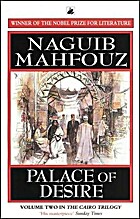
Palace of Desire by Naguib Mahfouz

Black Swan, 1997, 423 p. Translated from the Arabic Qasr al-Shawq by William Maynard Hutchins, Lorne M Kenny and Olive E Kenny

Palace of Desire cover

Originally published in 1957, this, the second part of Mahfouz’s Cairo Trilogy, follows on from Palace Walk and takes up the story of al-Sayyid Ahmad abd al-Jawad’s family some five years after the death of his son Fahmy in the Egyptian Revolution of 1919. His wife Amina remains grief stricken, his daughters are now both married into the Shawkat family, where Khadija is at odds with her mother-in-law, but the story focuses mainly on his first son (by a previous marriage) Yasin and his youngest son Kamal, on the cusp of adulthood. One curiosity:- in Palace Walk the standard of feminine beauty lay towards the ample, in Palace of Desire the more upper class Egyptians – though Mahfouz doesn’t really give us any below what might be called middle class – are beginning to lean towards a thinner ideal.

While Yasin now lives in Palace of Desire Alley the title of this second novel in the trilogy is indicative, since sexual longing threads the book. Ahmad himself returns to his extra-marital dalliances after a period of abstinence due to his mourning and sets up the lute player Zanuba on a houseboat as his mistress. Yasin is enamoured of women generally but serially disappointed by marriage. His second one, to next door neighbour Maryam, is as unfulfilling as was his first to Zaynab. At one point he tells Kamal that, “nothing works with women except beating them with a shoe.” A chance encounter with Zanuba (with whom he had an association as a bachelor) leads to her separation from Ahmad and marriage to Yasin. Neither Zanuba nor Ahmad were aware of their mutual connections.

Kamal also falls under the spell of love. He is smitten by Aïda Shaddad, the sister of one of his friends. She gets engaged and married to another, though. As a result Kamal loses his hitherto strong Muslim faith and begins to indulge in alcohol and women. He muses, “Love’s an illness, even though it resembles cancer in having kept its secrets from medical science,” and on a forced visit to the mosque to give thanks for his father’s recovery from serious illness thinks, “The most ancient remaining human structures are temples. Even today no area is free of them.”

As with Palace Walk the book takes a long time to get going. The prose is dense with the characters’ reflections and can seem long-winded. Whether this is due to the translation is impossible to tell but once again USianisms fail to ring true. Calling someone “buster” as a form of put down struck me as not very Egyptian, at any rate.

The third volume, Sugar Street (where the Shawkat families reside) awaits.

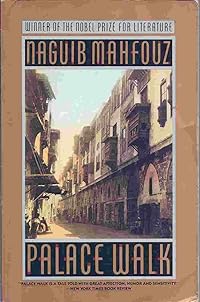
Palace Walk by Naguib Mahfouz

Doubleday 1990, 501 p. First published in 1956. Translated from the Arabic Bayn al-Qasayn by William M Hutchins and Olive E Kenny.

This is part 1 of Mahfouz’s Cairo trilogy, said to be one of his major works and a contributor to his being awarded the Nobel Prize for Literature in 1988.

Palace Walk cover

al-Sayyid Ahmad abd al-Jawad is an overbearing father and husband who does not allow his daughters or wife outside the house (nor anyone bar family members to see their faces) and rules his sons with a rod of iron. He is also, to Western eyes, an outrageous hypocrite – pretending to religious rectitude but spending his evenings carousing with his friends, drinking, and being “entertained” by female singers. In this respect he is not too different from those friends, though. His much put upon (second) wife, Amina, waits on him – literally hand and foot – and is consoled only by her strong religious belief and her love for her children. The family’s story is set during the First World War (there are frequent references to Kaiser Wilhelm, Hindenburg and zeppelins.) In the background the tensions associated with the British (the text frequently says English) occupation of Egypt at that time are laid out. While hating the English, a particular ire seems to have been reserved for Australians – and Indians are mentioned once as being hardly better.

The text is saturated with religiosity, both the dialogue and the characters’ thoughts make frequent reference to suras from the Qur’an (chapter and verse) – sometimes, as is the way with many observers of a faith, to provide support for their dubious position or actions.

Gradual alterations of the internal relationships in the family occur as time goes by, the two daughters, Aisha and Khadija are married out (to the youngest son Kamal’s distress and confusion,) Yasin, al-Sayyid’s son by his previous marriage, disgraces himself and forces his father to arrange a marriage for him too, his wife also being made by al-Sayyid to accept his strictures, and Amina’s eldest son, Fahmy, becomes embroiled in the revolution.

The claustrophobia and sexual repression within the household are striking. Offspring here are allowed no say in whom they are to marry, have not even seen their intended till after the engagement. The wider culture does allow sexual outlets, but only clandestinely. Life in Cairo in the early part of the Twentieth Century is illuminated almost incidentally. A local cleric occasionally drops in to al-Sayyid’s shop to dispense warnings and advice but mostly to receive a present.

The revolution, when it happens, comes as an apparent intrusion to the narrative which up to that point had closely focused on the family members and their interactions. While it continues to do so, there is a noticeable broadening out thereafter.

The text tends to the wordy. I must assume this reflects the original Arabic but while the characters are being established – each of the family has sections to her- or himself in various alternations – it can sometimes be unwieldy.

The translation is into USian and can be fussy. “Why did not the revolution achieve its objectives quickly?” has that “not” awkwardly placed. There were other infelicities. Skirt chaser didn’t seem correct as a term for womaniser in an Egyptian context and the British General Allenby is called a son of a gun when he releases the Egyptian revolutionary Sa’d Zaghlul from custody; surely too approbatory for a man whom the speaker despised. A man is “plunked” down; in Britain that would be “plonked.”

While it took a while to become engaged with the characters and the milieu things picked up latterly and I was encouraged sufficiently to read part 2 of Mahfouz’s Cairo Trilogy soon.

Book Haul

On Saturday we went to the Christain Aid booksale which is held every two years at St Andrew’s and St George’s Church, George Street, Edinburgh. It was mobbed.

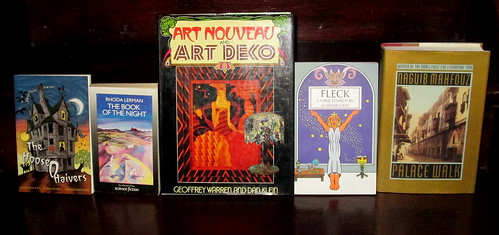
This was my haul:-

Book Haul

The Hoose O Haivers took my fancy just because of its title – it contains short stories by Matthhew Fitt, Susan Rennie and James Robertson.

Rhoda Lerman’s The Book of the Night is a Womens’ Press SF publication from 1986.

The Art Nouveau and Art Deco book was spotted by the good lady (who herself bought 13 books!) It has some lovely illustrations.

Fleck is a verse comedy by Alasdair Gray.

Palace Walk is the first of Naguib Mahfouz’s Cairo trilogy.

Goodness knows when I’ll get round to reading them.
The Hoose O Haivers and Fleck are quite short so I could fit them in easily enough I suppose. The Mahfouz looks like a long project though.

The book sale continues till Friday.

free hit counter script