Palace Walk by Naguib Mahfouz
Posted in Other fiction, Reading Reviewed at 20:49 on 15 December 2013
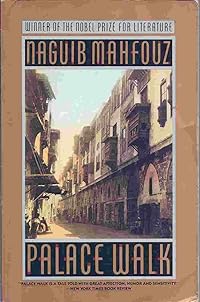
Doubleday 1990, 501 p. First published in 1956. Translated from the Arabic Bayn al-Qasayn by William M Hutchins and Olive E Kenny.
This is part 1 of Mahfouz’s Cairo trilogy, said to be one of his major works and a contributor to his being awarded the Nobel Prize for Literature in 1988.
al-Sayyid Ahmad abd al-Jawad is an overbearing father and husband who does not allow his daughters or wife outside the house (nor anyone bar family members to see their faces) and rules his sons with a rod of iron. He is also, to Western eyes, an outrageous hypocrite – pretending to religious rectitude but spending his evenings carousing with his friends, drinking, and being “entertained” by female singers. In this respect he is not too different from those friends, though. His much put upon (second) wife, Amina, waits on him – literally hand and foot – and is consoled only by her strong religious belief and her love for her children. The family’s story is set during the First World War (there are frequent references to Kaiser Wilhelm, Hindenburg and zeppelins.) In the background the tensions associated with the British (the text frequently says English) occupation of Egypt at that time are laid out. While hating the English, a particular ire seems to have been reserved for Australians – and Indians are mentioned once as being hardly better.
The text is saturated with religiosity, both the dialogue and the characters’ thoughts make frequent reference to suras from the Qur’an (chapter and verse) – sometimes, as is the way with many observers of a faith, to provide support for their dubious position or actions.
Gradual alterations of the internal relationships in the family occur as time goes by, the two daughters, Aisha and Khadija are married out (to the youngest son Kamal’s distress and confusion,) Yasin, al-Sayyid’s son by his previous marriage, disgraces himself and forces his father to arrange a marriage for him too, his wife also being made by al-Sayyid to accept his strictures, and Amina’s eldest son, Fahmy, becomes embroiled in the revolution.
The claustrophobia and sexual repression within the household are striking. Offspring here are allowed no say in whom they are to marry, have not even seen their intended till after the engagement. The wider culture does allow sexual outlets, but only clandestinely. Life in Cairo in the early part of the Twentieth Century is illuminated almost incidentally. A local cleric occasionally drops in to al-Sayyid’s shop to dispense warnings and advice but mostly to receive a present.
The revolution, when it happens, comes as an apparent intrusion to the narrative which up to that point had closely focused on the family members and their interactions. While it continues to do so, there is a noticeable broadening out thereafter.
The text tends to the wordy. I must assume this reflects the original Arabic but while the characters are being established – each of the family has sections to her- or himself in various alternations – it can sometimes be unwieldy.
The translation is into USian and can be fussy. “Why did not the revolution achieve its objectives quickly?” has that “not” awkwardly placed. There were other infelicities. Skirt chaser didn’t seem correct as a term for womaniser in an Egyptian context and the British General Allenby is called a son of a gun when he releases the Egyptian revolutionary Sa’d Zaghlul from custody; surely too approbatory for a man whom the speaker despised. A man is “plunked” down; in Britain that would be “plonked.”
While it took a while to become engaged with the characters and the milieu things picked up latterly and I was encouraged sufficiently to read part 2 of Mahfouz’s Cairo Trilogy soon.
Tags: Bayn al-Qasayn, Cairo trilogy, First World War, General Allenby, Hindenburg, Kaiser Wilhelm, Naguib Mahfouz, Nobel Prize, Olive E Kenny, Sa’d Zaghlul, the Great War, William M Hutchins, World War 1, WW1, WWI

Palace of Desire by Naguib Mahfouz – A Son of the Rock -- Jack Deighton
18 January 2014 at 12:00
[…] published in 1957, this, the second part of Mahfouz’s Cairo Trilogy, follows on from Palace Walk and takes up the story of al-Sayyid Ahmad abd al-Jawad’s family some five years after the death […]
Sugar Street by Naguib Mahfouz – A Son of the Rock -- Jack Deighton
16 February 2014 at 20:21
[…] Originally published in 1957, this third part of Mahfouz’s Cairo Trilogy has al-Sayyid Ahmad abd al-Jawad entering old age and so dwells more on the younger members of his family. His children reflect that their youngsters seem to know it all and do not listen to their words of wisdom. ’Twas ever thus. The book takes place in the run up to and during the Second World War so mirrors the First World War setting of Book 1, Palace Walk. […]