Palace of Desire by Naguib Mahfouz
Posted in Other fiction, Reading Reviewed at 12:00 on 18 January 2014
Black Swan, 1997, 423 p. Translated from the Arabic Qasr al-Shawq by William Maynard Hutchins, Lorne M Kenny and Olive E Kenny
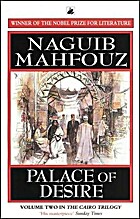
Originally published in 1957, this, the second part of Mahfouz’s Cairo Trilogy, follows on from Palace Walk and takes up the story of al-Sayyid Ahmad abd al-Jawad’s family some five years after the death of his son Fahmy in the Egyptian Revolution of 1919. His wife Amina remains grief stricken, his daughters are now both married into the Shawkat family, where Khadija is at odds with her mother-in-law, but the story focuses mainly on his first son (by a previous marriage) Yasin and his youngest son Kamal, on the cusp of adulthood. One curiosity:- in Palace Walk the standard of feminine beauty lay towards the ample, in Palace of Desire the more upper class Egyptians – though Mahfouz doesn’t really give us any below what might be called middle class – are beginning to lean towards a thinner ideal.
While Yasin now lives in Palace of Desire Alley the title of this second novel in the trilogy is indicative, since sexual longing threads the book. Ahmad himself returns to his extra-marital dalliances after a period of abstinence due to his mourning and sets up the lute player Zanuba on a houseboat as his mistress. Yasin is enamoured of women generally but serially disappointed by marriage. His second one, to next door neighbour Maryam, is as unfulfilling as was his first to Zaynab. At one point he tells Kamal that, “nothing works with women except beating them with a shoe.” A chance encounter with Zanuba (with whom he had an association as a bachelor) leads to her separation from Ahmad and marriage to Yasin. Neither Zanuba nor Ahmad were aware of their mutual connections.
Kamal also falls under the spell of love. He is smitten by Aïda Shaddad, the sister of one of his friends. She gets engaged and married to another, though. As a result Kamal loses his hitherto strong Muslim faith and begins to indulge in alcohol and women. He muses, “Love’s an illness, even though it resembles cancer in having kept its secrets from medical science,” and on a forced visit to the mosque to give thanks for his father’s recovery from serious illness thinks, “The most ancient remaining human structures are temples. Even today no area is free of them.”
As with Palace Walk the book takes a long time to get going. The prose is dense with the characters’ reflections and can seem long-winded. Whether this is due to the translation is impossible to tell but once again USianisms fail to ring true. Calling someone “buster” as a form of put down struck me as not very Egyptian, at any rate.
The third volume, Sugar Street (where the Shawkat families reside) awaits.
Tags: Cairo trilogy, Foreign fiction, Naguib Mahfouz, Other fiction, Palace Walk
