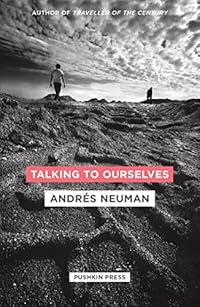
Talking to Ourselves by Andrés Neuman
Posted in Other fiction, Reading Reviewed at 12:00 on 6 February 2022
Pushkin Press, 2014, 153 p. Translated from the Spanish Hablar Solos by Nick Caistor and Lorenza Garcia.
Neuman’s Traveller of the Century was one of the best books I read in 2015. In the last ten years in fact. While that novel concentrated more on love, Talking to Ourselves is more concerned with the other two of literature’s three perennial concerns, sex and death. That may seem to be an odd thing to say about a book where one of its three narrators is seven-year old boy, Lito. The others are his mother Elena and his father Mario. Lito thinks he can change the weather by thinking about it. Elena has a penchant for quoting from other authors’ works. Mario has a terminal illness, which he and Elena are trying to keep from Lito, and his narration is by way of the contents of an account he is dictating into a recording machine. For much of the time scale covered by the novel Mario and Lito are on a last road trip together in a camper van they call Pedro. All three viewpoints are distinctive and convincing with Lito’s exactly as a young boy’s would be.
While Lito and Mario are away Elena embarks on an affair with Mario’s doctor, Ezequiel Escalante. When he suggests acting out his less conservative sexual desires they are at first outrageous to her but soon she finds them overwhelming and experiences intense orgasms from “different places.” She is at once repelled by her behaviour but also compelled to it. The affair seems to be a way of distracting herself from her situation but may be a means to connect her through the “little death” to the bigger one. This brings her to ruminate on desire, “pleasure brings hope. Maybe that is why so many men leave us dissatisfied: their desire holds no promise. They are wary when they get into bed. As though they were already leaving before they have arrived. We women, even if only for a moment, even if we aspire to nothing more, tend to give ourselves completely, out of instinct or habit.”
At one point she lists for Ezequiel all the verbs different Spanish speaking traditions use to describe an orgasm, meaning variously to draw near, to run, to end, to arrive, to give it, to go, to finish, to cross over. These seem masculine to her and she wonders if there are words for female orgasms, drowning, dissolving, unravelling, irradiating.
Only a few stabs of lightness break the intensity. Elena recounts, “I remembered once, during a dinner, a man asked my sister if she lived alone. In a rare show of humour, my sister replied; Yes, I’m married.” Of attracting younger people’s attention she says, “Any woman who thinks this is a problem strictly to men, very well: she is probably naïve, a coward, or a hypocrite. I have women friends who fall into all three categories. Until, one day, when they least expect it, they leave their bald husbands for some other man.” She herself is “starting to mistake beauty for youth.”
On her mother’s statement that things are fine when Lito has gone to his grandparents’ while Mario dies Elena says, “When things are going fine, I think they are about to get worse and I feel even more scared.” In the hospital ward she tells us “I have the impression that families, and doctors, too, perhaps, soothe the sick in order to protect themselves from their agony. As a buffer against the excessive, unbearable disorder which the ugliness of another’s death creates in the midst of one’s own life.”
Then there is the aftermath, with its unwanted urgencies. “Buying the coffin and dictating the death notice. No one teaches you these things.” She laments the varying charges different funeral directors put on their services, the necessity to choose. On the death notice itself she notes that “grammar doesn’t believe in reincarnation. Literature does,” but, “There isn’t time to start reinventing the format.”
In the days of mourning she finds “All the books in the world, whatever they are about, spoke to me of death.” She reflects that since death interrupts all dialogues then it is natural to write posthumous letters, that maybe all writing is letters to the one who is no longer there.
Talking to Ourselves is a superb piece of writing, germane to those who are still here.
Pedant’s corner:- venirse (lower down the page this is rendered venirme but this may be a difference in the Spanish usage,) question marks ae always followed immediately by another punctuation mark, either comma or full stop, “sawed in half” (sawn.) “‘They hurt bad’” (USian usage. The correct adverb is ‘badly’,)