Posted in Art, Museums, Sculpture, Trips at 12:00 on 20 May 2024
One of the oddest things we saw in the Rijksmuseum was this display of woollen hats:-

A unique harpsichord he only surviving one of its type which plays one-fifth above normal pitch. Made by the Ruckers family from Flanders:-

The top floor of the museum is reserved for more modern exhibits. This biplane was designed during the Great War by Dutchman Frits Koolhoven for the British Aeronautical Transport Company:-

There was a chess set whose pieces looked like Great War crested china memorabilia but was designed by German Georg Fuhg “to glorify Nazi Germany’s urge to conquer.” It was shown in the Rijksmuseum in 1941 exhibition Kunst der Front organised by the occupier. The text in the border refers to countries occupied by Germany in 1939 and 1940:-


A cloth book for children which, as I recall, was made during the German occupation:-


Plaster model for the sculpture The Destroyed City by Ossip Zadkine, made to commemorate the bombing of Rotterdam in 1940. Zadkine said of it “I have sculpted tears.”:-

No Comments »
Posted in Trips at 22:00 on 13 May 2024
The Rijksmuseum has an impresive looking library, taking up several floors:-


No Comments »
Posted in Art, Museums, Trips at 12:00 on 11 May 2024
One of the downstairs rooms in the Rijksmuseum held paintings that weren’t perhaps as famous as The Night Watch or Vermeer’s Milkmaid.
Two were by by Hendrick Avercamp, both reminiscent of the work of the Breughels.
Ice Entertainment Near a City :-

Winter Landscape with Skaters:-

Self portrait by Betsy Westendorp-Osieck:-

Self Portrait by Émile Bernard:-

van Gogh Self Portrait:-

Therese Schwartze Self Portrait:-

Portrait of Theresia Ansingh (Portret van Sorella) by Therese Schwartze. Also known as Woman Wearing a Hat. A better picture than mine is here:-

The Night School by Gerard Dou. An illustration of depiction of light. (Again better to see here):-

An unusual Mondrian. Painting of a Windmill:-

1 Comment »
Posted in Art, Museums, Trips at 12:00 on 7 May 2024
The centre piece of the Rijksmuseum’s Great Hall is Rembrandt’s masterpiece The Night Watch.
Imagine our disappointment when we entered the room in which it is displayed to see this:-

It was cordoned off and we therefore could not see it properly. Apparently minor air movements make the canvas flex, potentially damaging it, and they were measuring just how large the movements were so that they can prevent any future deterioration.
However there was a painting of a similar subject (well, lots of Dutch burghers) just to The Night Watch’s right as you look at it, which I had to take two photos of to get it all and then stitch:-

Vermeer’s milkmaid was also in the Great Hall but the lighting conditions weren’t good and my photo came out blurry.
Also nearby was this still life. Still Life with Cheese by Floris Claesz Van Dijck:-

No Comments »
Posted in Architecture, Museums, Trips at 12:00 on 5 May 2024
One of the reasons for our trip to Amsterdam was to visit the Rijksmuseum. Entry isn’t cheap (now it’s €22.50) especially if you’re used to free British Museums but it’s a very good museum indeed.
Building:-

The Great Hall is on the first floor (second floor if you’re USian.)
It has a nicely painted ceiling:-

with illustrations on the areas above the side halls:-

and stained glass windows to the front:-


No Comments »
Posted in Architecture, Art Deco, Trips at 12:00 on 2 May 2024
This was the most Deco building I saw in Amsterdam. A casino on the street called Damrak:-
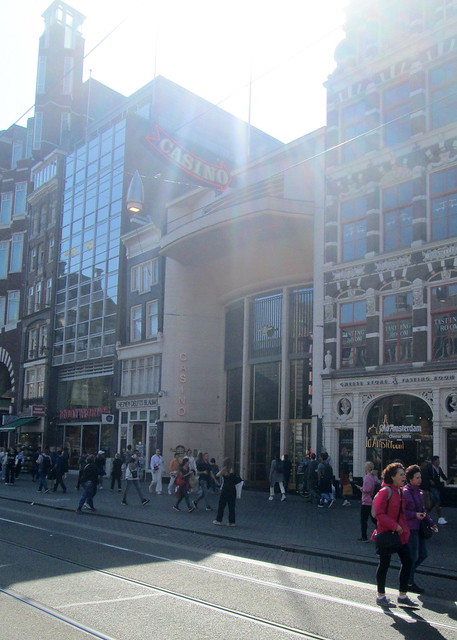
Canopy, horizontals in windows above:-

Rounded supports:-

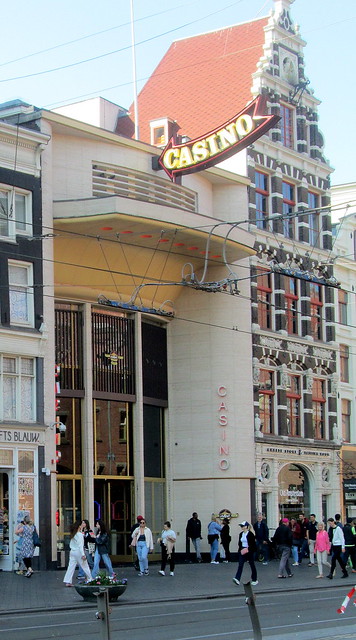
No Comments »
Posted in Architecture, Art Deco, Museums, Trips at 12:00 on 1 May 2024
City Archive Building. Horizontals and verticals galore, plus banding:-

Detailing. Frieze and note lettering above door to left:-

Frontage:-
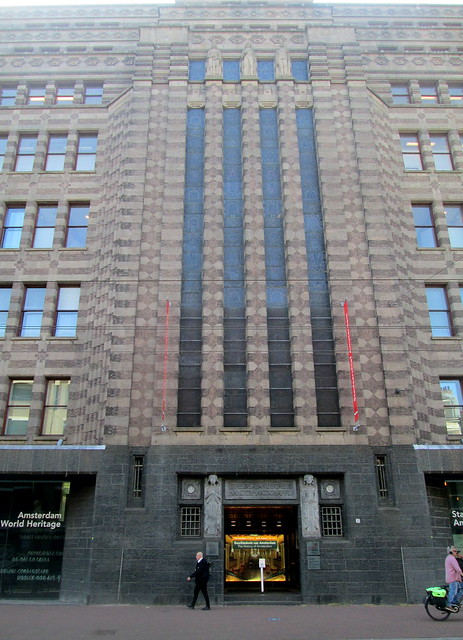
Entrance. The building now seems to be or at least house a museum on the History of Amsterdam:-

No Comments »
Posted in Architecture, Art, Trips at 12:00 on 28 April 2024
In The Netherlands it’s sometimes difficult to tell whether a building is Art Deco or an example of De Stijl, though De Stijl tends to be starker.
Anyway I found some buildings in Amsterdam which I thought were Deco.
Horizontals, verticals, rule of three in windows, canopy, rounded window column:-

The lower windows on this one have been knackered though:-

But its detailing is good. Note the figures in the columns between the lower windows:-

This tall one has lots of verticals and horizontals plus elaborate ironwork round the windows and great detailing on upper level and towards roof:-

Another tall one was the Station Rokin Building:-

Upper Level:-

Lower level:-

No Comments »
Posted in Architecture, Trips at 12:00 on 25 April 2024
While we were in The Netherlands last June we took the chance to go to Amsterdam as it was somewhere we’d never visited. It involved quite a long train journey, first on a swish kind of Inter-City double-decker train from Heerenveen to Zwolle, then a slower type of train called a Sprinter, which seemingly stopped everywhere between Zwolle and Amsterdam, including six stations in Almere alone!
The sprinter had decorations in the style of the artist Mondrian.
Glass partition:-
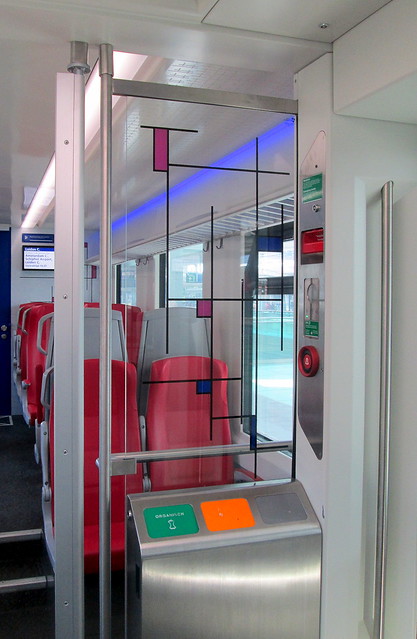
The walls of the toilet were also styled like Mondrian – see where corridor doglegs :-

We got off at Amsterdam Centraal Station. Central facade:-

Stitch of frontage:-

Canal scenes:-


Amsterdam City Hall:-

Clock building in Muntplein:-

No Comments »
Posted in Architecture, Modern Architecture, Trips at 21:52 on 29 September 2014
The ferry left Harwich late firstly due to “a cruise ship in the next berth” and then to the fact that they couldn’t get the engines to start. (Cue cries of, “They cannae take it, Captain.”) It was an electronic problem apparently. As a result we were an hour late arriving at Hoek van Holland.
Almost the first thing that happened after we got off the boat was we got lost. Our intructions said to take the second exit from a roundabout. It should have been the first. After a slight detour we got onto a road on the top of a dyke, which was pretty intimidating as there didn’t seem much room if there was any sort of traffic problem or accident. I missed another turning, found myself in the wrong lane and had to enter the A 20 motorway to Rotterdam. I was able to get off and pull into a petrol station where I consulted the map I had bought and worked out a way back onto the route I needed. Dutch motorways are brilliant, very well sign-posted.
Unfortunately the delays meant we hit Amsterdam at rush hour. Four north bound lanes more or less jam-packed. Fun. I wasn’t quite sure of which junction to come off the Amsterdam ring motorway but I spotted a sign for Leeuwarden and Heerenveen and took it. This route meant we drove over what used to be part of the Zuider Zee – on the Afsluitdijk, with the IJsselmeer on our right and the Wadden Sea hidden behind the dyke to our left. This was a weird experience but the dyke is a fantastic piece of civil engineering. At each end it has a set of huge sluice gates to allow the IJsselmeer to drain into the Wadden Sea. Presumably this only happens at low tide.
North of Amsterdam the traffic became very much lighter. Most of the way was motorway and the journey passed very quickly.
At certain junctions the motorway regulations stop a few hundred metres before the roads meet. This happened just west of Heerenveen where there is effectively a roundabout between the A 6 and A 7 motorways. (In Groningen two motorways meet at a set of traffic lights.)
I was struck by the number of smallish industrial units near the motorways and at the edges of towns – way more than in the UK. Old Dutch buildings tend to be traditional with pitched roofs. The industrial buildings all looked modern and were either rectangular boxes, some up to seven or eight stories, or else replete with curves.
The towns seemed tidy and prosperous looking. That may be due to the brickwork pavements and cycleways. I can’t say I noticed any litter.
No Comments »

