Archives » Altered History

The Society of Time by John Brunner

The Original Trilogy and Other Stories, edited by Mike Ashley. British Library, 2020, 287 p. Reviewed for Interzone 290-291, Summer 2021.

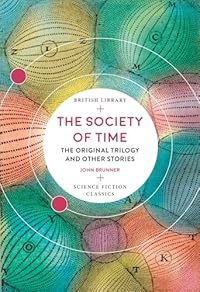
 The Society of Time cover

This British Library reprint, subtitled “The Original Trilogy and Other Stories” contains five novellas first published in 1961 and 1962. The “time” trilogy was collected as Times without Number shortly after then. Its three stories are set around the four-hundredth anniversary of the victory of the Duke of Parma’s Armada over the English fleet when a (Catholic) Spanish Empire – centred on the British Isles – of which our protagonist Don Miguel Navarro, a licentiate of the powerful Society of Time, is a citizen, is at its peak. These are, then, tales of Altered History, with place names such as Jorque and Londres
Curiously we are told Spain itself has been reconquered by “virile” Islam but nothing more is made of this. The Empire’s main rival is instead a Confederacy of Northern European states. The Society of Time controls the time travel machines of the Empire (“Borromeo showed us how we might rotate the dimensions of substances so that the worlds became flat and we could voyage back into time,”) and has rigorous rules to prevent interference with History. A similar organisation in the Confederacy acts likewise. The Islamic powers we must assume to have no time travel capability. All three stories centre round the inevitable (otherwise no story) floutings of these interference protocols. Miguel, a rather correctly behaved individual, is also shocked by other infractions the Society’s members condone, such as pandering.

In the first novella, Spoil of Yesterday, Miguel immediately recognises a work of Art as an illegal import from the past and arrests its owner. The breach is resolved by a trip to the past to replace it immediately after its removal, but the reader does not take this time trip with Miguel, is only told of it. In the second, The Word not Written, Miguel finds that prominent members of the Society actively explore ruptures in time when an argument between them is attempted to be settled by allowing female warriors from a time which would not have occurred bar interference to come to their present, with disastrous results. Again, only a trip back to the past, again unseen, restores the status quo ante. Only Miguel and his confessor retain memories of the infringement. In The Fullness of Time, in retrospect a cunning title, we do finally accompany Miguel to the past. The Empire’s exploitation of the mineral resources of its lands in the New World is protected by the (carefully worded, so as to avoid any possible contravention) Treaty of Prague between it and the Confederacy. Evidence has been found of the Confederacy using its time travel capability to mine in the past where it had no right to. While (in a nod to what actually happened in the reader’s world) recognising that without the Empire the natives of the New World might have been ground between the interests of competing European nations, Miguel’s companion, a Mohawk, resents the Empire’s intrusions on the natives’ ancient lands, despite his tribe becoming a leading light in Empire circles. It is his interference in the past which drives the story and ultimately ensures there will be no more Don Miguel tales.

This is all still very readable, though Brunner’s writing occasionally lapses into cliché, the characterisation is sometimes rudimentary, and there is a rather awkward portrayal of sexual roles and attitudes.

The other two novellas are stand-alones which arguably do not belong with the trilogy though editor Mike Ashley’s introduction says Brunner was at his best at novella length.

In Father of Lies a small area of England is on no maps and technology breaks down when it is entered. Miles Croton is part of a group investigating the phenomenon and penetrates the anomaly on foot after his car will no longer work. He almost straight away sees a dragon from whom he soon has to rescue a naked woman tied to a stake and finds he has entered a world based on mythology (mainly but not exclusively Arthurian.) While this might seem like a fantasy scenario Brunner supplies a rational explanation for them.

The Analysts by contrast is a tale of unusual architecture. Joel Sackstone can visualise from a drawing how a building will be experienced by its inhabitants and as such has been crucial to his firm’s success. A new project baffles him by its design – on which the clients are irrevocably set – seeming to lead people in a direction that isn’t there. In amongst all this oddness Brunner managed to include some asides on sexual and racial politics.

The following did not appear in the published review:- contains the phraseology of the time eg coloured for black.

Pedant’s corner:- “two capital L’s” (strictly speaking the plural is ‘two capitals L’, but that is not how people say it,) focussed (focused,) “if there was anything more undignified than a Licentiate could do” (if there was anything more undignified that a Licentiate could do,) “once for all” (once and for all,) “landing astraddle of the branch” (landing astraddle the branch,) staunch (stanch,) “that all was not well” (that not all was well,) a full stop where there ought to have been a comma, “ten year ago” (years.)

The Calculating Stars by Mary Robinette Kowal

A Lady Astronaut Novel, Solaris, 2019, 506 p, including 3 p Acknowledgements and 6 p Historical Note.

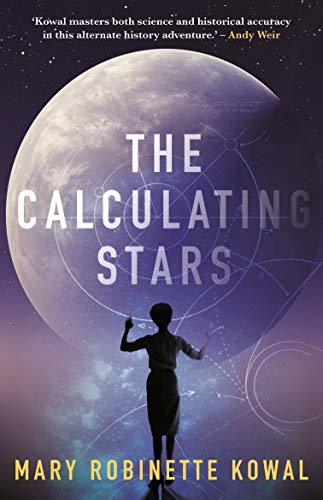
The Calculating Stars cover

Each chapter of the book is prefaced by a cod news clipping. Kowal uses these to provide background (and commentary on the times) but takes care to make clear that this is an altered history in her first two words, President Dewey. In case you were in any doubt about the timeline, the chapter proper then starts with “Do you remember where you were when the Meteor hit?” Said meteor (actually, as Kowal points out, a meteorite) hits the sea just off Maryland on March, 3rd, 1952, and wipes out most of the surrounding area, US government and all. Narrator Elma (Wexler) and her husband Nathaniel York were luckily up in their mountain cabin and so survived. Elma is a woman of many talents, a mathematician, a pilot and a war veteran. Due to her hothousing in maths (and proficiency relative to her male counterparts, which in turn led to her being held up as an example to them; never a good place to be) she has developed a visceral fear of speaking in public, manifesting in a vomiting reflex. She is also the first to calculate the likely results of the impact. After the initial cooling phase due to reduced sunlight hitting the ground the volume of water raised into the atmosphere will induce runaway global warming since H2O is a potent greenhouse gas. Her husband realises that humans will have to get off Earth. After persuading the new powers that be an accelerated space programme is the result.

The scenario allows Kowal to address the inherent sexism of the times – but women are eventually allowed onto the space programme (it would be silly after all to engage in a colonisation programme without them.) The Yorks’ initial billeting on the black Major Lindholm after their survival of the impact also leads her to an awareness of racism, her own heretofore more or less unconscious attitudes, but also that of wider society. The figure of Colonel Stetson Parker (here the first man into space) provides an embodiment of sexism and sense of sexual entitlement, from which Elma was only saved during the war by being a General’s daughter.

This isn’t great literature but it is story and all passes easily. The reader can have some fun looking out for resemblances and differences to the space programme in our timeline – the Moon rocket here is an Artemis 9 instead of a Saturn V, for example. Despite an attempt to be forthright in the opening paragraph, there is a rather awkward treatment of the Yorks’ sex life.

I do have a couple of quibbles with the scenario. Given much of the US eastern seaboard has been wiped out would there have been sufficient resources left to mount a space programme? Okay it’s an international effort, but still. And in this perennially cloud bedecked post-disaster world (“Do you remember when you last saw the stars?”) would enough crops have been able to grow to sustain life as we more or less know it?

However, Elma is an engaging enough narrator to encourage me to read the next two novels in the sequence.

Pedant’s corner:- “Neither of us were squeamish” (neither of us was,) a missing comma before a piece of direct speech (x 2.) “‘What.’” (it was a question, therefore ‘What?’) “export of corn and oats were blocked” *export … was blocked,) “I was looking for ejecta that wasn’t going to be there” (ejecta is plural; ‘ejecta that weren’t going to be there’,) “some involvement over was chosen” (over who was chosen,) “a small women” (woman,) O2 (O2,) “lays over the Earth like a blanket ” (lies over,) “smoothes out” (smooths out,) Williams’ (Williams’s.)

Bookshelf Travelling for Insane Times Again

And so, back to the beginning of Bookshelf Travelling for Insane Times, which started with Judith at Reader in the Wilderness but is now hosted by Katrina at Pining for the West.

These books sit on the very top of that bookcase I featured in the first of these posts, above the shelves that contain all my (read) Scottish books.

Books Once More

They’re here because they fit into the space – at least in the case of the three “What If…” books, What If?, More What If? and What If America? – anthologies of Altered History stories – and Philip Roth’s The Plot Against America. Then there is Pat Barker’s Regeneration trilogy, Colin Greenland’s excellent Finding Helen, a Paul Torday, Joseph O’Neill’s Netherland and Marina Lewycka’s A Short History Of Tractors In Ukrainian, non-SF works by SF writers Brian Aldiss and Norman Spinrad, Robert Standish’s Elephant Walk and three books by Erich Maria Remarque including the incomparable All Quiet on the Western Front.

If I were filing my books thoroughly systematically these would all have to be moved.

Spy Fiction Bookshelf Travelling for Insane Times

This meme, originating with Judith, Reader in the Wilderness, has now been taken over by Katrina at Pining for the West.

Spy Fiction Books

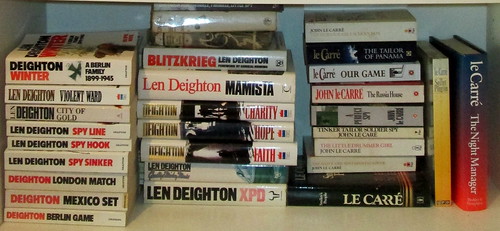
Back in the days of the Cold War spy fiction was a big thing. The two main purveyors of the form – in the UK anyway – were my (sur)namesake Len Deighton (although he pronounces the “Deigh” part to rhyme with “day” rather than “die”) and John le Carré. I also have a le Carré omnibus of his early works shelved elsewhere.

These, too, are housed in the garage, below the last of my SF paperbacks (see last week’s post.)

I have read all the books by Deighton here. His book Fighter is not on these shelves because it’s a history of the Battle of Britain but then Blitzkrieg is also a history book and it is here. Winter is not a spy novel but reflects Deighton’s knowledge of Germany (specifically Berlin) in the first half of the twentieth century. Goodbye Mickey Mouse is a novel featuring members of the US Air Force which took part in the campaign in World War 2 in the lead up to the invasion of Normandy. SS-GB is an altered history set in a Britain where a German invasion of the UK in 1940 succeeded.

I’ve not read all the le Carrés. Spy fiction lost a lot of its resonance when the Cold War ended whereupon he moved on to other things. I always meant to get round to his later stuff but life (and other books) got in the way.

Britain in the the 15th Century

I’ve just been perusing the blurb on the publisher’s page for a book called Divine Heretic written by one Jaime Lee Moyer.

The blurb starts with the sentence, “Everyone knows the story of Joan of Arc, a peasant girl who put Charles VII on the throne and spearheaded France’s victory over Britain before being burned by the English as a heretic and witch.”

Britain? In the 15th century? That’s some Altered History! The United Kingdom didn’t become so until about 300 years later, 1707 in fact.

I wonder who at Jo Fletcher Books (for it was they) thought Britain had an army in the 1400s – or that back then such a country existed that could have one. Or doesn’t know the difference between Britain and its constituent parts. Or mistakenly thought they might offend some not English inhabitant of the present day UK by saying England (in which case they failed miserably.)

(At least they put the blame for Joan’s burning in the right hands.)

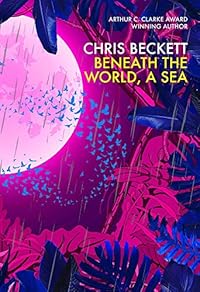
Beneath the World, A Sea by Chris Beckett

Corvus, 2019, 283 p. Published in Interzone 282, Jul-Aug 2019.

 Beneath the World, A Sea cover

“The ground of one world is the sky of the world below” runs one of the myths and legends of the Submundo Delta, the most inaccessible place on Earth, the Delta Beneath the World. A place of magenta trees with spiral leaves and flowers with bright pink mouths, overhung by a huge sun and moon as if inside a magnifying bubble, and not really below the outside world, it can be accessed only from South America via a long boat trip on the (perhaps too obviously named) River Lethe, passing through the Zona de Ovido, the Zone of Forgetfulness, all memories of which disappear the moment you leave it. The Delta has no radio communication with elsewhere, aeroplanes which try to penetrate its airspace all crash.

Such a cut-off world is a staple of fantastical fiction of course – fairyland, hollow hills, parallel worlds, alien planets and so on – but Beckett’s vision is a fresh take on the sub-genre even if the Delta is a slightly recycled though embellished version of the Caramel Forest of the planet Lutania in the same author’s collection The Peacock Cloak.

The Delta’s local human inhabitants are called Mundinos, and are descended from a group tricked into going there by a Baron Valente in the semi-distant past, long enough ago for them to have developed their own gods in the benign Iya, whose idol adorns every Mundino household, and the less indulgent Boca. More recent incomers are scientists and adventurers or hippie types plus the odd business man on the lookout for profitable exploitation.

Following a UN decree that a Delta life-form known as duendes, grey long-limbed, frog-like flaccid creatures with black button eyes, (somewhat reminiscent of the goblins of Lutania’s Caramel Forest) and which may be the offspring of trees – with which they perhaps form a single dimorphic species – are ‘persons’ entitled to the protection of the law, police Inspector Ben Ronson has been delegated from London to investigate their endemic killing by Mundinos. Duendes can project settlers’ thoughts back into human minds, “‘Things already inside your head ….. become as powerful as things you normally choose to focus on,’” and build enigmatic structures called castelos. Despite their persecution the duendes keep intruding on Mundinos’ space.

What makes all this SF rather than fantasy is the attempt at scientific rationale. “‘There’s no DNA equivalent. No ‘animals’ or ‘plants’ in the delta,’” Ronson is told. “It seemed to him that it was just about possible to imagine that a completely different form of life might not only have a different chemistry and different anatomy, but might even involve the mind-stuff itself being configured in some manner unfamiliar to human beings,” while, “‘the trees and the harts and the duendes and so on aren’t competing against each other … any more than our blood cells are competing against our bone cells,’” but quite why the story is set in nineteen ninety is not clear. The Delta is obviously not quite of this world, making the tale an alternative history does not add to that.

Beckett also undercuts expectations. Despite the set-up what we have here is not a police procedural, nor a straightforward crime novel with a clear-cut resolution, nor indeed an action adventure. The author is more interested in the psychological aspects of isolation, the effect a strange environment has on human behaviour and particularly the influence the Zona might have on motivations and actions. Ronson is almost paralysed by the thought of what he might have done during those four days he cannot remember but is reluctant to consult the notebooks he compiled while in transit.

There are faint echoes here of other odd worlds, perhaps even a nod to Conrad’s Heart of Darkness, there is a touch of Ballard in the detachment of many of the characters. We do not have the complete isolation that applied to the inhabitants of Beckett’s Dark Eden, nor the genetic paucity of that environment, and the existence of the duendes adds a distinctive flavour but at the end the nature of the enigma they represent is not unravelled. Perhaps Beckett intends to return to the Delta.

That might be a misstep, though. Beneath the World, A Sea is not really concerned with its backdrop. Instead it uses that backdrop to question how much a person can know of him- or her- self. While not in the highest rank – the characters indulge in too much self-examination for that – like all the best fiction it explores the nature of humanity.

The following did not appear in the published review.

Pedant’s corner:- “whose contents, she learnt, turned yellow and shrank as it dried” (as they dried.) “Their only child, wherever she went inside the house, she was surrounded by” (that second comma distorts the meaning and should be removed,) outside of (outside, just outside, no ‘of’,) “before continuing towards to the west” (either “towards” or “to”, not both,) “a posse of men and woman” (it’s possible only one woman was involved but it reads oddly,) “for hundreds of millions of year” (years,) automatons (automata,) “‘take it out in the duendes’” (on the duendes,) ambiance (ambience,) a tendency to use ‘her’ and ‘him’ where ‘she’ and ‘he’ are more grammatical, “for goodness’ sake” (if the apostrophe is there it ought to be goodness’s, best to leave it out altogether,) “‘she’ll always being able to support herself’” (always be able.) “There were also a number of” (there was a number,) “all the holes on the ground” (in the ground,) “‘a range of tawdry attractions are duly provided for them’” (a range of tawdry attractions is duly provided,) epicentre (centre,) “cheer fully” (was split over two lines without the necessary hyphen when “cheerfully” was meant,) “‘to see if Rico’s turned up If you run into him’” (needs a full stop after “up,”) “three young woman were smoking” (women,) engrained (ingrained.) “He had a mango in there He’d bought at the last village” (No capital H after “there”, ‘he’d bought’.)

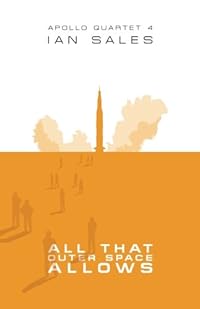
All That Outer Space Allows by Ian Sales

Apollo Quartet 4, Whippleshield Books, 2015, 155 p, including 2 p Notes, 4 p You Have Been Reading About writers and editors, 1 p Further Reading, 2 p Bibliography, and 1 p Online Sources.

 All That Outer Space Allows cover

Like previous books in his Apollo Quartet the author does not take a straightforward approach in this short novel. It is ostensibly the life story of Ginny Eckhardt, wife of Apollo astronaut Walden Eckhardt (a character based on actual Apollo 15 Lunar Module pilot Jim Irwin.) On the quiet, though, Ginny is a writer of Science Fiction, and the book, as well as delineating the lot of an astronaut’s wife in the 1960s, describes the evolution of Ginny’s idea to write an alternative history of the US space programme in which women were the astronauts. She knows they are at least as capable as the men, if not more so. However, her personal life as first an Air Force wife, and then an astronaut’s after Walden is picked in the latest round of recruits, becomes increasingly circumscribed. This is how it was in the 1960s. Ginny’s mother, along with others of her generation, had been quickly levered back into the home after working during the Second World War, and forever resented it. Ginny herself had made sure to obtain a degree before marrying but has no opportunity to use it. (The role of astronaut’s wife is as prop and support, adornment, rather than a person in her own right.) Given her inner thoughts, the solidarity she feels with other female writers of SF in the 1960s and of the position of women generally, Ginny’s attitudes to this might have been expressed more forcefully, she seems too willing to conform to the role set – even if she does resolve to find out as much technical detail of the Apollo Programme as possible in order to enhance her fiction. We are told she loves Walden, but we don’t really feel it, and Walden gives little back in the way of emotional support, not even wondering how the sanctuary of his room manages to stay tidy and clean.

In common with other instalments of the Apollo Quartet Sales gives us (in boxes lined-off on the pages) technical and biographical information. So here we have a table of contents from Galaxy magazine, Vol 26, issue 3, February 1968 (which contained Ginny’s story “The Spaceships Men Don’t See” as by V G Parker;) comments on the position and relative scarcity of female SF writers of the time; biographical details from a NASA press release of the 19 newly recruited astronauts of 1966; a letter to Ginny from another woman SF writer signed YouKay; the utterly male Hugo Awards Winners listings for 1966; a historical overview of Ginny’s writing career; the complete text of “The Spaceships Men Don’t See” (a nice piece of literary ventriloquism by Sales, though it reads more like a 1950s piece;) a specification for Lunar Module Cockpit Simulation training; a letter to the editor of Galaxy bemoaning “Mr” Parker’s contribution to that Feb 1966 issue; another NASA spec, this time for the Lunar Module; one-sentence extracts from SF stories by women each commenting on some aspect of the female experience; a Wikipedia biography of Walden Eckhardt’s life; the Nasa specs for spacesuit materials; a short transcript of Neil Armstrong’s early exchanges with ground control just after he set foot on the Moon’s surface that first time; the launch schedule for Apollo 15 (Walden’s mission;) a NASA description of the Apollo 15 landing site; V G Parker’s entry from the Encyclopedia of Science Fiction.

This is an Altered History, though. In Ginny’s world, SF is written, edited and read mainly by women and denigrated more (if that’s possible) because of that. At several points Sales addresses the reader directly by interpolating comments on his choices as a writer when composing the story and on the subject of Science Fiction as an enterprise, especially on how it generally does not reflect the harsh realities of space travel. Worth reading in and of itself All That Outer Space Allows also acts as a kind of primer in the history of women writers of SF in the world the reader knows.

Pedant’s corner:- “makes turban of a second towel” (makes a turban is more natural sounding,) “and so predates Ginny’s migration” (postdates,) “Only a Mother” (“That Only a Mother”), “There was loud thunk” (a loud thunk,) “The descent stage measure ten feet seven inches high by… ” (‘measures ten feet seven inches high’. This was in the NASA Lunar Module spec so I assume was their mistake,) vapourised (vaporised,) “as she lays on the beach” (as she lies on the beach,) misrembering (misremembering.)

Mexica by Norman Spinrad

Abacus, 2006, 510 p.

Mexica cover

Spinrad is no stranger to readers of Science Fiction, coming to prominence around the time of the New Wave with works such as Bug Jack Barron and The Iron Dream (an Altered History SF novel whose author was supposedly Adolf Hitler.) In the early part of this century, though, he took a turn into historical fiction with The Druid King, about Julius Caesar’s adversary Vercingetorix the Gaul. Mexica is his take on conquistador Hernán Cortés (in the text always referred to as Hernando Cortes) one of History’s supreme adventurers – or villains, depending on your viewpoint.

Our narrator is Cortés’s companion, and unwilling advisor, Avram ibn Ezra (an Arabised form of the Jewish Ben Ezra,) who was baptised Alvaro Escribiente de Granada since being a Jew in the newly united Christian Spain under the scrutiny of the Inquisition was not a healthy prospect. This choice allows the narrative to distance itself both from the brutal Christianity of the Spanish invaders and from the sanguinary religious practices of the indigenous Mexica and their vassals. (Only once or twice is the word Aztec mentioned. This apparently was an insulting term deriving from the bumpkinish highlands down from which the Mexica came to replace their predecessors, the Toltecs, whom the Mexica still revered, after that earlier people had vanished into the east.)

It is arguably a necessary choice, as religion mattered. For how else can a few hundred men bring down a mighty empire? In this telling the Mexica – or at least their emperor Montezuma – were undone by their beliefs. The Toltec god Quetzalcoatl, the feathered serpent, was prophesied to come back from the east with a light skin whereupon the fifth world (that of the Mexica) would end and the sixth begin. On hearing of the arrival of the Spaniards Montezuma awaits a sign from his god of war, Huitzilopochtli, as to their true nature, and receives none. A native woman, Malinal (known to present day Mexicans as Malinche but here dubbed Marina by the Spaniards as it’s easier for them to pronounce,) a princess of one the Mexica’s vassal states, sold into slavery when they were defeated, takes up with Cortés and, aided by Alvaro, becomes his translator. She it is who nudges Cortés (despite his own religious qualms) into affecting the appearance, and, in native eyes, substance, of Quetzalcoatl. The prospect of not having to pay blood tribute to the Mexica in the form of the hearts of their young men also leans on the Mexican vassals whom Cortés enlists as allies, vassals all but mystified at the thought of a god who gives his flesh and blood to be eaten by his worshippers rather than requiring their own of his believers.

It was still a very long shot, emphasised when after a couple of military victories against allies of the Mexica on the journey to the central high plateau, Alvaro briefly views through the clouds the magnificence of the Mexica capital Tenochtitlan, from the mountain pass above. The city was built on a series of lakes and joined to the surrounding land by four causeways. An impregnable fortress it would seem.

Later, after falling in love with the place, Alvaro wonders, “How could the civilization that had built Tenochtitlan rip out human hearts on such a bloody altar?” but also, “How could the civilization of the Prince of Peace who commanded men to love their neighbours as themselves burn human beings at the stake in his name? How could those who worshipped an Allah who was styled the Beneficent and Merciful behead the infidels who would not bow down to him?”

Whle the central figure here is always Cortés, the most sympathetic and tragic is Montezuma, who is entrapped and imprisoned by Cortés and thus in conversations with Alvaro vouchsafes to the reader his philosophy. Here is a man who, in trying to do the best by his gods as he sees them, loses not only his empire, his people and his city, but also his life. That those gods were horrific taskmasters and not worthy of any such soul-searching or devotion does not diminish this. Religious beliefs make people do strange and bewildering things. From his religious perspective Alvaro sees, “This is the crime for which I have no name. Having conquered their lands, now we were conquering their spirit.”

Mostly a self-serving – not to mention greedy – hypocrite and casuist there are contradictions too in Cortés’s behaviour, illustrated when he gives full military honours to the dead Montezuma and Alvaro tells us, “There were so many reasons for me to hate Hernando Cortes…. But … there were moments …., when no matter how I tried, I found it impossible not to love the bastard.”

Before the story gathers momentum with the landing in Central America the reflective nature of Alvaro’s account can be a little tedious. The text is liberally larded with the word ‘thereof’ and vocative asides to “dear reader”, a tendency which drops out when the action sets in only to reappear many pages later. ‘Alvaro’’s intent in setting this down is to expose and expiate his guilt at the part he played in the downfall of the Mexica and the beautiful city they constructed. But in the end he rationalises that, “..it could not have been prevented. Even if Columbus had never set sail it could not have been prevented, for Europe had the ships, and sooner or later someone would have discovered this New World.” The fulfilment of Montezuma’s omen was inevitable. “For this new world held treasure and unbounded virgin land unknown in the tired old one, and Europe had the greed to covet and the means to sieze it.” The greatest devastator of the Mexica though, would be what Alvaro names as the small pox, a weapon more deadly to the natives than either cannon or arquebus. The Mexica live on, however, in the adaptation of their name to that of the modern day country sitting on their lands, a process which had begun even in Cortés’s time.

Alvaro’s profoundest thoughts are however inspired by the much older civilisation that built the huge pyramids at Teotihuacan, whose people were forgotten even by the Mexica. “This was not a New World. This was a world old beyond imagining…. Five worlds come and gone … And now the breaking of the fifth and the coming of the sixth.” He consoles himself with the thought that in the end great events do not matter; civilisations amd conquerors may come and go but, “It is in the small things that life comes closest to eternity.”

Pedant’s corner:- Cortes’ (innumerable instances, Cortes’s,) sprung (sprang,) “to the point where no one dare approach him” (the narrative is in past tense so, ‘no one dared’ – and ‘no one’ ought to be ‘no-one’,) maws (mouths was the intended meaning, not stomachs,) imposter (I prefer impostor,) “but more than not wearing only simple cotton shifts” (more often than not is a more usual construction,) “in a foreign land as Britain might be to a Spaniard” (there was no Britain as a foreign ‘land’ (in a political sense) in the time of Cortes – only the geographical island.)

Night Birds on Nantucket by Joan Aiken

Puffin, 1969, 172 p.

Night Birds on Nantucket cover

At the start of this follow-up to Black Hearts in Battersea, itself a sequel of sorts to The Wolves of Willoughby Chase, Dido Twite has been comatose for four months, fed by one of the crew on the whaling ship Sarah Casket, which rescued her from drowning.

On her awakening she is asked by Captain Casket to befriend his now motherless daughter Dutiful Penitence (Pen) who is too scared to come on deck and hides away in her cabin. Dido soon finds another member of the crew, Mr Slighcarp (a surname readers of the series know well,) acting suspiciously and keeping secret the presence on ship of a mystery woman.

After following a pink whale (the captain’s obsession) from the Arctic down past the Galapagos and round into the Atlantic, Dido and Pen, now firm friends, are dropped off at the ship’s home port in Nantucket, where it has been arranged for the captain’s sister Tribulation to look after Pen for a while. Readers familiar with the series know where this domestic situation is going by now but perhaps its target younger audience might not. Excitement ensues though, when our two young friends come across a Hanoverian plot to kill King James III.

This is wholesome fare, as befits its intended YA audience but also eminently readable for older booklovers. Dido and Pen are agreeably portrayed – though some of the adults’ characterisations are a little over the top.

The book is decorated at intervals with illustrations (one of which is unfortunately placed one page too early.)

Pedant’s corner:- “The whole crew were trying to…” (the whole crew was trying to,) imposter (I much prefer impostor,) sculduggery (I know Dido does not speak in received pronunciation but the spelling of words she does speak ‘normally’ should not be altered; skulduggery,) trapesing (traipsing,) “‘when you Papa’s at sea’” (your Papa’s.) In the ‘About the author’; “the Amercian writer” (American.)

The Violent Century by Lavie Tidhar

Hodder, 2014, 347 p.

 The Violent Century cover

This is at once an unusual but also common tale, innovative in style but not so much in plot. (Then again, there are only supposed to be seven of those.) The narrative is conducted in large part via short, verbless sentences, sometimes only one or two words long, at times almost reading like a description of a film playing out before the reader’s eyes, telling us what we would be seeing on the screen. Now and then an authorial voice slides in, adopting the first person plural, as if the reader is a cinema audience relating the story to itself. The narrative jumps backwards and forwards in time from 1926 to the present day, allowing Tidhar’s characters to be active at various points in the unfolding of the violent mid- to late twentieth century, even the early twenty-first. Scene changes are akin to cinematic dissolves, though each is “captioned” with its time and place in its chapter heading. Throughout, direct speech is not set within quotation marks – which does lead to the occasional phrase requiring a reread.

The plot begins (and periodically unwinds) like an echo of le Carré’s Tinker, Tailor, Soldier, Spy, Henry Fogg called in by his old oppo, Oblivion, to meet the Old Man, boss at his former employer, The Bureau for Superannuated Affairs, to be questioned about his past evasions.

The background is that sometime in 1932 Dr Joachim Vomacht pushed the button on his machine and unleashed a quantum wave. As a Dr Turing (Alan, we assume) tells the British altered, recruited to a training area in Devon, “To observe an event is to change it. On the quantum level. When Vomacht pressed the button, everything changed. The Vomacht wave was a probability wave. The wave made genetic changes at a subatomic level… For most the change was undetectable ….. But perhaps a few hundred became … you.” The changed, dubbed Übermenschen, have superpowers and are named appropriately. Fogg conjures fog out of the air or any smoke available, Oblivion destroys things, Spit conjures up and projects bullets from her mouth, Mr Blur … blurs, Tank is built like one, Mrs Tinkle can make time retrace itself. Corresponding Übermenschen exist in other countries. The US has Tigerman, the Green Gunman and Whirlwind; the Soviets, the Red Sickle and Rusalka; Germany, Schneesturm and Der Wolfsmann.

The crux of the plot is Sommertag, Vomacht’s daughter Klara, who can pass through doors into a perfect summer’s day, an attribute Fogg finds irresistible despite her being an enemy citizen when they meet. His defence is that, “‘It,’” (the Vomacht wave,) “‘fused into her somehow. It kept her pure.’”

Tidhar appears to have gone to great lengths to make sure that history in this story is unchanged from what the reader knows happened – apart from the appearance of rocket men on the Russian Front (unless this is a WW2 manifestation of which I had not previously heard, a singular unlikelihood) and the Potsdam Conference being held one year later than it was, still with Churchill attending rather than Attlee as it would have been in 1946 (and as it was for the latter part in 1945) – the rise of the Nazis, World War 2, the Cold War, Vietnam, September 11th all take place here as they did in our time. It is as if the comic books were true and those superheroes were present to take part in events but without affecting anything substantial, participants but not decisive.

One scene in Afghanistan involves Sheik Osama bin Mohammed bin Awad bin Laden calling the changed ‘abominations’ while the Americans (who regard him as, “The rich spoiled son of a rich and powerful family…. Playing soldiers in the desert,”) are trying to use him against the Soviets – and thereby sow the seeds for the Twin Towers whirlwind. Of that 11th September our (plural) narrator tells us, “That day we look up to the sky and see the death of heroes.”

A Russian says, “We should have learned from your history. The British. Three wars and you lost every one. You can’t win a war here. You couldn’t, we can’t, and whoever comes after us is going to lose too. This land hates invaders,” and warns, “This bin Laden. This Saudi. Kill him now. Kill him when you have the chance, or he will turn on you.” Easy to say in a book published over ten years after an event but many did give out warnings at the time.

The Violent Century is admirably plotted and well paced, with an atmosphere of menace throughout, I’m puzzled as to why this wasn’t on any award shortlist for its year.

Pedant’s corner:- Antennas (antennae.) “Facing the bar counter are a row of barstools.” (Facing the bar counter is a row of barstools,) barkeep (not a British usage. We say ‘barman’ or maybe ‘landlord’,) “air separating into nitrogen and hydrogen” (that’s a neat trick, there’s very little hydrogen in air, only what is the relatively low proportion of air comprised of water vapour.) “None of us choose what we become” (None of us chooses,) King George IV (George VI, as he was correctly designated later,) “the moans reach a crescendo” (a climax perhaps; a crescendo is a build-up, not a culmination,) eldrich (eldritch,.) “None of them have been properly introduced yet” (None of them has been properly introduced.) “None of them are.” (None of them is,) Roberts’ (Roberts’s,) “none come” (none comes,) “do this hundreds of time” (of times.) “Millions more watched the ceremony around the world in a special broadcast by the BBC.” (Millions around the world watched the Coronation ? In 1953? Before communication satellites? I don’t think so.) “The only thing in motion are his eyes” (‘thing’ is singular so cannot have a plural verb form; ‘the only things in motion are his eyes,) Johnny Rivers’ (Rivers’s,) a missing question mark after “What do I know”, another question mark ought to replace a comma later on, “we’re not in the army here, Bob, Bob says, Yeah, yeah,” (a full stop instead of a comma after the first ‘Bob’) “Incoming!” (British troops do not shout this. They yell, ‘Take cover!) “Goddamned” (nor do British folk say this.)

free hit counter script