Archives » Altered History

Paris Adrift by E J Swift

Solaris, 2018, 379 p. Reviewed for Interzone 274, Mar-Apr 2018.

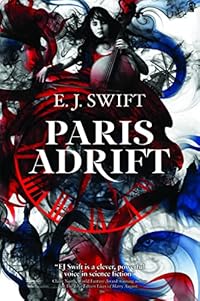
Paris Adrift cover

Time travel is one of Science Fiction’s most venerable tropes but in more recent times has taken something of a back seat to other aspects of the genre. In Paris Adrift, E J Swift has adopted an oblique approach to the topic, gaily skipping over any problems with the ethics of non-intervention and avoidance of the grandfather paradox. She does not make anything of, still less explain, the mechanics of the process (which arguably puts us in fantasy territory,) it is simply an integral part of the story she has to tell.

Hallie, an English geology student estranged from her family, is on a gap year in Paris trying to sort her life out. She takes a waiting job at Millie’s, a bar near the Moulin Rouge. Millie’s is a nexus for the strange. Fellow employee Gabriela finds she is always somehow prevented from leaving Paris while Hallie has odd encounters with birds that talk to her, an apparent doppelganger, and customers, while also experiencing odd sensations both in the keg room and in Paris’s catacombs. She still finds space for a relationship with fellow waiter Léon, and Swift charts superbly the overwhelming intensity of a burgeoning love affair.

The narration is almost exclusively from Hallie’s viewpoint, in that pressing present tense which can seem like a default in so much modern SF. Occasional mentions of geological terms underline Hallie’s background.

The incursions of the weird might perhaps have been more unexpected had we not already read a prologue chapter introducing us to the chronometrist, a person seemingly able to take control of other’s bodies at will but whose essence is fading, and to the concept of anomalies and their incumbents. Hallie soon finds out the keg room is a time portal and her future has been mapped out by the Way of Janus.

Her first experience of timefaring takes her to 1875 where she seems to adapt to her new situation remarkably quickly and is befriended by the Millie who will one day found the bar. She also meets the architect designing the Sacré-Coeur. Partly due to Hallie’s interference that building will no longer be erected. In its stead will arise the Moulin Vert which becomes a significant location in the rest of the book (plus inspiration for a political movement) and technically makes the novel an alternative history. However, other aspects of our modern world and its history are unaffected, there are mentions of Whatsapp, plus the Bataclan, Stade de France and Nice attacks.

The anomaly’s next flare sends Hallie to 1942 and a suitably claustrophobic encounter with would-be cellist Rachel Clouarte. Hallie dodges German soldiers and the curfew to reunite Cluarte with her cello and aid her escape in order to ensure her career in music will prevail, so that she will not marry and produce (eventually) the descendant who will contribute to a catastrophic war in the future. This 1942 Paris is lightly affected by the occupation, street life continuing gaily as normal, though of course the deportations from which Clouarte is to be saved proceed apace. I did wonder why Hallie’s intervention in the Clouarte family tree had to be quite so early but of course it does give Swift the opportunity to depict Paris in wartime and up the danger quotient.

Another flare takes Hallie to 2042 and a terribly plausible fascist Paris (complete with Metro station called LePen) and the seeds of the situation which the Way of Janus seeks to avert. Other timefaring trips are mentioned but not gone into in detail.

The 1942 and 2042 excursions lend the novel aspects of a thriller yet there are other scenes which bring to mind Angela Carter’s Nights at the Circus and the work of Tim Powers. Throughout, Swift’s portrayal of her characters is assured. These are people we can believe in even if one of them is prey to the logical fallacy that because the Earth is remarkably suited to humans it is a sign of something miraculous rather than the unfolding of impersonal forces which merely allowed us to arise.

Paris Adrift deals with the heavy theme of totalitarianism and the threat of the far right but never loses sight of the smaller people who live through interesting times. While Léon and Hallie are pivotal to the resolution of the plot (and History itself) its emotional focus, though sometimes sidelined, is on their relationship.

Like a lot of SF this suggests life is hard and pain impossible to avoid but unlike most recent SF it proffers hope along with the sacrifice. Never mind it being good SF/Fantasy, this is a good novel.

The following did not appear in the published review.
Pedant’s corner:- “the night team begin to trickle in” (the night team begins to trickle in,) “the group want shots” (wants,) “a stream of people flow inside,” (a stream flows,) “the confines of the locker room lends an air” (the confines lend an air,) “a travelling company were performing” (a company was performing,) “the shape of the walls change, become smooth and rounded” (the shape changes, becomes smooth,) “Her age and appearance has altered once again” (have altered,) “the floor team are doing the rounds” (the team is doing the rounds.) “None of these people have an anomaly. None are bound to this place” (none has, none is.) “Only a small proportion of the catacombs are maintained for visitors.” (Only a small proportion is maintained,) “as the assault team go through their final checks” (as the team goes through its final checks.) Yet despite all these examples of such failures of agreement of subject and verb Swift obviously knows what’s what as we had the correct “a rickety set of steps leads up to”,) “till I am stood right next to him” (it wasn’t a passive activity, so standing”,) “sat on the gravestones” (sitting,) gotten (in a narrative otherwise so British in tone this USianism jars,) “since she bid me farewell” (bade me farewell,) “preempting the touch that will follow” (the context implied savouring rather than pre-empting,) Dušanka calls Hallie “‘my petit chou.’” She responds, “‘And I’m not a pastry.’” (That response would be to “my petit choux” – chou is a cabbage and “petit chou” a term of endearment. Hallie’s French isn’t supposed to be good but surely she would not confuse the two?) “is sat” (is sitting,) “another woman is stood at the window” (is standing,) dove (USian; the British past tense of dive is dived,) “sat sipping” (sitting sipping,) “glasses pile up on either side” (context implies both sides,) inside of (USian, it’s just inside, no “of”,) descendent (descendant,) focusses (focuses,) syllabi (I prefer syllabuses, though I concede syllabi is a correct Latin plural,) “you’ll be never be happy” (that first “be” is redundant, “‘How can I do that.’” (That is a question so requires a question mark, not a full stop.)

The Smoke by Simon Ings

Gollancz, 2018, 300 p

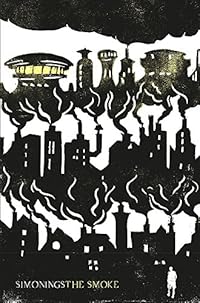
 The Smoke cover

We start on a space vehicle on which the brother of protagonist Stuart Lanyon is about to take off from Woomera – powered by successive explosions of atom bombs underneath it blasting it into space. This is something of a distraction however, though a signifier of an altered history where Yellowstone erupted in 1874, immolating North America, and a Great War was ended in 1916 after the atomic bombing of Berlin.

The main meat of the story is the ramifications of the discovery of the Gurwitsch ray – biophotonic weak ultraviolet pulses passing from cell to cell in living things, each creature with its own characteristic emissions, orchestrating development, leading to the ability of humanity to sculpt organic forms at will. Hence we are in the age of speciation of mankind. The dead of the Great War battlefields were subjected to Gurwitsch’s ray, producing strange organisms known as chickies which are able to exert sexual allure among other abilities, a technocratic intellectually superior elite called the Bund has arisen in Eastern Europe and dominates world affairs.

The weird aspects of all this are underlined by Ings’s story-telling, part of the novel being narrated in the second person, though the down to Earth sections are more traditional first person and some interludes are in third. Though the background details seem to sit oddly with one another – a thoroughly industrial Yorkshire can feel more like the 1930s, a television series more signifies the early 1960s, parts of London are dominated by ultra-modern architecture – Ings manages to hold them together. The setting is occasionally reminiscent of Andrew Crumey’s Sputnik Caledonia with the merest hint of Ballard thrown in for extra alienation.

At the novel’s heart is the love story between Stuart and Bund citizen Fel, aka Felicine Chernoy, daughter of Georgy, inventor of the Chernoy Process which utilises Gurwitsch’s ray to enable rebirth. Stuart’s mother, dying of cancer, undergoes this treatment and is reconstituted as an infant. A curious phenomenon to behold, this, a child with an adult’s memories, behaving in unchild-like ways – and subject to unthinking prejudice. Stuart and Fel’s different backgrounds lend their affair the attributes of all star-crossed lover stories.

The characters are well drawn but despite their supposedly greater intellects the two members of the Bund shown here – Fel and her father – do not seem significantly different from humans as we know them. Stuart does though in his narration refer to his father as Bob and mother as Betty, which is a touch unusual.

Ings’s vision here is a particular one, at once curiously fantastic and yet also recognisable, a flight of fancy (several flights if you like) but utterly grounded.in human emotions. The Smoke goes to show that Science Fiction continues to produce work of which those detractors who dismiss it without ever sampling it assume it to be incapable.

Pedant’s corner:- “the Bund” is treated as plural throughout, but ought to be singular, “And since no one wants to meet each other’s eye, it makes logical sense that the entire audience repair en masse to the bar” (others’ I think, plus make that no-one, and, the entire audience repairs,) Lutyens’ (Lutyens’s,) potshard (potsherd, please,) Picasso is referred to as a Parisian artist (he was Spanish, but this is an altered history,) “the family were meant to cheer Jim off to Woomera” (the family was meant to,) “it would be the most natural thing in the world for me to stove this thing’s head in” (the verb is to stave in, stove is the past tense form.) “The odds against there being no set now increases” (the odds …. increase.) “‘According your friend’” (According to your friend,) “till it run out of” (runs out,) a parenthetical sentence not started with a capital letter as it ought to have been, “for goodness’ sake” (this ought to be written “goodness’s” even if it’s pronounced “goodness”.)

Buying Time by E M Brown

Solaris, 2018, 357 p.

 Buying Time cover

The designation of the author as E M Brown is a slight repositioning by the publisher of my old mate Eric Brown to highlight works of his that are more character based. (It’s a bit late and a bit odd. He has always produced these to go alongside his action adventure novels but even in those he did not neglect character.)

In 2017 Ed Richie, prodigious boozer, script-writer for Coromandel Cable’s Morgan’s Café and also with a few radio plays to his name, is a serial monogamist with a penchant for women of a certain type. His latest relationship with a woman called Anna blows up in his face after he has had some sort of medical emergency experiencing a blinding white light. The break-up is part of a pattern repeated throughout his life. He has a long standing, equally boozy, friend Digby Lincoln, a jobbing script-writer on the TV serial Henderson’s Farm, with whom he discusses his situation.

We then jump to 2030, where in an independent Scotland Ella Croft works as a journalist for ScotFreeMedia. England and the US are in the grip of right-wing authoritarian regimes and Scotland is accepting LGBT refugees from a US where gay marriage is banned and same sex relationships suspect. It seems Richie disappeared some time in 2025 after switching successfully to a career as a novelist. Croft, who knew Richie in her childhood, sets out to find out what happened to him.

When we return to Richie he has had another white light episode and discovers himself in April 2016, much to his confusion and others’ bafflement.

The Richie and Shaw strands alternate throughout the book, interspersed with interpolations from various journal extracts, some Richie’s own, others newspaper or media outlet pieces. Richie is tumbling backwards through time, from 2017 to 2016, then 2013, 2008, 2002, 1995, 1988, and finally 1983. At first Richie wonders if these are hypnagogic hallucinations but Brown later provides, via the 2030 Croft sections, a science-fictional explanation.

Brown draws some amusement from Richie’s knowledge of the future. To the revelation that Trump will be elected President of the US Digby responds, “What? The multiple-bankrupt TV celebrity shyster? Come on, even the Americans can’t be that stupid!” and when told Leicester will win the league in 2016 comments, “Now I know you’re crazy.”

A Trove of Stars, Digby’s SF piece, had caused a rift between them for a while as Richie told him he, “took needless time out to tell the reader about the characters’ states of mind.” Digby objects, “‘What I’m trying to do here is bring the concerns of the modern psychological novel to the hidebound format of hard SF.’ Richie had restrained himself from accusing his friend of talking pretentious bollocks.” In a later time-shift the book’s success signals we’re in a different timeline. All Richie’s touches down in the past must be in altered histories or else there would be time paradoxes.

Ed suffers further confusion when Finnish artist Emmi Takala, whom he met on a trip to Crete, seems to know about his condition but he time–jumps again before she can elucidate. Ella finds out Emmi also disappeared in the late 2020s when she went to England to meet a man called Ed. There is a connection too to scientist Ralph Dennison – mates at University with and Ed and Digby – an investigator into the theory behind faster-than-light travel but who, too, vanished in 2010. The scientists’ backer, tycoon Duncan Mackendrick, finally provides Ella (and us) with the puzzle’s solution.

Brown’s characterisation is excellent throughout. The Richie sections do not read like SF which is fine – good even – the Shaw ones do when necessary. Whether Buying Time brings “the concerns of the modern psychological novel to the hidebound format of hard SF” or is “pretentious bollocks” is for each reader to decide. I thought it was very well done indeed.

Pedant’s corner:- imposter (I prefer impostor.) “How many woman have you lived with over the years?” (women) “that all was not as it should be” (that not all was as it should be,) Diggers’ (Diggers’s – several other instances,) “her portrayal a grieving mother” (portrayal of a grieving mother,) Man U (earlier it had been Man U.,) humous (humous means ‘like a component of soil’, the food is houmous or hummus,) “He could curb the TV work, continued writing radio plays, and, to flex his creative muscles and ambition, tried his hand at stage plays.” (continue writing….try his hand,) recent British politics (given it’s 2030 here would that not be English politics?) Waterstones’ crowd (earlier, Waterstones staff and Waterstones crowd had had no apostrophe,) a double full stop at the end of a sentence (facing each other..) “‘You can bring yourself to love anyone’” (You can’t bring yourself to,) (and again later) -Tennant’s lager (Tennent’s,) “Pam took herself off the bed” (off to bed,) flag-stoned (flagstoned,) “she later said that that was what she initially liked about him was his ability” (she later said that what she initially liked about him was his ability.)

My Real Children by Jo Walton

Corsair, 2014, 318 p.

My Real Children cover

Multiple lives have been having a bit of a vogue recently what with the likes of Life after Life and The First Fifteen Lives of Harry August. The trend may be waning now but this is one to add to the list – though its premise is more akin to that of the film Sliding Doors in that its protagonist, known variously as Patricia, Patsy, Patty, Pat, Tricia, Trish, has two lives here, the hinge being when she accepts or rejects her fiancé’s demand to marry her on the instant when he garners only a third class degree instead of the first they had both been expecting. The first chapter sees Patricia in a nursing home at the end of her life, remembering her past and confused as to whether she had four or three children. Up to the fifth chapter we follow the course of her early life until the (in)decisive moment. The two strands of her life alternate chapters with each other thereafter.

Both are altered histories. Depending on the strand, there are relatively small nuclear exchanges between the US and USSR over Cuba, others later in the Middle East and elsewhere, Bobby Kennedy becoming President in 1964, the UK joining the Coal and Steel Community at its inception in the 1950s, a rise in authoritarianism in Pat’s later life. Unfortunately all of this requires too much telling and not enough showing and this applies to the main thrust of the stories as well as the historical background.

It’s all shot through with how hard life is for women and the unfairnesses of discrimination against minorities, particularly same sex couples. Worthy, but done heavy-handedly.

I know we’re implicitly invited to do so ourselves but it is only in the final chapter, when Patricia’s lives seem to have re-coalesced, that Walton begins to make wider contrasts and connections by which time it is really too late.

Pedant’s corner:- Despite being a British edition this uses the USian text and spellings. Otherwise; post office (Post Office,) Finefare supermarket (it was Fine Fare,) “wracked with guilt” (racked.) “‘They will, however, will serve adequately’” (has one ‘will’ too many.) “The government were funding” (the government was funding,) grifters (is a USian term. A Brit wouldn’t use that but ‘conmen’ instead.) “Could she made it again, knowingly?” (Could she make it again.)

Black Hearts in Battersea by Joan Aiken

Illustrated by Pat Marriott.

Vintage, 2012, 290 p.

 Black Hearts in Battersea cover

This is a sequel of sorts to The Wolves of Willoughby Chase. However it does not follow the fortunes of the two main characters from that book but rather those of their friend Simon. He has received a message from Dr Field containing an invitation to take up a place at a school of drawing in London and to lodge in the same house as himself. However, when Simon reaches Rose Alley no-one admits to knowing the Doctor. He was first met there by Dido Twite, a perky child, though neglected by her parents. It soon becomes apparent that underhand activities are taking place in the house. Mr Twite sings Hanoverian songs (in this setting the Stuarts were never displaced from the British throne that second time) and Simon inadvertently stumbles on a stash of guns in the basement.

In the meantime Simon has enrolled in the Art School and encountered Justin, the heir to the Dukedom of Battersea, and a very poor artist, despite artistic ability running in the family. Also in Simon’s orbit is Sophie, his friend from the orphanage back home, who is now the Duchess’s lady’s maid. The Duke is an eccentric who befriends Simon through the medium of chess and asks him to clean one of his paintings. This, it turns out, has a representation of a Battersea ancestor to whom both Sophie and Simon bear a strong resemblance. It is immediately obvious where this is going and Aiken does not disappoint. In its working out, as befits a YA novel, we have breathless incident galore – a fire in a box at the opera, a sinking barge, shanghaiing, hot–air balloons, possibly poisoned mince pies, a gunpowder plot – before the villains are unmasked and the world brought to rights. (Well, most of it.) The characters are necessarily broad-brush but recognisable human types nevertheless. Yet quite why a putative James III (even if he would have been the eighth King of Scotland of that name) would be described as a Scottish gentleman, have a Scottish accent and speech patterns is beyond me. He would have been brought up as an English gentleman.

The book is slightly marred by its illustrations being misplaced so that they often occur just before the incident which they depict but it is all good fun.

Pedant’s corner:- “to show this good intentions” (his,) hoboy (hautboy. I suppose the spelling “hoboy” may have been adopted to avoid flummoxing Aiken’s younger readers but it is still wrong,) a missing full stop, topsy-turvey (topsy-turvy,) “the whole party were in charity with one another (the whole party was,) knit (knitted.)

Philip Roth

I heard on the radio news this morning that Philip Roth has died.

I must confess I have not read much of his work, apart from the (ahem) seminal Portnoy’s Complaint – which I was moved to sample partly because of the attention it received – and My Life as a Man which covered much the same ground. Anything you ever wanted know about living as a young(ish) male Jew in the USA was here.

I do remember being intrigued by a long ago television programme about him which featured, as I recall, his creation Nathan Zuckerman fantasising about Anne Frank surviving the Holocaust and making a new anonymous life for herself in (I think) the US, which may have been another spur to reading him.

I can’t say I much took to what seemed from the evidence of those two books to be his perennial subject matter but he was obviously an important US novelist of the second half of the twentieth century whether I favoured his work or not and his ability as a writer shone through in any case.

Much later I read his Altered History novel The Plot Against America which I reviewed on this blog here. The impulse behind his decision to write it was admirable – and arguably necessary – but I felt that overall it was an opportunity missed, that the punches the book threw were somewhat pulled.

Sadly that impulse might be even more necessary in today’s political climate than it was when he published it thirteen years ago.

Philip Milton Roth: 19/3/1933 – 22/5/2018. So it goes.

The Wolves of Willoughby Chase by Joan Aiken

Illustrated by Pat Marriott. Vintage, 2012, 227 p.

The book is an altered history set in an early Nineteenth Century England. There is a Channel Tunnel mentioned in a prefatory Note and wolves roam the countryside. Apart from two instances (where they variously attack a stationary train and chase the main characters) plus the odd howl from far off the wolves are mainly an off-stage menace though. It is clearly aimed at a YA – or even younger – audience.
Bonnie Green is the daughter of the grand house Willoughby Chase. Her cousin Sylvia is coming to visit as her carer, Aunt Jane, is getting on. Bonnie’s mother is ailing and requires a trip to help cure her, naturally accompanied by her husband. The first requirement of a children’s adventure, the absence of parents, is hereby secured. The governess hired to look after them, Miss Slighcarp, a supposed distant relative, is the usual wicked creature, not content with mistreating the pair but also intent on defrauding Bonnie of her inheritance with the assistance of the forger Mr Grimshaw. Much Dickensian harsh schooling ensues but the plucky pair escape with the help of Simon, a local boy who lives in the woods. They make their way to London to enlist the services of Mr Gripe, the estate’s lawyer.

It all rattles along (as YA novels have to) but this leaves little time for anything but sketching each character. Best read as a young person I would think.

Pedant’s corner:- a missing comma before a piece of direct speech, backboards (context demands “blackboards”.)

Latest Review

You may have noticed in my side-bar that I am now reading Fifty-One by Chris Barnham.

 Fifty-One cover

I bumped into the author at Follycon and vaguely remembered his book was on a list for review from Interzone a few months back.

Not knowing whether it had been sent to anyone else I blagged a review copy anyway with the promise of trying to get it into Interzone or else posting about it here.

IZ hadn’t sent it out so I’ve got the gig. The review might even be in the next issue (275) along with Andrew Crumey’s The Great Chain of Unbeing.

It’s a time travel story.

The cover (okay it has a doodlebug, but….) totally misrepresents the contents by the way.

The Massacre of Mankind by Stephen Baxter

A sequel to The War of the Worlds.

Gollancz, 2017, 464 p.

 The Massacre of Mankind cover

This sequel to H G Wells’s War of the Worlds is authorised by the H G Wells estate and in it, of course, the Martians return to Earth. Since in our timeline they did not ever come in the first place that makes this book an altered history. To make it correspond with the original Baxter has to employ early twentieth century cosmology and speculation as part of his story, in particular the supposedly superpowerful civilisation inhabiting Jupiter’s cloud banks.

Our narrator is Julie Elphinstone, sister-in-law of the narrator of the earlier book. Elphinstone is a journalist (divorced from her husband) and at the start of the novel is working in New York. Britain is under an authoritarian regime, astronomy is banned to the general public – apparently worldwide – but of course everyone expects the Martians to invade again at the next opposition. Elphinstone is invited back to England to hear from her brother-in-law of their imminent arrival.

This time they come in greater force, have adapted their tactics and gained immunity from the microbes that did for them before. Britain’s armed forces, though better prepared, still fight the last war and the Martians swiftly gain a foothold and press their advantage. Two years later landings take place all around the world, allowing Baxter to set more scenes in the US, but much of the book is taken up with how people in England adjust to life under the gaze of the Martians and efforts to strike back against them. Elphinstone becomes an unwitting agent of the government in its attempts to defeat the Martians in the same old way but is instrumental in invoking the power of the Jovians to rebuff the Martians – or at least to make them retreat to the Arctic.

All the familiar Wellsian touches recur, the heat-ray, the red weed, the Martians’ desire for the blood of their conquered foes. (I know this adds to the horror – and Baxter adds in some gruesome scenes to illustrate it – but it is extremely unlikely that human blood rather than flesh could be a prime food source. I find excessive harping on the efficacy of blood in magic rituals and the like, as here, risible.) Baxter makes more of the Cythrereans the Martians have brought from Venus than I remember Wells doing. A strange inconsistency was that despite the Martians targeting motorised transport it is still used later under their eyes.

Baxter’s use of a female narrator is, of course, a reflection of our times rather than Wells’s. In this regard the inclusion of the strongish female character Verity Bliss (who might once have been introduced solely as a love interest for Elphinstone’s former husband Frank Jenkins but actually has much more agency than that) is another nod to the twenty-first century. Baxter also references things about which Wells would have been ignorant, like the Schlieffen War – in the book still raging between the Empires of Germany and Russia – Craiglockhart Hospital, Porton Down, Stapledon, and Ataturk as an Ottoman representative. He has a certain RFC Lieutenant, William Leefe Robinson kill a Martian in an air attack on one of their machines and mentions Wells as the Year Million Man.

But I’m struggling to see the point. Did we need a sequel to War of the Worlds? Does it really tell us anything about ourselves now? Or is it about present day fears? As an illustration of the ills that plague us in Britain – and the Western world in general – I would have thought a story about unfeeling monied zombies bleeding us dry would be much more apposite.

I don’t blame Baxter for taking the project on; it’s an open goal after all and he does accomplish it rather well. And I suppose it’s entertaining enough.

Pedant’s corner:- I read an ARC (proof) so some of these may have been corrected in the final publication. Practise (as a noun, so practice,) “‘I am aware have called some of you’” (I am aware I have called some of you.) “Even the privileged few like myself who had advance warning of the new invasion, this coldly stated news, the reality officially confirmed, came as a dreadful shock.” (Even to the privileged few,) “meant for a comparative trickle commuting clerks,” (of commuting clerks.) “Frank already had an intuition that the percentage of survivors would be small, that the wounded they encountered from the periphery of the infall,” (that the wounded they encountered came from the periphery of the infall,) “Frank said as determinedly as we could” (as he could.) “‘But he’s had no time for his precious fishing that since he was called up for the reserves’” (no “that” required,) “as he was.,” (has an extraneous comma,) “my sister-in-had” (my sister-in-law had,) “the thousand-strong crew .” (should have no space between crew and the full stop,) scuttlebutt (a USian term, so an unlikely usage on a British warship in the 1920s,) Jenkins’ (Jenkins’s, which appears four lines later!) “the contents of the their kit-bags” (of their kit-bags,) “mirroring my own side by riddled with detail,” (mirroring my own side in being riddled with detail,) Ted Land (elsewhere always Ted Lane,) “‘That looks it came off a sewer.’” (That looks as if – or, That looks like – it came off a sewer’) “the next I remember I was lying in on green grass” (no “in”,) “sat on a low twig” (seated or sitting, but since it was a yellowhammer perhaps perched,) “‘I can always use an enthusiastic NCO’” (the British usage is “I could always do with an enthusiastic NCO”,) “supplies of antibiotics” (in the 1920s?) fit (fitted,) “we newcomers were been invited” (were invited; or, had been invited,) priel (prial,) an extraneous open quote mark, Chapter 23’s number and title were not in the larger font size of all the others, ”he based had his calculations” (he had based his calculations.) “Even now it’s hard to recall now” (has an extraneous now,) “”adjusting their positions, And Cherie saw them” (a full stop after positions or no capital A at and,) “from the gitgo” (isn’t it getgo?) “where the fires where” (where the fires were,) “had so nearly had befallen” (has one had too many.) “Straight after the Second War he plunged straight into the Basra conferences” (two straights in eight words.) “‘And he’s as careless of his health as ever he is,’” (as ever he was,) the earth (the Earth, many instances.)

The Underground Railroad by Colson Whitehead

Fleet, 2016, 373 p (plus an additional 16 pages extract of Colson’s first novel, none of which I read.)

 The Underground Railroad cover

Even if this was the winner of the Pulitzer Prize for Fiction for 2017 I might not have got round to it for some while had it not also won this year’s Clarke Award (- not to mention the shadow Clarke Award.).

The main viewpoint character, Cora, is a slave on a cotton plantation in Georgia, whose grandmother bequeathed (informally of course) to her descendants a small patch of ground in the slave quarters on which she grew scrubby vegetables. Cora’s mother ran away when she was small – the only runaway from the plantation not to be recaptured – and Cora tries to defend the patch as best she can, before she is pushed out to the Hob (a kind of depository for the less fortunate slaves.) This demonstration of the hierarchy that existed within the slave community is one of the features of Whitehead’s book. While Cora lives on the relatively benign half of the plantation this benignity is still only relative. Whitehead does not go overboard on the indignities and horrors but nevertheless portrays slave life in all its wretchedness, yet he doesn’t skirt over the harshnesses they endure nor can themselves inflict. Cora is female: no more need be said. Things change when the Randall brother in charge of her half of the estate dies and the whole plantation becomes subject to the whims of Terrance Randall. When she steps in to absorb his blows on a slave boy he becomes her implacable enemy and so she accepts the offer of male slave Caesar, who has been in contact with the Underground Railroad, to escape with him. They do not make it to the Station without mishap and in a confrontation with a group of whites Cora, in order to evade capture has to kill one of them by striking his head with a stone. This makes her even more of a target for tracking down.

At the Station they descend below the cellar and come to a tunnel along the floor of which run two parallel steel lines. Thus is the metaphor of the organisation which helped runaway slaves, and gave Whitehead his title, made literal. This literalisation is the sort of thing Science Fiction does and I suppose is what allows the book to be classified as such (or, indeed, an Altered History) and thus eligible for the Clarke. In other respects though the story the book tells does not rely on this speculative element – could have been written without this device – and so would lie outside the boundaries of the genre. The book might not have received as much attention without this presence of steel and steam, though.

The main sections are titled for the various States in which Cora finds herself, Georgia, South Carolina, North Carolina, Tennessee, Indiana, and “The North” while shorter chapters relate aspects of the lives of Cora’s grandmother Ajarry, captured and enslaved in Africa; slave-catcher Ridgeway; an anatomist and “resurrectionist” called Stevens; Ethel, the wife of one of the Railroad’s agents; Cora’s escape companion Caesar; and the ironical fate of Cora’s mother.

Cora ponders the US Declaration of Independence’s “self-evident truth” that, “All men are created equal,” with the thought “unless we decide you are not a man.”

Set in the time and place it is there are of course frequent uses of the “n” word, which therefore appears in full in some later quotes here.

It is not just slave-catchers – and Ridgeway in particular – that Cora has to be wary of. In South Carolina she and Caesar find the authorities are collecting data about and performing medical procedures on the “coloured” – controlled sterilisation, research into communicable diseases by pretending to give treatment but really allowing the disease to run rampant, perfection of new surgical techniques on the socially unfit – to protect “our women and daughters from their (the coloureds’) violent jungle urges” which was understood “to be a particular fear of southern white men.”

Whitehead tells us, “The ruthless engine of cotton required its fuel of African bodies. More slaves led to more cotton.” But more slaves represented a problem. “Even with the termination of the slave trade, in less than a generation the numbers were untenable: all those niggers.” North Carolina’s response was to advertise for Europeans to be indentured for a while to pick the cotton. “In effect they abolished slavery. On the contrary, Oney Garrison said in response. We abolished niggers.” Coloured men and women were banned from North Carolina soil on pain of death. Bodies of those unable to flee lined the so-called Freedom Trail for mile upon mile.

The resurrectionist anatomist reflects on the irony that, “when his classmates put their blades to a coloured cadaver, they did more for the cause of coloured advancement than the most high-minded abolitionist. In death the negro became a human being. Only then was he the white man’s equal.”

About the excesses of his fellow slave patrollers Ridgeway ruminates, “In another country they would have been criminals. But this was America.” And later, that justification of acquisition, “If niggers were supposed to have their freedom, they wouldn’t be in chains. If the red man was supposed to keep hold of his land, it’d still be his. If the white man wasn’t destined to take this new world, he wouldn’t own it now. Here was the true Great Spirit, the divine thread connecting all human endeavour – if you can keep it, it is yours. Your property. slave, or continent. The American imperative.” Later he tells Cora about the country they are travelling through after she is captured, “Settlers needed the land, and if the Indians hadn’t learned by then that the white man’s treaties were entirely worthless, Ridgeway said, they deserved what they got.” Ridgeway describes the American spirit, “to conquer and build and civilize. And destroy what needs to be destroyed. To lift up the lesser races. If not lift up, subjugate. And if not subjugate, exterminate. Our destiny by divine prescription – the American imperative.”

Cora is freed from Ridgeway’s clutches and finds a temporary refuge in Indiana where a black speaker orates, “‘Who told you the negro deserved a place of refuge? Who told you that you had that right? Every minute of your life’s suffering has argued otherwise. By every fact of history it can’t exist. This place must be a delusion, too. Yet here we are. And America, too, is a delusion, the grandest one of all. The white race believes – believes with all its heart – that it is their right to take the land. To kill Indians. Make war. Enslave their brothers. This nation shouldn’t exist, if there is any justice in the world, for its foundations are murder, theft, and cruelty. Yet here we are.”

On her first journey underground Cora was told, “If you want to see what this nation is all about, you have to ride the rails. Look outside as you speed through, and you’ll find the true face of America.” But, “It was a joke then from the start. There was only darkness outside the windows on her journeys, and only ever would be darkness.”

All nations have their darker shadows. Slavery is the USA’s original (and in the form to which it evolved, racism, its besetting) sin. Whitehead shows how the patterns it produced were engrained, embedded by the “Peculiar Institution”. The Underground Railroad is extremely well-written, its characters far more than ciphers or types – and Whitehead gives due consideration to the views of the slave-holders – but the tale it tells seems, sadly, to be as relevant today as the organisation it was named for was all those years ago.

Pedant’s corner: a pile of ball and chains (balls and chains,) “The doctors were stealing her babies from her, not her former masters” (is ambiguous. “The doctors, and not her former masters, were stealing her babies from her,” would make it clearer,) forbid (forbade, x 3,) “Every town … held their Friday Festival” (its Friday Festival,) hung (hanged,) “the fire had eliminated the differences in their skin” (in their skins,) laying (lying,) “The two rifles turned to him” (on the previous page it had been “his pistol” and “A second man held a rifle,” so not two rifles then.)

free hit counter script