Archives » Altered History

The Cuckoo Tree by Joan Aiken

Jonathan Cape, 1971, 249 p. Illustrated from drawings by Pat Marriott.

Sixth in “The Wolves of Willoughby Chase” sequence, (though seventh if counting The Whispering Mountain which acts as a prequel to the series,) The Cuckoo Tree sees Dido Twite returned to England with Captain Hughes of HMS Thrush, carrying a warning to the Admiralty of a Hanoverian plot to blow up St Paul’s Cathedral during the planned coronation of Stuart King Richard IV.

Their carriage is wrecked and Captain Hughes badly injured. Did has to solicit help from a group of men she meets on the road, who point her towards Tegleaze Manor. (The men are smugglers, using canals to ferry their wares to London, a route later used by Dido.)

At the manor Dido is treated with some disdain by Lady Tegleaze but befriends her mollycoddled grandson, Sir Tobit. Lady Tegleaze allows Captain Hughes to be housed and nursed in a tenant cottage by the unlikeable and hostile Mrs Lubbage.

Dido wants to send the Captain’s dispatches to London but mistrusts the post and goes to the smugglers’ rendezvous at The Cuckoo Tree to enlist their help. There she meets orphan Cris, a slightly uncanny child who plays a part in thwarting a plan to swindle Sir Tobit out of his heritage. Mixed up in all the shenanigans is Dido’s Pa, but Dido’s presence gives him some pause.

This is all good adolescent fun, featuring adventure and mishap, locals with malapropistic speech, mind altering sweetmeats called Joobie nuts, long lost siblings etc, with authorial touches to appeal to adults; a firm of solicitors named Pickwick, FitzPickwick and Wily, the valuable family heirloom, The Tegleaze Luck-piece, a painting by P Breughel stolen in order to be sold to the Margrave of Bad Fallingoff.

However, why King Richard is portrayed as Scottish, with a Scottish accent and speech patterns is beyond me. He would certainly have been brought up as an English gentleman. (I noted this about his father here.) That his coronation takes place in St Paul’s Cathedral rather than Westminster Abbey is excused by the fact it’s an Altered History.

Pedant’s corner:- Bruegel (Brueghel, [used later],) “nobody could take if from him” (take it from him.)

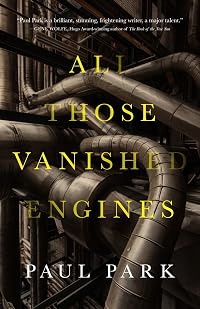
All Those Vanished Engines by Paul Park

Tor, 2014, 264 p.

This is a strange concoction, part SF (with more than a touch of Altered History,) part history of the author’s family – including the mystical implications of being born in a caul – part disquisition on the art of fiction.

The first section seems to be from the viewpoint of a child living in a post US Civil War era where the North is ruled by a queen and there are Martians apparently threatening Earth. (Or is that bit an extract from the SF novel being discussed?) The second revolves around a Second World War secret endeavour. The third is less clear cut, with the narrator (or Park himself) looking into an incident in his family’s past that may, or may not, have involved aliens.

The later sections refer to and turn back on the earlier ones, with characters appearing again in different guises, or are the same but in a different situation, all mixed in with the author’s family’s convoluted history. This metafictional aspect of the book does make it slightly less than a straightforward read. And hence difficult to sum up succinctly.

At one point we read, “It’s all metafiction, all the time.” Being told this doesn’t make it any easier on the reader, who, in any case, has already worked out this is metafiction.

A recurring theme is the Battle of the Crater at the Siege of Petersburg, about which I had some previous knowledge but Park subverts that when at one point, in an Altered History twist, instead of a mine exploding, the crater is said to have been created by the explosion of a locomotive on lines dug under the entrenchments to provide swift access to the city when the projected attack is to take place. (Or is this some sort of joke about the Underground Railroad?)

Park does present some aperçus. “One of the interesting things about autistic people is the insight they provide into ourselves. We all have strategies to distract ourselves from what we cannot bear.”

In his capacity as a tutor of writing, our narrator – we are again perhaps intended to assume this is Park himself – says, “I always warned students against complexity for its own sake, and to consider the virtues of the simple story, simply told.” Park is poking fun at himself here, I suppose, for All Those Vanished Engines is very far from a simple story, simply told.

Pedant’s corner:-  “The tiny incised pattern on the plates …. were not identical” (The tiny patterns….,) “I went upstairs and smote for a while, trying to get Captain Lukas to finally make a stand” (‘smote’ here does not seem to be the past tense of smite,) “the kaiser’s government” (the Kaiser’s,) “a font of the kind of wisdom” (the phrase is ‘a fount of wisdom’,) “Burnsides’s Corps” (the general was called Burnside; so ‘Burnside’s Corps’.) “I shined the light” (shone, please.)

Len Deighton

The once prolific writer Len Deighton – whose surname I share (apart from its pronunciation: he rhymed it with Dayton, my family rhymes it with Brighton) – has died: at 97, a good innings by any standard.

Back in my youth I was a keen reader of his spy fiction – he and John Le Carré were the two preeminent spy writers of the time – but it was his Bernard Samson stories, the Game, Set and Match; Hook, Line and Sinker and Faith, Hope and Charity trilogies and their prequel, Winter, which I consumed most avidly.

Then there were his forays into Altered History, SS-GB and XPD, which I greatly enjoyed.

His interest in the Second World War was explored further in the novels Bomber and Goodbye Mickey Mouse, both excellent, before he embarked on History proper with the books Fighter: The True Story of the Battle of Britain; Blitzkrieg: From the Rise of Hitler to the Fall of Dunkirk; the lavishly photographically illustrated Battle of Britain, an interest consummated by the much later review of that war in its entirety in Blood Tears and Folly.

Of these latter I only read one during my blogging years.

Leonard Cyril (Len) Deighton: 18/2/1929 – 15/3/2026. So it goes.

Limbo Lodge by Joan Aiken

Red Fox Books, 2000, 222 p.

After her adventures in The Stolen Lake, Dido Twite is trying to make her way home to England on the Royal Navy ship HMS Thrush. She gets diverted on to a smaller ship going to the island of Aratu to help look for Lord Herodsfoot, an envoy searching out games for the ailing King James III back in Britain. On board she meets the ship’s Doctor, Talisman van Linde, whom we later find is actually a woman, Jane Talisman Kirlingshaw, born on the island but miraculously preserved from a fall from a precipice by landing on a Dutch trading ship being swept past in a tsunami following an earthquake. Talisman was subsequently brought to Europe where she trained as a doctor. Her presence is essential to the plot as she is the daughter of its Sovran King John (once known as John Kirlingshaw) and his long dead island wife Erato.

On their way to Limbo Lodge, the palace where King John has lived kept almost in seclusion since Erato died, obstacles are put in the way of Dido and Talisman both, as the King’s brother Manoel Roy seeks to prevent Talisman succeeding as titular ruler since he desires the position for himself. The islanders they meet, who by and large are helpful, are presented sympathetically by Aiken, as are their beliefs.

This is the longest book so far of The Wolves of Willoughby Chase sequence but never drags. Aiken draws her characters sparingly but effectively.


Pedant’s corner:- “feel even dryer” (drier,) “where she had gown up” (grown up,) “Mr Ruiz’ residence” (Ruiz’s; plus other instances of Ruiz’,) “a trading schooner who will receive her cargo” (schooner which will receive.) “None of the group were aware of” (None … was aware…,) “to take anything with them Plates, bowls, baskets of fruit” (needs a full stop after ‘them’.)

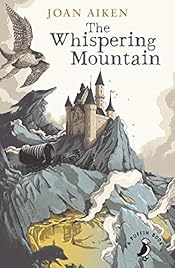
The Whispering Mountain by Joan Aiken

Puffin, 2016, 369 p, plus 2 p Map and 12 p Extras.

This is set in Aiken’s world of The Wolves of Willoughby Chase where the Stuart King James III is the ruler of Great Britain, but being a kind of prequel does not feature most of the characters from those stories.

Our protagonist here is young Owen Hughes who lives in the town of Pennygaff in Wales. His mother is dead and his father serving in the navy somewhere in Asia. As a result he stays with his grandfather, the keeper of the town’s museum whose most precious holding is the golden harp of Teirtu.

Pennygaff lies under the lea of the local mountain Fig-Hat Ben which makes a sound when the wind is up, hence the book’s title. It is also rumoured to be the home of small, possibly magical, humans who are only occasionally glimpsed.

The local laird, Lord Malyn, wants the harp for himself but Owen’s grandfather disputes his title to it since it belongs to the last survivor of an order of monks. Malyn sets two criminals, Prigman and Bilk – who converse throughout in thieves’ cant – to steal the harp. Queering the pitch is the mysterious foreigner, The Seljuk of Rum, prone to speaking like a thesaurus. Sand somewhere in the neighbourhood, incapacitated by a hunting accident, is David James Charles Edward George Harold Richard Tudor-Stuart, the Prince of Wales. Who for some reason speaks in a kind of cod Scots.

Other notable characters are itinerant Tom Dando and his daughter Arabis who make their living by selling herbal remedies and the like and whom Owen met on his way to Wales from London.

When the harp is stolen from the museum Owen is kidnapped by Bilk and Prigman and given the blame for it. Many scrapes and adventures ensue including meetings with the clan who live secretly in the mountain and gave rise to the rumours of people living there. Their Middle-Eastern origins – they use camels for transport – tie them to The Seljuk of Rum.

The text deploys a lot of Welsh words but there is a glossary of them to be found among the Extras. The thieves’ cant might have been a hindrance to a young reader but context usually makes it obvious what is meant.

In these books we are never in any doubt as to who is good and who the baddies are. Aiken characterises the latter in just enough of an over the top way to ensure that while her heroes and heroines are all resourceful and competent they have to struggle to overcome them.

It’s all a jolly good romp and as is to be expected in YA fiction, all’s well that ends well.

Pedant’s corner:- “the castle of Balmoral” (in our timeline the royals did not acquire the Balmoral estate until the mid-nineteenth century and then built the castle there,) Yehemelek (elsewhere always Yehimelek,) “there were numerous opening leading out of the big cave” (openings.) “‘I hope your lassie wisna come to harm’” (willna come to harm.) In glossary of welsh words; perwinkle (periwinkle.)

The Moon and the Sun by Vonda N McIntyre

Pocket Books, 1997, 422 p, plus ii p Major Characters and v p Afterword

I’m not quite sure how to categorise this. I’ve seen it described as Alternate/Alternative History (what I prefer to call Altered History) but I can’t see any change in actual history in it. It has no discernible Jonbar Point, no ramifications for its future. Yes, it’s set in the reign of the Sun King, Louis XIV of France, but it’s not a purely historical novel either, though that aspect of the novel is very well executed. What it does have – and what tends to make it more of a fantasy than anything else – is a “sea monster,” a mermaid-like creature which turns out to be near human, brought to Louis’s court to provide him with immortality by eating a part of its flesh. (The first part of this premise – the human-like sea creature – is not really too far-fetched. There has been scientific speculation that humans spent part of their evolutionary history as aquatic creatures.)

Our viewpoint character is Marie-Josèphe de la Croix, lady in waiting to Mademoiselle Elisabeth Charlotte d’Orleans, Louis XIV’s niece. Marie-Josèphe was brought up in Martinique and her relationship to the court is, to begin with, opaque. She is an innocent, (she has not heard the word ‘whore,’ has never drunk wine, nor encountered the idea of homosexuality,) sent to a convent when her parents died and subjected to its repressive strictures. Her brother Yves is the Jesuit priest and enthusiast for scientific enquiry who was instrumental in capturing two sea-monsters and bringing them to Versailles. One of the monsters is dead and Yves is to carry out an autopsy on it. Questions of protocol and the need for the king’s presence tend to delay this though.

Marie-Josèphe finds herself sensitive to the creature. She can hear it sing, feel its pain, discern its meaning, and ends up relating its stories of persecution by humans to the court.

Coincidentally, Pope Innocent XII is on a diplomatic mission to Versailles (as a kind of rapprochement with the King) but he is keen for the live sea creature – which due to its tale-telling soon comes to be called Sherzad – to be taken back to Rome for study.

Other historical notables to appear in the text include Philippe, Duc d’Orléans, (Louis’s brother and Mademoiselle’s father,) Charlotte (Philippe’s Duchess,) the Chevalier de Lorraine (Philippe’s male lover,) James VII (II of England) and his wife Mary of Modena (in exile due to the so-called “Glorious Revolution.”)

Marie-Josèphe is talented, not only does she sketch the dissection of the dead sea-creature, she also composes music. This latter outrages the Pope, who insists – using Biblical references – that women ought to be silent. She is not short of enemies at the court but also forms friendships. Her relationship with her slave Odolette is complicated and develops in a way more attuned to modern sensibilities than those of the seventeenth century.

The writing is accomplished throughout and the interpersonal relationships depicted tend to strike true.

Pedant’s corner:- Yves’ (Yves’s. Since the ‘s’ of Yves is not pronounced then without an ‘s’ after the apostrophe then the possessive’s sound is not signalled by the spelling. All the possessives of names ending in ‘s’ are treated like this, Chartres’, Louis’, etc) “the duke and duchess d’Orleans” (these are specific titled people, not merely an unspecified member of a class. Their titles are proper nouns. So, “the Duke and Duchess d’Orleans. McIntyre generally tended to adopt a similar practice of using lower case whenever specific titles were used, even for mademoiselle de la Croix. Note in English she would be Miss de la Croix, not miss de la Croix,) perruke (innumerable times, peruke,) “His Holiness’ route” (His Holiness is singular, so, ‘His Holiness’s route’,) “she kept her own council” (counsel, is council a US usage in this context?) “her royal mistress’ ridicule” (mistress’s,) “Father de la Croix’ medal” (again, no ‘s’ is sounded at the end of Croix, it needs an ‘s’ to render the possessive accurately, ‘de la Croix’s medal’,) “her left aureole” (areola,) “and has sense of humour failed him” (and his sense of humour,) “a hareem” (x 2, usually spelled ‘harem’.)

Neom by Lavie Tidhar

Tachyon Press, 2022, 240 p, including 2 p Map, 5 p Afterword and 26 p Beyond Neom, an A to Z. Reviewed for ParSec 5.

Another downloading from Tidhar’s fertile imagination. Science Fictional ideas and references spin off this in giddy profusion. If you want your fix of the strange and wonderful, even the downright odd, get it right here. Set in the same future as the author’s Central Station (2016,) in which humanity and its adjuncts have sprawled across the Solar System, it takes its title from a city set by the Red Sea, a city which at the moment is only the dream of a Saudi prince but in this book, as Tidhar informs us in a short foreword, is old. There is also a prefatory map of the area which is not strictly necessary for understanding or enjoyment but adds to the effect. (Tidhar seems fond of such maps, they are also found in Central Station and Unholy Land.)

This imagined Neom “was built on the premise that anything can be fixed, made good, made better,” and is policed by the shurta. Not that it needs much policing. As one character’s viewpoint has it, “the only real crime in Neom was being poor. And only the poor joined the shurta.” Wars have come and gone. In the desert beyond the city lurk UXOs, Unexploded Ordnance, aka smart bombs. In the recent past Terrorartists, mass murderers, used pain and death as their paint, people as their brushes, “the experience itself became their canvas.” Such art requires witnesses. After all, “If a bomb went off in a crowded market and there was no one to broadcast and amplify the experience, did it really go off?”

In this world people are noded at birth to be part of the communication system known as the Conversation, “that virtuality of worlds that is all around, as persistent as air.” We follow various characters – human, robot and jackal – as they make their way in and around or towards the city. For herself to survive and to pay for her mother’s care Mariam took any job she could (“Neom was a city for the rich and the rich needed the poor in order to be rich,”) and we see her in several of them, firstly when she gives a flower to the robot, who subsequently keeps bumping into her at her various employments. The boy, Saleh, goes with the Green Caravanserai carrying an artefact he has salvaged from a terrorartist event wherein his family died and which he hopes to sell. The jackal, Anubis, teams up with him in El Quesir. Shurta member Nasir is attracted to Mariam but the time somehow isn’t right. On a patrol one night in the desert he and his companions Laila and Habib come across the robot digging a hole. Its activities attract the dangerous attention of UXOs, drawn in by emanations from the golden limbs it is excavating.

All come together at Mukhtar’s Bazaar of Rare and Exotic Machines where the golden parts are to be reassembled into a golden man, with Saleh contributing its missing piece, the black hole at its heart, a beacon for robotkind, the last work of terrorartist Nasu.

As a writer Tidhar is frequently playful, allusive and self-referential. Grace notes await the attentive reader. There are sly quotations of the Laws of Robotics (here regarded as being only ever a philosophical concept,) a small black monolith in a corner gives someone a headache when they look at it, mentions of the Up and Out, his own Lior Tirosh is included in a list of admired poets. The robot points out the meaning of Shylock’s “Hath not a Jew” speech in the question, “If you wrong us shall we not revenge?” saying Shylock understood violence. There is acute observation too. “Religions propagated much like viruses. They evolved, spread, died.” His characters are sketched economically but believably.

A harsh critic would complain it all ends too soon and we don’t really see much of Neom the city, but, as Tidhar’s Afterword (in which he explicitly bows to Cordwainer Smith) says, he’s always loved future histories, so there could be more to come from this source. There is, though, a 26-page A to Z of the Central Station universe to bulk things out.

Tidhar has of late become fairly prolific. Perhaps he’s made good use of lockdown. Neom shows there has been no drop-off in quality.

Pedant’s corner:- Elias’ (x 3, Elias’s,) “Nasir feared the hole will close up on them” (feared the hole would close up,) “none were ever turned away” (x 2, none was ever turned away.) “It had voice like old sand grinding” (It had a voice like,) “Mukhtar genuinely troubled”  (Mukhtar was genuinely troubled,) distill (distil.) “‘I wish you didn’t come’” (hadn’t come,) a full stop instead of a question mark at the end of a question (x 2.) “‘The trick is finding someone who would listen’” (who will listen.) “‘One of the Monks lay in the carrot patch. Their head was bashed in’” (Its head,) “‘an when I got to’” (and when I got to,) “how they’d went out to dinner together” (how they’d gone out,) “it existed in a state of relative piece” (relative peace,) no one (no-one,) “and the figure in on the pedestal” (no ‘in’ needed.) “He shined his torch around” (He shone his torch.) “‘It’s only <em>miniature</em> black hole’” (only a <em>miniature</em> black hole’,) “the nanite algae that grows” (algae that grow,) “sank in nano-goo” (sunk,) virii (viruses?) “fell into quicksand, fell into pits” (fallen into quicksand, fallen into pits,) “she put the air condition on” (the air conditioning.) In the A to Z; “often and affectionately to Polyport” (often and affectionately shortened to/known as Polyport,) “though stories told in the Outer System” (though stories are told in,) “often moving from world to another” (from one world to another,) “where there presence” (their presence,) synthetising (synthesising,) utlising (utilising.)


The Stolen Lake by Joan Aiken

Jonathan Cape, 1981, 270 p.

This picks up the story of Dido Twite after Night Birds on Nantucket, the third in Aiken’s ‘Wolves’ trilogy. She embarks on His Majesty James III’s* ship Thrush en route for Britain. The ship is diverted to South America by a message requiring Captain Hughes to respond to a request for help from Queen Gunevra of New Cumbria. This South America was colonised by ancient Britons when the Saxons invaded Britannia. New Cumbria’s two neighbouring kingdoms are called Lyonesse and Hy Brasil.

Dido is befriended by the Thrush’s steward Mr Holystone but Captain Hughes has little time for her. Nevertheless, on landfall Hughes wants Dido to accompany him to the Queen’s court. New Cumbria is a strange place where girl children between five and fifteen are absent – said to be prey to flying creatures named Aurocs, so many girls are sent away to avoid this fate. Queen Gunevra desires the British to persuade King Mabon to restore her lake (which he removed as ice-blocks in retaliation for the abduction of his daughter Elen on her return from education in England.) Gunevra expects Dido to claim to be Elen to satisfy him. She wants the lake back so that her husband will be able to sail back to her across it, something she has been awaiting for hundreds of years. This referencing of the story of King Arthur is exploited further in the rest of the tale during which Dido as usual meets people who wish to do her harm.

The characters tend to the cartoonish but its intended readership (YA readers) will not mind about that.

*In Scotland this would have been James VIII.

Pedant’s corner:- A fair bit of the dialogue was in non-standard English. Otherwise, nothing to report.

Ilario: The Lion’s Eye by Mary Gentle

Gollancz, 2007, 669 p.

This is set in Gentle’s First History universe which she introduced in Ash: A Secret History. It is a stand alone novel though, merely sharing the same background.

We meet narrator Ilario trying to enter Carthage, a city under the dark shield of the Penitence and hence no view of the sun, and with naphtha lights providing illumination. Marcomir, the border guard she deals with, offers her a place at the boarding house of his mother. Once there, lust struck, they stumble to bed together. At first this might seem merely to show us that Ilario is a true hermaphrodite, having functional sets of both sex organs, but the encounter is to have plot ramifications. The morning after, Marcomir’s mother gives her a drugged drink and she wakes up to find herself a slave once again.

Freed by her/his King, Rodrigo Sanguerra of Taraconensis in Iberia, Ilario had fled after her/his true parentage was revealed, leading to her/his supposed father, Viderico, the King’s right-hand man, suborning her/his mother, Rosamunda, into trying to kill her/him to expunge the shame of engendering a freak. This wasn’t the first time Rosamunda had attempted this since after the birth, Ilario had been left on a hillside from which she was rescued by a couple who raised her/him as their own. In late childhood she/he was offered to the king as an amusement and, as a slave, no threat to anyone.

The beautifully intricate and cleverly designed plot revolves around the tension between the desire of Carthage to take over Taraconensis, the high politics of Ilario’s homeland – at first navigated from a distance – efforts to avoid assassination by Viderico’s agents, and Ilario’s desire to be an artist, exploring painting and the New Art of true representation (perspective.) Through it we are taken not just to Carthage but all over the Mediterranean of this scenario, to Rome, known as the Empty Chair since no Pope has sat there for centuries, to Venice, a growing power, to Alexandria-in-exile, seat of the Ptolemies in what is still called Constantinople by adherents of the Green Christ, whose religion mixes in aspects of the Christianity we know with elements of Mithraism.

This all comes about since Ilario is bought by the Egyptian eunuch Rekhmire’, a “humble buyer of manuscripts” (though a de facto spy) and a cousin to Alexandria’s ruler, the Pharaoh Queen Ty-Amenhotep. In Rome, while apprenticed to Masaccio, a master of the New Art, Ilario encounters a golem-statue designed as a weapon to be used against the Alexandrine monarch, meets in Venice a pseudonymous Herr Mainz who has a new, quick method of manuscript reproduction (ie he is really Gutenberg,) and her real father (and delighted to be so) Honorius, the lion of Leon and Castille, recently retired from fighting the Franks on behalf of King Rodrigo and whose personal guard accompanies him. Along the way Ilario discovers she/he is pregnant by Marcomir and, the dangers heightened manyfold for a hermaphrodite mother, is operated on by a Turkish doctor, Bariş, in the manner of Caesar. (Since this is less than halfway through the book much of the tension of that situation is thereby vitiated.) Both mother and infant survive, the daughter, Onorata, another complication that Ilario has to deal with. The lack of love Ilario confesses for Onorata is belied by the way in which she/he ensures there is always someone around to care for her. Honorius’s soldiers are exemplary in this respect. In Constantinople, all are astounded by the huge size of a ship which has lost its way in a storm, not least its complement of five thousand men. The ship’s captain is Zheng He and it is part of a Chinese fleet exploring the world. Both Alexandria and Tarconensis will seek to use this as a lever against Carthage. Somewhere in amongst all this Rekhmire’ restores freedom to Ilario again.

Much of Ilario’s thoughts veer towards drawing and painting and the implements and materials required but there are also many reflections on the lot of the hermaphrodite. Ilario gets to see things both ways, “Men alone together talk as if women are children; women together speak as if men are not-very-intelligent animals.” Gentle displays a flash of feminism towards the end when Rosamunda says that, freak or not, Hilario’s possession of a penis (however rudimentary a one) gives her/him agency, places her/him above women in the pecking order.

Ilario is an engaging character throughout and the others we meet in this portrayal of a world that never was (or, if we are to believe Ash: A Secret History, was expunged,) behave in ways that are entirely believable.

Finally, I must thank Gentle for introducing me to the wonderful word exomologesis which, however, I am sure I will never use again.

Pedant’s corner:- Anagastes’ (Anagastes’s. Except for Azadanes, Taraconensis and Gades, other names ending in ‘s’ – such as Honorius – are given s’s as their possessives,) calcium sulphate (as a paint additive/colouring. In this time period it would surely have been called gypsum.) “Not only is Rekhmire’ legally paid my wages” (Not only has Rekhmire legally paid,) “in their practise” (practice,) laying (several times; lying,) lay (several times; lie.) “The slow grey light of dawn illuminated in the sky” (no need for that ‘in’ surely?) elipse (ellipse,) cartilege (cartilage,) “because ‘is unwise’” (because ‘it is unwise’,) “to down out” (to drown out,) “to breath in” (to breathe in.) “I belated realise” (belatedly,) “woman accompanied by male relatives” (women accompanied,) “the polished finished of his helmet” (the polished finish,) jailor (jailer,) Aldro (elsewhere Aldra,) fontanels (fontanelles,) “I brought0my cloak” (type-setting error for ‘I brought my cloak’,) sung (sang,) “a crew of oarsman was in evidence” (oarsmen,) “moved two and fro” (to and fro.) “Instead I throw up, like a child” (the rest of the passage was in past tense; ‘threw up’.) “‘I’d wrap in anchor chain and dump it’” (wrap it in anchor chain,) sunk (sank.) “I could have done with somewhat to keep me occupied” (something is more natural than somewhat, here,) “looked at blankly at” (has one ‘at’ too many,) drunk (drank.)

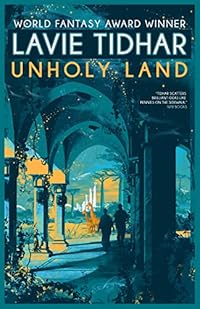
Unholy Land by Lavie Tidhar

Tachyon, 2018, 264 p, plus Mem>iv p Preface, 3 p Historical Afterword, and 2 p Afterword by Warren Ellis.

Taking as its inspiration an expedition by Theodor Herzl, the founder of Zionism, and Nahum Wilbusch into Africa in 1904 seeking out a possible homeland for the Jews, and Herzl’s own utopian novel Altneuland (Tel Aviv in Hebrew: and yes it did give its name to that city) which he set in a peaceful Jewish state in Palestine with equal rights for Arabs, Unholy Land imagines what it could have been like if both had come into being. It is also a meditation on the treacherous call of home.

Here, that homeland in Africa, on the borders of Uganda and Kenya, came to pass. It is called Palestina and viewpoint character Lior Tirosh, a writer of crime novels, was brought up there. When the novel starts, he is making the journey from his present home in Berlin, on the suggestion of his agent with the hope he might write something on the political situation there. Unlike in the similarly (though unhistorically) inspired The Yiddish Policemen’s Union, there are tensions between the Jewish settlers and the original inhabitants, paralleling the conflict between Jews and Arabs in the Israel of the reader’s reality. A wall is being built to keep terrorists out. (Of course, as one character says, it serves equally well to keep Jews in.) Tirosh himself witnesses a suicide bombing of a bus.

This aspect of the novel is an Altered History where the Holocaust never happened and (in an aside) Hitler was assassinated in 1948. There are too, allusions to stories Tirosh either has written or might write which, in our universe, Tidhar has actually written – Osama and one featuring Hitler as a private detective. The sections following Tirosh are told in the third person but it soon becomes apparent that these passages are being written by a Special Investigator Bloom who also contributes first person sections to the book. To complicate things further there is a third strand, written in the second person, describing the calling back to service of a special agent, Nur Al-Hussaini, who, like Bloom, has travelled between various realities via what Bloom calls a crosshatch and she a sephirot, places where the boundaries between the worlds blur and crossover can occur. Depending on which reality you inhabit the city Bloom ruminates on can be thought of as Jerusalem, Ursalim or Yerushailam.

Of this unsteady landscape Bloom says, “people think of reality as immutable: solid and reassuring, that it is true merely because it is there.” But, “The world is the sum of what it could be, what it might have been and how it could have been.” Of his calling he says, “There are always borders, and there are always those who guard them lest they fracture.” Tirosh experiences the blurring slowly, in the end all but forgetting his connection to his world and agent in a quest to find Deborah, a niece who has gone missing from Palestina.

It is a measure of Tidhar’s skill as a writer that this all makes sense as you read it. Jewishness is obviously of salient importance to him (naturally enough, since he is an Israeli.) The place of Jews in this world is problematic at best. He puts this into Bloom’s thoughts, “That is the condition of being a Jew, I sometimes think – to always be one thing and another, to never quite fit. We are the grains of sand that irritate the oyster shell of the world.”

As well as being an intensely readable thriller if you care to look at it that way, Unholy Land pleads the case for somewhere, in one of the realities, being a place where that last sentence no longer holds.

Pedant’s corner:- “a row of cars … were queued up” (a row was queued up,) “for the people seek retaliation” (for the people to seek,) “and its fruit were skulls” (its fruit was,) “the lay of the land” (lie, it’s ‘lie of the land’,) “over an irritant embedded it in the host body” (no need for that ‘it’,) “when a different peoples had to share the same land” (omit the ‘a’,) “‘you are nought but the ephemera’” (nought = zero, the number, and is not equivalent to ‘nothing’: ‘you are naught but the ephemera’,) “body wracked with painful coughs” (racked.)

free hit counter script