Archives » Alastair Reynolds

And Another…

 Revenger cover

A proof copy of Revenger by Alastair Reynolds landed on my door mat last week.

It’s the latest book I’ve received from Interzone for review purposes.

I must confess it was a bit of a surprise as, though I had expressed interest in reviewing it, I thought I was in line for a different book altogether. No complaints though.

The review is due in before the end of the month and is scheduled to appear in issue 266 shortly thereafter.

I’ll need to get reading it then…..

Poseidon’s Wake by Alastair Reynolds

Gollancz, 2015, 600 p.

 Poseidon’s Wake cover

Poseidon’s Wake is the third book in Reynolds’s Poseidon’s Children series, my reviews of the first two of which, Blue Remembered Earth and On the Steel Breeze, can be found by following the links. By the time of this novel the enhanced elephants to which Goma Akinya has devoted her life on Crucible, the planet of the sun 61-Virginis round which humans first encountered the enigmatic machines known as Watchkeepers and where is sited the still mysterious construction the Mandala, left by the M-builders, are losing their intelligence to genetic drift. Things are stirred up however when a message is received from the direction of the star Gliese-163 hitherto thought not to have been visited by humans. The message contains only two words, “Send Ndege.” Ndege is Goma’s mother and was the instrument by which Crucible’s greatest disaster, the sudden loss of the habitat Zanzibar girdling the planet with a ring of its remains, occurred when Ndege managed to activate the Mandala. Despite Crucible’s relative poverty an interstellar ship is prepared but Ndege is thought too old to withstand the rigours of such a journey and Goma goes in her place.

Meanwhile on Mars, Kanu Akinya, like Ndege a child of one the Chiku Akinyas from On the Steel Breeze, suffers extremely severe damage in a terrorist incident. The machines of the Evolvarium – to which he had been an ambassador – manage to revive him though, but while doing so insert into his consciousness one of their own, an intelligence named Swift. Under Swift’s influence he deviously procures a lift to Europa on a ship belonging to his ex-wife Nissa Mbaye. From there he retrieves his own interstellar ship and sets off for Gliese-163.

The narrative follows Goma and Kanu and their various companions in alternate chapters till very near the end of the book. Goma experiences troubles en route to Gliese, Kanu less so but things only really motor up when we get to that system which contains a huge waterworld, Poseidon, with strange wheel-like objects protruding from its ocean up into space. Poseidon moreover is guarded by lots of moons, getting too near which provokes them to “examine” intruders and induce in them a phenomenon (felt as “the Terror”) as a result of its revelation of knowledge of the end of the universe. These guardians do not allow the Watchkeepers anywhere near Poseidon but only creatures of a certain degree of consciousness. The signal which brought them all to the system had had nothing to do with Poseidon though. It was sent by Eunice Akinya, progenitor of the Akinya clan, not now the artilect we met in previous books but restored to human form by the Watchkeepers. Also in orbit in the system is part of Zanzibar the habitat it was thought Ndege had caused to be destroyed. This (large) remnant of Zanzibar is run by Dakota, an enhanced elephant now at the level of human intelligence or beyond, who fell out with Eunice and banished her – along with six elephants loyal to her – to Orison, another planet in the system.

This set-up takes some while to put in place but even once we get to Poseidon the pay-off there isn’t as great as a three book sequence perhaps requires. Reynolds has though left ample scope for further exploration of his scenario.

Further note: compare the cover of this book to the previous two in the sequence.

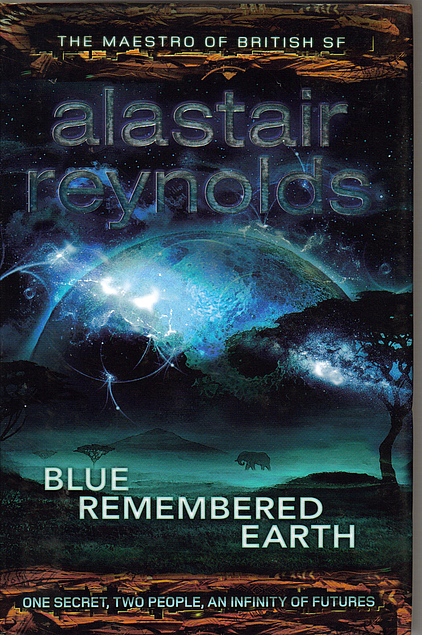
Blue Remembered Earth cover
 Poseidon’s Wake cover

 On the Steel Breeze cover

That is seriously odd. When I first saw Poseidon’s Wake’s cover I thought Reynolds had published a novel not in the sequence. I know that the paperback covers are now in broadly similar form but for owners of all three in hardback it will make their shelves look askew.

Pedant’s corner:- The inside cover blurb has the message to Crucible which kicks things off reading as “Send Nedgi.”
Despite the speed of light being an absolute barrier the habitat Zanzibar was transported seventy light years with the people (and elephants) on board feeling only a few days at most had passed “in their frame of reference.” Surely even at only a fraction under the speed of light they would experience the interval as being much longer than this? I must confess, though, the intricacies of time dilation effects are beyond me.
Otherwise:- with offset with disquiet (was offset,) ‘I feel obligated to point out’ (I feel obliged to point out,) they might yet make it our alive (out,) the new generation of engines were faster (the new generation was faster,) before any of them were allowed (was allowed,) the link between his name and artist’s (and the artist’s,) epicentre (centre,) rolled over into his belly (onto,) ‘what his surname?’ (what’s his surname?) inside the orbit of the moons (orbits,) ‘Have you told spoken to her about it?’ (no “told” needed,) ‘with disarming speed – and an equally disarming lack of concern for their own safety – the figure appeared to descend the crag in a series of perilous backward hops’ (the figure; therefore “its” own safety,) ‘we might have wait’ (to wait) Nhemedjo (Nhamedjo,) ‘as to not matter’ (as not to matter,) rigor (rigour,) appraised (apprised,) ‘that we still recovering (we are still recovering,) had brought some valuable time (bought,) forsee (foresee,) a skull-faced person clasping their hands to the bony bulb of their head (her/his hands, her/his head,) ‘into it deepest secrets (its,) ‘when we returned from Poseidon (return,) it might signal a change of heart on Dakota’s behalf (on Dakota’s part,) ‘I’d be glad if weren’t going deeper now’ (if we weren’t,) rancor (rancour,) waiting the deliverance (awaiting the deliverance,) a century and half (a century and a half.)

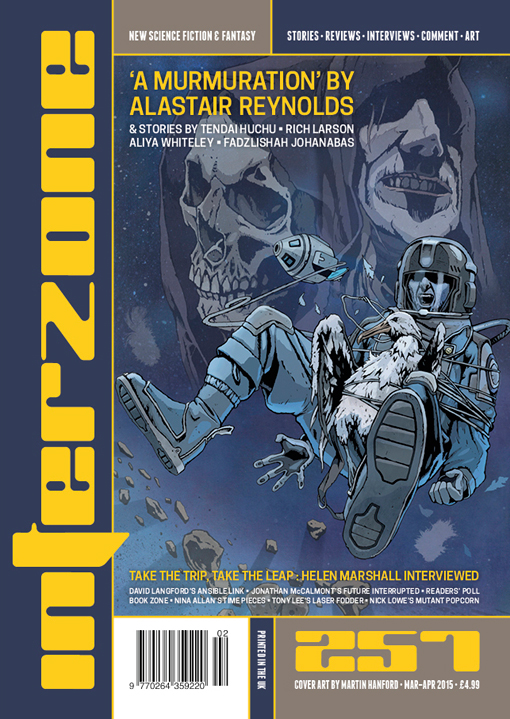
Interzone 257 Mar-Apr 2015

Interzone 257 cover

We kick off with Alastair Reynolds and A Murmuration1 wherein a researcher into the flocking behaviour of starlings begins to be able to control their movements. This leads to conflict with the referee of the scientific paper on the research. Moreover, the birds start to behave contrarily.
In Songbird2 by Fadzlishah Johanabas, due to addiction to electronic devices people can no longer process emotions apart from a few women who can synthesise the emotions when they sing.
Brainwhales Are Stoners, Too3 by Rich Larson sees a teenage girl and the boy she fancies break into the ThinkTank where a brainwhale is confined, wired up, drugged to do computations.
The Worshipful Company of Milliners4 by Tendai Huchu. In a dilapidated factory in Harare a group of half-human, half-cat milliners – invisible to true humans – make equally invisible hats for authors to wear. Full membership of the sisterhood is only granted when the author becomes successful.
Aliya Whiteley’s Blossoms Falling Down is set on a generation starship where different cultures are housed on different decks with occasional tourism between them. The navigator is struck by his visit to a Japanese “Haiku Room”.

1 “The cameras should be aimed into the middle of the perimeter, and elevated sufficiently to catch the murmuration’s epicentre.” (Epicentre used, apparently correctly, as meaning “off-centre”. Remarkable.)
2 written in USian, lay (lie,) the liquid in the cylinders in front of me glow green (glows,) staunch (stanch.) Clear seems to be used as a synonym for colourless.
3 less (fewer,) snuck (sneaked,) a “I’m fine” look (an “I’m fine” look.)
4 sprung (sprang,) epaulets (epaulettes,) “‘almost as though you’re recycled no reincarnated,’” is surely missing punctuation of some sort.

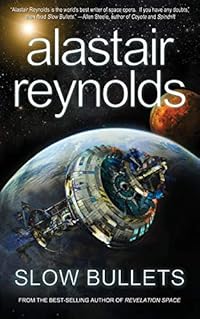
Slow Bullets by Alastair Reynolds

Tachyon Publications, 2015, 194 p

 Slow Bullets cover

This novella starts just after an armistice in a long war waged partly on religious differences. Each side had its sacred Book, “And I’m sure there is tremendous grace and power in these words. Tremendous wisdom and humanity – as well as ignorance and superstition and foolhardiness,” but Scur was not an ardent believer and her mother, very fond of the enemy’s official war poet, introduced her to the poem “Morning Flowers.” Just before the armistice Scur was captured by an enemy patrol and tortured by a war criminal called Orvin who left her for dead. Yet she mysteriously wakes up on the skipship Caprice along with soldiers of both sides, the ship’s crew and civilians of various sorts.

But things are awry. The skip has gone wrong, they are a thousand years in the future and the ship’s memory is malfunctioning. Not only that but sometime in the intervening years aliens dubbed The Sickening passed through human space. They could change physics, turning down the brightness of suns. No remnant of the civilisation the awakened people on the ship can remember is left.

While Scur’s desire for retribution on Orvin partly drives the story along so also does the rest of the ship’s company’s attempts to discard their differences and to preserve humanity’s knowledge. The slow bullets of the title contain information about their bearers, including personal memories, but can be overwritten. As such they are necessary to the story’s resolution, as is “Morning Flowers.”

The novella length doesn’t really give Reynolds much chance to develop character, most of the inhabitants are there to carry the plot along, but the justice Scur metes out to Orvin is not what we might expect and there is an elegiac tone to the ending.

Top Ten Space Operas

Another list.

According to Wikipedia “Space Opera is a subgenre of science fiction that often emphasizes romantic, often melodramatic adventure, set mainly or entirely in outer space, usually involving conflict between opponents possessing advanced abilities, weapons, and other technology.”

Partly as a comment on the sub-genre and also as an attempt to subvert it I provided my own novel A Son of the Rock with the tagline “A Space Libretto” mainly because – while it roamed the spaceways and deployed technology – advanced abilities and weapons were largely, if not completely, absent.

As to Space Opera itself, Gareth Powell has posted a list of what he considers a Top Ten of Space Operas on his website. It leans heavily towards relatively recent works.

As you can see I’ve read all but three of them.

Nova by Samuel R. Delany
The Centauri Device by M. John Harrison
Consider Phlebas by Iain M. Banks
A Fire Upon The Deep by Vernor Vinge
Revelation Space by Alastair Reynolds
Ancillary Justice by Ann Leckie

The Reality Dysfunction By Peter F. Hamilton
Leviathan Wakes by James SA Corey
Space by Stephen Baxter
Excession by Iain M. Banks

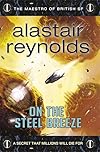
On The Steel Breeze by Alastair Reynolds

Poseidon’s Children 2 Gollancz, 2013, 483 p. Reviewed for Interzone 250, Jan-Feb 2014.

In Blue Remembered Earth, the previous volume in Reynolds’s Poseidon’s Children sequence, the Akinya family was instrumental in the development of the Chibesa-drive engine which drastically increased the maximum speed of space travel. On the Steel Breeze is set a very long generation or so after the events of the previous book and the family is now much less powerful. Chibesa physics has allowed hollowed out asteroids dubbed holoships to be sent out in strings – Reynolds nods to history by using the term caravans – to various promising destinations in the stars. These holoships are each large enough to be able to house herds of elephants as well as the emigrating humans. Life prolongation techniques are so far advanced that withdrawal of such treatment is used as a punishment for crimes – a generation’s life span is now measured in several hundred years. Chiku Akinya, great-granddaughter of Eunice Akinya the begetter of the Chibesa drive, has an unusual triple identity. A process called Quorum Binding has stamped Chiku’s personality and memories on three indistinguishable bodies (her original and two clones) which are able to communicate almost telepathically deeply. Chiku Red set out after Eunice Akinya’s ship; Chiku Green is on the holoship Zanzibar, en route to Crucible, the extra-Solar planet with the enigmatic structure known as the mandala, discovered by the telescopic array Ocular; Chiku Yellow stayed on Earth. The novel intertwines the fortunes of the three Chikus. Making a reappearance is the artilect of Eunice – an AI in human form, as close an approximation to the human original as possible – which Chiku’s mother developed in the earlier novel. “She” is in a hidden chamber on Zanzibar tending a set of enhanced, “talking” elephants known as Trantors.

Much of the initial action takes place on Zanzibar, in whose caravan experiments to develop post-Chibesa physics have been proscribed. Travertine (who for some reason has a set of personal pronouns, ve, ver, vis, all to verself) has caused hundreds of deaths by an illegal but vital experiment. The holoships have been accelerated too much to be slowed down effectively enough by their Chibesa engines. The caravan’s politics, though, are set against the necessary research.

Back on Earth Chiku Yellow, with the aid of the merfolk of the United Aquatic Nations who reunite her consciousness with the returned Chiku Red’s, acts on a communication from Chiku Green to seek out a woman who can facilitate contact with their founder, Arethusa, who in turn may have knowledge that not all is as it seems on Crucible. This necessitates a journey to the surface of Venus (and, later, Mars and Hyperion.) Here the plot, as in Blue Remembered Earth, comes dangerously close to pulling the characters around the Solar System to show off the author’s research or to provide a set piece drama. The inevitable disaster with the space elevator connecting to Venus’s surface demonstrates the Chikus have a dangerous enemy. This is the “machine distributed consciousness” called Arachne which oversees the data produced by Ocular and has infiltrated the aug, the controlling agency of the Surveilled World familiar from Blue Remembered Earth. The secret Arachne is protecting is the presence in orbit round Crucible of over twenty enigmatic pine cone-like spaceships dubbed Watchkeepers.

Plot aplenty to be going on with then, and the above merely sketches the set-up. The playing out of the politics of Zanzibar’s caravan, involving the clandestine construction and launch of a scout ship to reconnoitre Crucible, the repression and conflict which ensues, the true situation on Crucible, fill out the story. The scout party’s meeting with Arachne’s avatar on Crucible verges on fantasy territory, though. While any sufficiently advanced technology may be indistinguishable from magic, in Science Fiction some degree of explicability is generally thought desirable.

Despite the space travelling elephants (and the light aeroplane able to fly within their hidden chamber in the holoship,) the mandala and the Watchkeepers, Reynolds doesn’t quite hit the sense of wonder button squarely with this one. The scale fails to register. (That may just have been a jaded reviewer’s perception, though.)

Yet with his holoships Reynolds has – much as he did in Pushing Ice – re-imagined the generation starship trope, albeit with less of a focus on the ships’ passengers than in novels of yore. Also in the mix, though such is the detail of Reynolds’s future that they have not yet been explored in any detail, is a Big Dumb Object in the shape of the mandala and a kind of first contact (the Watchkeepers.)

An example of the possibility of avoiding what the Watchkeepers apparently think is the inevitable conflict between organisms and artilects, Eunice poses the question of what it actually means to be human – highlighting a typically human tale of stupidities, betrayals, love and duty.

The following did not appear in the published review.
Omitted “a”, a for an, doubled “the”s, “had”s and “was”es, “assesment” “compliated” a “breaking” mechanism for slowing down, an “I have strode,” “on my behalf” instead of “on my part” plus the interesting coinage “programmemes.”
Another Review Book

My latest review book for Interzone is by Jen Williams, another writer new to me.

Ms Williams’s novel, her first, is entitled The Copper Promise and has a 2014 copyright date.

Plenty of time for this. The review – for Interzone 251 – is not due in till the end of January.

It’s a bit early yet for Interzone 250, which will contain my review of Alastair Reynolds’s On The Steel Breeze , Book 2 of his Poseidon’s Children series.

Review Delivered

My review of Alastair Reynolds’s On the Steel Breeze has been forwarded to Interzone.

Reviews head honcho Jim Steel tells me I was first in this time. (We aim to please.)

It’s due for Interzone 250, Jan-Feb 2014.

Blue Remembered Earth by Alastair Reynolds

Gollancz, 2012, 506 p.

Blue Remembered Earth cover

Global warming and sea level rises have altered the political landscape of Earth drastically. Africa is bounded by walls to keep out the sea and has become a global power house. People in this future have internal augmentation for long distance information and communication. Very few environments are beyond the reach of this Surveilled World, run by the Mechanism, which by overseeing everyone’s implanted augmentation prevents crimes occurring. Brother and sister Geoffrey and Sunday Akinya are two of the grandchildren of Eunice, the founder of the prominent industrial company Akinya Space, but are detached from this family enterprise; cousins Hector and Lucas are very much involved in its running.

Geoffrey is using aug to study elephants in the Amboseli region of Africa, Sunday is an artist in the Descrutinised Zone, an area of the Moon where, for privacy reasons, the Mechanism doesn’t operate. When Eunice dies both Geoffrey and Sunday are drawn into a search for something she may have left behind which Hector and Lucas fear may impact badly on the company’s fortunes.

The action roams from the shadow of Mount Kilimanjaro to the Moon, under the Indian Ocean in the realm of the United Aquatic Nations, on to Phobos, then Mars, out to the Kuiper Belt and back. An array of instruments known as the Ocular, spanning vast areas of the Oort Cloud, has allowed imaging of extraterrestrial planets at high resolution and detection of a structure known as the Mandala on Sixty-one Virginis-f.

In this vision of a future where humanity is scattered over the Solar System Blue Remembered Earth is reminiscent of Kim Stanley Robinson’s 2312. That novel, though, was to a large extent plotless, and its hero was really the Solar System. Blue Remembered Earth’s plot is intricately and cleverly meshed – like whatever passes for clockwork these digital days. And therein lies a problem. The characters are drawn all over the system by the plot’s exigencies. It is over-engineered, with complications that inspire “hold on a minute” moments. Its heroine is in effect Eunice, and she never makes an appearance except by way of machines imprinted with versions of her personality.

It’s still good SF though.

Pedant’s corner: overlaying for overlying. There was also a scene set on Mars where an abandoned Russian site on Mars had a faded hammer and sickle flag and Reynolds also mentions a former Soviet submarine. Is he still lost somewhere in the Cold War?

House Of Suns by Alastair Reynolds

Gollancz, 2009, 502 p.

It was apparent from early on that the title of this book was going to be a pun.

The Gentian Line builds stardams. Using ringworlds constructed by a lost civilisation known as the Priors they surround suns completely. Not even a supernova can get through. These suns, then, are housed.

The galaxy-spanning society where the novel is set contains many Lines known as Houses who employ stasis technology in their aeons long trips around the galaxy. The Lines’€™ members are called shatterlings, clones of their respective founders – but of both sexes – each with their founders’ memories. The Gentians’€™ founder, Abigail Gentian, had a strange, artificially extended childhood, brought up in near isolation on a small asteroid enclosing a tethered black hole, with only the game of psychological immersion known as Palatial for diversion.

The shatterlings Campion and Purslane – all the Gentians have names derived from plants – are aberrant in that they are lovers. They are late for their Line’€™s reunion, an important gathering where all the members’ memories of their latest “€œcircuit”€ of the galaxy are collected and shared. Before they arrive they receive the news that most of the Gentian Line has been destroyed in an attack. The novel works through their attempts to find out why, the significance of the mysterious occlusion of the Andromeda galaxy, and of the hidden Line called the House of Suns.

The book is split into eight parts each of which begins with a section which follows Abigail’€™s childhood. Thereafter succeeding chapters are, in turn, narrated from the viewpoints of Campion and Purslane. At first it is difficult to make sense of this as Reynolds does not differentiate their voices clearly enough. The other “characters,”€ some of whom are machine intelligences, step forward Cadence and Cascade – a King Crimson allusion? – are also not well delineated, even the elephant-like Ugalit Panth.

What Reynolds does give you is plot, in abundance. 500 pages of closely packed print is pushing it a bit, though.

free hit counter script