Pushing Ice by Alastair Reynolds
Posted in Alastair Reynolds, Reading Reviewed, Science Fiction at 21:47 on 12 January 2009
Gollancz, 2005, 384 p.
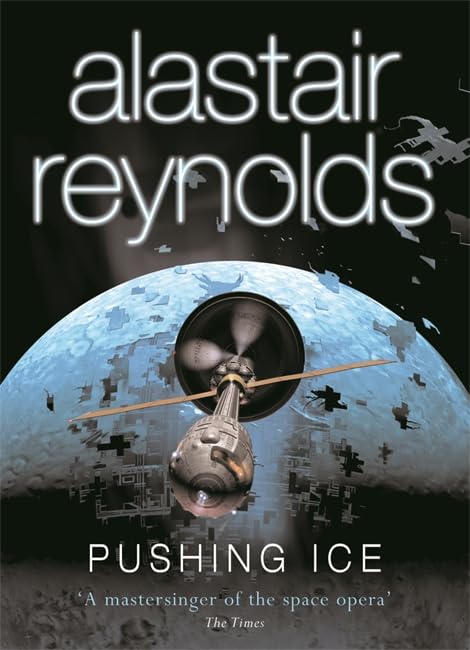
Alastair Reynolds came to prominence with a series of space opera novels exploiting that famed sense of wonder which Science Fiction fans are supposed to seek so much. Most of these are in a linked series set in an imagined future called Revelation Space but the one which stood out for me was the unrelated Century Rain where part of the action centred on a fake mid-20th century Paris which Reynolds realised with considerable success. The Gollancz paperbacks of these Reynolds books are of a strange size, the height of normal paperbacks but with a larger page width so that they sit proud of other books on a shelf. They also tend to be lengthy books. Charles Stross has recently posted on why SF novels became doorstops.
Pushing Ice is again unlinked to the Revelation Space series and begins as a Big Dumb Object (BDO) novel. The BDO in question is Janus, one of Saturn’s smaller moons, which has suddenly revealed itself to be an alien space ship and has zoomed off in the direction of the star Spica. The ice-pushing (ie comet quarrying) ship Rockhopper is the only Earth vessel capable of intercepting Janus and is sent to find out as much as possible. A sequence of accidents and misjudgements means Rockhopper is doomed never to return to Earth and will accompany Janus on its thirteen year journey. A major plot point concerns a message sent back from Rockhopper to Earth and broadcast on CNN. I did wonder; will CNN still be around in 2057?
The book then becomes a BDO novel thrice over as Janus comes to rest in a strand of a huge toroidal construction (I thought Bird’s Nest Stadium when I read the description) having passed through a tubular structure at Spica en route. Rockhopper, now firmly attached to Janus – off which it leaches its energy needs – has effectively become a generation starship. We then get first, and second, contact thrown into the mix.
In all there are three sections, separated – one more so than the others – in subjective time (Janus achieves relativistic speeds) and also thematically. The third section in particular stands on its own, but in the end the book is a touch too long. This does, however, mean there is incident aplenty as the inhabitants of Rockhopper come to terms with their ever changing situation and it gives Reynolds the opportunity to inject all sorts of SF wizardry, though he doesn’t lose sight of characterisation, but it all verges on becoming one damn thing after another.
I suppose Reynolds (and Gollancz) didn’t want to publish this as two books. That would have raised the cost too, a consideration even in non credit-crunched 2005.
Despite its slight overlengthiness, I did enjoy the ride, though.
Tags: Alastair Reynolds, Science Fiction
