Archives » Alastair Reynolds

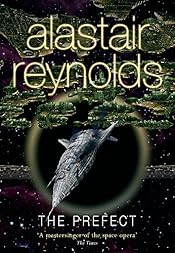
The Prefect by Alastair Reynolds

Gollancz, 2008, 502p.

I thought this one might be a bit of a slog. I know readers nowadays want a lot for their money but 502 pages is pushing things a bit. I buckled down, though, and got through over 100 pages a couple of nights so it wasn’t too much of a struggle.

Tom Dreyfus is the Prefect of the title, an agent of Panoply, the police force of the Glitter Band,* an agglomeration of diverse habitats orbiting the planet Yellowstone, a satellite of the sun Epsilon Eridani, the environment where the bulk of humanity now lives. Another detective novel, then, but with Space Operatic aspects.

The setting is a return to the universe of Reynolds’s previous Revelation Space novels but in this one the action takes place solely within the Glitter Band; apparently an ultra-democratic polity where votes on anything and everything take place all the time – including on whether Panoply may deploy weapons.

Someone has used a spaceship drive to destroy the Ruskin-Sartorious habitat thereby killing hundreds of people. The obvious culprit is punished but Dreyfus’s investigations lead him to believe this is merely cover for a much wider conspiracy. One of his assistants, Thalia Ng, is sent to begin software upgrades to the voting protocols on four habitats but when the last one is completed the constant contact (known as abstraction) the voters have with the centre is broken. A takeover of all four habitats ensues. The rest of the book is concerned with the efforts of Panoply to counter this insurgency and to prevent its spread to the whole Glitter Band. On the way this leads to the unmasking of two mysterious figures from the past, Aurora and the Clockmaker. The latter has put Panoply’s chief into mortal danger.

Once the set-up is over with and the plot gets into gear, the narrative flows nicely. There are plenty of twists and turns, with shifts in the balance of power, plus wheels within wheels, inside Panoply. Dreyfus is your standard good cop but is convincing as such, as is Thalia Ng. Some of their antagonists are a little less convincing, however.

A possible spoiler follows.

The main problem with the book is that the story merely stops. After those 502 (small font sized) pages the final conflict which the narrative sets up remains unresolved. Perhaps the book was too long already. Or is Reynolds going to give us a sequel? Whatever, while enjoying the ride, I was left somewhat unsatisfied.

*Since the disgrace of Mr Gadd I wonder if Reynolds regrets the name he gave this cornucopia of habitats?
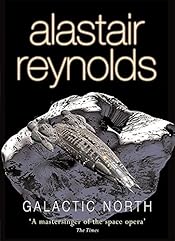
Galactic North by Alastair Reynolds

Gollancz, 2006

Galactic North is a series of shorter works (up to novella length) set in Reynolds’s Conjoiner/Demarchist/Ultra universe usually called Revelation Space; all galaxy-spanning hard SF tales with space operatic flourishes.
Aside:- Reynolds’s Conjoiners are humans enhanced by nanomachinery so that they are linked together (at shortish distances) in a hive mind. One of the problems I have with this idea is that they do not seem to behave appreciably differently from normal humans. I understand that to convey the essence of such people to Reynolds’s readers has great difficulties but they are not differentiated enough for me.

The stories in Galactic North are ordered to follow the chronology of the Revelation Space future not that of original publication. Unusually for a book of short stories the dates of their previous appearance are not given.

As is endemic to a lot of hard SF there is a good deal of info dumping and here we are also too often told things rather than shown them. The title story itself is particularly prone to this and could possibly have been expanded into a novel. It feels far too cramped in its allotted length. Also noticeable was that several of the plots involved quests of some kind.

A Spy In Europa, Grafenwalder’s Bestiary and Nightingale were more focused on character than the others in the book but all three verged rather too much into horror at their denouements.

Reynolds can spin a yarn and is capable of the gosh-wow, sense of wonder moment which SF aficionados like so much but too often in Galactic North the idea behind the story is its driver and the characters are there merely to illustrate it.

Reynolds is capable of reining in this tendency – he does so in the novels Century Rain and Pushing Ice and the reading experience is more satisfying as a result.

If you like Space Opera for its plots I’d recommend this book. If you prefer stories based more on character it’s not for you. Try Century Rain or Pushing Ice instead.

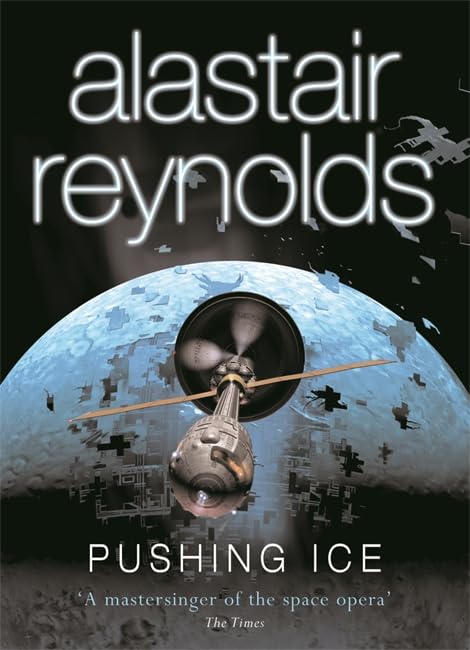
Pushing Ice by Alastair Reynolds

Gollancz, 2005, 384 p.

Weekend cover

Alastair Reynolds came to prominence with a series of space opera novels exploiting that famed sense of wonder which Science Fiction fans are supposed to seek so much. Most of these are in a linked series set in an imagined future called Revelation Space but the one which stood out for me was the unrelated Century Rain where part of the action centred on a fake mid-20th century Paris which Reynolds realised with considerable success. The Gollancz paperbacks of these Reynolds books are of a strange size, the height of normal paperbacks but with a larger page width so that they sit proud of other books on a shelf. They also tend to be lengthy books. Charles Stross has recently posted on why SF novels became doorstops.

Pushing Ice is again unlinked to the Revelation Space series and begins as a Big Dumb Object (BDO) novel. The BDO in question is Janus, one of Saturn’s smaller moons, which has suddenly revealed itself to be an alien space ship and has zoomed off in the direction of the star Spica. The ice-pushing (ie comet quarrying) ship Rockhopper is the only Earth vessel capable of intercepting Janus and is sent to find out as much as possible. A sequence of accidents and misjudgements means Rockhopper is doomed never to return to Earth and will accompany Janus on its thirteen year journey. A major plot point concerns a message sent back from Rockhopper to Earth and broadcast on CNN. I did wonder; will CNN still be around in 2057?

The book then becomes a BDO novel thrice over as Janus comes to rest in a strand of a huge toroidal construction (I thought Bird’s Nest Stadium when I read the description) having passed through a tubular structure at Spica en route. Rockhopper, now firmly attached to Janus – off which it leaches its energy needs – has effectively become a generation starship. We then get first, and second, contact thrown into the mix.

In all there are three sections, separated – one more so than the others – in subjective time (Janus achieves relativistic speeds) and also thematically. The third section in particular stands on its own, but in the end the book is a touch too long. This does, however, mean there is incident aplenty as the inhabitants of Rockhopper come to terms with their ever changing situation and it gives Reynolds the opportunity to inject all sorts of SF wizardry, though he doesn’€™t lose sight of characterisation, but it all verges on becoming one damn thing after another.

I suppose Reynolds (and Gollancz) didn’€™t want to publish this as two books. That would have raised the cost too, a consideration even in non credit-crunched 2005.

Despite its slight overlengthiness, I did enjoy the ride, though.

free hit counter script