Archives » Science Fiction

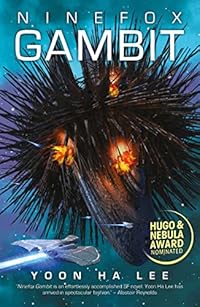
Ninefox Gambit by Yoon Ha Lee

Solaris, 2016, 317 p.

 Ninefox Gambit cover

This was on both the Clarke and Hugo Awards shortlists last year, which is why I read it. After two or so pages I wondered why I was bothering. The first chapter is a morass of information dumping and telling rather than showing with a battle described in terms that dwell on the grisly details yet are also bathetic. Plus, for an interplanetary conflict some of the weapons seem far too prosaic; bullets for instance.

We are in a milieu ruled by an all-powerful hexarchate – Shuos, Kel, Andan, Vidona, Rahal, Nirai – each of whose adherents at first seem to stick to one aspect of life (for example the Kel are soldiers whose “formation instinct” is their greatest asset) but turn out not to be quite so restricted. Some time in the past there was a heptarch (Liozh) but that tendency was expunged for calendrical heresy. Lee makes much play on this notion of keeping order by specifying time intervals. Calendrical rot is presented as a constant menace.

In Chapter One main viewpoint character Kel Cheris (Ajewen Cheris) is on a military mission to take an objective but is told to pull out as soon as she achieves it. She reflects that “Kel luck was frequently bad” – in which case why would anyone take part in it, then? Oh, of course. “Formation instinct,” (which seems more like indoctrination than instinct but is injected so must be chemical and which in any case comes over more as hidebound obedience. Yet occasionally some of the Kel do question orders so the instinct can’t actually be all that binding.) Later we are told, “It was one thing to sacrifice Kel soldiers. That was the purpose of the Kel.” Soldiers are for sacrificing are they? That might explain US military tactics down the years.

Cheris has been extracted as a possibility to lead the response to a calendrical rebellion at The Fortress of Scattered Needles. (Quite why she has been identified as a potential candidate is a mystery to this reader.) Her suggestion to resurrect the notorious, never defeated general Shuos Jedao, killer of millions in Hellspin Fortress centuries before and whose personality has been preserved in the black cradle to be trotted out from time to time when needed, is immediately accepted. His essence is implanted in her brain and off they go to challenge the rebels who are influenced by the Liozh tendency and in particular are on the way to implementing democracy, which general Jedao characterises as, “An obscure experimental form of government where citizens choose their own leaders or policies by voting on them.” Kel wonders how that could possibly work. Having Jedao in her head of course changes her by the book’s end, which sadly leaves ample scope for sequels.

The author’s apparent relish in describing body parts on the various battlefields makes his later attempts to induce sympathy or pity for victims of such extreme violence seem hollow, bordering on objectionable, while sentences such as, “It didn’t make him a mathematician, let alone one specializing in calendrical techniques, let alone one trained in this kind of evaluation,” with a phrase repeated after just four intervening words shows the lack of care in the writing (or editing.) This is only one example of many pieces of clunking prose in the book which is more or less a standard piece of military SF and not ground-breaking in any way.

Thankfully Ninefox Gambit won neither of those awards. What it was doing on the shortlists goodness only knows.

Pedant’s corner:- staunch (I prefer stanch,) “all the Kel weren’t as straightforward” (not all the Kel were as straightforward,) indictaed queries from other moth commander as well” (commanders,) “a small team of deltaform servitors were cleaning up the messes” (a team was,) practicing (practising,) “about what about what” (it doesn’t need the repeat,) “it didn’t take long for him long to respond” (either take out “long for” or “long to”,) damndest (damnedest,) a closing quote mark at the beginning of a piece of dialogue. “An infinitely brief pause.” (How can anything be infinitely brief? Infinite and brief are total opposites,) “alternately gold and bronze and silver” (successively gold and bronze and silver,) “‘They weren’t for the heretics, were they.’” (That sentence is a question; so needs a question mark not a full stop.) “‘I could care less.’” (The context is, “I couldn’t care less.”) “clear white” (there is no such thing, clear = see-through, white = opaque; so-called “white light” is actually colourless,) dodecahedrons (dodecahedra,) Nirai (the character has been called Niaad up to here – and later.)
Ursula Le Guin

I’ve just looked at the Locus website and discovered to my deep sadness that Ursula Le Guin has died.

She was one of the greats of Science Fiction and Fantasy and will be sorely missed.

Probably most famous for her “Earthsea” series of books she first came to my attention in the 1960s. I cannot now remember which book of hers I read first but I think it must have been the acclaimed The Left Hand of Darkness. I went on to scour bookshops for her work. I confess I wasn’t as impressed (in my relative youth) by the even more critically praised The Dispossessed – I probably hadn’t enough life experience then to appreciate it fully – but since those days her fiction has always been the background to my SF reading life, my anticipation of each new book never disappointed by its content.

Most recently I always enjoyed her book reviews for The Guardian, which showed a mind as sharp and incisive as ever.

Tonight the world – the universe – feels like a much smaller place.

Ursula Kroeber Le Guin: 21/10/1929 – 22/1/2018. So it goes.

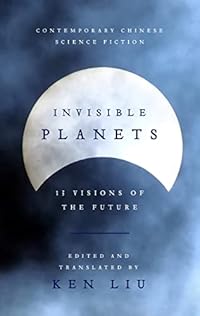
Invisible Planets: 13 visions of the future from China, edited and translated by Ken Liu

Head of Zeus, 2016, 383 p. Reviewed for Interzone 268, Jan-Feb 2017.

 Invisible Planets cover

Chinese SF has been making something of a splash in the wider world of late. This volume – containing thirteen stories (bar one all award winners in China) by seven authors, four women and three men, along with three essays on the form’s Chinese incarnation – provides the opportunity to delve into its ripples but perhaps dangles an invitation to a question. Do these examples of Chinese SF exhibit traits which are specifically Chinese in nature? Is it possible to discern characteristics unique to a culture’s literary output and, within that, to its SF?

In the broad sense, surely yes. Russian literature for example has a very different feel to that written in English. So too its SF. But does Invisible Planets spread its net widely enough to allow any such judgement? (I myself, though, having noted a qualitative difference in the broad sweep of US SF as opposed to that from the UK – which was then all but solely English – and so deliberately set out to write a novel that could only have arisen from a Scottish background, might be the wrong person to ask.)

In his introduction Ken Liu specifically warns us not to expect the contents here to be monolithic, that SF from China will be as diverse in nature as that from anywhere else, and cautions us that the stories he has chosen may not be representative; though he does note that SF from Singapore, the UK and the US “are all quite different” from each other, even if there are “further divisions within and across such geographical boundaries.”

He offers us “science fiction realism” from Chen Qiufan, the self-proclaimed “porridge SF” (neither “hard” nor “soft” – the terms apparently have slightly different meanings in China where hard refers to the inclusion of more technical material) of Xia Jia, “wry, political metaphors” from Ma Boyong, the “surreal imagery” of Tang Fei, “dense language-pictures” from Cheng Jingbo, the “fabulism and sociological speculation” of Hao Jingfang and Cixin Liu’s “hard science-fictional imagination”. Apart from Cixin Liu, most of the authors (whose names are all rendered in Chinese style, family name first) are “rising stars” and all work in professions.

The fiction starts with three stories from Chen Qiufan (Stanley Chan.) The Year of the Rat sees an unemployed graduate forced to join the Rodent-Control Force dealing with the genetically engineered NeoratsTM infesting the Chinese countryside. In The Fish of Lijiang, people exposed to time dilation or compression require occasional readjustment which they obtain by meeting up with those of the yin tendency to their yang. Body films, patches which express personality in response to muscular tension or temperature, feature in The Flower of Shazui which reworks the old tale of a man fascinated by a prostitute who is beyond his reach. She nevertheless requires his help.

Xia Jia also makes three appearances. In the at times dream-like A Hundred Ghosts Parade Tonight foundling Ning is the sole living inhabitant of a village of ghosts whose days as a tourist attraction are gone. He nevertheless does not age beyond seven. Tongtong’s Summer sees Tongtong’s grandfather needing care after a fall. This comes in the shape of Ah Fu, a robot controlled from afar via a telepresence body-suit. Soon grandfather is interacting remotely with others in his position. Packed with invocations of opposites and apparently inspired by the poem “With Dreams as Horses” by Hai Zi, Night Journey of the Dragon-Horse (a story original to this book) sees the dragon-horse awaken after centuries to a world long bereft of humans. It meets a bat and they travel together telling each other stories.

Ma Boyong’s The City of Silence might be taken to be a reflection of Chinese experience in its depiction of a time when web access and everyday discourse is restricted to only allowable words but its explicit reference to Orwell’s 1984 (and implicit one to Fahrenheit 451) implies a wider relevance. The inevitable attempts to circumscribe the rules lead to an ever narrowing list of healthy words. Marring this slightly was that some aspects of the story were seen from our frame of reference rather than its.

Hao Jingfang has two contributions. Invisible Planets uses a Scheherazade type storyteller (without the jeopardy) describing fantastical planets and their inhabitants to suggest how both interactions with others and experiencing stories can change us. Her Hugo Award winning Folding Beijing sees that city – out to the sixth ring road – as a kind of time share, with three Spaces taking turns in occupying the ground over two days before the cycle recurs. During two such Changes Third Space denizen Lao Dao, wishing to earn enough money for his daughter to attend kindergarten, makes the dangerous journey to take a message to the less crowded and much wealthier First Space.

Xiaoyi is the fifteen year-old titular character in Call Girl by Tang Fei. It isn’t sex she sells, though, but stories related to her ability to manipulate space and time. Cheng Jingbo’s Grave of the Fireflies is an almost indescribable admix of fairy tale – princesses, magicians – and end of the universe SF – the stars are going out – in five sequential sections headed three successively apart days in February yet spanning centuries.

We round off with two stories from Liu Cixin. The Circle is a reworking of a chapter from his Hugo winning novel The Three Body Problem. An ancient Chinese mathematician develops a binary calculating machine utilising soldiers carrying flags. In Taking Care of God two billion members of the God civilisation which created the conditions for life on Earth and oversaw its development are deposited on the planet’s surface from a horde of ageing spaceships. In exchange for the Gods’ knowledge their wellbeing is catered for by billeting each of them on a family. Inevitably tensions ensue. Their science turns out to be too far advanced to be intelligible and their daily habits tend to forgetfulness. There are echoes here of Aldiss’s Heresies of the Huge God, Clarke’s The Nine Billion Names of God and a touch of Leinster’s The Greks Bring Gifts. (Whether Liu was aware of, or even intended, these cannot be judged from a distance.)

The three concluding essays delve into various aspects of Chinese SF. Liu Cixin’s “Three Body and Chinese Science Fiction” covers SF’s century-long history in China, its original incarnation optimistic, its later role in the People’s Republic era where it was seen as being only for children, to be educative about technology, the startling absence of Communist Utopias within its purview, its new-found literary credentials and confidence, all as a lead-in to explaining the origins of the pessimistic vision imbuing his trilogy.

Chen Qiufan’s “The Torn Generation” contrasts the anxiety of the younger generation with the thoughtlessness of the older. “Faced with the absurd reality of contemporary China the writer cannot fully explore or express the possibilities of extreme beauty and ugliness without resorting to science fiction.” These are not strictures necessarily confined to China.

In the final essay, where Xia Jia tries to answer the question asked of her at a convention “What Makes Chinese SF Chinese?” she covers some of the same historical background as Liu Cixin, saying the breakaway from science-popularisation was motivated by binary oppositions such as China-the West, underdeveloped-developed, tradition-modernity, and concludes that while the Chinese SF community is full of internal differences she does find some commonality as the stories are written primarily for a Chinese audience, but, “Perhaps Western readers can also read Chinese science fiction and experience an alternative Chinese modernity and be inspired to imagine an alternative future.” Alternative futures. Any SF reader will drink to that.

But it’s the stories that matter. All here work well as SF. Their characters behave as characters do, with love, jealousy, resentment, tenacity, fear, and loathing. Apart from references to aspects of Chinese daily life and culture they could easily have originated from non-Chinese sources. Taken in all, however, I did note a tendency to didacticism, a leaning towards the fantastical, an awareness of contrasting opposites, an air of detachment. None of that would make them uniquely Chinese, though, and whether or not Chinese SF really is a creature all to itself, on this evidence it’s certainly worth reading.

The following did not appear in the published review.

Pedant’s corner:- “the fiction written in Singapore, the United Kingdom, and the United States are all quite different” (is all quite different,) interpretive (interpretative,) one of the China’s most elite colleges (one of China’s,) maw for mouth rather than stomach, Xian Quan (Xiao Quan,) hid (hidden,) “When seven words had been deleted, Arvardan knew it was Sunday. (Only if he’d started on a Sunday.) The structures on two sides of the ground were not even in weight, (is slightly clumsy; balanced in weight?) “has to transfer buses three times to get there” (has to change buses? Has to take three different buses?) “archers loosened volleys from their bows” (loosed volleys.)”There were a total” (there was a total.)

Interzone 274

Paris Adrift cover

Interzone has been taking a wee break.

The next issue, no 274, is though, I believe, scheduled to be published in March.

In the meantime I have received a copy of Paris Adrift by E J Swift for review in that number. She is the author of a trilogy which I’m afraid I haven’t read.

I have sampled her shorter fiction though.

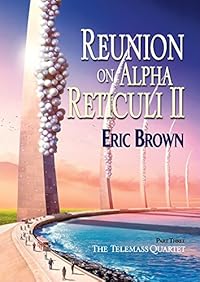
Reunion on Alpha Reticuli II by Eric Brown

Part Three: The Telemass Quartet, P S Publishing, 2016, 80 p.

 Reunion on Alpha Reticuli II cover

In this third instalment of Brown’s ‘Telemass Quartet’ Matt Hendrick is still following one step behind his ex-wife, Maatje, and the sleep pod containing his dead daughter Samantha, this time landing on the resort world of Tourmaline, now awaiting the imminent arrival of a starship despatched long before the days of telemass and whose inmates in suspended animation coldsleep are blissfully unaware of what will greet them. On landing he is rescued from the clutches of one (poor) telepath in Maatje’s employ by another (better) one not so encumbered. This is Mercury Velasquez, who volunteers her help in Hendrick’ s quest.

Unlike in the previous instalment the plot this time is more centred on Hendrick’s pursuit of his daughter. Maatje and her new lover Horvath have engaged the services of a Zuterainian effectuator. who may be able to restore Samantha to life. Velasquez’s telepathic ability reveals the dangers in the procedure. However, no full resolution is achieved (Part Four is still to come after all) and Maatje, Horvath and the insensate Samantha give him the slip again.

No weird religion this time but at least two types of strange alien to be going on with. If I have a criticism it is that the ending (involving arrival of the starship) is perhaps overly sentimental. But Brown has always emphasised human considerations.

Pedant’s corner:- In the cover – and internal – blurb; “all is not as it seems” (not all is as it seems.) Otherwise: “‘None of us like our private thoughts made public’” (ought to be “none of us likes”, but it was in dialogue, so may be true to the character,) an albino girl is described as having silver pupils (pupils? Not irises? And don’t albinos have pink irises anyway?) “‘pre-Telemass, pre-Expansion, prealmost everything we take for granted’” (to fit with the other two that should be pre-almost everything,) a missing comma at end of a speech quote, “‘Vizzek would have gone through the charade’” (through with the charade,) “‘Maatje’s might still be on’” (Maatje might still be on,) “‘I read you pain’” (your pain,) “Hendrick hitched himself onto high seat” (onto a high seat,) “him and his fellows humans” (him and his fellows; or, him and his fellow humans,) last line, difficultly (difficulty,) “he might have been able to accept it easier than” (‘he might have been able to accept it more easily than’ is the more natural form,) “Hendrick saw the saw the weapon” (only one ‘saw the’ needed,) “tears roll down her cheeks” (rolled.)
Time interval later count: 6 (though one was a sneaky “a little later”) plus one “minutes elapsed”.

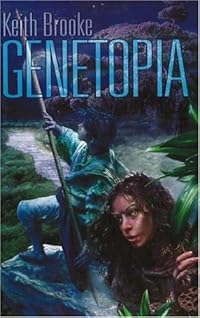
Genetopia by Keith Brooke

Pyr, 2006, 303 p.

 Genetopia cover

We are long in the aftermath of The Fall, in a genetically unstable world. Traits can migrate from species to species, carried by plague and fever, or deliberately induced in the gennering vats. Humans can become Lost, animals be brought up from beasthood to a form of sentience. Those called Mutts have been bred to obey – to love – humans without question and carry out menial tasks; slavery by another name. Technology has regressed to that of muscle power only. In all of this, true humans strive to keep their bloodlines pure. People are judged on what can be divined of their breeding and different clans specialise in different occupations.

While Brooke occasionally uses other viewpoints our main window on this world is through Flintreco Eltarn, whose sister Amber (Amberline Treco) has been sold into Muttdom by their father who (suspicious of his wife Jeschka’s proclivities) has always thought of her as impure, one of the Lost. The book then takes the form of Flint’s quest to find Amber. Along the way Brooke has the opportunity to present various aspects of his imagined world where everything outside the familiar bounds of a person’s knowledge is dangerous, any transformation a frightening thing, all change harmful and corrupting. As well as in the gennering vats changing vectors may occur in unfamiliar plants and fruits – or even in familiar ones. Yet human nature it seems is perennial. Venality, concupiscence, love, fear, hate all make their appearance.

He finally encounters one of the Lost, whose changing he was complicit in bringing about, who tells him, “‘The last trump has wiped out most of True humankind. All of nature (was) engineered to defer to your kind. When you find your judgement, the world will be inherited by those who have embraced change,’” and, “To be human is to be fluid, unfixed. Humanity today is not what it was yesterday, and it is only the start of what it will be tomorrow…. Out here we are truly posthuman. To be changed is to be blessed.”

Genetopia is in some ways an odd book. Within that familiar quest structure (which it partly subverts at the end) it seems to both decry and advocate a change in humanity. Perhaps the biggest problem I had with it was that the profound ability for biological change felt out of place with the regression of other technology. Brooke is good on relationships though, if a little pessimistic here about the possibility of a kinder humanity.

Pedant’s corner:- “When a human baby shows signs of the taint, when it reveals itself as one of the Lost – it was taken and exposed on the Leaving Hill.” (“it was taken”; therefore “showed” and “revealed”,) “a series of wooden rungs were lashed” (a series was,) “they were easier tolerated than enslaved” (they were more easily tolerated,) bouyancy (buoyancy,) Taneyes’ (Taneyes’s,) “and it fit” (fitted, but it was a US publication,) “either side fringed by bamboo and tall rushes” (each side.)

New York 2140 by Kim Stanley Robinson

Orbit, 2017, 619 p.

 New York 2140 cover

Most Science Fiction deals with Physics or Biology, sometimes Chemistry, and not infrequently societal development. It rarely treats with Economics.

In New York 2140 Robinson explicitly considers that dismal science. I was going to say economics with the emphasis on the con. A con in two senses. It isn’t a science – it’s not falsifiable; or at least its adherents do not alter their models when faced with contrary evidence – and its assumptions are unrealistic (at the very least too simplistic.)

In Robinson’s scenario sea level has risen fifty feet after two great pulses of Antarctic ice melting, The lower lying parts of New York (along with many other coastal cities; though Robinson is not much concerned with them as his main readership will not be) have been submerged. Skyscrapers rear out of the water like the stumps of piers. Nevertheless people still live in the intertidal area – a diamond-like polymer waterproofs internal and external surfaces as much as possible though buildings more susceptible to rotting occasionally “melt” back into the water/silt. The city’s thoroughfares are now canals – a SuperVenice. Walkways suspended above the waters allow passage between buildings without taking to the waves.

Robinsons hangs his story on the inhabitants of the Met Life building and some of those who come in contact with them. Each succeeding section adopts the viewpoint of one or other of two computer coders called Mutt and Jeff (surnames Rosen and Muttchopf); Police Inspector Gen Octaviasdottir; a hedge fund manager called Franklin; the building’s main caretaker, Vlade; an unnamed citizen, who provides Robinson with the opportunity to dump information and history at will; Amelia Black, a broadcaster to the cloud from her airship Assisted Migration and whose principal attraction to her viewers seems to be shedding her clothes; building representative Charlotte Armstrong; and Stefan and Roberto, two orphan adventurers searching the waters for archaeological remains under the guidance of a Mr Hexter.

There are some nice touches such as the description of our species, with regard to its (lack of) response to warnings of global warming, as Homo sapiens oblivious and references like, “ This moment of the storm,” to delight the SF aficionados plus the nickname Amelia Errhard bestowed on Black due to her facility to make mistakes.

The initial plot seems to be about an offer to the inhabitants of the Met to take it over while at the same time subjecting the building to attack. The main set piece of the book is the huge hurricane that hits New York bringing down lots of buildings and the wider financial system. (Robinson’s main target here is economics after all, rather than global warming.)

Spoiler alert.

Robinson suggests that in the aftermath of this crash (the third big one in his timeline) government will finally take on the bankers and bend them to its will/the benefit of the people. He also posits the adoption by the US of a universal health care system. Now that really is Science Fiction.

Pedant’s corner:- no start quote when speech begins a chapter, squoze (for squeezed. Is squoze a USianism?) compos mentos (it’s compos mentis, but ut may have been the character misspelling for effect,) sordiditties (sordidities,) “have look around” (have a look around,) “and shined his lamp” (shone,) Friederichschafen (Friedeichshafen?) “they remain costumed as executives or baristas or USA casuals but always in costume” (costumed in costume? Hmmm,) “use to be” (used to be,) maw (a maw is not an opening, it’s a stomach!) “of saying You look like you would be good” … “aimed a look at Amelia, like, Don’t encourage him” (why omit the quotation marks?) “Their offices were a kid of shabby decrepit office located at” (offices…office within 7 words,) “Homo sapiens oblivious” (Homo Sapiens oblivious,) “if worse came to worst” (I know that formulation is more logical but I’ve always known the phrase as “if the worst came to the worst”,) “he had never been a wind over a hundred” (in a wind,) “avuncular, meaning “unclelike” in Latin” (no, avuncular means unclelike in English; it’s derived from the Latin for uncle.) “So she was getting reading to go to dinner” (ready to go to dinner,) “‘raft buildings on it to study it’” (to steady it.)

Best of 2017

Fifteen novels make it onto this year’s list of the best I’ve read in the calendar year. In order of reading they were:-

The Amazing Adventures of Kavalier and Clay by Michael Chabon
His Bloody Project by Graeme Macrae Burnet
A Man Lies Dreaming by Lavie Tidhar
The Panopticon by Jenni Fagan
The Stornoway Way by Kevin MacNeil
The Sea Road by Margaret Elphinstone
The Untouchable by John Banville
Swastika Night by Katherine Burdekin writing as Murray Constantine
Spaceman of Bohemia by Jaroslav Kalfař
The Power by Naomi Alderman
Imagined Corners by Willa Muir
This is Memorial Device by David Keenan
The Underground Railroad by Colson Whitehead
Kalpa Imperial by Angélica Gorodischer
Psychoraag by Suhayl Saadi

That’s six by women and nine by men. Six were SF or Fantasy, counting in The Underground Railroad, (seven if the Michael Chabon is included,) seven were by Scottish authors.

Birthday and Christmas 2017

As you may know my birthday falls on Christmas Eve.

This means I get presents two days in a row (then I have to wait a whole year to get any more.)

No complaints though.

These are some of the things my family gave me this year.

Science Fiction: A Literary History edited by Roger Luckhurst:-

Science Fiction: A LIterary History

Five 1960s SF paperbacks:-

Books for Christmas

Eight Keys to Eden by Mark Clifton
Blue Moon edited by Douglas Lindsay
Path Into the Unknown: The Best of Soviet SF
E Pluribus Unum by Theodore Sturgeon
Nine by Laumer

That cover of Blue Moon is so redolent of the time.

A box of postcards of covers from Penguin SF books. Front of box:-

Postcards of Penguin SF Book Covers

Reverse of box:-

Postcards of Penguin SF Book Covers

Kurt Vonnegut themed Christmas presents. “And Soap it Goes” plus “Breathmints of Champions.” This recognises the source of my use of “So it goes.”

Kurt Vonnegut Themed Christmas Presents

“And Soap it Goes” ingredients:-

Kurt Vonnegut Themed Soap

“Breathmints of Champions” ingredients:-

Kurt Vonnegut Mints

And last but not least, a 2016-17 Sons home shirt. Sadly it wasn’t a lucky one on Boxing Day.

Dumbarton FC Home Shirt 2016-17

The Massacre of Mankind by Stephen Baxter

A sequel to The War of the Worlds.

Gollancz, 2017, 464 p.

 The Massacre of Mankind cover

This sequel to H G Wells’s War of the Worlds is authorised by the H G Wells estate and in it, of course, the Martians return to Earth. Since in our timeline they did not ever come in the first place that makes this book an altered history. To make it correspond with the original Baxter has to employ early twentieth century cosmology and speculation as part of his story, in particular the supposedly superpowerful civilisation inhabiting Jupiter’s cloud banks.

Our narrator is Julie Elphinstone, sister-in-law of the narrator of the earlier book. Elphinstone is a journalist (divorced from her husband) and at the start of the novel is working in New York. Britain is under an authoritarian regime, astronomy is banned to the general public – apparently worldwide – but of course everyone expects the Martians to invade again at the next opposition. Elphinstone is invited back to England to hear from her brother-in-law of their imminent arrival.

This time they come in greater force, have adapted their tactics and gained immunity from the microbes that did for them before. Britain’s armed forces, though better prepared, still fight the last war and the Martians swiftly gain a foothold and press their advantage. Two years later landings take place all around the world, allowing Baxter to set more scenes in the US, but much of the book is taken up with how people in England adjust to life under the gaze of the Martians and efforts to strike back against them. Elphinstone becomes an unwitting agent of the government in its attempts to defeat the Martians in the same old way but is instrumental in invoking the power of the Jovians to rebuff the Martians – or at least to make them retreat to the Arctic.

All the familiar Wellsian touches recur, the heat-ray, the red weed, the Martians’ desire for the blood of their conquered foes. (I know this adds to the horror – and Baxter adds in some gruesome scenes to illustrate it – but it is extremely unlikely that human blood rather than flesh could be a prime food source. I find excessive harping on the efficacy of blood in magic rituals and the like, as here, risible.) Baxter makes more of the Cythrereans the Martians have brought from Venus than I remember Wells doing. A strange inconsistency was that despite the Martians targeting motorised transport it is still used later under their eyes.

Baxter’s use of a female narrator is, of course, a reflection of our times rather than Wells’s. In this regard the inclusion of the strongish female character Verity Bliss (who might once have been introduced solely as a love interest for Elphinstone’s former husband Frank Jenkins but actually has much more agency than that) is another nod to the twenty-first century. Baxter also references things about which Wells would have been ignorant, like the Schlieffen War – in the book still raging between the Empires of Germany and Russia – Craiglockhart Hospital, Porton Down, Stapledon, and Ataturk as an Ottoman representative. He has a certain RFC Lieutenant, William Leefe Robinson kill a Martian in an air attack on one of their machines and mentions Wells as the Year Million Man.

But I’m struggling to see the point. Did we need a sequel to War of the Worlds? Does it really tell us anything about ourselves now? Or is it about present day fears? As an illustration of the ills that plague us in Britain – and the Western world in general – I would have thought a story about unfeeling monied zombies bleeding us dry would be much more apposite.

I don’t blame Baxter for taking the project on; it’s an open goal after all and he does accomplish it rather well. And I suppose it’s entertaining enough.

Pedant’s corner:- I read an ARC (proof) so some of these may have been corrected in the final publication. Practise (as a noun, so practice,) “‘I am aware have called some of you’” (I am aware I have called some of you.) “Even the privileged few like myself who had advance warning of the new invasion, this coldly stated news, the reality officially confirmed, came as a dreadful shock.” (Even to the privileged few,) “meant for a comparative trickle commuting clerks,” (of commuting clerks.) “Frank already had an intuition that the percentage of survivors would be small, that the wounded they encountered from the periphery of the infall,” (that the wounded they encountered came from the periphery of the infall,) “Frank said as determinedly as we could” (as he could.) “‘But he’s had no time for his precious fishing that since he was called up for the reserves’” (no “that” required,) “as he was.,” (has an extraneous comma,) “my sister-in-had” (my sister-in-law had,) “the thousand-strong crew .” (should have no space between crew and the full stop,) scuttlebutt (a USian term, so an unlikely usage on a British warship in the 1920s,) Jenkins’ (Jenkins’s, which appears four lines later!) “the contents of the their kit-bags” (of their kit-bags,) “mirroring my own side by riddled with detail,” (mirroring my own side in being riddled with detail,) Ted Land (elsewhere always Ted Lane,) “‘That looks it came off a sewer.’” (That looks as if – or, That looks like – it came off a sewer’) “the next I remember I was lying in on green grass” (no “in”,) “sat on a low twig” (seated or sitting, but since it was a yellowhammer perhaps perched,) “‘I can always use an enthusiastic NCO’” (the British usage is “I could always do with an enthusiastic NCO”,) “supplies of antibiotics” (in the 1920s?) fit (fitted,) “we newcomers were been invited” (were invited; or, had been invited,) priel (prial,) an extraneous open quote mark, Chapter 23’s number and title were not in the larger font size of all the others, ”he based had his calculations” (he had based his calculations.) “Even now it’s hard to recall now” (has an extraneous now,) “”adjusting their positions, And Cherie saw them” (a full stop after positions or no capital A at and,) “from the gitgo” (isn’t it getgo?) “where the fires where” (where the fires were,) “had so nearly had befallen” (has one had too many.) “Straight after the Second War he plunged straight into the Basra conferences” (two straights in eight words.) “‘And he’s as careless of his health as ever he is,’” (as ever he was,) the earth (the Earth, many instances.)

free hit counter script