Archives » Science Fiction

Interzone 274 Has Arrived

Interzone 274 cover
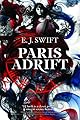
Paris Adrift cover

After its brief hiatus, Interzone is back, this time with issue 274.

Among the usual selection of goodies – including no less than seven stories – this issue contains my review of Paris Adrift by E J Swift.

The Rift by Nina Allan

Titan Books, 2017, 421 p. One of the novels on this year’s BSFA Award shortlist.

 The Rift cover

In 1994, when she was fifteen, Selena Rouane’s two years’ older sister Julie disappeared, an event which has haunted the family ever since. Years later, after Selena has had an on-off relationship with Johnny, who occasionally phones her from Malaysia where lay the job opportunity she ushered him off to, Julie returns to her life saying that in the interim she had been living on the planet Tristane in the Suur system, in the Aww galaxy. No mechanism is described for this. It just happened to her, as if by magic. Neither is there a description of how she managed to get back. Selena is convinced by her story, especially as Julie remembers a particular childhood toy, but their mother is not.

The Rift is oddly constructed. Most of the narration is from Selena’s viewpoint but other perspectives are introduced from time to time to broaden out the story Allan has to tell. We have diary extracts (and one from a terrestrial novel,) newspaper clippings, and a scientific report. In Selena’s recollections of the time of Julie’s disappearance the sections can read like a YA novel. At other times a fairly prosaic mainstream one.

Julie’s knowledge of Tristane’s geography and history as relayed to Selena is derived from the planet’s books, her memories sometimes presented as a gazetteer – akin to Christopher Priest’s The Islanders, only not so comprehensive. (Or did this comparison only come to my mind because of the connection between Allan and Priest?) Some emphasis is laid on a creature known as a creef, a parasite from Tristane’s system companion the planet Dea (once accessible by spaceship, now cut off,) which debilitates its victims from the inside, slowly eroding their mental and physical capabilities as described in a Tristanean novel The Mind-Robbers of Pakwa.

Creef are said to be like a silverfish or centipede. It is here that severe doubts about Julie’s intergalactic voyaging grow on the reader. Would a Tristanean novel really use such Earthbound terms? Then too there are the previous mentions of “Ziploc wallets”; the choice of the name Marillienseet for one of Tristane’s seas and Cally (pronounced Kayleigh) for Julie’s friend in her exile, seemingly pointing to an origin within Julie’s mind, since the band Marillion is referred to several times in the terrestrial sections of the book. Later we find that “centigrade” is the Tristanean unit of temperature. Plus in one of the “gazetteer” extracts Tristane’s main raw material, julippa, is stated to be similar to rubber – surely the entry’s writer would not even have known what rubber is; yet Julie would. And of course the correspondence between “julippa” and “Julie” is marked. None of these is presented as Julie trying to make a terrestrial comparison for the sake of clarity.

An invocation of the fake Grand Duchess Anastasia, Franziska Czenstkowska, otherwise known as Anna Anderson, is another powerful steer towards the possibility that “Julie”’s memories have been constructed from newspaper and other accessible information. The case was a brief media infatuation, as such things are. And what to make of Cally’s statement to Julie, “‘The written word has a closer relationship to memory than with the literal truth, that all truths are questionable, even the larger ones’”?

Allan’s characterisation is good, even the minor players in the story appear as rounded people (though those on Tristane are more barely sketched.) A nod to the importance of reading (and the lack of awareness in ignoring genre?) is given by the sentences, “Categorisation is a kind of brainwashing. How do you know which books will turn out to be important to you, until you’ve encountered them?” Yet it is a big ask to read this as SF rather than a quotidian novel with SF trappings. Though she clearly feels an affinity with speculative fiction other qualities in Allan’s writing speak more loudly.

Two of the four BSFA Award shortlisted novels down. Two to go. I might not manage one of them though.

Pedant’s corner:- broach (several times; that particular style of jewellery is spelled “brooch”,) “her beside clock radio” (bedside clock radio,) “it still fit” (fitted,) “for not pursing it” (pursuing.) “The southern polar regions …… remains largely unmapped” (regions remain unmapped,) “[its support plinths] are still judged by certain scientists … to be a logistical impossibility” (from a gazetteer extract. Logistics is the art of moving, lodging and supply; the rest of the sentence does not support this meaning. The materials for the construction must have been able to be transported and lodged; that is, supplied. But if this was merely one of Julie’s imaginings Allan may have used the wrong term deliberately,) “the [organic] bond takes place at the sub-atomic level” (how is that possible? Organic bonds occur between atoms,) “on the playground” (the usual expression is “in the playground”,) “in her stocking feet” (it’s “stockinged feet”,) “‘one less thing to worry about’” (was in dialogue, but it still ought to be “fewer”, as it should five lines later, in plain text,) sung (sang.)

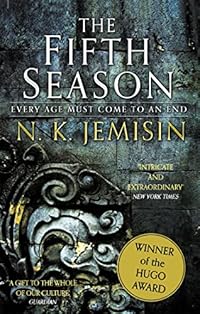
The Fifth Season by N K Jemisin

Orbit, 2016, 443 p

 The Fifth Season cover

The world contains a single supercontinent subject to perennial seismic disturbances via earthquake or volcanic eruption. Its inhabitants call this uncertain land The Stillness. Certain of them have the genetic capability to incite or direct the forces causing the upheavals. This arguably puts the book squarely in Fantasy territory but a Science-Fictional gloss is provided by the information that rogga (or orogenes, the term used depends on the speaker’s kindliness, or lack thereof, towards them) have organs known as sessapinae in their brain stems which confer the ability to sense and alter their surroundings and the rocks beneath, all the way down to the magma. Rogga are viewed with fear by the general populace and may be killed when discovered or else sent off to the Fulcrum in the great central city of Yumenes to be trained by Guardians into controlling their abilities for the greater good. A system of rings denotes adepts’ relative proficiencies (think belts in judo.) For the rest, life is mediated by a body of aphorisms known as stonelore.

The novel has three narrative viewpoints, sequentially interwoven through the early part of the book and carefully chosen by Jemisin to reflect her invented world. One strand is narrated in the second person (though by a woman called Essun whose husband Jija, before running away with their daughter, killed their toddler son when he in turn, in Essun’s absence, inadvertently revealed his rogga nature.) This strand is concerned with Essun’s search to be reunited with her daughter. We also experience the adolescent life of Damaya, a young girl whose frightened parents invite the Guardians to take her away to be trained and through whom the rigours and restrictions placed on an orogene are revealed. The third strand follows Syenite, a four-ring sent by the Fulcrum on a mission to clear the harbor of a town named Allia of an outgrowth of coral blocking shipping access. She is overseen by the ten-ring Alabaster (orogenes take the name of a rock when they achieve their first ring) in the hope the pair will produce orogenically gifted offspring. Neither Syenite nor Alabaster is particularly keen on this requirement. Their lack of agency in this and other regards is explicitly compared to slavery, which of course it is. Though it becomes obvious later on that the three strands are not contemporaneous each is narrated in the present tense. In addition every chapter has an epigraph (derived from stonelore) but only at its end.

Internal evidence implies that this world may be our Earth long after a geological catastrophe killed off most of humanity with only a few surviving to repopulate the world, and their descendants experiencing a series of Fifth Seasons in which environmental consequences of seismic upheavals result in societal breakdowns. There is a degree of technological backwardness but only a degree. Transportation is on a human or animal powered scale (or sail in the case of ships) but yet, curiously, the society still has antibiotics and blood testing.

Jemisin’s characterisation is excellent. With the possible exception of the second person narrator (the choice of that mode inevitably involves a distancing, though Jemisin has good reason to employ it as Essun is trying to be as detached from her situation as possible,) the reader experiences the book’s denizens as real people. They are as complex and flawed as humans usually are. Though we know there must be a connection between Dayama, Syenite and Essun it is a considerable achievement by Jemisin that its form remains opaque till close to the book’s end.

This was certainly worthy of winning the Hugo Award in 2016. Its sequel The Obelisk Gate also won in 2017. I’ll certainly be looking out for both it and the third in Jemisin’s “Broken Earth” trilogy, The Stone Sky, plus her previous novels.

Pedant’s corner:- as if sawed (sawn,) “takes a lot out of a you” (a lot out of you,) “these are just are shakes” (has one “are” too many,) aparatus (apparatus,) “gets ahold of himself” (gets a hold,) “but metal rusts” (metals corrode, but only iron rusts; you cannot get rust from any other metal,) “there’s iron ore in some of it and it’s rusted from the moisture in her skin” (iron ore does not rust; it is rust.) “None of you say anything” (None of you says anything,) Yumenes’ (Yumenes’s, which is used later,) “none of them are allowed to ..” (none of them is allowed to,) no opening quote mark when a chapter starts with a piece of dialogue, prestitious (prestigious,) adaption (context suggests adoption.)

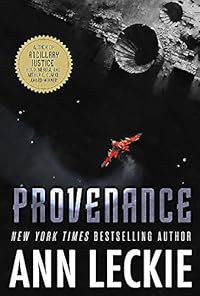
Provenance by Ann Leckie

Orbit, 2017, 443 p

 Provenance cover

This novel is set in the same universe as Leckie’s highly successful “Ancillary” books but this one is in a far-off corner well away from the Imperial Radch fiefdoms though a Radch ambassador makes an appearance at one point.

In an attempt to impress her foster mother Netano, and so improve her own chances of succession rather than have that bestowed on her foster brother Danach, Ingray Aughskold has travelled at great expense to the planet of Tyr Siilas to try to extract Pahlad Budrakim from a state of imprisonment known as Compassionate Removal. Budrakim is the son of the Prolocutor, an elected official on Ingray’s home of Hwae. Netano is a former Prolocutor who will be seeking re-election soon.

Pahlad is delivered to her in a suspension pod but Tic Uisine, the captain of the ship Ingray has paid to travel home in, is unwilling to carry any passenger without that person’s express approval. When the pod is opened its occupant denies being Pahlad but after some toing and froing agrees to go on the ship.

On arrival at Hwae they become embroiled in a diplomatic contretemps with the ambassador of the Geck – a race in contact with the mysterious Presger who are an incipient menace to humans. Though he has all the necessary papers the Geck believe that Tic Uisine has stolen his ship from them (more than one in fact) and want him for restitution.

Meanwhile the Omkem, from the next interstellar gate to Hwae, are manoeuvring to gain access to Byeit, the system one on from Hwae with whom Omkem used to have gate access before a revolution on Byeit broke the link.

Hwae society has an exaggerated respect for vestiges, each household seems to have its own repository of such things, called a lareum. Hwae’s most venerated object is a copy of its original independence document kept in the system Lareum. (I liked the use of this word, with its echoes of a Latin term for Roman household gods, for a vestige repository.) However it turns out that “copy” may be the precise word. Provenance you see. Though does that actually matter if everyone agrees that what the document represents is all that counts?

A bunch of Omkem soldiers invades the Hwae Lareum, taking schoolchildren hostages in the process, and Ingray offers herself instead. There is also some byplay about the disturbance of a possible vestige site and the death of an Omkem ambassador.

Leckie throws personal pronouns about with abandon. Unlike in the Ancillary books she does not use she exclusively. Ingray is a she, Danach a he, but others are designated e. This indeterminate pronoun necessitates the use of em and eir as possessives, plus emself and eirself. From a British perspective a phrase such as, “she told em,” reads a little awkwardly at first as plural.

Leckie also makes much of Ingray’s full skirts and her uselessness with hairpins. The text is also riddled with information dumping – a lot of which is unnecessary, Leckie telling us about her universe because she can’t resist doing so. There is far too much of Ingray’s inner monologue and a degree of prurience about sexual relationships straying very close to, if not over the border of, Becky Chambers territory. Yes, the narrative has a chatty style but at times it seemed as if Leckie might be being rewarded for a high word count as whatever strengths she may have, economy isn’t one of them. See Pedant’s corner for an example.

Provenance is on the BSFA Award short list this year for best novel. I’ve not read any of the others yet but I think it’s safe to say it won’t be my number one.

Pedant’s corner:- Sat (sitting.) “‘They are disquieting, aren’t they.’” (is missing a question mark,) “since she’d waked” (woken.) “One small child turned their head to look at Ingray. Sniffled. Opened their mouth.” (what’s wrong with “one small child turned its head? Opened its mouth?) “‘Does she.’” (Again, missing the question mark,) “and besides, both Dicat and Chenns very probably knew what they were doing. She would only be in the way, and, besides, she’d caused this, it was her fault that Nicale was hurt” (like so much else in the book this needs a damned good editing; get rid of at least one of the “besides”, and either the “she’d caused this” or the “it was her fault” as they both tell us the same thing.)

BSFA Awards for 2017

The shortlists for the BSFA Awards for last year went live while I was traipsing about down south.

They are:-

Best Novel

Nina Allan – The Rift (Titan Books)

Anne Charnock – Dreams Before the Start of Time (47North)

Mohsin Hamid – Exit West (Hamish Hamilton)

Ann Leckie – Provenance (Orbit)

I have read the Leckie (and will post a review on Saturday.) Two others are in hand.

Best Shorter Fiction

Anne Charnock – The Enclave (NewCon Press)

Elaine Cuyegkeng – These Constellations Will Be Yours (Strange Horizons)

Greg Egan – Uncanny Valley (Tor.com)

Geoff Nelder – Angular Size (in ‘SFerics 2017’ edited by Roz Clarke and Rosie Oliver, Createspace Independent Publishing Platform)

Tade Thompson – The Murders of Molly Southbourne (Tor.com)

I’ve read none of these so far.

Best Non-Fiction

Paul Kincaid – Iain M. Banks (University of Illinois Press)

Juliet E McKenna – The Myth of Meritocracy and the Reality of the Leaky Pipe and Other Obstacles in Science Fiction & Fantasy (in ‘Gender Identity and Sexuality in Current Fantasy and Science Fiction’ edited by Francesca T Barbini, Luna Press)

Adam Roberts – Wells at the World’s End 2017 blog posts (Wells at the World’s End blog)

Shadow Clarke Award jurors – The 2017 Shadow Clarke Award blog (The Anglia Ruskin Centre for Science Fiction and Fantasy). The 2017 Shadow Clarke jurors are: Nina Allan, Maureen Kincaid Speller, Victoria Hoyle, Vajra Chandrasekera, Nick Hubble, Paul Kincaid, Jonathan McCalmont, Megan AM.

Vandana Singh – The Unthinkability of Climate Change: Thoughts on Amitav Ghosh’s The Great Derangement (Strange Horizons)

Best Artwork

Geneva Benton – Sundown Towns (cover for Fiyah Magazine #3)

Jim Burns – Cover for ‘The Ion Raider’ by Ian Whates (NewCon Press)

Galen Dara – Illustration for ‘These Constellations Will Be Yours’ by Elaine Cuyegkeng (Strange Horizons)

Chris Moore – Cover for ‘The Memoirist’ by Neil Williamson (NewCon Press)

Victo Ngai – Illustration for ‘Waiting on a Bright Moon’ by JY Yang (Tor.com)

Marcin Wolski – Cover for ‘2084’ edited by George Sandison (Unsung Stories)

Luna: Wolf Moon by Ian McDonald

Gollancz, 2017, 390 p, including i p derivation of Wolf Moon, i p map of the Moon’s nearside, iii p Glossary, iv p Dramatis Personae and ii p Lunar Calendar.

 Luna: Wolf Moon cover

Not long into this second of McDonald’s “Luna” sequence of novels, the rolling city of Crucible, surmounted by solar mirrors focusing the sun’s rays into the enormous smelter for which it is named and beneath which its inhabitants live, the source of the power and influence of Mackenzie Metals, one of the Five Dragons (the families which effectively control everything on the Moon,) meets the end which we have suspected it would since the moment McDonald introduced it in the previous book Luna: New Moon. Software hidden in its controlling programming is activated to misalign the mirrors; with catastrophic results.

At first surprisingly, McDonald makes very little of this potential set-piece, certainly much less than he did the destruction of Boa Vista, the city of the now fallen Corta family, in the previous volume. But then, the focus of his Luna books is, or seems to be, that particular family. Corta Hélio, their firm which mined the helium-3 which powered the fusion reactors which keep Earth going, is now no more, its functions taken over by the Mackenzies. A few of the Cortas have survived, notably Lucas, who has enlisted the help of the Vorontsovs (the clan in charge of the Dragon which transports cargo between Moon and Earth) and made the dangerous decision to accustom himself to Earth gravity to travel there and prepare the way for his revenge. The narration, in that urgent present tense which permeates a lot of modern SF, also follows Robson Corta, a ward of the Mackenzies, lawyer Ariel Corta, Lucas’s son Lucasinho, and Wagner, one of those “wolves” who are affected by the Earth’s phases. A significant addition to the cast is Alexia Corta, Queen of the Pipes, who keeps the water supply flowing in her Brazilian township till she inveigles herself into Lucas’s orbit and becomes his right-hand woman.

MacDonald’s decision almost to underplay the fall of Crucible becomes understandable as it sets the scene for what can only be described as total war between several Moon factions. Certainly a great deal of mayhem is involved. Almost as an incidental the Eagle of the Moon dissolves the Lunar Development Corporation before he himself is deposed. Along the way MacDonald subtly slips in references to previous works of speculative fiction, “The company of wolves wheels on,” “Earth is a harsh mistress,” “The bone clocks.”

A neat touch is Lucasinho’s contention that in a society where just about everything can be printed and recycled, cake is the perfect gift as it has to be hand-crafted. Admittedly he was saying this in extremis to distract his young companion from impending doom but it was a welcome light-hearted aside.

McDonald’s Luna does not present as an appealing place in which to live. Its people are for the most part even less appealing. It was ever thus with pioneers.

Pedant’s corner:- USianisms intrude -ass for arse, curb for kerb, shit for shat – yet we have manoeuvre. “‘Oh can I?’ Dr Volikova and again Lucas heard the amusement in her voice,” (has a “said” missing,) “Death is nothing. Not even not nothing,” (not even not nothing? “Not even nothing” is more parsable,) as in the previous volume the “2”s of CO2 and O2 are rendered as here in normal type and not as subscripts CO2, O2, lip-sticks (lipsticks.) “None ask to see the lip-gloss-smeared bruises.” (None asks,) “insisted that that Lucas Corta would inherit” (only one “that” needed,) “‘I think you should go back to you seat,’” (your seat,) “‘That’s there a Corta left to ask?’” (That there’s a Corta…) “was she doing it all?” (doing it at all.) Elamentals (Elementals,) “in Ariel’s’ entourage” Ariel’s,) “a third squad of hired blades secure the doors,” (a squad secures the doors,) “the maids’ uniform,” (it was one maid so maid’s.) “Jinji brings down a personnel capsule down” (only needs one “down”,) “the pod AI warn” (the AI warns,) “Communications seems to be down” (communications is plural, so “seem to be down”.) “Foods shortages” (Food shortages) “He feel sick” (feels,) “‘And you are withered old scorpion’” (a withered old scorpion.)

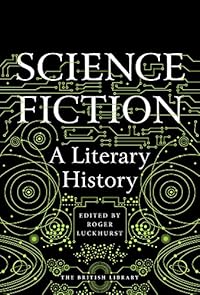
Science Fiction: a Literary History Edited by Roger Luckhurst

British Library, 2016, 254 p (including 2 p Preface by Adam Roberts, 3 p Introduction by Roger Luckhurst, 2 p Notes on Contributors, 1 p Picture Credits and 18 p Index.

Science Fiction: a Literary History cover

Adam Roberts’s Preface notes SF’s relative ubiquity in today’s world and praises this book as as compact and exhaustive an introduction to the subject as you will find. Roger Luckhurst’s Introduction, by way of reference to Jorge Luis Borges’s short story The Garden of Forking Paths (which presaged many-worlds theory by a considerable time,) acknowledges the impossibility of summing up SF in such a short space as a single book but hopes it will provide pointers to newcomers to the genre and to old hands alike.

The overall approach is more or less chronological. Chapter 11 sees Arthur B Evans tackle early forms of SF in The Beginnings. Roger Luckhurst himself covers the transition From Scientific Romance to Science Fiction in Chapter 2. The Utopian Prospects of 1900-49 are considered by Caroline Edwards in Chapter 32. There is some overlap in time here with Mark Bould’s Chapter 43, Pulp SF and its Others, 1918-39. Malisa Kurtz examines immediate post-war SF in Chapter 54, After the War. Chapter 65 has Rob Latham look at The New Wave ‘Revolution’. Chapter 7’s voyage From the New Wave into the Twenty-First Century6 is undertaken by Sherryl Vint. Gerry Canavan brings us up to date with Chapter 8, New Paradigms, After 2001. Each Chapter is repletely referenced and has a list of “What to Read Next” at its end. Imagine my satisfaction when finding I had read most – if not all – of the relevant recommendations. Plus I am in the process of ticking off another right now.

Perhaps the most interesting part (because the most remote) was Chapter 1 wherein Evans identifies many instances of SF or proto-SF from before 1900 and exemplifies two of its fundamental attributes at that time; diversion (imagination) and didacticism (cognition) – or, as Jules Verne’s editor/publisher Pierre-Jules Hetzel put it, instruction that entertains and entertainment that instructs. Well before the twentieth century subterranean or interplanetary adventure became well established – along with time travel – and u- and dystopias have always abounded. It is noted that early interplanetary spaces were modelled on colonial spaces – Space Opera and Star Wars your origins lie here. Indeed the colonial adventure (King Solomon’s Mines etc) can be considered as SF. Examples of the genre emanating from outwith the anglo- or francophone spheres are given due note, including SF works from pre-revolutionary Russia, Africa, Asia, Latin America – and also by black US writers – of which I was not previously aware.

The New Wave chapter laments that “unique talents” such as R A Lafferty, D G Compton, David R Bunch and Edgar Pangborn are little read these days. In one of those omissions Luckhurst acknowledged would occur discussion of one of my favourites from the time, Richard Cowper, is absent.

For anyone wishing to acquaint themselves with the genre this is an admirable place to start. It also provides potential new avenues for aficionados to pursue.

Pedant’s corner:- 1“by adding this own critical observations” (his own,) “the series of six novels … are set” (the series is set.) “But all is not perfect.” (But not all is perfect,) Cerillas’ (Cerillas’s.) 2“Has strengthened African-American will and prepared them for an international liberation movement” (“them” is the wrong pronoun here but to avoid it the whole sentence needs recasting.) “An imperial cabal of … plot to undermine the ..” (a cabal plots.) “As the new intake are given” (the new intake is given,.) “Slovakia’s defence strategy, and the novel’s SF element, employs the technique of…” (notwithstanding the parenthetical commas that “and” requires a plural noun; so, employ the technique.) 3“a series of coups weaken the fascist grip” (a series weakens the grip.) “The expedition… encounter” (the expedition encounters.) 4”from embracing the ‘the divine right of machines’” (omit the “the” before the quote,) “as the scientific elite have developed…” (the scientific elite has developed,) “the dark side of the Moon” (every side of the Moon is dark, for 14 days out of 28; I believe the “far side” was intended.) 5fit (fitted,) New Worlds’ (New Worlds’s.) 6ascendency (ascendancy,) a missing full stop, “between this world and the our present” (either “our” or “the”, not both,) “thus rejected earlier version of speculative genres” (versions of,) “it was posed to become” (poised to become.)

A Wrinkle in the Skin by John Christopher

Hodder and Stoughton, 1965, 218 p.

A Wrinkle in the Skin cover

John Christopher is perhaps best remembered for his Tripods series of books for young adults but also contributed to the British sub-genre of “cosy catatstrophe” most mined by the other John (Wyndham.) A Wrinkle in the Skin falls firmly into the catastrophe category as a series of giant earthquakes befalls the world. (From a modern perspective Christopher’s description of the cause of earthquakes was obviously written before the theory of plate tectonics was fully established.)

Matthew Cotter is a widower living in Guernsey when the earthquakes hit. After living through the ’quakes, his aim is to try to find his daughter who was living somewhere in England before the catastrophe. He first joins a small group of survivors one of whom acts as a kind of petty king intent on keeping the best female to himself to ensure any sons that ensue are recognized as his and regards Cotter (whose relative lack of interest in the opposite sex was established in the short pre-disaster chapter) as his right hand man. It is here perhaps that the sexual attitudes of the time A Wrinkle in the Skin was written (of time immemorial?) are most obvious as a woman who is a willing sexual partner for most of the others is referred to in the text in crudely dismissive terms.

Soon Cotter escapes to strike out on his own but is followed by a pre-pubescent boy whom he had earlier managed to rescue from a damaged building and for whom he now has to take responsibility. The English Channel has disappeared in the vast upheaval and they can walk across the old sea bed. During this sojourn they come upon a more or less intact oil tanker deposited on the new land, inhabited by a captain who has gone slightly mad.

Making it to England they hit upon a group who recognize them as non-threatening and take them in. The group seeks to hide both themselves and their stash from bands of marauders but of course can not always be successful. One such raid takes place when Cotter and many of the others are away from the camp on a food search. They arrive back in time to prevent the attackers from unearthing the food and Cotter uses a shotgun to drive them off, wounded or not. However, he later learns from one of the women of the new accommodation she has had to make to those gangs of men who chance upon her and the contempt in which she holds all men for their appetites. In a lawless, almost hopeless environment I suppose this is the way it would be.

As I recall the author’s The Death of Grass was somewhat similar in its treatment of the post-apocalyptic scenario.

Pedant’s corner:- “‘You know how to get here?’” (context suggests there rather than here,) Skiopos’ (Skiopos’s,) dark-aureoled (they weren’t aureoles, but areolas,) “he cut if off” (he cut it off.)

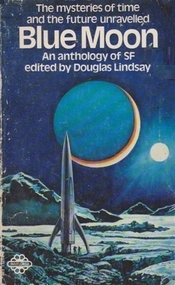
Blue Moon edited by Douglas Lindsay

Mayflower, 1970, 174 p

Blue Moon cover

I only really bought this because of its cover painting of an iconic V2-shaped rocket on a desolate planet with crescent moon overhead – a really evocative image. As to its contents, had I not noticed the publication date I would have sworn they were written in the 1950s. Such is the rudimentary writing style adopted by all the contributors, the emphasis on gung-ho action, the cartoon characterization, the ad-hoc information dumping, the casual xenophobia, the equally unthinking sexism, this read like a pulp magazine. The New Wave might as well not have happened.

Blue Moon1 by Norman L Knight starts with a totally unnecessary prologue and goes on into an equally forgettable space adventure which throws a decades-marooned spaceman, telepathy, and aliens up in the air then allows them to land where they will, with a rather telling aside about black humans being easily forgotten and sexual dynamics of the most rudimentary kind. (This last stricture applies to most of the stories here.)

Twilight of Tomorrow2 by Joseph Gilbert features a dictator who commissions a time machine to enable him to eliminate the threat to his plans to take over the world. Unfortunately the story’s last sentence, its whole raison d’être, for which it depends for its effect, isn’t true within the terms of the story. For the spoiler see Pedant’s corner.

Rain of Fire3 by Ray Cummings is a tale of interplanetary conflict. The eponymous rain is inflicted on Earth by inhabitants of the Jovian moon Phorgos. Three humans set off in a space-flyer – home-built by a Dr Livingston – to try to find out how to stop it. Phorgos is small and said to be utterly inhospitable; yet has a breathable atmosphere!! The three’s immediate response to its inhabitants is to shoot at them.

In Time Exposure by E A Grosser, using the new Hsuing drivers reveals the Lorentz-Fitzgerald effect to be an expansion rather than a contraction. Ships’ crews end up spread all over time.

The Case of the Vanishing Cellars4 by J S Klimaris features the Society for the Investigation of Unusual Phenomena looking into why cellars are suddenly disappearing. It’s all a fiendish alien plot.

In Ajax of Ajax5 by Martin Barrow, a certain Ajax Calkins is invited to be the ruler of a group of planetoids orbiting the leading of Jupiter’s Trojan Points and which are named after ancient Greek heroes. This is all as a cover for piracy.

The last two stories were written by Hugh Raymond. Washington Slept Here6 sees a real estate agent set out to find why there is a spate of seemingly natural deaths in the company’s properties. By the end the story has morphed over into fantasy. The Year of Uniting starts off in a US right winger’s wet dream of a restrictive US state (run by something called the Science Government.) Protagonist John Clayhorn makes his escape to Europe and there (for reasons unexplained in the text) receives help to instigate a revolution back home.

As a collection it’s tempting to say Blue Moon is of its time. But it’s actually worse than that. Even in its time it ought to have been after its time. Before 2016 I’d have said it is only to be read now as a historical curio. But we may well be going back there.

If you see a copy, buy it for its cover only.

Pedant’s corner:- Despite it being a British publication all of the stories are written in USian. 1an unindented new paragraph (x 2,) Hermes’ (Hermes’s,) demonaic (demoniac,) Dinapod (elsewhere Dinopod,) crepulscular (crepuscular,) equatic (aquatic,) terrestrial (terrestial.) “A gang of Dinopods were labouring” (a gang was,) a missing start quote mark at one piece of dialogue, a missing full stop. 2one less hero (fewer,) a missing full stop. Spoiler follows. That last sentence was, “He never existed.” But he did exist, up until the year of the time machine’s intervention in his life. And if he hadn’t, there wouldn’t have been a story. 3frightening numerous (frighteningly,) Hans’ (Hans’s,) “a line of metallic globes and cylinders were being assembled” (a line of …. was being assembled,) “Earth was a huge yellow glowing ball” (yellow?) “My metal-tipped fingers somehow seemed gripping Simms’s shoulder” (seemed to be gripping,) plus why invent a Jovian Moon? 4“a fine spech” (speech.) 5“Martian non-wheel cars” (the one the narrator is in has an exterior …. wheel! The whole is five lines later called “a huge single wheel”. Words almost fail me,) thusly (thusly? Who in real life ever uses that word?) Jobian (Jovian,) “the movements of one would effect all the others” (affect.) 6“‘I have never before been known consciously to refuse a drink’” (since the speaker hasn’t refused one this time either, that “before” is redundant,) “in the older days” (in the olden days is more usual,) nonchalently (nonchalantly.) 7Sanders’ (Sanders’s,) “she sat the both of them” (she seated both of them,) “with no slight sign of suspicion” (without the slightest sign of suspicion is a more natural phrasing,) Curtis’ (Curtis’s,) “in which was stored some rare viands and beverages” (viands, plural; and beverages, also plural; so “in which were stored.”)

Reelin’ In the Years 145: Hold Your Head Up. RIP Jim Rodford, Hugh Masekela and Mark E Smith

What a week this has been. It’s like 2016 came back again.

First Jim Rodford of Argent (and later The Kinks and the re-formed Zombies) then Jimmy Armfield, Hugh Masekela, Ursula Le Guin and Mark E Smith of The Fall.

Jimmy Armfield was an almost forgotten member of a certain England football World Cup squad but had a follow-up career as a manager in which he took Leeds United to the European Cup final where they were diddled out of a win by some dodgy refereeing but crowd trouble took some shine off the team’s efforts and later as a commenter on BBC radio’s football coverage.

I’m not much into jazz but was aware Hugh Masekela was an impressive musician, and equally important for his standing in the anti-apartheid movement.

I posted about Ursula Le Guin on Wednesday 24/1/2018. There were two articles about her in yesterday’s Guardian. This one by Alison Flood and Benjamin Lee plus David Mitchell’s appreciation.

The Fall is a band I didn’t follow (they were a bit after my time) but some folks swear by them. By all accounts Mark E Smith was a particularly exacting taskmaster.

Argent’s biggest hit was Hold Your Head Up from 1972. This is a TV performance from 1973.

Argent: Hold Your Head Up

Below are two samples of Masekela in performance.

Miriam Makeba and Hugh Masekela: Soweto Blues

Hugh Masekela: Bring Him Back Home (Nelson Mandela.)

And here’s The Fall’s cover of the Holland-Dozier-Holland song There’s a Ghost in My House, which gave them their highest UK chart placing.

The Fall: There’s a Ghost in My House

James Walter Rodford: 7/7/1941 – 20/1/2018. So it goes.
James Christopher Armfield: 21/9/1935 – 22/1/2018. So it goes.
Hugh Ramapolo Masekela: 4/4/1939 – 23/1/2018. So it goes.
Mark Edward Smith: 5/3/1957 – 24/1/2018. So it goes.

free hit counter script