Archives » Science Fiction

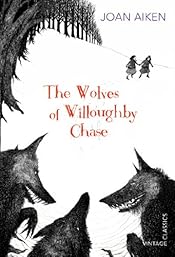
The Wolves of Willoughby Chase by Joan Aiken

Illustrated by Pat Marriott. Vintage, 2012, 227 p.

The book is an altered history set in an early Nineteenth Century England. There is a Channel Tunnel mentioned in a prefatory Note and wolves roam the countryside. Apart from two instances (where they variously attack a stationary train and chase the main characters) plus the odd howl from far off the wolves are mainly an off-stage menace though. It is clearly aimed at a YA – or even younger – audience.

Bonnie Green is the daughter of the grand house Willoughby Chase. Her cousin Sylvia is coming to visit as her carer, Aunt Jane, is getting on. Bonnie’s mother is ailing and requires a trip to help cure her, naturally accompanied by her husband. The first requirement of a children’s adventure, the absence of parents, is hereby secured. The governess hired to look after them, Miss Slighcarp, a supposed distant relative, is the usual wicked creature, not content with mistreating the pair but also intent on defrauding Bonnie of her inheritance with the assistance of the forger Mr Grimshaw. Much Dickensian harsh schooling ensues but the plucky pair escape with the help of Simon, a local boy who lives in the woods. They make their way to London to enlist the services of Mr Gripe, the estate’s lawyer.

It all rattles along (as YA novels have to) but this leaves little time for anything but sketching each character. Best read as a young person I would think.

Pedant’s corner:- a missing comma before a piece of direct speech, backboards (context demands “blackboards”.)

Latest Review

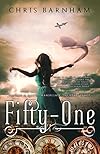
You may have noticed in my side-bar that I am now reading Fifty-One by Chris Barnham.

 Fifty-One cover

I bumped into the author at Follycon and vaguely remembered his book was on a list for review from Interzone a few months back.

Not knowing whether it had been sent to anyone else I blagged a review copy anyway with the promise of trying to get it into Interzone or else posting about it here.

IZ hadn’t sent it out so I’ve got the gig. The review might even be in the next issue (275) along with Andrew Crumey’s The Great Chain of Unbeing.

It’s a time travel story.

The cover (okay it has a doodlebug, but….) totally misrepresents the contents by the way.

Hugo Award Nominations

As on the Locus website where the full list of nominees can be found. There’s a lot of “the usual suspects” here:-

Best Novel

The Stone Sky, N.K. Jemisin (Orbit US; Orbit UK)
Six Wakes, Mur Lafferty (Orbit US)
Provenance, Ann Leckie (Orbit US; Orbit UK)
Raven Stratagem, Yoon Ha Lee (Solaris US; Solaris UK)
New York 2140, Kim Stanley Robinson (Orbit US; Orbit UK)
The Collapsing Empire, John Scalzi (Tor US; Tor UK)

Best Novella

River of Teeth, Sarah Gailey (Tor.com Publishing)
Down Among the Sticks and Bones, Seanan McGuire (Tor.com Publishing)
Binti: Home, Nnedi Okorafor (Tor.com Publishing)
“And Then There Were (N-One)”, Sarah Pinsker (Uncanny 3-4/17)
All Systems Red, Martha Wells (Tor.com Publishing)
The Black Tides of Heaven, JY Yang (Tor.com Publishing)

Best Novelette

“Children of Thorns, Children of Water”, Aliette de Bodard (Uncanny 7-8/17)
“Extracurricular Activities”, Yoon Ha Lee (Tor.com 2/15/17)
“The Secret Life of Bots”, Suzanne Palmer (Clarkesworld 9/17)
“Wind Will Rove”, Sarah Pinsker (Asimov’s 9-10/17)
“A Series of Steaks”, Vina Jie-Min Prasad (Clarkesworld 1/17)
“Small Changes Over Long Periods of Time”, K.M. Szpara (Uncanny 5-6/17)

Best Short Story

“The Martian Obelisk”, Linda Nagata (Tor.com 7/19/17)
“Fandom for Robots”, Vina Jie-Min Prasad (Uncanny 9-10/17)
“Welcome to your Authentic Indian Experience™”, Rebecca Roanhorse (Apex 8/17)
“Sun, Moon, Dust”, Ursula Vernon (Uncanny 5-6/17)
“Clearly Lettered in a Mostly Steady Hand”, Fran Wilde (Uncanny 9-10/17)
“Carnival Nine”, Caroline M. Yoachim (Beneath Ceaseless Skies 5/17)

I’ve read two of the novels and will read the Jemisin at some point. Not so much the shorter fiction.

BSFA Awards 2017

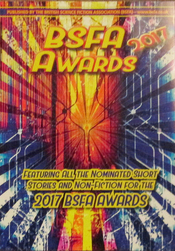
BSFA Awards 2017 booklet cover

Short fiction nominees:-
The Enclave1 by Anne Charnock (NewCon Press, Feb 2017) is not obviously Science Fiction. Written well enough, it focuses on Caleb, a refugee seemingly from Spain but it could be further south, at a time when the world seems to have global warmed. It has some echoes of Oliver Twist as Caleb is variously exploited and learns to trust no-one. The titular enclave lies somewhere near Manchester.
In These Constellations Will Be Yours by Elaine Cuyegkeng (Strange Horizons, 7/8/17) oraculos from the planet Buyin have enabled much swifter interstellar travel at the cost of having their backs opened, spines, brains and nervous systems attached to the galleon-ships which ply the celestial sea. Some avoid this fate by paying to opt out. There is a revolt.
Uncanny Valley2 by Greg Egan (Tor.com, 9/8/17) is an extract only. The full text is available online but I dislike reading fiction from a screen so this one page sample had to do and was consequently hard to adjudge.
Angular Size3 by Geoff Nelder ( SFerics, 2017) is in the tradition of the big dumb object story, or, in this case, the maybe not quite so big as something the apparent size of the moon but only detectable in the visible range of the electromagnetic spectrum suddenly appears in the solar system. However it may be as small as a button but, more importantly, a precursor to alien invasion.
The Murders of Molly Southborne4 by Tade Thompson (Tor.com publishing) is also an extract, two pages this time; too short an extract to appraise properly.

In the non-fiction items the extract from Modern Masters of Science Fiction: Iain M Banksa by Paul Kincaid is mainly about Feersum Endjinn, Whit, A Song of Stone and Excession.
Juliet E McKenna’s The Myth of Meritocracy and the Reality of the Leaky Pipe and other Obstacles in Science Fiction and Fantasyb examines the ways in which women are undervalued in and marginalised from SF.
There is an extract from Wells at the World’s Endb by Adam Roberts in which he looks at The Invisible Man.
Various contributors consider The 2017 Shadow Clarke Awardsc.
The Unthinkability of Climate Change: Thoughts on Amitav Ghosh’s ‘The Great Derangement’d by Vandana Singh deals with the unwillingness of people to think about climate change.

Pedant’s corner (fiction):- 1focussed (focused,) sat (sitting,) “no sense of daring-do” (it’s derring-do.) 2a stationers (stationer’s.) 3”they might consider humanity are a scourge on the planet” (is a scourge,) miniscule (minuscule,) focussed (focused,) “‘The White House are having kittens’” (is having,) “‘take it Edwards’” (take it to Edwards,) “‘it’s slowing down but still heading for the Moon’” (unless it was very close to the Moon already, not in any trajectory I’ve ever heard of.) 4feces (faeces.)
(Non-fiction):- ain a passage about Banks’s prefiguring of txt spk, “duz she 1/2 a naim” (I read that as one/two, not ½,) rumor and center (in a British piece about a British writer! Rumour and centre, please.) bCandaules’ (Candaules’s, yet we have Wells’s and Griffins’s,) “to talk an individual caught up in … is to describes” (to talk of an individual… is to describe,) “as good as stopping photons” (as good at stopping.) b”which that presenting evidence” (which presenting that evidence,) practise (practice,) selfevidently (self evidently.) c”as a third wave of riots break out” (a wave breaks out.) dCO2 (CO2.)

Interzone 274

Interzone 274 cover

Antony Johnston’s guest editorial considers influences. We all have them but everybody’s are different. In what he tells us will be his last column for Interzone Jonathan McCalmont1 lauds the spread of short stories exploring the experiences of the oppressed and marginalized but bemoans the fact that this has not travelled over into the genre’s main novel publishing outlets. In Time Pieces Nina Allan2 argues that the influence of Hugo Gernsback was to the detriment of both the genre and the mainstream, though that influence might now have run its course. In the Book Zone I review E J Swift’s Paris Adrift, Andy Hedgecock3 the Lewis Carroll inspired anthology edited by Ellen Datlow, Maureen Kincaid Speller considers Sam J Miller’s Blackfish City and interviews the author, Science Fiction: A Literary History4 is admired by John Howard, Rod Duncan’s The Queen of All Crows gets a thumbs up from Ian Hunter, Gareth L Powell’s Embers of War is given a guarded welcome by Duncan Lunan5, Lawrence Osborn notes the cliff-hanger ending to Charles Stross’s Dark State (but it is the second in a trilogy,) Stephen Theaker loved Blood Binds the Pack by Alex Wells even if it lacked originality, The Smoke by Simon Ings gets the approval of Ian Sales and Elaine Gallgher reviews Gary Dalkin’s plant based anthology Improbable Botany.

In the fiction:-
Beautiful Quiet of the Roaring Freeway by James Sallis is a very short piece bulked out by graphics redolent of rear light trails and features an illicit jaunt with a human driver on roads governed by automation.
Antony Johnston’s Soul Musica is set on a far-flung environment once connected to human civilisation by an Einstein-Rosen bridge now broken. The plot concerns gold-coloured local manifestations known as souls.
Schrödinger’sb by Julie C Day tells of the eponymous strip club (“A Universe of possibilities”) run by women in which a Dr Ringenbach has installed a box wherein molecular isolation is enabled by quantum refrigeration. But what can be kept in can also be kept out.
Saif and Hjørdis are two conjoined personalities – light years and centuries apart – in Never the Twainc by Michael Reid.
T R Napper’s Opium for Ezra is set inside a virtually impregnable battle tank engaged in a war against the Chinese. Or is it the experiences of someone immersed in a highly addictive virtual game? Whatever, it revels overmuch in the battle details.
baleen, baleend by Alexandra Renwick is the story of Zeke, who keeps diving into the ocean to drown and “pierce the curtain”, with his friends there to haul him back out. But every time he resurfaces the world has changed.
In Zene by Eliot Fintushel an alien invasion of the solar system is being enabled by koans.

Pedant’s corner:- 1series’ (series’s.) 2half-cock (half-cocked.) 3Richard Bowes’ (Bowes’s.) 4Caroline Edwards’ (Edwards’s,) 5hommages (homages, or else italicize the French spelling.) a2Res’ (2Res’s,) liquified (liquefied.) bWritten in USian, “I’d setup” (set up,) “she headed out door” (outdoors, or out of the door,) Britta (elsewhere the name is spelled Bitta,) “A reminder for us girls each and every time we turned created our quantum world.” (No. I can’t parse that.) cWritten in USian – except, centre!) both d and eWritten in USian.

BSFA Awards for 2017

This year’s BSFA Awards (for works published last year) were announced at Eastercon on Saturday 31st March.

The winners were:-

Best novel: The Rift by Nina Allan

Best Short Fiction: The Enclave by Anne Charnock

Best Non-fiction: Paul Kincaid for Iain M Banks

The Best Artwork Award: was shared between Jim Burns and Victo Ngai

The Mountains of Parnassus by Czesław Miłosz

Yale University Press, 2017, 188 p. Translated from the Polish Góry Parnasu, Science Fiction, Wydawnictwo Krytyki Polityczenej, 2012, by Stanley Bill. Reviewed for Interzone 268, Mar-Apr 2017.

 The Mountains of Parnassus cover

My knowledge of Polish SF has heretofore begun and ended with the works of Stanisław Lem. I saw this book as a welcome opportunity to rectify that. However, Miłosz made his reputation as a poet and essayist – as cited in his Nobel Prize – and this unfinished work (deliberately unfinished, the translator’s introduction tells us) is, as far as I can tell, his only attempt at an SF novel. Miłosz apparently had doubts about the viability of the novel as a form, though he considered SF’s realist conventions as the most promising vehicle for it even if “Science Fiction has mainly consisted of gloomy prophecies.” In his Introductory Remarks to the novel he says will “never be written” he notes that his depiction of two female characters “who do not appear in the pages printed here” made him shrink from the “horror” of writing a “novel from life.” Since “literature always fares awkwardly when it strives to depict good people and good intentions,” he describes what lies in front of us as artistically dubious and immoral. So much for fiction, then.

The book as a whole seems designed more for the academic than general reader with its Translator’s Introduction plus Note (both complete with references) emphasising Poland’s highly literary tradition of SF writing and Milosz’s view of SF as akin to scripture in its use of the past tense to describe future events. Correspondingly the “novel”’s latter parts are steeped in Catholicism. The style is discursive, its six sections reading more like essays than a conventional narrative. Strewn throughout them are nuggets allowing us to glean the outlines of society plus references to powerful groups of various sorts; the Botanists’ and Astronauts’ Unions, the Arsonists’ Association. There is no dialogue; unless you count the Mass of the Catechumens in the Appendix.

A description of the Mountains of Parnassus, supposedly kept in a state of wilderness, is written almost like a gazetteer. Their visitors exist in “an Earth without fatherhood” and strive to become their own fathers. A general atmosphere of ennui (avoiding “killing time” via the M37 current or erotic games, which prove unsatisfactory palliatives) leads a character called Karel to play Russian Roulette. His survival and altered mental state lends him immunity to the activities of an organisation known as The Higher Brethren of Nirvana which has begun to cull humans to prevent degeneration and extinction, its victims simply disappearing, each “losing its unitary quality in a single moment” with no one knowing the criteria for selection.

There follows an adumbration of the theories of Professor Motohiro Nakao which overturned the practice whereby “long ago the more energetic rulers had made the strange assumption that the minds of the ruled were a threat if they could not be convinced by persuasion or fear.” Data collection of “tracks” of perception can identify any which may be harmful to the rational social order defended by the Astronauts. This leads to Cocooning, interfering with the ability to communicate by slowing or accelerating the speed of a person’s thoughts thus denying access to those of others.

The “Cardinal’s Testament” of Petro Vallerg, all but the last celibate, finds him struggling to understand the thinking behind John XXIII’s aggiornamento in calling the Second Vatican Council, as it caused a rotting structure to collapse by attempting to refurbish it. Vallerg recognises the Church’s failings, where ritual has petrified into form, but “if the Church had not used the stake and the sword of obedient monarchs in the critical thirteenth century, little would have remained of Christianity,” and “no purely human institution similarly depraved could have survived,” but bemoans “the shame that induced us to reject the relative good simply because it was relative” and that the numinous has been reduced to metaphor and figures of speech.

Lino Martinez, member of the elite Astronauts’ Union, whose perk for risking their lives on humanity’s behalf is monthly longevity treatments, is never the absolutely perfect Astronaut and finding desires, passions, betrayals and faults reduced to miniature dimensions and the effects of time dilation disturbing, he deserts, to expose himself to time.

An Appendix: Ephraim’s Liturgy looks back to when inhabitants of Earth were allowed to run wild as educating them would be too difficult; “the petty and insignificant became great and significant”; a guaranteed small income allowed anyone who wished, to be an artist (but structuralism destroyed any hope of immortality thereby, rendered works indistinguishable) and the promise of communication had led to its negation. Ephraim therefore believed speech could be imparted only by ritual.

It’s all undeniably intellectual, almost Stapledonian but lacking the extraordinary timescale and perspective. I doubt it’s representative of Polish SF, of anything but Miłosz himself.

Pedant’s corner:- in the Translator’s Introduction “allows Milosz to takes these” (take.) I found it odd that the author’s full name (and indeed Lem’s first) – except twice, both times in Notes – is rendered with an unPolish unbarred l while that of another mentioned Polish writer, Sławomir Sierakowski, isn’t. Otherwise: “In the name of the Kingdom. I made sacrifices…..” (no full stop necessary?) snobbism (snobbery is more usual,) “sent their long ago” (there,) Bureaus (Bureaux.)
Path Into the Unknown: The Best of Soviet SF

McGibbon and Kee, 1966, 185 p No translator’s name given.

Path Into the Unknown cover

The first story in this collection, The Conflicta by Ilya Varshavsky is dedicated, To Stanislav Lemm (sic) “in memory of our argument which will never be resolved”. It focuses on a mother distraught at the affection in which her child holds the robot household help, an extremely intelligent machine but not without its own emotions.

A household robot also features in Robbyb again by Ilya Varshavsky. This one becomes increasingly cantankerous as it tries to apply logic to everything.

In Meeting my Brotherc by Vladislav Krapivin a young boy sees himself as the brother of a cosmonaut on a mission from long ago. When the mission returns his wish is fulfilled in a roundabout way. This story is less focused on the SF set-up than Varshavsky’s two, and more on human relationships.

A Day of Wrathd by Sever Ganovsky sees a journalist go seeking a group of artificially produced reasoning creatures called Otarks who may be more intelligent than humans but uncompassionate.

In An Emergency Casee by Arkady and Boris Strugatsky a spaceship returning from Titan to Earth is plagued by an infestation of eight-legged flies.

Arkady Strugatsky’s Wanderers and Travellersf features a scientist investigating a new type of cephalopod who meets a spacefarer who in turn has become the source of radio signals.

The Boyg by G Gor is the tale of an unusual school classmate whose father claims to have found evidence of aliens on Earth in the Jurassic period, one of whom may have survived to the present day.

In The Purple Mummyh by Anatoly Dneprov, said mummy is an artefact convolved (printed) from radio signals emanating from across the universe – its colour a manifestation of the Doppler Effect – and (barring a reversal of internal organs,) an exact replica of the narrator’s wife. This is taken to be proof of the existence of anti-matter worlds.

Reading this was a strange experience. Whether any infelicities are due to the nature of Soviet SF, to the translation(s) or to the times in which the stories were written is difficult to discern. It was interesting though.

Pedant’s corner:- patronymics are throughout spelled with “ich” at the end, the modern style is “ic”. Otherwise; aStanislav Lemm (now more usually written in English as Stanislaw Lem,) bDescartes’ (Descartes’s,) “watching the telly” (felt far too prosaic for the rest of the narration; “watching TV” might have fitted better,) paperbooks (paperbacks is the accepted term.) c”too late for Alexander to change their plans” (yes it was the group’s plans but the construction feels clumsy,) an ice-locked land, devoid of any life” (yet it has a breathable atmosphere? That requires oxygen – which requires …. life. Later we find it has plants – of a sort. But still one of the cosmonauts says ‘if it wasn’t for the sheet of ice there would be life here,’) milleniums (millennia,) one of them refers to himself as an astronaut (he seems to be Russian so would be a cosmonaut.) dTranslated into USian, “there was not a single trail of chimney smoke or a stack of hay” (nor a stack of hay,) sprung (sprang,) sybernetic (now spelled cybernetic,) staunch (stanch,) Nubio (context implies Nubia.) d“the spaceship lost speed and deviated from its course” (??? Not in any kind of orbital mechanics that I know,) unvoluntarily (involuntarily,) one end quote mark was missing. “.. go round sprinkling them with alcohol. Then set fire to them.” (deliberately set a fire? On a spaceship?) f“your onboard wireless” (reads very oddly nowadays; radio is referred to later,) ampule (is this USian for ampoule?) “the less chances there were “ (the fewer chances.) gseomthing (something,) “part were very much in doubt” (part was,) prgramme (programme,) “things that that there weren’t the slightest mention of in our textbooks” (that there wasn’t the slightest mention of,) a missing end quote for a piece of direct speech. “Everyone he had ever known were all here” (everyone was all here,) philosophere (philosopher,) “hydrogen links” (may be a direct translation from the Russian but the term in English is hydrogen bonds,) “a dinosaur which had small front teeth with very stressed grasping functions and no teeth” (small front feet.) Whether I could stomach him or not?” (That isn’t a question so does not require a question mark,) “the diing room” (dining room.) hparallelopiped (parallepiped,) radio-eradiation (seems to be a somewhat clumsy attempt to render into one word the radiation masking caused by a Faraday cage even though eradiation has an opposite sense.)

Shoreline of Infinity 4: Summer 2016

The New Curiosity Shop

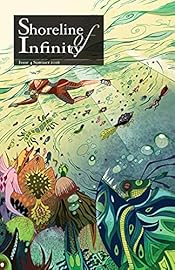
Shoreline of Infinity 4 cover

In this issue there are interviewsa with Ken Macleod and Tricia Sullivan by Gary Dalkinb. Duncan Lunan reviews Ken Macleod’s The Corporation Wars: Dissidence mainly by way of discussing other works; Iain Maloney mystifyingly likes Yoon Ha Lee’s Ninefox Gambit and praises publisher Unsung Signals for taking a punt on Dan Grace’s long short (or short long) piece of fiction, Winter, not to mention the work itself. Elsa Bouetc likes Lavie Tidhar’s Central Station, Benjamin Thomasd eulogises Guy Gavriel Kay’s Children of Earth and Sky despite its tendency towards info-dumping, Ian Huntere is less generous to Ian Boffard’s Tracer. Ruth EJ Booth’s first column discusses the effect of winning a first award on a writer. Russell Jones’s introductionf to Multiverse (the poetry section) manages to tell us what the poems are about before we read them.
As to the fiction:-
Well Enough Alone1 by Holly Schofield depicts the cognitive decline of an elderly woman. Keen to get rid of her electronic minder by damaging it, she persuades the repair technician to download its programming into her smartcane while awaiting a replacement. The smartcane has programming of its own.
In Senseless2 by Gary Gibson a future National Unity totalitarian government perverts a medical breakthrough by using a device to remove senses from the prisoners it detains. A blind inmate who has developed compensation mechanisms and concocted an escape plan is suspicious of a new cellmate.
Andrew J Wilson’s The Stilt-Men of the Lunar Swamps3 is a typically exuberant piece of Wilsoniana, a Vernian/Wellsian pastiche in which our intrepid adventurers travel into a cavern in the Moon to meet the titular stilt-men and their even more alien controllers. There’s also a character named MacGuffin.
Model Organisms4 by Caroline Grebell relates the last yearnings of a dying life-form.
In Note to Self5 by Michael Stroh a wannabe Science Fiction writer busily piling up the rejection slips receives a package in the post: his first novel, sent to him by his future self.
Robert Neilson’s From the Closet is the somewhat predictable story of a man who tailors himself – literally – to the profile required by his internet dating partner.
The G4.A of geefourdotalpha6 by Clive Tern is a fighting robot which achieves consciousness when brought down in its final battle, surviving hundreds of years before being unearthed by a human anxious to preserve her hunting grounds.
Beachcomber by Mark Toner is a continuation of the graphic/comic strip series introduced in Shoreline of Infinity 3. This episode manages to combine 1950s UFOlogy with the Broons!
Gay Hunter by James Leslie Mitchell (Lewis Grassic Gibbon) is an extract from that author’s novel of the same title, the latest to be considered under Monica Burns’s7 SF Caledonia umbrella.

Pedant’s corner:- aIn the introduction “Ken Macleod and Tricia Sullivan have both have contributed” (remove a “have”.) b“as an writer of the left” (a writer,) “advances are being made bio-engineering” (made in bio-engineering,) “this conservative tenancy” (tendency.) c“the benefits and drawback” (drawbacks make more sense.) dhonorable (honourable, please.) e”the very imposing, nay, ruthless figure, who” (has its second comma misplaced; it ought to be after “ruthless”.) fDodds’ (Dodds’s.) gIn an appeal for subscribers; super nova (supernova.) 1Written in USian, “an sensible-looking brush” (a sensible-looking.) 2”The guard led pushed Bill into a chair” (led, or pushed? Or led/pushed?) plus a missing comma at the end of a piece of direct speech. 3”is audience were in for” (his audience was in for,) there was an unwarranted change in font size part way through, “hoisted by our own petard” (hoist by our own petard.) “There was ghastly, flatulent bang” (a ghastly flatulent bang.) 4”I have laid immersed” (lain immersed,) kilometers (kilometres,) “spermatozoa multiplies in my ovaries” (spermatozoa is plural; so, multiply. Plus spermatozoa are male sex cells, they would multiply in testes, not ovaries.) 5Written in USian. 6Written in USian, “ – hat’s how the file translated” (that’s.) “At the start of its final battle started G4.A controlled the sector” (As its final battle started G4.a; or, At the start of its final battle G4.A,) “advantage point” (it’s vantage point, no “ad”.) 7”The list of his best loved authors ….include (includes,) “the unique SF canon … go virtually ignored” (goes.)

Exit West by Mohsin Hamid

Hamish Hamilton, 2017, 233 p. Another of the novels on this year’s BSFA Award shortlist.

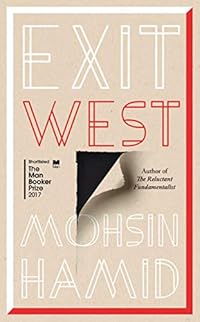
 Exit West cover

In an unnamed Middle-Eastern city on the threshold of becoming embroiled in an insurrection, Saeed and Nadia meet while attending evening class. Despite wearing a black robe that covers her from toe to neck she tells him, “I don’t pray,” and on their first coffee together answers his question about the reason for her attire by saying, “So men don’t fuck with me.” As their relationship develops mysterious black doors are meanwhile beginning to appear at various locations on Earth, allowing people to move from place to place without traversing the ground, air, or sea between.

The relationship between Seed and Nadia becomes closer but when given the opportunity Saeed says he doesn’t want to have sex till they are married. Nadia’s response is pithy. To have Nadia as the less repressed of the two (she was independent enough to live in her own flat and had taken a previous lover,) to be the unreligious one of the pair, is a neat touch by Hamid. History has its own way with them, though, as the insurgents take over the city and life becomes repressive and dangerous. On Saeed’s mother’s death Nadia moves into his family’s apartment. They keep a fake marriage certificate in case of inquiries.

The militants are only ever in the background – though they do give Hamid the chance to convey the flavour of their impact – but they provide the impulse for our lovers to take a chance on escaping via a black door. The doors are essentially a fantasy element. How they work is never gone into, they just appear and do their, effectively magical, work.

Nadia and Saeed first alight on the Greek island of Mykonos, confined to a refugee camp, then later another door transports them to a plush but otherwise unoccupied London flat. Soon the flat fills up with more migrants through the door, unrest at the incomers builds up in the UK and the neighbourhood becomes ghettoised and a microcosm of the wider immigrant experience.

It is perhaps a flaw that Hamid doesn’t quite fully explore this strange new world where borders have been for all practical purposes abolished – and I suspect he is far too sanguine about the political accommodation the British state makes with the migrants, one which, in any case Saeed and Nadia eschew by taking another door to the US. Hamid’s main interest lies in portraying the migrant experience through the arc of Nadia and Saeed’s love affair, the strains their uncertain existence puts on the relationship between. Hamid also does a lot of telling rather than showing, but that is not uncommon among writers more celebrated than he is.

Hamid makes the point that migration is a trauma for the individual, “When we migrate, we murder from our lives those we leave behind,” and that, “We are all children who lose our parents ….. and we too will be lost by those who come after us and love us, and this loss unites humanity.” Then again, “Everyone migrates, even if we stay in the same houses our whole lives, because we can’t help it. We are all migrants through time.” (This is why nostalgia, a yearning for a lost golden age, is such a pernicious emotion.)

Despite Exit West’s nomination for the BSFA Award, nothing in Hamid’s treatment betokens Science Fiction. This is really a mainstream novel (albeit a good mainstream novel) with an SF idea bolted on. The black doors are not necessary for the plot to work and the implications of easier transit between countries are rather skated over.

All three nominees I’ve read so far are lacking in some regards. I really don’t know which novel to place first; only the one I won’t.

Pedant’s corner:- legs akimbo (legs cannot be placed on hips; at least not on the same body’s hips,) fit (fitted.)

free hit counter script