Archives » Science Fiction

Best Reading of 2018

Listed below in order of reading. 16 in total; 7 by Scottish writers, 4 SF or Fantasy (+ 1 non-fiction about SF,) 3 in translation, 10 by men, 6 by women:-

Living Nowhere by John Burnside
All Our Worldly Goods by Irène Némirovsky
Science Fiction: A Literary History Edited by Roger Luckhurst
The Fifth Season by N K Jemisin
The Black Book by Orhan Pamuk
The Gathering Night by Margaret Elphinstone
When They Lay Bare by Andrew Greig
The Great Chain of Unbeing by Andrew Crumey
Hame by Annalena McAfee
I Remember Pallahaxi by Michael G Coney
Not so Quiet …. stepdaughters of war by Helen Zenna Smith
Memories of My Melancholy Whores by Gabriel García Márquez
Time Was by Ian McDonald
The Shipbuilders by George Blake
Mr Alfred M.A. by George Friel
Moon Tiger by Penelope Lively

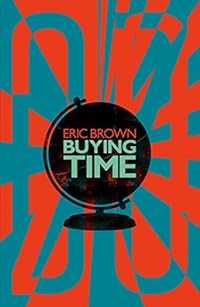
Buying Time by E M Brown

Solaris, 2018, 357 p.

 Buying Time cover

The designation of the author as E M Brown is a slight repositioning by the publisher of my old mate Eric Brown to highlight works of his that are more character based. (It’s a bit late and a bit odd. He has always produced these to go alongside his action adventure novels but even in those he did not neglect character.)

In 2017 Ed Richie, prodigious boozer, script-writer for Coromandel Cable’s Morgan’s Café and also with a few radio plays to his name, is a serial monogamist with a penchant for women of a certain type. His latest relationship with a woman called Anna blows up in his face after he has had some sort of medical emergency experiencing a blinding white light. The break-up is part of a pattern repeated throughout his life. He has a long standing, equally boozy, friend Digby Lincoln, a jobbing script-writer on the TV serial Henderson’s Farm, with whom he discusses his situation.

We then jump to 2030, where in an independent Scotland Ella Croft works as a journalist for ScotFreeMedia. England and the US are in the grip of right-wing authoritarian regimes and Scotland is accepting LGBT refugees from a US where gay marriage is banned and same sex relationships suspect. It seems Richie disappeared some time in 2025 after switching successfully to a career as a novelist. Croft, who knew Richie in her childhood, sets out to find out what happened to him.

When we return to Richie he has had another white light episode and discovers himself in April 2016, much to his confusion and others’ bafflement.

The Richie and Shaw strands alternate throughout the book, interspersed with interpolations from various journal extracts, some Richie’s own, others newspaper or media outlet pieces. Richie is tumbling backwards through time, from 2017 to 2016, then 2013, 2008, 2002, 1995, 1988, and finally 1983. At first Richie wonders if these are hypnagogic hallucinations but Brown later provides, via the 2030 Croft sections, a science-fictional explanation.

Brown draws some amusement from Richie’s knowledge of the future. To the revelation that Trump will be elected President of the US Digby responds, “What? The multiple-bankrupt TV celebrity shyster? Come on, even the Americans can’t be that stupid!” and when told Leicester will win the league in 2016 comments, “Now I know you’re crazy.”

A Trove of Stars, Digby’s SF piece, had caused a rift between them for a while as Richie told him he, “took needless time out to tell the reader about the characters’ states of mind.” Digby objects, “‘What I’m trying to do here is bring the concerns of the modern psychological novel to the hidebound format of hard SF.’ Richie had restrained himself from accusing his friend of talking pretentious bollocks.” In a later time-shift the book’s success signals we’re in a different timeline. All Richie’s touches down in the past must be in altered histories or else there would be time paradoxes.

Ed suffers further confusion when Finnish artist Emmi Takala, whom he met on a trip to Crete, seems to know about his condition but he time–jumps again before she can elucidate. Ella finds out Emmi also disappeared in the late 2020s when she went to England to meet a man called Ed. There is a connection too to scientist Ralph Dennison – mates at University with and Ed and Digby – an investigator into the theory behind faster-than-light travel but who, too, vanished in 2010. The scientists’ backer, tycoon Duncan Mackendrick, finally provides Ella (and us) with the puzzle’s solution.

Brown’s characterisation is excellent throughout. The Richie sections do not read like SF which is fine – good even – the Shaw ones do when necessary. Whether Buying Time brings “the concerns of the modern psychological novel to the hidebound format of hard SF” or is “pretentious bollocks” is for each reader to decide. I thought it was very well done indeed.

Pedant’s corner:- imposter (I prefer impostor.) “How many woman have you lived with over the years?” (women) “that all was not as it should be” (that not all was as it should be,) Diggers’ (Diggers’s – several other instances,) “her portrayal a grieving mother” (portrayal of a grieving mother,) Man U (earlier it had been Man U.,) humous (humous means ‘like a component of soil’, the food is houmous or hummus,) “He could curb the TV work, continued writing radio plays, and, to flex his creative muscles and ambition, tried his hand at stage plays.” (continue writing….try his hand,) recent British politics (given it’s 2030 here would that not be English politics?) Waterstones’ crowd (earlier, Waterstones staff and Waterstones crowd had had no apostrophe,) a double full stop at the end of a sentence (facing each other..) “‘You can bring yourself to love anyone’” (You can’t bring yourself to,) (and again later) -Tennant’s lager (Tennent’s,) “Pam took herself off the bed” (off to bed,) flag-stoned (flagstoned,) “she later said that that was what she initially liked about him was his ability” (she later said that what she initially liked about him was his ability.)

The Bone Yard by Paul Johnston

NEL, 2003, 316 p. First published 1998.

 The Bone Yard cover

Being the renewed adventures of Quintilian Dalrymple (after Body Politic) in an independent Edinburgh in 2020 where the inhabitants lead circumscribed lives ruled over by a Council and guardians while tourists to the year-round Festival are afforded every luxury.

Two people are found with their throats bitten out, tongues and genitals removed, and a cassette lodged in the wounds, in each case with a blues song (the Blues are banned in this Edinburgh) on the tape. When the first body is found Dalrymple is assigned the case due to his success in solving earlier murders. The usual conflicts with his nominal overseers ensue. Along the way we find out what the mysterious Bone Yard is, plus its connection to both the mothballed Torness Nuclear Power Station and pills dubbed Electric Blues – which are potentially fatal to those with weak hearts. We, Dalrymple, and his sidekick Davie, also make re-acquaintance with Quint’s love interest from Body Politic, Katharine Kirkwood. Her experiences outside Edinburgh in the interim, as recounted to Quint, have been grim (and a touch gratuitous) but provide a link to the killer.

The voice in which Johnston describes Quint and his attitudes is of the usual couldn’t-give-a-toss, rule-bending, I’ll-go-where-the-leads-take-me, would-be irreverent maverick type. While it seemed bright and almost fresh in Body Politic, here the similes and metaphors are either strained or overcooked.

Johnston has certainly hit on an unusual situation in which to set a crime novel. The speculative aspects are only trappings though. This is first and foremost a crime novel. A good enough one at that. But he’s since written five more Dalrymple books (plus eleven others.) This one didn’t much encourage me to look out the rest.

Pedant’s corner:- “the temperature swapped a minus for a plus reading” (the temperature went down, so a plus was swapped for a minus,) “didn’t use to turn up” (didn’t used to.) “Tonight was the only night of the year when the curfew isn’t enforced.” (conflict of tenses; wasn’t enforced is more natural,) had a accident (an accident,) bunsen burner (Bunsen burner,) e-string (E-string surely?) span (spun,) “a clear liquid” (colourless I think,) ouside (outside.) “Even though the numbers of Moslem tourists has fallen” (either ‘number of’ or else ‘have fallen’,) the Forth Rail Bridge (aka the Forth Bridge: since it’s the original only any others need a qualifying description,) a missing re-opening quote mark when a piece of dialogue resumed. Asshole, ass and smartass (this is Edinburgh; even there they put the “r” in. Arsehole, arse and smartarse,) “didn’t use to be like this” (used to be.)

Reading Scotland 2018

The ones in bold are in the 100 Best Scottish Books list.

I’ve read 33 Scottish (in the broadest sense) books in 2018, 7 SF or Fantasy (italicised,) 13 by women, 20 by men. E M Brown (aka Eric Brown) qualifies by having a small part of Buying Time set in Scotland and by living near Dunbar for the past few years.

I’ve not a good balance this year between men and women, mainly due to exhausting the women on the 100 Best list.

The Distant Echo by Val McDermid
Living Nowhere by John Burnside
The Hound of the Baskervilles by Arthur Conan Doyle
The Gathering Night by Margaret Elphinstone
When They Lay Bare by Andrew Greig
Autumn by Ali Smith
The Great Chain of Unbeing by Andrew Crumey
The Lie of the Land by Michael Russell
As Though We Were Flying by Andrew Geig
Madame Doubtfire by Anne Fine
Jericho Sleep Alone by Chaim I Bermant
Hame by Annalena McAfee
The Thirteenth Disciple by J Leslie Mitchell (Lewis Grassic Gibbon)
Memento Mori by Muriel Spark
Miss Marjoribanks by Margaret Oliphant
The No 1 Ladies’ Detective Agency by Alexander McCall Smith
The Gloaming by Kirsty Logan
The New Road by Neil Munro
Glitter of Mica by Jessie Kesson
From Russia with Love by Ian Fleming
The Abbess of Crewe by Muriel Spark
Supercute Futures by Martin Milllar
The Corn King and the Spring Queen by Naomi Mitchison
Places in the Darkness by Chris Brookmyre
Confessions of an English Opium Eater by Thomas de Quincey
Adam Blair by J G Lockhart
Naming the Bones by Louise Welsh
The Shipbuilders by George Blake
Mr Alfred M.A. by George Friel
Serious Sweet by A L Kennedy
Interrupted Journey by James Wilson
The Bone Yard by Paul Johnston
Buying Time by E M Brown

My Real Children by Jo Walton

Corsair, 2014, 318 p.

My Real Children cover

Multiple lives have been having a bit of a vogue recently what with the likes of Life after Life and The First Fifteen Lives of Harry August. The trend may be waning now but this is one to add to the list – though its premise is more akin to that of the film Sliding Doors in that its protagonist, known variously as Patricia, Patsy, Patty, Pat, Tricia, Trish, has two lives here, the hinge being when she accepts or rejects her fiancé’s demand to marry her on the instant when he garners only a third class degree instead of the first they had both been expecting. The first chapter sees Patricia in a nursing home at the end of her life, remembering her past and confused as to whether she had four or three children. Up to the fifth chapter we follow the course of her early life until the (in)decisive moment. The two strands of her life alternate chapters with each other thereafter.

Both are altered histories. Depending on the strand, there are relatively small nuclear exchanges between the US and USSR over Cuba, others later in the Middle East and elsewhere, Bobby Kennedy becoming President in 1964, the UK joining the Coal and Steel Community at its inception in the 1950s, a rise in authoritarianism in Pat’s later life. Unfortunately all of this requires too much telling and not enough showing and this applies to the main thrust of the stories as well as the historical background.

It’s all shot through with how hard life is for women and the unfairnesses of discrimination against minorities, particularly same sex couples. Worthy, but done heavy-handedly.

I know we’re implicitly invited to do so ourselves but it is only in the final chapter, when Patricia’s lives seem to have re-coalesced, that Walton begins to make wider contrasts and connections by which time it is really too late.

Pedant’s corner:- Despite being a British edition this uses the USian text and spellings. Otherwise; post office (Post Office,) Finefare supermarket (it was Fine Fare,) “wracked with guilt” (racked.) “‘They will, however, will serve adequately’” (has one ‘will’ too many.) “The government were funding” (the government was funding,) grifters (is a USian term. A Brit wouldn’t use that but ‘conmen’ instead.) “Could she made it again, knowingly?” (Could she make it again.)

Drowntide by Sydney J van Scyoc

Futura, 1987, 222 p.

Drowntide cover

Keiris is the scion of a family/clan, of Adenyo stock, which has the genetic ability to span (communicate telepathically) with sea creatures known as mams. The ordinary people of his society are Nethlor who accepted the Adenyo after their lands were drowned following a volcanic eruption. When Kieris’s sister Nandyris fails to return from a sailing expedition he appears to be the only heir to his mother’s calling – yet he has not manifested any capability in it. In the aftermath his mother acknowledges her powers are fading, reveals to him that he had a twin sister whose father had taken her away very shortly after the birth and charges Keiris with the duty of setting out to find them both and bring his sister back.

This planet has two moons, whose celestial wanderings lead periodically to a period called drowntide when the land to which Keiris travels is subject to daily inundation. In his journey through the islands at the end of the land the book has similarities to Kim Stanley Robinson’s A Short, Sharp Shock (which this novel predates.) Keiris eventually meets the tide folk, where his father is a sort of headman, and his sister – who has the hallmarks of another called race, the rermadken. In following the tide folk’s yearly pilgrimage Keiris develops a spanner’s voice and we discover from their folk tales that all these varieties of human originated from, and left, a poisoned Earth a long, long time ago.

This novel still stands up reasonably well thirty-plus years after its first publication. The cover doesn’t though.

Pedant’s corner:- Nandyris’ (Nandyris’s. Many of the names in this book end in “is” eg Tardis. Every one of their possessives was rendered is’ rather than is’s, ditto Harridys’,) “you care more for your own affairs then for our heritage” (than for our heritage.) “What shore had then chosen?” (What shore had they chosen?) “It gave into” (usually it’s “it gave onto”,) “on an unchartered beach” (uncharted,) “a very young women” (a very young woman,) patienty (patiently,) compell (compel,) “on nights when its warm” (when it’s warm.)

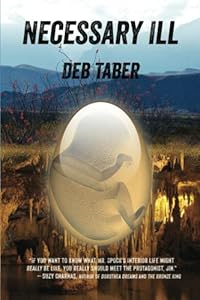
Necessary Ill by Deb Taber

Aqueduct Press, 2013, 350 p.

 Necessary Ill cover

The book features the presence of a large number of human neuters, whose personal pronoun is “it” and whose chests are free of nipples. It is implied that they are also without genitalia (but they do have a urethra for urination.) They speak to each other in stripped-down phraseology and call sexed humans “gens”. Another way in which they are different from “normal” humans is that they have heightened senses. This allows them to interpret human behaviour readily but they lack empathy. They of course have to disguise themselves as “normal.”

Chapters narrated in the present tense focus on the neuter Jin. The other main character’s viewpoint chapters are in the past tense. These feature the gen, Sandy, who when we first meet her is rescued by a neut from rape at the hands of the gang who have just raped and killed her mother and so becomes closely associated with neuters.

For some not very clearly articulated reason (gens are overburdening the planet? Really?) there is an organisation of neuters dedicated to spreading plagues designed to reduce gens’ numbers. Jin is such a spreader. In that light any animosity shown by gens towards neuters – which would have been in evidence in any case due to the common human failure to accommodate difference – is hardly surprising and therefore given a justification by the narrative. It seems an odd undertaking for a reviled/misunderstood minority to initiate and carry through, even if, “Genders fear what they don’t understand, and the way they choose to understand neuters is to turn them into something they don’t fear. Women. As if carving a slit through the tiny neut urethra would suddenly give it estrogen* and ovaries and an acceptable biological flow.”

The plagues start as biologically based but one predicated on soundwaves embedded in music, effective in inducing heart attacks in gens who show aggressive tendencies, has the most success.

To mitigate the effects of the inevitable anti-neut campaign a group of neuts in the film industry make a film of Jin’s life-story to try to make him, and by extension all neuts, more relatable to gens. (Like that would work.)

Necessary Ill is well enough written but I’m afraid the story it tells never quite convinced me.

Pedant’s corner:- *aka oestrogen, “wash away the mucous and grime” (mucous is an adjective; the noun required here is mucus,) gasses (gases,) Blue-eyes’ (Blue-eyes’s.) “Its zooms in on” (It zooms in on,) “the powder seemed to absorb the chemicals odours” (chemicals’.) “The cavern system stretches far beneath the surface the Guadeloupe Mountains into the Cornudas” (beneath the surface of the Guadeloupe Mountains,) a total figure for plague deaths was first given as ending at the date 10.06 but later 36% of the deaths were said to be from 10.1-10.6, “still she felt she needed speak the words” (needed to speak the words,) a missing comma before a direct speech quote (x 2,) “‘Well if the benefit of my feminine charms mean that much to you’” (if the benefit of… means that much,) “Jin thoughts fall into dreams” (Jin’s thoughts.)

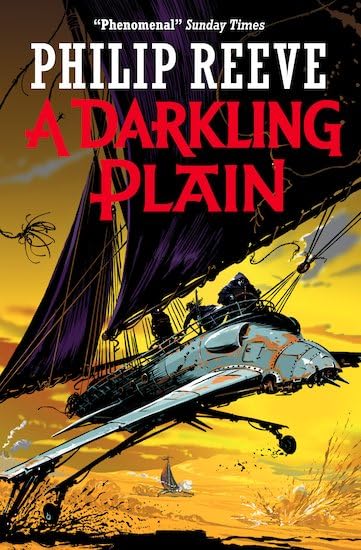
A Darkling Plain by Philip Reeve

Scholastic, 2006, 580 p, plus i p Acknowledgements and vii p Timeline of the Traction Era.

A Darkling Plain cover

This is the last in Reeve’s Predator Cities series of novels, continuing on from where we left off in Infernal Devices.

Tom Natsworthy now with a dicky heart after his shooting by Professor Nimrod Pennyroyal, and his daughter, Wren, are trying to pick up the pieces of their lives since their estrangement from Hester Shaw (respectively his wife and her mother.) In Wren’s case this is made easier by her attachment to Theo Ngoni. The plot kicks off when Tom thinks he recognises a woman, Clytie Potts, from his days in the now destroyed London, but she disclaims all knowledge of him. However an encounter with Wolf Kobold, the son of the ruler of the traction city Murnau leads to them going on his “suburb” Harrrowbarrow through the lines of the anti-traction army the Green Storm to where the remains of London lie in its surrounding debris fields. London turns out to be not quite the derelict it appears. Its surviving inhabitants have taken great care to keep themselves secret as they build a new city capable of magnetic levitation on the Earth’s Magnetic field.

Things haven’t gone entirely smoothly, though, as Wren and Theo have been separated by his enslavement – from which he is rescued by Hester. Other characters to reappear from the earlier books are the aforementioned Professor and the machine-like Shrike and Anna Fang. The latter of these drives part of the plot as she is able to control an orbiting WMD called ODIN using it against both sides of the traction city wars to undo a peace initiative.

As usual in YA fiction there is an abundance of action and incident, though a degree of coyness with matters of attraction between the sexes. Reeve lards his text with extratextural references (some of which may go over the heads of a YA audience.) We have characters named Lurpak, Nutella, Lego and Duplo, a street in Murnau called Über-den-Linden, a traction city named Peripatetiopolis, stories of awful salvage-stealing Wombles, a tunnel-like street called Holloway Road – heavy-handedly re-stated as Hollow-Way Road – mistakes about old-time usages (contract lenses,) and mention of a statue of Thatcher, the all-devouring goddess of unfettered Municipal Darwinism. I did wonder whether Cynthia Twite was possibly a nod to Joan Aitken’s Black Hearts in Battersea.

All great fun if you like that sort of thing and not entirely without jeopardy but one caveat.

I know the concept of predatory cities roaming the plains aiming to devour each other is an extrapolation ad absurdum but is the emphasis on violence not perhaps an unsuitable way to socialise the young?

Pedant’s corner:- burgermeister (burgomeister, but presumably Reeve didn’t want to alienate his YA audience,) “the Green Storm were” (the Green Storm was,) “than the old-fashioned jigs and reels than Wren had learned” (that Wren had leatned,) off-of (off,) “the old brake-blocks which supports Crouch End’s roof” (brake-blocks which support.) “Was that was this was all about?” (Was that what this was all about?) “Stories which she had had scoffed at” (only one “had” required,) “wondering where he had sprung him” (sprung from.) “A group of Green Storm aviators were running” (a group was running,) “one less regret” (one fewer.) “A party of his men were herding ..” (a party was herding,) “a saucer-shaped antennae” (antennae is the plural, one of them is an antenna.)

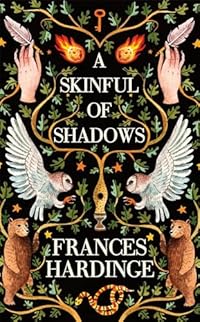
A Skinful of Shadows by Frances Hardinge

Macmillan, 2017, 423 p. Reviewed for Interzone 273, Nov-Dec 2017.

 A Skinful of Shadows cover

A YA novel with the usual quota of incident this is also a book written with a pleasing clarity and focus.

Makepeace Lightfoot is brought up as a Puritan in her aunt’s house in Poplar, sleeping on a straw mattress shared with her mother. More unusually her mother frequently forces her to spend nights in a church so that she might learn to ward off ghosts. Her lack of knowledge of her origins and the conflict this produces induces Makepeace to run off after a man her mother lets slip came from Grizehayes, her father’s home. This leads Makepeace into a mob heading for Lambeth Palace, protesting against the influence Archbishop Laud has over the King. In the confusion her chasing mother loses touch with her. Makepeace encounters wisps emanating from the body of a mistreated dancing bear, whose presence, as Bear, will be with her for ever. When Makepeace’s mother dies in the disturbances the classic ingredient for a children’s story, no parents, is in place but there is a moment of horror as Makepeace battles off her mother’s ghost.

Quickly packed off to Grizehayes, the ancestral seat of the powerful Felmotte family where the patriarch Lord Felmotte is a malevolent presence, calling her ‘the by-blow’, Makepeace is despatched to work in the kitchen where she befriends the domestic animals, despite Bear’s reluctance, and in turn is taken up by her half-brother James, another Felmotte by-blow who tells her a Felmotte’s character changes for the worse when he comes into his inheritance. While the reader has already divined the phenomenon it is only slowly that the extent of Makepeace’s genetic disposition – beyond the Felmotte cleft chin – becomes fully apparent to her.

That the waters we swim in colour our attitudes is indicated by Makepeace’s observation that, “Back in Poplar, everyone had known that the king was being led astray by evil advisers and Catholic plots. …. in Grizehayes it was just as obvious … that a power-hungry Parliament driven to frenzy by crazy Puritans was trying to steal power from the rightful King.”

Up to this point that background conflict seems only colouring but Hardinge integrates it into her plot with the revelation of the existence of a charter bearing the King’s seal acknowledging the Felmottes’ unique strangeness in return for their financial support.

The relatively kindly Sir Thomas Felmotte, who has not yet inherited, reveals to Makepeace, “‘There is a …space inside us. We can host more than ourselves.’” Makepeace realises, “‘We’re hollow. And dead things can get in.’” On death, the Elder Felmottes pass on their personalities to their chosen heir’s body, which acquires exceptional skills as a result. As Sir Thomas rationalises, “‘Imagine how great a family would be, if no experience, no skills, no memories were ever lost.’” The downside? Only the strongest personalities survive among the mix.

Makepeace ponders their toleration by the Elders and begins to understand the danger she and James are in, telling him, “‘We are spares,… somewhere to put the ghosts in an emergency!’”

The dispute between King and Parliament has by now erupted into full blown war, “The world was turning cartwheels … and nobody was sure which way was up any more,” providing Makepeace with the opportunity to flee when that emergency does arise. But James has meanwhile succumbed to Felmotte infiltration.

“Humans always betrayed you sooner or later,” Makepeace reflects, but embarks on a search for a way to restore James to himself and destroy the Felmottes forever. Along the way she incorporates a doctor, a Parliamentary soldier and a Felmotte sent ahead to take her over. These talk to her in a different, lighter font. Her travels take her to the King’s court at Oxford and capture by a Parliamentary detachment where she is accused of witchcraft. She speaks again to our times with the thought, “Humans are strange, adaptable animals, and eventually get used to anything, even the impossible or unbearable. In time, the unthinkable becomes normal.”

Towards the end Hardinge has a playful stab at the author/reader relationship with the doctor’s ghost’s rumination, “I am nothing but a bundle of thoughts, feelings and memories, given life by someone else’s mind. But then again, so is a book.”

The author’s touch is assured and her execution admirable. Apart from some dialogue which (arguably necessarily) doesn’t quite have a 17th century feel there is little to find fault with here.

The following did not appear in the published review.
Pedant’s corner:- Remarkably for these times I found only one typo, “she had had unexpectedly halted” (only one “had”.) Yes the book had a few examples of collective nouns being given a plural verb but these were in dialogue and therefore possibly true to the character – except for “a murder of Crowes were gathered around Lord Felmotte” (was gathered.) The phrase, “‘I had a ringside seat’” is hardly a 17th century expression, I’d have thought, and unfortunately we had an explosion occurring at an “epicentre” (centre.)

A Door Into Ocean by Joan Slonczewski

Women’s Press, 1987, 410 p.

The novel starts off on the planet Valedon but is mostly set on its aquatic satellite, Shora, inhabited for centuries solely by women. They wear no clothes since they spend a lot of time in the moon-spanning ocean and have a bluish tinge due to microbes which, in the aquatic environment, help them to maintain breath. In contrast to Valedon – a world where the usual vices of political power are prevalent and which seems to be a militarily directed society – life on Shora is peaceable, its values based on sharing learning, and where the highest form of punishment is Unspeaking (that is, sending someone to Coventry.) They are also capable of a state known as whitetrance, a type of withdrawal where their hearts slow almost to death. The Shorans live on rafts of plant material floating on the water’s surface and have an appreciation of the interactions between all the life-forms – beneficial or seemingly inimical – that make up Shora’s web of life. They also have a deep knowledge of biology and genetics and a plant-based means of expressing new organisms quickly.

Traders from Valedon – sometimes known pejoratively as malefreaks – have been present on Shora for years and Berenice Hyalite – known on Shora as Nisi – has come to a deep understanding of its way of life. Her father set up the trading post but she reports back to the rulers of Valedon. There is some interplay between Valans and Shorans on whether the others are really human with respect to each other but all the characters present as recognisably so to the reader. Berenice’s fiancé Realgar is a military man, and he is given the command of the Valedon forces sent to Shora to bring it fully under control.

The novel is thus set up to explore the mutual incomprehension of the military mindset and the habitual, instinctive, non-violence of the Shorans. It can therefore be read as a feminist work but is equally parsable as a Science Fictional exploration of a different approach to life’s challenges. In A Door Into Ocean Slonczewski is exploring an alternative way of being human. This is partly territory pioneered by the late lamented Ursula Le Guin. Slonczewski is no Le Guin but is good enough to be going on with.

Pedant’s corner:- laniard (lanyard,) “Berenice like to absorb” (the rest of the paragraph was in past tense, so, Berenice liked,) maw (mouth was implied, a maw is a stomach,) sunk (sank,) shined (shone,) octopi (octopuses, or, octopodes, but since we’re on an alien planet, octopods,) sprung (sprang,) “I could take take pills” (only one take needed,) “‘You could to that?’” (do that,) brusk (brusque,) langauge (language,) “more that she let on” (than she let on,) “was kept with in raftwood” (within,) strategem (stratagem,) collander (colander,) waked up (woken up,) automatons (strictly, automata.)

free hit counter script