Archives » Science Fiction

ParSec 1

ParSec 1 cover

New digital SF magazine ParSec launched today from PS Publishing. It’s a handsome cover image.

You can buy it here.

I have no fewer than four, yes four, reviews within its pages.

This Fragile Earth by Susannah Wise

Composite Creatures by Caroline Hardaker

The Mother Code by Carole Stivers

The First Sister by Linden A Lewis

I’ll be posting those here once a decent time interval has passed.

Luna: Moon Rising by Ian McDonald

Gollancz, 2019, 446 p.

This is the third (and final?) in the author’s Luna series (see here and here) and McDonald’s characteristic prose style is again in evidence, his ear for a telling phrase, the almost lyrical descriptions, but straightforwardly down to earth (down to Moon?) when necessary.

Once more we are shown ongoing events in the present tense, a device which imparts a sense of urgency – and contingency – to the narrative. The main plot here relates to who is to assume the guardianship of Lucasinho Corta who suffered catastrophic anoxia on the lunar surface in the previous book and now has to have his memories rebuilt from the recollections of others, but this is counterpointed with the ongoing conflict between the powerful lunar companies collectively called Dragons.

Since Corta Hélio has fallen, only four of the Dragons remain, Taiyang of the Suns, the Asamoahs’ AKA, the Vorontsovs’ VTO and the Mackenzies of Mackenzie Metals and MacKenzie Helium, but Lucas Corta is determined to make the most of the position as Eagle of the Moon he levered himself into in the last book. An introduction here is the University of Farside – fiercely independent of the Dragons – to where Lucasinho is taken for the memory restoration treatment and whose employees eschew former family connections.

As in Luna: Wolf Moon the defining feature of lunar life, the Four Elementals of air, water, carbon and data, rights to which are monitored by the chib in every inhabitant’s interactive contact lens, are not lingered on but this reflects the chib’s everyday nature for lunar citizens. Unless those rights run low they would not be a concern. They do, though, come into play at the dénouement.

The Dragons and their jostling for power – here joined by the incipient threat from Earth to eliminate the Moon as a competitor – is an exaggerated metaphor for unbridled capitalism, red in tooth and claw. The level of bloodshed is a warning about the consequences of the absence of legal restraints – though doubtless some readers will greet those scenes with approval. But McDonald raises the question of whether such a mode of living could be sustainable (and given the high body count here a certain degree of doubt is justified.) While their means of pursuing their interests had been indistinguishable from the other Dragons’ the Cortas’ collective insistence that family is everything suggests a different set of values is possible. It’s certainly desirable.

The scenes involving Marina Calzaghe (returned to Earth and finding herself regretting it,) though highlighting prejudice as they do, are something of a distraction from, and ultimately unrelated to, happenings on the Moon. But they illustrate McDonald’s wider vision.

Among those I no doubt missed there are embedded reference to Flanders and Swann, to Casablanca (in the film Bogart never actually said, “Play it again,” but of course Woody Allen used the phrase as the title of a play which later became a film,) and to Candide. There is a bar named The Flashing Blade, an adaptation of the Scottish (and Northern Irish?) term of approbation ‘Ya dancer’ to the US audience, a pun on ‘take the heat off them,’ another on ‘The Eagle has landed’ – this last’s setting up waiting almost three books for its payoff.

Few who read this could be disappointed with the experience.

Pedant’s corner:- “the lay of her belly” (the lie of her belly,) “a housand dins” (a thousand dins,) “in every cell her body” (cell of her body.) “The position rotate every two years” (rotates,) “blown four million years in the eruptions” (blown four million years ago,) “the size of size of her torso” (only one ‘size of’ required.) “Lucas’s hand tighten on the knurl of his cane” (tightens,) bola (the throwing weapon referred to is a bolas.) “Waiting in the corridor are AKA employee to lift and store…” (employees,) “smashed every rule the road” (of the road,) “looking down in to the” (down into,) sub-regolithis (sub-regolith.) “He strokes Lucasinho cheek” (Lucasinho’s,) “darker even that the dark basalt” (than the dark basalt,) “systems runs checks” (systems run checks,) Alexis (Alexia,) “puts out medical alert to his blades” (puts out a medical alert,) zeros (used to be spelled zeroes,) “‘there’s be’” (‘there’ll be’,) prospket (x2, prospekt,) “catches it, throw it on to another” (throws it on,) “and how she used to them” (how she used them,) “when the Earth-light in hot in him” (is hot in him,) open maws (a maw is a stomach, not a mouth,) staunch (stanch,) “the thunder of carnival give way to” (gives way to,) “loathe to involve itself” (loath, or, loth. Loathe is to despise/hate/abhor,) ambiance (ambience,) “none are as small and compact” (none is as small,) “When the Gularte’s left Caio for dead” (Gulartes.) “Wagner heart turns over” (Wagner’s heart,) “none of them are worthy of” (none of them is worthy of.)

Glister by John Burnside

Jonathan Cape, 2008, 263 p.

Begin with a warning. In a prefatory chapter, someone, who has passed through the Glister, is remembering the story of his life, again. In that story his name is Leonard and he remembers John the librarian saying to him, “When it comes to reliability, it’s not the narrator we should be worried about, it’s the author,” but Leonard himself tells us it’s not the author either; it’s the story that is unreliable.

Be that as it may, it is Leonard’s recollections which take up the bulk of the book. He grew up in a coastal town somewhat cut off from the rest of the world – outside influences do intrude, there is a Spar shop and references to television (curiously to Dr Kildare and Richard Chamberlain, which seems a bit out of time with the rest of the narrative) – a town once home to a chemical plant, whose contamination blights the lives of those who worked there, and perhaps even those who stray or rummage onto its former grounds or into the so-called poisoned wood, but people stay and put up with it all. (Not Leonard’s mum, though, who, unable to cope with her situation, pissed off when his father took ill leaving Leonard to take care of his dad.) But the town has a bigger problem. There have been disappearances of children, teenage boys, over the years, unexplained disappearances which cast a pall over everyday life.

Leonard lived in the Innertown, the most deprived and blighted area, distinguished from the Outertown where the big houses are. The Innertown has the same claustrophobic feel as the village in Burnside’s earlier novel The Devil’s Footprints and the hellish residue of the plant bears echoes of the Corby he described in Living Nowhere. Leonard’s story is given in the first person but other sections are written in the third and describe incidents to which he was not a witness. (These may still be him writing from an omniscient viewpoint, however; remember the unreliability of story.) They include Morrison, the local policeman, who seems to have got his position without in any way training for it, the local big man Bryan Smith (who levered Morrison into his job so as to have a hold over him,) Morrison’s alcoholic wife, Alice, recluse Andrew Rivers, and Leonard’s girlfriend, the precociously sexually adventurous Elspeth.

Morrison is conflicted by his knowledge of finding the dead body of the first boy to disappear, his enthralment to Bryan Smith (who got his henchman Jenner to deal with it) and his duty as a policeman. Towards the end he reflects that “the soul is wet and dark, a creature that takes up residence in the human body and feeds on it …. possessed of an unhuman joy that cares nothing for its host, but lives, as it must live, in perpetual, disfigured longing.” Alice senses her husband’s confusion but is mired in her own difficulties. Rivers has kept all the reminders of his dead father and is alert to the possibilities his behaviour has of being misunderstood. Elspeth is a spark of life but seems to be perpetually randy. The mysterious outsider Leonard calls the Moth Man, supposedly conducting a survey of the flying insect population of the contaminated area but also taking the opportunity to explore the nooks and crannies of the disused chemical plant and possibly with a darker involvement in events, with a hint of the supernatural, flits in and out of Leonard’s story while occasionally providing him with brews of a strange tea. Of his non-exclusive, on both sides, relationship with Elspeth, Leonard muses that romance is for older people, not adolescents.

Despite the realistic depiction of Leonard’s encounters with John, Elspeth, the Moth Man and the members of the small teenage gang led by Elspeth’s ex-boyfriend Jimmy van Doren, there is an overhanging feel of Science Fiction or fantasy to proceedings. This prefigures the ending, the manifestation of the Glister, which, while possibly explaining the disappearances does not do so fully but is nonetheless satisfactory.

At one point Leonard tells us of “the sense I have of a story all disjointed and out of sequence.” The novel is not like this at all. Burnside writes supremely well. I wasn’t overly satisfied by the ending even though it is in accord with what preceded it, but in all other respects Glister is gold.

Pedant’s corner:- “maybe ony a few minutes” (maybe only a few,) cargos (this plural used to be spelled ‘cargoes’,) unimagin-able (not at a line break, unimaginable,) ditto “separ-ate” (separate.) “It has to with Leonard” (It has to do with Leonard.) None of the others see me go (sees me go,), Rivers’ (Rivers’s,) “when she come across” (comes across,) a missing start quotation mark.

New Review Books

Via Parsec (see here) I’ve received two more books for review.

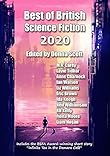
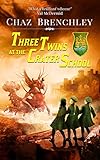
These are Best of British Science Fiction 2020 edited by Donna Scott, which I hope will live up to its title, and Three Twins at the Crater School by Chaz Brenchley. This last seems to be the first in a series of “English girls’ boarding school stories. On Mars,” based I assume on the Chalet School books by Elinor M Brent-Dyer, an author whose œuvre I do not remember ever sampling.

White Wing by Gordon Kendall

Sphere, 1986, 312 p.

Gordon Kendall is a pseudonym used – for one book only – by S N Lewitt (Shariann Lewitt) no doubt for the same reason female writers have always used male pen names. The Internet Speculative Fiction Database says the book was a collaboration with Susan Shwartz.

Humans are in a war against the Sej. Earth has been destroyed and the remnants of its population forced to take refuge on other human worlds of the League, where they are seen as largely second-class citizens and subject to prejudice. Earthers’ military arm, it has to be said, does not help in this regard. Except in their own company its members keep their emotions to themselves, presenting an unflinching, unemotive face to the worlds at large, only ever expressing their feelings in private. The League’s armed forces are split up into Wings, each with its own designated colour. The White Wing of the title is the Earther Wing, trained up on Wing Moon, a world given to them begrudgingly by the League. Their unit of battle is typically, though not always, made up of groups of seven. These are tight knit contingents, living and fighting together, joined in a contract they call marriage. Never has a member of White Wing been captured by the Sej. If any of them is in danger of that (and the subsequent maltreatment the Sej will no doubt administer) they are granted what is called the Mercy. In other words their own unit will kill them in order to prevent it. This happens to squad member Maryam in chapter two and makes pilot Gregory, who committed the deed, almost a pariah among the other Wings.

Squad Comm officer Suzannah has an eidetic memory. Her chief in League Security, Federico Hashrahh Kroeger, is another eidetic, keen to capture as much data about Earthers as he can. The plot revolves around the gap Maryam’s death has left in the squad, the solo pilot Dustin who may in the end become her replacement, Sej spies called Bikmat and Aglo, a Sej drug named hathoti, and a rabble-rousing politician, Ag Kolatolo, eager to exploit and amplify anti-Earther attutudes. The novel’s resolution is perhaps a bit too optimistic about how easily prejudice in public life can be overcome.

The book is a fairly typical SF tale of its time. Of military SF at any time. There are sufficient battle scenes and intrigue to satisfy adherents of the form but there is more of a tendency towards describing the interactions between, and thoughts of, the characters than most of its male purveyors tend to provide.

Pedant’s corner:- epicantic (epicanthic,) Gus’ (Gus’s,) Charles’ (Charles’s.) “None of them were” (was,) eidectics (eidetic,) neutrino (neutrino – spelled correctly elsewhere,) forseeable (foreseeable.) “A phalanx of Reds were closing in” (a phalanx … was closing in,) hanger (hangar– spelled correctly elsewhere, except for Hanger Deck,) “‘when she’d off duty’” (when she’s off duty.) “‘You said ‘us’ Federico,’” (to which he assents. He actually said ‘we’.)

Acadie by Dave Hutchinson

Tor, 2017, 97 p.

In a planetary system protected by an early warning network known as the dewline, members of The Colony are hiding out from the authorities back on Earth, The Bureau, still looking for them after the thefts the Colony’s founders made on leaving Earth. The Colony has made genetic modifications to its members – forbidden by The Bureau – resulting in “superbrights” known as The Kids, “tall, fragile children with towering IQs and a penchant for terrible jokes.”

The crisis for The Colony is precipitated by the sudden emergence well within the boundaries of the dewline of a probe, which, though destroyed almost immediately by a Colony member, may still be noticed by The Bureau as missing and so bring down their vengeance. The Colony makes provision to escape elsewhere and instructs the dewline to dismantle itself. Our narrator, John Wayne Faraday (nicknamed Duke,) is The Colony’s latest President (elected by default,) and is one of those left behind to oversee the dewline’s disassembly after the Colony migrates. The banter between Duke and his Colony compatriots is as friendly and barbed as you’d expect and Duke himself appears (ahem) down to Earth and as a narrator seems utterly reliable.

Well before the dewline has finished its last task another probe enters the system. Duke’s negotiations with the man called Simeon Bivar operating it lead his companions to suspect that it is actually an AI. Bivar’s reaction to that assertion is surprising, and twists the entire tale.

This is a beautifully written novella, replete with allusion – spaceships are called One Potato, Two Potato and Gregor Samsa, for example. However, it does mention Science Fiction conventions – an unlikely allusion several centuries hence I’d have thought. It is, though, another instalment in SF’s long examination of what it means to be human.

Pedant’s corner:- “The second wave of probes were tasked with” (the second wave … was tasked with.) “There were a couple of sunloungers” (there was a couple,) “‘a great fuck-off big colony transport’” (violates the adjective order rule; ‘great big fuck-off colony transport’,) “with the most up-to-date motors … that would have been a trip of about ten light-years” (a light-year is a distance, not a time; it would have been a trip of ten light-years whatever kind of motor was employed.) “As soon as the second generation of Kids were old enough” (as soon as the second generation … was old enough,) “huge Christmas tree bubbles” (baubles surely?)

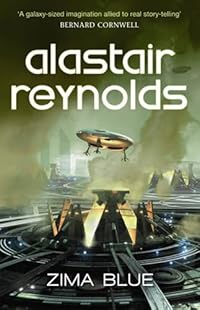
Zima Blue by Alastair Reynolds

Gollancz, 2009, 503 p, including 3 p Introduction by Paul McAuley.

This is a collection of Reynolds’s short(ish) stories from the early part of his writing career. They vary in length from short story to novella.

The Real Story is a beautifully well-thought out and executed tale of an investigation by journalist Carrie Clay into the whereabouts many decades later of the first man to land on Mars. His was a solo project which almost went catastrophically wrong and caused him profound psychological problems. There is a great set piece where the pair of them base jump from Mars’s premier city into that deep scar across the Martian surface, Valles Marineris.

Beyond the Aquila Rift is set in a universe where barely understood technology left behind by aliens allows interstellar travel. Sometimes, though, there are routing errors. Our narrator ends up beyond the local bubble in the Milky Way, beyond the Aquila Rift.

In the framing device of Enola the remnants of humanity live out their lives terrified of the alien enolas reining down destruction from the skies. The middle section of the story, the meat in the sandwich, contains the recollections of the last of the enolas, AI weapons of mass destruction but capable of reasoning with one another.

The world of Signal to Noise is one where correlators can “cold-call” similar machines in other realities, resonate with and lock on to them to allow information transfer. In the wider world implanted nervelinks can connect one body to the sensory inputs of another, sedated, body, giving control over it. In his world, Mike’s wife dies in an accident. His friend, Joe Liversedge, works in the correlation unit – where they were about to try nervelinking between worlds – and gives him the opportunity to interact with his estranged wife’s counterpart in a newly correlated other world. But the signal fades with time.

Cardiff Afterlife is set in the same milieu as Signal to Noise a few years later. Joe Liversedge doesn’t like the use the governments (and the parallel universes’ governments) are making of the correlation capability and sets out to do something about it.

The far future of Hideaway is one in which humans have long left Earth and its location has long been forgotten. The remnants of the Cohort, on a ship called the Starthroat, are in a decades long flight from a species known as the Huskers. When a Husker fleet is also detected in front of them the crew is forced to head for a likely planetary system to hide out. Unfortunately the star and the system’s biggest planet have unusual activity in them. The details of this involve some speculative physics. The story is told in five parts. For some reason in my proof copy parts 3-5 were in italics while 1 and 2 had been in a normal typeface.

In Minla’s Flowers, Merlin, a survivor from the previous story, is thrown out of the Waynet, an ancient interstellar transport system. He is forced to seek aid on a planet of a nearby sun, whose inhabitants’ technology is at the biplane/airship stage. He discovers the Waynet will intersect with the system’s sun in about seventy years. He drops them hints about physics so that they will be able to develop the means to leave for another world, coming out from ‘frostwatch’ cold sleep every fourteen years or so to see how things are going. The story has an embedded reference to Margaret Thatcher’s “no such thing” comment about society.

Merlin’s Gun is a third story featuring Merlin. Here Sora survives an otherwise devastating Husker attack only for her familiar to shut her down in frostwatch for three thousand years – relativistic time-scales are one of Reynolds’s characteristics – waking her up only when a likely rescue ship enters the system where she is hidden. Merlin takes her on his quest to find the ‘gun’ which will allow the Huskers (whose true nature is revealed here) to be defeated. Reynolds’s knowledge of the SF genre is exemplified when he calls the gun ‘a weapon too dreadful to use’.

In Angels of Ashes aliens called the Kiwidinok, whose perception of quantum reality differs from that of humans, came to Earth and revealed to a “lucky” volunteer, Ivan, the remnants of a nearby neutron star whose formation ‘miraculously’ spared Earth the radiation devastation. The Kiwidinok suddenly left again. Ivan became the inadvertent Founder of a new religion but he is now on his deathbed and wishes his truth to be known.

Spirey and the Queen is another story set during an age-old interstellar war, where Von Neumann machines nicknamed wasps have evolved into consciousness but its main thrust is concerned with protagonist Spirey – from a branch of humanity which is entirely female – and her endeavours to survive while on a mission to kill a traitor and her discoveries about the reasons for the war continuing.

Understanding Space and Time is for some strange reason printed in italics. Its subtitle, Mars ain’t the kind of place to raise your kids…, is a tip of the hat to the holographed Piano Man who appears in the story, complete with Bösendorfer grand. He appears to John Renfrew, the last survivor of humanity, in a habitat on Mars. Renfrew has little to do but converse with the holograph and use the few books available to try to understand space and time. With the later help of Aliens called the Kind who resurrect him from mummified death centuries after he suffers an accident on the Martina surface he spends his days, years and centuries, unlocking the layers of reality.

Digital to Analogue is, in effect, about an ear-worm which is akin to a virus, propagating via the sampling of a music track, and may be a new life-form.

Everlasting explores a ramification of the many worlds theory. Moira drives hurriedly through the snow to Ian’s house as he had talked on the phone about not killing himself. There he expounds his notion that in every dangerous branching of the worlds there will always be one where there is an unlikely survival and that he is therefore effectively immortal. Then he produces a revolver with one round in it. The twist in this tale is not hard to foresee but is arguably inevitable in any case.

Zima Blue is a story about memory and belonging, the tale of a universe-renowned artist called Zima, body adapted to endure the most extreme environments – interstellar vacuum, the pressures of gas giants etc – famous for the increasing vastness of his works (to the scale of moons,) and the particular blue colour he always employs. He gives his final interview to the Carrie Clay of The Real Story earlier in this book and produces his final, very much scaled down, artwork.

Pedant’s corner:- In the Introduction; “That’s doesn’t mean” (That doesn’t,) “that begin in a different times and places” (in different times,) “none of the stories … are” (none … is.) Otherwise; “none of my expectations were actually contradicted” (none … was,) epicentre (centre,) overlaying (overlying,) “the atmospheric gases became steadily more fluidic” (gases are already fluids; they flow. I think Reynolds meant ‘steadily more like liquid’,) “to condense the air into its fluid state” (ditto; liquid state,) “glimpsed_moving”, “added_some”. “Slammed_Tyrant”. “The_closer”, (I have no idea what those underslashes are for, and another appeared in a later story) “‘with the things I’ve showed you’” (shown,) “letters in Lecyth us A marched in stentorian ranks across the high vertical face” (how ranks of alphabetical symbols can be loud is something of a puzzle.) “The music reached its crescendo now.” (No. The crescendo is the rise, not its climax,) “where gouged by” (were gouged by,) “had opened a rosewood box and showed them to him” (shown,) “like kneeling orisons” (I didn’t know invocations/acts of supplication to a deity could kneel,) “I understood the math” (Oh, please. It’s ‘the maths’,) “‘as it conveniences us’” (no need for the ‘it’,) one story’s afterword has no indents at a new paragraph. “The moment reached a kond of crecscendo” (No. It reached a kind of climax,) smidgeon (smidgin, or, smidgen, but in any case, the word has no ‘o’ in its spelling,) “for old time’s sake” (times’,) “finding that the scene was established in Newcastle made up for the wrench” (‘the scene that was established’ makes sense of this,) a new paragraph that is not indented, “than any prescience on my behalf” (on my part,) Sacks’ (Sacks’s.)

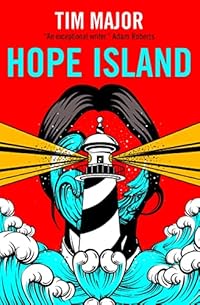
Hope Island by Tim Major

Titan Books, 2020, 389 p. Published in Interzone 288, Jul-Aug 2020.

 Hope Island cover

Workaholic Nina Scaife has not taken a break from her job as a producer on a north of England TV news programme for five years. Now, her partner Rob Fisher having left her for another woman (and the two kids they’ve had,) she is accompanying her young teenaged daughter, Laurie, to Hope Island off the coast of Maine – where Nina has been too busy to travel to before – to visit Tammy and Abram Fisher, Rob’s parents, to break the news to them – and Laurie. The island is isolated, with bad communications to the outside world, and internet and mobile phone coverage barely even patchy.
On the way from the ferry terminal to the Fishers’ house Nina has to brake suddenly to avoid hitting a young girl on the road. This disorienting experience sets a tone of mild unease for the narrative, which, however, hovers below the edge of manifesting into something greater for well over half the book before it finally tips over into the weird.

Nina feels unsettled by Tammy who she thinks disapproves of her because of her atheism and also for never marrying Rob. Abram seems a detached presence, possibly descending into dementia. The Fishers’ bond with Laurie is strong though, but that between Laurie and Nina is fraught. Laurie’s teenage discontents, her wrong-footings of Nina, are well portrayed.

Tammy introduces Nina to a sort of commune known as the Sanctuary, run by a group known as the Siblings at the other end of the island. One of its members, Clay, is carrying out experiments into sound but also into silence using noise dampening headphones and a recorder. As part of his demonstration he takes Nina into a shell midden, a cavern inside a hill where no shells should be, where she has a strange experience with a sound that at first she perceives as the wind through the entrance passage but then feels as if it comes from everywhere. After this she tends to carry the headphones around with her but also experiences dreams of floating.

Due to her previous visits to the island with Rob, Laurie has an affinity with the local children – especially the oldest, Thomas, whose mother Marie has a young baby who wails incessantly and claws at his mother’s neck constantly, drawing blood, but, to Nina, Thomas can appear distant, as if his awareness is elsewhere. He also manifests a tic of rubbing at his ears, something Abram too does in his absent-minded moments.

Gradually, sound becomes a recurring motif. In what seems an innocent exchange Tammy tells Nina, “‘Everybody’s got a voice inside them,’” a voice telling them what’s going on in the outside world and also what’s inside themselves. Nina begins to feel everyone is shouting.

When a man called Si Michaud finds the body of Lukas Weber on the beach, skull caved in, the novel seems as if it might change tack into the crime investigation genre as Nina tries to find out who the murderer was. Nina takes Abram to the cliff above where the body was found, where he lets out a wordless howl to shut out the voices in his ear. Later Abram too becomes a murder victim and the islanders behave oddly at the gathering to mourn him.

Nina’s suspicions soon fall on the children. To this end she alienates the islands’ parents after she reasons some of the children have tried to kill her. Tracking down May and Noah Hutchinson she finds them almost feral and apparently terrorising their mother and father. All this gets trammelled up in Nina’s mind along with the implications of Tammy’s paintings of a man falling off a cliff. She wonders if she can trust anyone, even Laurie.

It is to Major’s credit that, despite the nagging familiarity of the situation, the necessity of isolation, the lack of communications, to the story, there is still an impetus to keep turning the pages, but how it all hangs together, the importance of sound and of the shell midden, are revealed in something of a rush. Suffice to say the explanation is not down to Earth but it does come as a bit of a deus ex machina.

Nevertheless, Major writes well, character and relationships are handled deftly, but the realistic register of the parts of the book which deal with these aspects feel as if they come from another novel entirely compared to the fantastical flourishes which are in store in its climax.

The following did not appear in the published review:-

There is overuse of a metaphor relating to white blood cells.

Pedant’s corner:- English coins (that would be British coins.) “At the crescendo of their performance” (At the climax of their performance,) fit (fitted,) “the fishmongers” (I’ve read that they don’t have such retail specialists in the US. And would a small-ish island have one anyway?) “beneath that were a series of decorated shells” (beneath that was a series of,) “lying prone” (this was while she was gazing up at the sky. Difficult to do when face down.) “The crowd were becoming restless again” (The crowd was becoming restless,) “his voice rising to a crescendo” (to a climax.) “It was around a metre across and sixty centimetres.” (sixty centimetres tall?) crenulations (crenellations,) shrunk (shrank,) sunk (x 2, sank,) “was last thing she wanted” (was the last thing,) snuck (sneaked.) “None of the adults were concerned” (None of the adults was concerned,) “as she swum” (as she swam,) sprung (sprang.)

Clarke Award 2021

It’s Arthur C Clarke Award time again.

This year’s shortlist is:-

The Infinite by Patience Agbabi

The Vanished Birds by Simon Jimenez

Vagabonds by Hao Jingfang

Edge of Heaven by R.B. Kelly

The Animals in that Country
by Laura Jean McKay

Chilling Effect by Valerie Valdes

I’ve read none of them.

Interzone 290-291 Arrives

Wild Harbour cover

After a hiatus in publishing of the magazine the latest Interzone has now started to arrive on doormats. (At least it has on mine.) It’s a double issue 290-291 to make up for the time since issue 289.

This one (two?) contains my reviews of Wild Harbour by Ian Macpherson and The Society of Time by John Brunner, respectively originally published in 1936 and 1961/62 but both recently reissued under the British Library imprint.

free hit counter script