Archives » Reading Reviewed

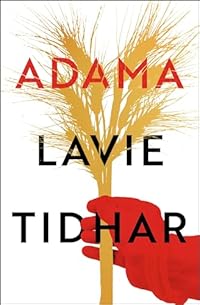
Adama by Lavie Tidhar

Head of Zeus, 2023, 397 p.

This is the second in Tidhar’s Maror sequence, in which he examines the history of Israel. I reviewed the first here. In Adama (the name is Hebrew for earth, and here is used as a synonym for homeland) the focus is on the setting up and evolution of the Israeli state as seen through the experiences of the members of one family. The book is episodic in nature, ranging in time from Haifa in 1946 and a displaced persons, DP, camp in Germany in 1947 via the war to establish Israel (what Palestinians refer to as the Nakba,) the aftermaths of the Six Day and Yom Kippur wars, events in Kibbutz Trashim in intervening years, to Florida in 2009; not necessarily in date order.

Told in fifteen parts starting with one titled The End and with the last called The Beginning, our viewpoint characters are matriarch Ruth, her sister Shosh, their children Yoram, Ophek and Yael, grandchildren Lior and Esther, fourth generation Hanna and Shosh’s husband Dov.

As a staunch believer in a Jewish homeland, Ruth made her way to Palestine early, leaving behind in Europe her family who were apparently betrayed to the Nazis by Shosh’s then boyfriend Nathan Deutsch – upon whom Ruth later wreaks an extended revenge. Only Shosh survived. Unlike her sister, Shosh was not invested in the dream of Israel, only ever wanting to make her way to the US. Their descendants navigate the vicissitudes of the Israeli experience, the souring of the kibbutz ideal of socialism, its failure (and by extension Israel’s) to live up to its promise, the compromises and accommodations necessary to keep things going.

Ruth does what she has to as a member of the Jewish underground during the British mandate; as does Shosh in her efforts to be away from the DP camp. Only Ruth has some success. Dov’s tale relates to the 1948 war and shows its unforgiving nature. Kibbutz life is illuminated in passing as the book’s incidents unfold.

In 1989 Lior returns to the kibbutz from Tel Aviv for the funeral of his friend Danny, not believing the story he is told about Danny’s apparent suicide, and finds something rotten in its state. “Lior knew what hash smelled like, it smelled like Lebanon, there was so fucking much of it.” In this section Chief Inspector Cohen from Maror makes a brief appearance, reminding the reader (if any such were needed) of the murky underbelly of Israeli society which Tidhar is exploring.

A prominent recurring reference in the novel is a fictional film called The Vultures, starring actor Bill Goodrich, a film shot partly in the kibbutz, perhaps here intended to show the founding of Israel as Israelis would like to see it: but extortion, drug running and violence are never far away from any of the characters in this book.

Tidhar’s writing is immediate; sharp, abrasive and to the point. Despite its tight focus, Adama contains multitudes.

Pedant’s corner:- “Ruth was sat in front of the television” (‘was sitting in front of the television.) “They were sat in the Casino” (They were sitting,) “where there were nothing but camels” (where there was nothing but….,) “the metaplot” (elsewhere spelled metapelet.) “‘Did he, fuck,’ he said.” (no need for that comma after ‘he’; plus it actually changes the meaning.)
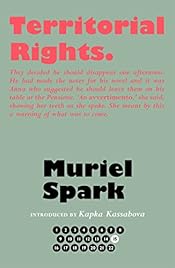
Territorial Rights by Muriel Spark 

Polygon, 2018, 206 p, including 9 p Introduction by Kapka Kassabova and 4 p Foreword (general to these Polygon retrospective editions.)

Art historian Robert Leaver is staying in the Pensione Sofia in Venice. His girlfriend, Lina Pancev, is Bulgarian, a defector from the communist regime there who is searching for the grave of her father, Victor. (It turns out he was murdered in the grounds of the Pensione but she never discovers this.)

One day two guests arrive at the Pensione; Robert’s father Arnold, in tow with Mary Tiller, a teacher at the school where Arnold is headmaster. Anthea, Mrs Leaver, remains at home, for now oblivious. To escape his embarrassment Arnold hies himself and Mary off to another – and better – hotel.

Suspicious she engages GESS (Global-Equip Security Services) to investigate. Their local agent is one Violet de Winter.

Grace Gregory, matron at Arnold’s school and who, to prevent his wanderings, had serviced him herself in the infirmary when there were no boys sick, warns Anthea off using the agency and travels to Venice to see what’s going on.

Robert’s friend Curran, (he answers only to his surname,) is also part of the proceedings as is a supposed kidnapping.

The above provides a flavour of the book, which in some quarters has been described as a farce. To me it is too heavy-handed for that.

I continue to find Spark an unacquired taste.

Pedant’s corner:- a missing comma before a piece of direct speech (x 3,) candelabras (candelabra is already plural,) “whether she longed to say and talk it over” (‘longed to stay and talk it over’ makes more sense.)

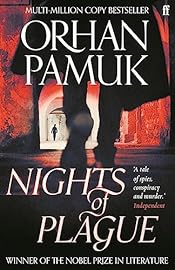
Nights of Plague by Orhan Pamuk

Faber and Faber, 2023, p. Translated from the Turkish, Veba Geceleri, by Rekin Oklap.

This is not a typical Pamuk novel. For a start it’s not set in Istanbul which has been pretty much a major character in most of his books. Instead, it deals with the fictional Mediterranean island of Mingheria during a 1901 outbreak of bubonic plague which provided the opportunity for its revolt against Ottoman rule. Also, unlike most Pamuk novels. it’s largely told rather than shown. Part of this is that the narration is couched partly as a historical record of the revolution.

Mingheria is supposedly located somewhere northeast of Crete. Its main city, Arkaz, is dominated by a castle on a hill at one side of the harbour entrance but there isn’t adequate anchorage for large modern ships and landfall has to be made by rowing boat.

The present Ottoman Sultan, Abdul Hamid, who was installed as Sultan by a palace coup in which he replaced his brother Murad V, has sent Bonkowski Pasha to combat the outbreak. On the same ship but en route to China as envoys are Murad’s daughter (and therefore Abdul Hamid’s niece) Princess Pakize, until recently kept in seclusion in Istanbul until she married the husband Abdul Hamid procured for her, Doctor Nuri. Hence Nuri is often referred to in the text as “the Doctor and Prince Consort.”

A few days later, after Bonkowski Pasha is murdered having inadvisedly gone walkabout, Princess Pakize and Doctor Nuri are ordered back to Mingheria to investigate his death using the methods of Sherlock Holmes. (Abdul Hamid is an avid consumer of detective fiction.)

Many locals, especially devout Muslims, resist the attempts by the authorities to enforce quarantine. The ensuing confusion allows a Major Kâmil to institute a revolution which overthrows Ottoman rule. The Major (soon Commander) becomes the first leader of independent Mingheria.

Much of the supposed history here is said to be taken from the letters of Princess Pakize to her sister Princess Hatice back in Istanbul, letters which she wrote daily even when the postal service had been suspended. An emphasis on the relationships between Princess Hatice and Nuri and Major Kâmil and his wife Zeynep (nostalgic legends in Mingheria) are a corollary to this.

Several narratorial interpolations reveal that this retrospective history of the founding of the Mingherian state has been written by a descendant of Princess Hatice and Nuri. The final chapter is an envoi from that point of view.

The means by which a new state establishes itself and the myths it comes to believe are subtly portrayed (as are the parallels with the decline of the Ottoman state,) but like most revolutions the Mingherian one soon begins to eat itself. In short order Kâmil and Zeynep are dead due to plague; his successor, the Muslim sect leader and quarantine opposer Sheik Hamdullah, also succumbs to the disease; Princess Hatice is made Mingheria’s Queen but pushed into the background by Nimetullah Effendi with the felt hat; and so on. Relations with the Great Powers, who blockade the island to prevent the plague reaching Europe, are critical to Mingheria’s future.

Pamuk is consummate and always in control but to my mind in Nights of Plague, though there is plenty of story (you could almost say too much) some of the rewards of reading fiction are missing. There is not much here to allow the exploration of character, most of whom are sketched rather than fleshed out, or indeed character development. It is certainly unusually structured for a novel. It is however an exemplary way of writing a critique of Turkish society without going at it head-on; an approach arguably necessary for a writer from a state sensitive to any hint of criticism.

Since he started writing this book in 2016 it is also unlikely to be a reflection on the Covid pandemic, though of course that does now hang over any reading.

Mention of football (albeit only in one sentence) and of the author Orhan Pamuk as being an acquaintance of the narrator – both are museum enthusiasts – are typical Pamuk touches.

It is of course essential reading for Pamuk completists but has enough to recommend it to the merely curious.


Pedant’s corner:- Translated into USian. “the hoi polloi” (hoi means ‘the’; it’s just ‘hoi polloi’, then, no ‘the’,) enormity (employed here to mean ‘hugeness’. It doesn’t; it means ‘monstrousness’,) “off of” (no ‘of’, just ‘off’,) “a particularly tough contingent who was known to mistrust” (a particularly tough contingent which was known to mistrust,) “that he was going be punished” (going to be punished,) a chapter beginning with a sentence of dialogue with no starting quotation mark (I know this is a publisher’s convention but it annoys me,) “the Halifiye sect were being goaded” (the Halifiye sect was being goaded,) “landscapes …. that Sami Pasha had hanged on the walls” (I doubt this meant they were executed: ‘had hung on the walls’,) “arrival to the island” (arrival on the island,) Cretian (Cretan,) “moored to the docks” (moored at the docks,) “was I was finally” (the second ‘was’ is superfluous.)

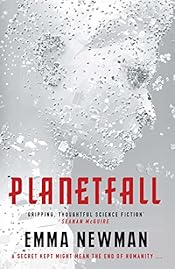
Planetfall by Emma Newman

Gollancz, 2018, 324 p, plus ii p Acknowledgements.

That I have read Newman’s Planetfall sequence in the wrong order (3,4,2,1 to be precise) doesn’t really matter that much as they can all be read as stand alone titles. Here, we are in the years after an expedition to another planet under the guidance of a woman called The Pathfinder in search of God. On landing the expedition’s members found what is now called God’s city. This is an “organic citadel” like a “huge forest of baobab trees tangled round one another,” and, when hot, grows tendrils to manage the heat.

The story is narrated by expedition member Renata Ghali (Ren,) the settlement’s 3D printer engineer, whose later revelation to be a hoarder whose home pod is piled with rubbish stolen from the settlement’s recycling machine, the Masher, is an indication of possible unreliability. She is troubled by fellow expedition member Cillian Mackenzie (Mack,) whose resolve held the community together after the Pathfinder did not return from a foray inside God’s City, saying she was “communing with the creator,” and telling them all to await her return. What has evolved in the colony in the years since is in effect a cult.

Some time after The Pathfinder’s disappearance, other members of the original expedition were lost elsewhere on the planet. Plot kicks in when a lone outsider called Lee Sung-Soo, a survivor of those lost colonists, who is also The Pathfinder’s grandson, turns up at the city.

Ren’s obligations to Mack take her inside God’s city, a strange unsettling place where perspectives shift and passageways can suddenly change orientation. Her explorations lead her to wonder whether the colonists are the first or if there have been previous visitors to the planet; visitors who could only have been alien.

As things unfold we discover what actually happened to The Pathfinder inside God’s city, the revelation of which to the colony has ramifications for Ren, Mack and the settlement as whole.

Newman’s writing is not in question. She is particularly good on Ren’s mental disintegration.

The integration of religious elements with an SF setting is a little awkward though.

Pedant’s corner:- Printed in USian, bacteria (the word is treated as if it’s singular – but that would be bacterium,) outside of (x 2: just ‘outside’; no ‘of’,) “none of them satisfy me” (none of them satisfies me,) “in the opposite direction of God’s city” (it’s ‘opposite direction to’ not ‘opposite direction of’.) “None of them were looking at me” (None of them was looking at me.) “None of them are good” (None of them is good.) “None of them are paying attention” (None of them is paying attention,) “neither of them say anything” (neither of them says anything.) “None of them are listening” (None of them is listening,) “our species’ capacity” (species here is singular; so ‘the capacity of our species would be better.) “None of them are familiar” (None of them is familiar.)

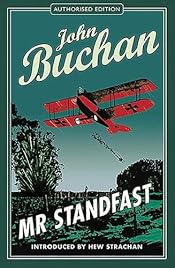
Mr Standfast by John Buchan 

Polygon, 2010, 342 p, plus vi p Introduction by Hew Strachan. First published in 1919.

In this third of Buchan’s Richard Hannay novels our hero has been pulled from his General’s post on the Western Front to visit Fosse Manor in the Cotswolds where he is to pose as a pacifist. Among the mostly harmless people he meets there is, however, a Mr Moxon Ivery who will turn out to be more dangerous. Part of the party is Miss Mary Lamington with whom Hannay is very taken and who is the agent from whom he is to accept his further orders. Their mutual knowledge of the Pilgrim’s Progress is to be used as a kind of code book to convey and hide messages (the origin of Mr Standfast’s title.)

Mary’s instructions take Hannay to Glasgow to make himself known in the pacifist working men’s associations and then on to Skye. These northern regions of the country were apparently subject to strict travel restrictions which, as a pseudonymous agent, he has to circumvent. Several escapades among the heather later he has discovered a German spy ring working as the Wild Birds and heard the name Bommaerts.

He relays his information to the authorities in London before being returned to his battalion in Belgium.

Meanwhile his friend Peter Pienaar has joined the Royal Flying Corps and struck up a rivalry with the German air ace named Lensch, who Pienaar says is better than Richthofen. (This gives the excuse for the otherwise not too apposite cover picture.) Pienaar is eventually shot down and badly wounded. Hannay’s other companion in the Erzerum affair in Greenmantle the US citizen, Blenkiron, also makes an appearance. He makes the observation, “There’s something comic in the rough about all Germans, before you’ve civilized them.”

In Belgium Hannay has enough downtime from his front-line duties to go ferreting about a nearby chateau in search of the mysterious Bommaerts, who captures him and boasts of his superior abilities and the devastating blow the Germans will soon strike. Bommaerts, Ivery and a journalist called Clarence Donne who had managed to hoodwink Blenkiron turn out to be one and the same man, the Graf von Schwabing.

Hannay escapes in a very ‘with one bound he was free’ type of way and makes a foray into Switzerland to try to thwart von Schwabing’s designs, making an arduous passage on foot over the Swiss mountains in attempting this.

On his return once more to army duty we are given some fairly detailed descriptions of the German spring offensive of 1918 and, by Buchan’s account, how close it came to complete success. From the point of view of the British Tommy it must indeed have seemed a desperate situation.

Mr Standfast is  a Boys’ Own Adventure kind of enterprise. Plot here is everything, characterisation a secondary concern – if a concern at all. The most engaging character – Mary Lammington is inserted only to give Hannay a love interest but is barely memorable – is a true pacifist who has been inducted into the Labour corps and finds fulfillment there.

Sensitivity note. The book is of its time in its off-hand racist comments. “There are some things that no one has a right to ask of any white man,” “‘a great big buck nigger,’” “‘like a bankrupt Dago railway,’” “a droop like a Polish Jew’s,” “a face like a Portuguese Jew’s,” – this otherwise nameless character is referred to thereafter as the Portuguese Jew – “a Paris Jew-banker,” “he was an Austrian Jew,” “all breeds of Dago and Chinaman, and some of your own South African blacks.”  “‘He is a white man, that one,’” is said by Pienaar of his air adversary Lensch.


Pedant’s corner:- Afrikander (nowadays spelled Afrikaner,) “the Coolin” (several times; nowadays usually spelled, as in Gaelic, Cuillin.) “It seemed to more a stone and to replace it” (to move a stone makes more sense,) “shinning up a rain-pipe” (downpipe is more usual, and  the Scottish term is roan pipe; alternatively, rone,) a missing comma before a piece of direct speech, “‘and most of my tactics. I had to invent myself.’” (no need for that full stop ‘and most of my tactics I had to invent myself.’) “In the press of a fight once scarcely realizes death” (In the press of a fight one scarcely realizes death.)

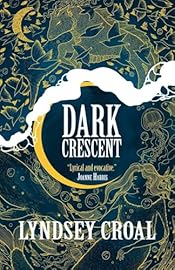
Dark Crescent by Lyndsey Croal 

Luna Press, 2025, 176 p including Author’s note on Finding Inspiration in Scottish Folklore. Reviewed for ParSec 14.

This is a collection of one novella and 22 short stories – some very short; the title story is barely three pages long, a couple are only two, with the longest, The Frittening, just twelve – all taking inspiration from Scotland’s folklore, superstitions, or landscape.

The short pieces are loosely bunched under headings for the four seasons with each section’s stories prefaced with a wood- (or lino-)cut engraving of one of the Moon’s principal phases and a scene illustrative of a story within it. A ‘Bonus Section’ at the end outlines those particular tales and legends which sparked Croal’s imagination.

An individual story here can contain relatively familiar apparitions or hauntings – selkies, kelpies, hagstones, seer stones, magpies, omens and shape shifting, Will-o’-the-Wisp, the Otherworld, Changelings – but others like the Sluagh, the Frittening or the Boneless, the Cat-Sith, the Ghillie-Dhugh, Baobhan Sith and the Fiddlers of Tomnahurich Hill, the Cailleach, the Nuckelavee, the Marool, the Ceasg, Bee-telling, the Sea-Mither, Each Uisge, the Wulver, the Bride and Angus, may be less so. Some are set in depopulated post-disaster worlds and border on Science Fiction; others touch on gothic, weird horror, dark fantasy, and solarpunk. Many draw stimulus from nature, climate, and the environment, with feminist and eco themes prominent. Croal’s Author’s Note informs us three of her tales do not have a specific derivation but are original to her.

Hence, among others, we have omens in the sky, tappings on windows, a strange puddle emerging on a doorstep, pebbles appearing in a nest in the night, a will-o’-the-wisp manifesting more strongly each day, a fiddler finding his muse in a painting whose scene gradually changes, the green man as a malevolent influence, the thoughts of the last surviving whale as it roams the deserted seas. Except for a common thread of the sea there is little beyond the Gaelic names of the various phantasms to mark these stories out as specifically Scottish.

The novella, Daughter of Fire and Water, with its intermingling of gods/goddesses and mortals in fact reads more like a Greek, or perhaps Norse, myth – except for the prince in it being named Angus.

Taken individually the stories here are perfectly fine but the cumulative effect of Croal’s general style tends to the dry. She has a fondness for italicized paragraphs, especially in throat-clearing beginnings, and there is the occasional odd choice of verb, which can be jarring. There tends to be a kind of distance between the tale and the reader and the stories are too often told rather than shown while some are not really given enough room to breathe fully. There is not much emotion evoked in these tales but then stories of weird creatures and the whole apparatus of fairy tale have always been admonitory in intent.

This is a collection to be sipped rather than quaffed. (Not really an option available to a reviewer.)

Curiously, a few lines on Content Notes and Warnings come dead last in the book though a signal to them does lie on the publishing information page. Surely if such warnings are needed they ought to be more prominently placed?

The following did not appear in the published review.

Pedant’s corner:- focussing (focusing,) maw (more than once. A maw is not a mouth,) several USianisms (cookies, snuck, dove [for dive,] inside of, etc,) sunk (several times; sank.) “The only muscle the woman moved was her mouth” (a mouth is not a muscle,) razor—sharp (razor-sharp,) sung (x 2, sang.) “She lay the Seer’s map on the table” (She laid the Seer’s map on the table.) “She was his only companion, his confidant” (she; therefore ‘confidante’,) “Then she said with sharp cruelty, ‘no. Not if you…’” (she said with sharp cruelty, ‘No. Not if you…’,) “Everyone knelt and lay the offerings at her feet” (and laid the offerings,) “all that kept me company were layers of clouds” (all that kept me company was ….) “If I wanted so bad not to be alone” (If I wanted so badly not to be alone,) “and lay it over my chest as a pendant” (and laid it over my chest,) “and lay her in blankets” (and laid her in.) “When the sea witch, turned away and disappeared” (doesn’t need the comma, which in fact detracts from the sense,)  “that I’d wove so carefully” (woven,) “mouth scrunched up into an eclipse” (only makes sense if ‘ellipse’ was meant,) a new paragraph that was not indented, a missing full stop, “span” (spun,) “as if expecting me turn into” (to turn into.) “‘Your association with them isn’t exactly customary’” (sense expects, ‘Your association with them isn’t exactly exemplary’,) sat (seated; or; sitting.) “The fall made the landscape blur, and then a screech” (needs clarification,) “there were no sign of burns or marks” (there was no sign.) “then he swept out the room” (as written this means he cleaned the room with a brush; what was intended was ‘he swept out of the room’,) “the hot water stung into my legs” (the hot water stung my legs,) focussed (focused, annoyingly used two pages earlier.) “They looked between one another” (looked at one another,) galivanted (gallivanted.) “Much of these stories are inspired by” (Many of these stories are.) “I became fascinated in the dark, strange, and rich folklore” (became fascinated by,) “rife with unexplained phenomenon” phenomena makes more sense.) “Hagstones are stones with natural holes bored in centre are thought to be,” (the holes can’t have been bored; plus the sentence needs an ‘and’ before ‘are thought’.)


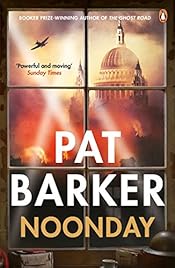
Noonday by Pat Barker 

Penguin, 2016, 263 p.

This is the final book in Barker’s Brooke family trilogy which started with Life Class and continued in Toby’s Room. In this one we have moved on to World War 2, Elinor Brooke and Paul Tarrant are long married and volunteering during the London Blitz; she as an ambulance driver, he as an ARP warden. Their lives are still entwined with that of Kit Neville who is also a volunteer. All three still paint whenever they can.

Paul wishes Elinor to remain in the country in her childhood home where the family has taken in an evacuee called Kenny who keeps getting let down by his mother’s failures to visit. Elinor’s mother is on her death bed but still has enough recall to reveal she knew how close Elinor and brother Toby had been. Kenny eventually disappears off back to London where his family is bombed out and finds shelter in a school, which is later the scene of a tragedy underreported for morale reasons. Paul bears a residual guilt about guiding them there.

The scenes of danger during bombing raids in London and their aftermaths of damage and destruction are well described, if a little familiar from documentaries and histories. Throughout we track the gradual erosion of Elinor and Paul’s marriage.

A curious interpolation is that of a medium (I nearly typed fraudulent medium; as if there were any other kind) – named somewhat oddly as Bertha Mason and who, like the first Mrs Rochester, lives in an attic – but who doesn’t seem to fulfil any narrative purpose apart from to discomfit Paul.

Elinor is asked by Kenneth Clark, head of the War Artists’ Advisory Committee, to contribute to its collection, but only with portrayals of women and children. Elinor has other ideas but suspects they won’t be accepted.

As a conclusion to the trilogy this lacks the impact which the Great War had on the characters’ lives in the previous books and stands in contrast to it. It is, though, a reminder that in the midst of war people’s lives still carry on, with all their imperfections and resiliences. Plus it ends on a slightly hopeful note.

Pedant’s corner:- “just now give her” (just now gave her,) “stood there” (standing there.) “She was sat” (she was sitting,) fetid (foetid; even better fœtid,) “a plastic bag” (plastic? In 1940?) “twenty foot deep” (‘twenty feet deep’ please,) “‘His majesty’s ship Repulse is at the bottom of the sea’” (Repulse was sunk in December 1941, well after the blitz waned,) an extraneous quotation mark, “hadn’t showed up” (hadn’t shown up,) a missing full stop.

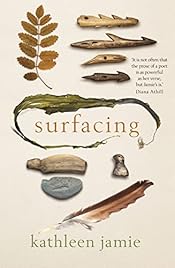
surfacing by Kathleen Jamie

Sort of Books, 2019, 253 p.

Jamie is known as a poet. She is, of course a former Scottish Makar.

This, though, is a prose work or, rather, twelve essays variously about her encounters with the natural world, the two architectural digs of which she has been part, and a trip to as near Tibet she could get. (Getting into Tibet itself would have been difficult at any time but as this coincided with the Tiananmen Square events, reaching Tibet was impossible. It also meant she and her companions were arrested for a short time.)

Her writing about the natural world shows a keen eye for detail; as you would expect from a poet. The account of her trip to China reads almost like a novella.

The first dig she visited was on the Pacific coast of Alaska at Quinhagak village, the dig site was called Nunallaq. The finds were shown to the community where the elders were (usually) able to recall their significance to their Yup’ik culture, giving the younger inhabitants a way to rediscover their traditions, which they were in danger of losing. Jamie’s sympathy with the locals and appreciation of the efforts of the archaeologists is evident.

The other dig was at the Links of Noltland in Orkney and had been ongoing for about ten years. However, time pressure was building as the funding from Historic Scotland (as was) was running out and unlikely to be renewed. And this on a site whose significance is seemingly as great or greater even than Skara Brae.

Curiously the locals weren’t too interested in the ancient remains since apparently Orcadians and Shetlanders identify with the Vikings rather than their much longer ago neolithic ancestors. Jamie quotes one of the archaeologists, “‘The Vikings “won”,’ said Hazel.’ …. ‘After the Vikings arrived, all traces of the older culture ceased. That’s what the archaeology is suggesting.’”

This is an engaging and informative work showing Jamie’s prose is as worth paying attention to as her poetry.

Pedant’s corner:- I have no idea why the title is not capitalised on the book’s cover and spine – nor indeed why the author’s name isn’t either. On the title page both are. Otherwise “Quanset hut” (I’ve previously only ever seen this spelled as ‘quonset’,) “‘kids from his village’” (‘kids from this village’ makes more sense.) “Posters went up the school and store” (Posters went in up the school and store,) “a wintery atmosphere” (wintry,) “and begin to speak” (the earlier part of the sentence was in the past tense so ‘began to speak’.) “Sat right there on their village wall” (Sitting, or Seated,) “sat on seats” (again: sitting; or seated,) “sprung up” (sprang up.) “He was laid on his bed” (he was lying on his bed,) “they were all glad for the diversion” (glad of the diversion.)

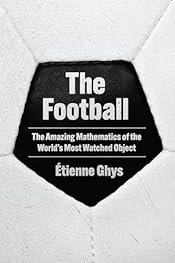
The Football by Étienne Ghys

The Amazing Mathematics of the World’s Most Watched Object, Princeton University Press, 2025, 130 p, including 4 p Credits, i p Preface, i p Translator’s Note. Translated from the French LA PETITE HISTOIRE DU BALLON DE FOOT, (Odile Jacob, 2023,) by Teresa Lavender Fagan.

The translator’s note at the beginning informs us the history of both names for the game played with the titular object is fascinating but she has chosen to call the game football rather than soccer (as is only proper.) There was only one lapse.

This book could almost have been designed for me A football fan (well, a fan of the Sons of the Rock, so arguably not football) with a scientific background and therefore a grounding in maths. How could a discussion of the mathematics surrounding the football not interest me? Nevertheless it wasn’t a book I sought out; indeed I was unaware of its existence until I unwrapped it as a birthday present.

Amazingly (to me at least, I discovered it in this book) the rules of football state about the construction of the ball only that it must be made of a suitable material – but without specifying what constitutes suitability! (It must also be spherical and lie within a certain circumference and weight range with internal pressure between 1.6 and 2.2 atmospheres at sea level.)

The book starts with the familiar Telstar ball, dating from the 1970 World Cup and containing twelve black pentagonal panels, twenty white hexagons and requiring ninety seams. It is impossible (despite the illustrations on UK road signs which indicate football grounds) to construct a sphere only from hexagons, or indeed solely from pentagons. In this regard the logo for the (so-called) Champions League is incorrect. The actual ball has five-pointed stars surrounding curved hexagons, three stars around each hexagon. The logo, in places, has four.

In terms of geometry the Telstar is in fact a truncated icosahedron (ie one with its points cut off) and then inflated to [near] sphericality. It is also extremely symmetrical, ensuring stability in flight, but the pattern for cutting out the panels is very complicated.

The balls for more recent World Cups are truncated versions of other Platonic solids. Teamgeist (2006) was a truncated octahedron, the Jabulani (2012) a truncated tetrahedron with eight panels which weren’t flat, the Brazuca (2014) a truncated cube! (Albeit that last had curved panels.) 2022’s Al Rihla was based on an icosidodecahedron.

So much for geometry. The other criterion considered here is drag. It is the interaction between drag and gravity that determines a football’s flight. Without drag the ball’s flight would be inherently unpredictable and, due to turbulence, slow down too quickly! The ninety seams on the Telstar ensured sufficient drag. The Jabulani’s fewer seams and relative smoothness made it seemingly erratic. (Drag reduces with smoothness.) French goalkeeper Hugo Loris called the Jabulani a catastrophe. More modern footballs like the Al Rihla, as a close-up photograph demonstrates, are dimpled (in a similar way to golf balls) so as to reduce drag.

This is an excellent book for those interested in both football and maths but I think its explanations, not to mention the copious illustrations and diagrams, are sufficiently clear to pose no barrier to the maths-phobic.

Pedant’s corner:- “The horizon is a straight line” (It isn’t; it’s actually slightly curved,) “the English government” (there is no such thing. [there is a UK government, though],) uses English plurals (rather than Greek) for the Platonic solids.

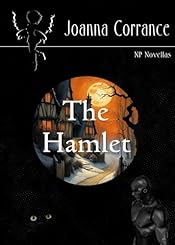
The Hamlet by Joanna Corrance

NewCon Press, 2025, 115 p. Reviewed for ParSec 14.

This was published as a novella but reads more like an assemblage of short stories with characters which cross over from one to the next, though outwith their own tale, usually only in brief appearances. Its background premise – something strange (but unspecified) has happened and people have been advised to remain indoors – may be a literary response to Covid. The setting is a small village in Scotland – locals call it a clachan but incomers have used the description hamlet (which I note is actually a particularly English designation) for so long that it has become more common. The village ‘spinsters,’ however, still frown upon it. Apart from the first, very short, chapter which introduces the strange event, each section is given over to the experiences of different characters, Beth, Polly, Helen, Eve, Robyn and Jeanie, with the novella ending with a sort of epilogue from the point of view someone called the Spaceman.

The stories’ time scales are not always immediately apparent as some chapters start before the strange event or more or less ignore it happening. However, there’s enough oddness going on even without it.

Responding to a voice calling to her, Beth, who has inherited her home from her mother and not improved it in any way, instead letting it run to squalor, manages to move through the pipes in her plumbing, whether by her shrinking or the pipes expanding is moot. Eventually she is drawn down to an underground chamber to chat with the spinsters about the end of the world. The chapters which follow may represent different ways in which that end happens.

Thanks to the green-suited spaceman who appears at her window one night, schoolgirl Polly travels the universe and becomes both a witch and a princess.

Helen begins to produce videos which attract internet followers but increasingly show her lack of control of her life.

To escape the locked down city Eve has come to the cottage she rents out to Matthew (known locally as the Pest.) Not a good choice.

At Helen’s request Robyn builds a doll’s house as an exact replica of Helen’s home but realizes it also needs a doll’s house inside it and then another inside that and so on down.

Jeanie begins to act strangely and eventually locks herself away from everyone. She is however revealed to be a figment, a skin the narrator wore to make her life more amenable. The implication is that all the viewpoint characters are such skins. (But this is the essence of fiction. The reader temporarily becomes – or at least empathises with – a book’s characters.)

The Spaceman is from another world.

The Hamlet has aspects of a fairy tale (but there do not seem to be any happy ever afters, except perhaps for Polly,) has some of the heightened sensibility of magic realism (with a faint echo of John Burnside’s Glister,) moments of horror, and makes a foray into Science Fiction. Whether the disparate elements necessarily cohere into a unified whole is a matter for the individual reader. Corrance can write though.

The following did not appear in the published review.

Pedant’s corner:- “The McIvor’s lived in” (the McIvors lived in,) sat (x 2, sitting, or, seated,) “Mums washing machine” (Mum’s,) “paper mâché” (paper mache:  if its ‘mâché’ then it’s papier mâché,) “it sloped passed me” (past me,) airplane (aeroplane,) “the High-lands” (the Highlands,) curb (kerb.) “‘So where did you learn to cook?’ She asked.” (‘So where did you learn to cook?’ she asked,) “when they played drafts” (draughts,) dollhouse (doll’s house,) “most Saturday’s” (most Saturdays,) “and come pick me up” (come to pick me up,) miniscule (minuscule,) “the little girls’ eyes” (it was only one girl; ‘little girl’s eyes’.)

free hit counter script