Archives » Read Scotland 2014

Cold Turkey by Carole Johnstone

TTA Press, 2014, 159 p. (Novella no. 3 from TTA Press, publishers of Interzone and Black Static.)

Cold Turkey cover

I don’t know why I was sent this. I had agreed to read TTA Press Novella no 2 (Nina Alan’s Spin) and review it on my blog but had thought that was a one-off. Yet this too has turned up in the post (though it was actually sent to my old address.) It seemed only polite to accord this book the same courtesy.

I had not realised before starting it that it would count towards the Read Scotland 2014 challenge but the author is a Scot whose blog is here. (She now lives in Essex. I did that for two years.) The first clue was the mention of Fir Park – one I have still to cover in my series on Scottish Football Grounds. (The story is set in a Lanarkshire town.)

Raymond Munroe is a Primary School teacher in Glengower. His mother and father have had gruesome deaths due to smoking. Raym is trying to give up. Again. This time his attempts are accompanied by the sound of a nursery rhyme and memories from his childhood, of the tally van and the grotesque figure of Top Hat – a creature with black tails, “really long ones, like party streamers.” Raym is also losing time. Each cigarette lapsed into eats up an hour in the real world. Johnstone has Raym explicitly acknowledge to himself that he could be suffering hallucinations due to nicotine withdrawal, but some of the children can also see Top Hat and what occurs in the lost hours is not remembered by anybody else.

Raym’s slow decline while trying to maintain his mental equilibrium under this joint barrage is the meat of the story but the other characters are equally well drawn, with Raym’s girlfriend Wendy very acutely observed. Only teaching assistant Caitlin seems too pat, too designed to the purposes of plot.

Despite Cold Turkey being in essence a horror story there are flashes of humour – “You are a fine teacher; even if you did pursue your degree in Dundee.”

Towards the end a drunk he encounters tells Raym that the phrase “cold turkey” is derived from a US saying and means the unvarnished truth. In any novel the truth has to be varnished. Johnstone is good with the brush.

Note to non-Scots readers. At one point Raym is described as “careering along the road like an escapee from Carstairs.” Carstairs is the location of a State Hospital (that is, an institution to house the criminally insane.)

Pedants’ corner. Raym is said to work in a “small rural primary school on one of the worst estates in Lanarkshire.” If the town is big enough to have an estate (which here means housing scheme) then it’s hardly rural. The staff room (I’ve been in a few – though admittedly mostly secondary school ones) seems excessively sweary to me. There is a reference to town meetings. (In Lanarkshire? I’ve lived in Scotland for all but two years of my life and never known of such things here.) The impression is given that primary schools have their day structured by periods and that basic trig is part of their curriculum. (They don’t and it isn’t.) Though “totilly waddy an’ a hauf” is new to me, neither “absolute mince” nor “the old heave-ho” is an obscure catchphrase. There was a shrunk count of 2 and 1 sunk. We had “site” for “cite,” “snuck” for “sneaked,” a “gotten,” “scroat” for “scrote,” starter blocks (starting) and a faux “Macintosh” chair.

Gillespie by J MacDougall Hay

Canongate, 1983, 450 p.

Gillespie cover

This novel was first published in 1914 – not a good time to make a debut – and was all but forgotten for the next fifty or so years. When it was reprinted in 1979 it was hailed in some quarters as if it was some sort of lost classic, compared to The House with the Green Shutters, with which it has some thematic similarities. Alasdair Gray describes Gillespie as having “the worst first chapter that ever introduced a novel worth reading.” The chapter is indeed overwrought, and overwritten, but lasts less than two pages.

The book’s subject, Gillespie Strang, is born under a bad sign. Literally. In an inn whose emblem is a dagger striking down. His mother fears all the male Strangs are doomed. This premonition haunts the book but not Gillespie himself. He is the type of man who might be described as a bad lot. On the make, sly and avaricious, tight with his money, he starts off trapping rabbits on others’ land, swiftly moves on and up, proposes to a local girl to cement a business deal with her father – a deal which condemns a neighbour to penurious widowhood – grows to be a power in the town, the fishing village Brieston, based on Hay’s boyhood home, Tarbert, on Loch Fyne. Structured over four books the novel describes Gillespie’s rise and rise through his and his family’s eyes and those of some of his neighbours. Herring fishing, its ups and downs, is a large presence in the early books; weather, storms and drought, a counterpoint to the tale. All are grist to Gillespie’s acquisitive mill.

Gillespie is a very Scottish novel and has that Calvinist intertwining of the religious with the everyday that pervades Scottish literature and even now, despite the decline in religious observance and belief, affects the Scottish character. Predestination hangs over Gillespie Strang like the striking dagger above the inn. Hay was a Church of Scotland minister, so this flavouring is unsurprising. A key phrase is the Biblical quote, “God is not mocked,” that the widowed Mrs Galbraith pins to her door after her eviction due to Gillespie’s dealings with his future father-in-law. It isn’t perhaps a book you would recommend as an introduction to Scottish writing, it is of its time – or perhaps earlier – and its casual references to “the Jew” who pawns items for the locals jar nowadays. And the overwriting too present in chapter one also plagues the book. There is a glossary at the back but not all the Scots expressions used in the novel can be found there. Yet let it wash over you; in most cases the sense will come through.

The viewpoint characters are complex and individual. One of them claims Scottish exceptionalism, “We are the land that barred out the Romans; the land that has pride without insolence; courage without audacity; blood with condescension.” While Mrs Galbraith reflects on the state of women, “They compromised themselves, not out of vice, but simply to please men, who take advantage,” “A woman will sacrifice everything, even life itself, which often is a slow martyrdom, to satisfy the claims of her family,” she herself plans to degrade Gillespie’s wife as a means to repay him the wrongs he has done her.

In an introduction (which, like most such, should not be read till after the book itself) Bob Tait and Isobel Murray say, “The English novel characteristically limits itself to issues more domestic than the Scots.” The strength of the English novel, “lies in analysis of individual, family or group relationships, of individual psychology, or in forms of novels of manners. Gillespie like other Scots novels, has a wider scope. To find similar scope and ambition we have to go to the Russian or American novel where matters political, social, philosophical and metaphysical are more commonly treated.” They explicitly compare it to Moby Dick in its “relentless questioning of the universe and the source and nature of evil.”

To modern tastes Gillespie as a novel might appear overcooked. Its roots lie in Victorian literature; there are reminders of Thomas Hardy in its grimmer scenes, of Dickens in its length and list of characters. It describes a rural/remote Scotland on the cusp of the modern age – a Scotland that has long gone – but reminds us that human nature is unchanging.

Alasdair Gray’s summation of Gillespie is that it is “good, but not throughout.” I’d go along with that.

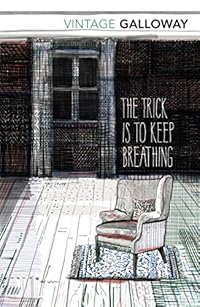
The Trick is to Keep Breathing by Janice Galloway

Vintage, 2010?* 236 p. First published 1989.

 The Trick is to Keep Breathing cover

Janice Galloway’s much lauded first novel, The Trick is to Keep Breathing, relates the adult experiences of a woman who is/was a teacher but also worked in a bookmaker’s and whose life started to unravel when the man she was living with (another woman’s husband) drowned. In the main body of the novel the narrator is an anorexic and self-harmer unable to talk about her situation. “We are veering into the difficult territory of how things are.” She is recommended by a psychiatrist to enter hospital. The doctors she meets are so indistinguishable she thinks of them as numbers; Drs One, Two and Three. In the hospital, “Most of (the rules) work on the landmine principle: they just let you loose till you trip on one of them.”

Partly to suggest her skittish mental state the text is non-linear, full of lists, repeated phrases, unconventional typography (one whole page has nothing but the word “oops” just over halfway down,) dialogue that is not indicated by quotation marks – but in interviews with health workers is rendered as in the text of a play – and has sentences that break off somewhere in

In addition wide margins allow the occasional insertion of (repeated) words or phrase fragments. This is almost in the style of Alasdair Gray’s marginal notes but here really add nothing to the novel but I suppose are again indicative of mental state.

Prior to the – unnamed; at least, I can’t recall one – narrator’s hospital admission (the doctor) “gave me pills to tide me over when I got anxious. I got anxious when they didn’t tide me over into anything different. He gave me more pills.” Later; “Maybe the pills know the answer. I doubt it but I have no proof.” Some time later she looks in a mirror. “But what looks back is never what I want. Someone melting. And too much like me.” She also avers, “Persistence gets me every time. I haven’t got any.”

She is prone to noting things like,
“This the Way Things Are.
This is What Passes For Now.”

She realises, “There’s no fucking point is there?” and eventually that the difference between her and other people is minding. They don’t mind they don’t know what the point is.

In sum The Trick is to Keep Breathing is neither a comfortable nor an easy read. As an examination of a fragmenting psyche and the incomprehension and indignities it suffers it’s illuminating, though.

Pedants corner: The text refers to a fifth form romance – in Scotland we say fifth year. We had a “sunk” count of one, “‘What are supposed to come here for?’ I said,” “He sat me down and said looked serious,” an “is” for “if,” attracive, an “it’s” for “its,” and “too neat and know” which no matter how I tried I just could not parse.

*The book states “published by Vintage 1999” but at the back has an advert for the same author’s 2003 novel Clara so must be a later reprint.

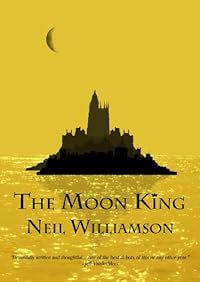
The Moon King by Neil Williamson

NewCon Press , 2014, 338 p.

The Moon King cover

Disclosure. I have known the author for a considerable number of years and he has been writing short stories – and getting them published – for all that time. He is one of nature’s good guys with many strings to his bow. (Strictly that should be lots of keys on his piano.) The Moon King is his first novel.

The book is tinged with subtle touches of Scottishness and is a curious beast, a blend of Science Fiction and Fantasy – with equal facility in both aspects. There is a machine at the heart of the plot but what it controls is strange indeed. Creatures made of water stalk its pages but can be neutralised by scooping the water from them. The world in which it is set has discontinuities with our own but is recognisably Earth-like. Its characters are all too human, though.

The city of Glassholm lies on an island. Its ruler and founder, the seemingly immortal Lunane, saved his followers by somehow tethering the Moon in an orbit that holds it above the city. The Moon’s cycles of day and night are reflected in the city’s calendar – the months are divided into wax days and wane days – and influence not only the people’s moods (Full is a day of abandonment and revelry, the heady behaviour it engenders referred to as Fullishness, Dark a time of mayhem and danger) but also the rate at which decay and rot occur.

Anton Dunn wakes up the day after Full and discovers the Palace staff think he is the Lunane. Gradually he discovers that he has indeed become the face of the Lunane, his mind and body taken over as his engineering expertise is needed. For things are beginning to fall apart on Glassholm. Unprecedentedly, a murder has taken place on Full – and the tethered Moon is beginning to stray. Anton is one of three viewpoint characters, the others are Lottie Blake, an aspiring artist whose overbearing mother is the leader of a religion, and Jonathan Mortlock, former cop and now member of the Palace guard.

Glassholm is populated with well-drawn characters. Even the minor ones feel as if they have an existence beyond the page. Lottie’s Aunt Ruby is an especial delight. This aspect fell down slightly when Dunn ventured beyond the city and met with the remnants of the indigenes the Lunane usurped when he took over the island – but that was the section where fantasy intruded most and it may have been my tendency to look on that less generously which made me feel this. The Lunane’s Palace is refreshingly exotic. Though it inevitably has faint echoes of other large fictional buildings it has a distinctive topography.

Williamson has his characters occasionally employ those impeccably Scottish terms of endearment for, respectively, a woman and a younger man, hen and son. Other artfully deployed Scotticisms were muckle, wersh, skite, puss (pronounced as in bus and meaning a person’s face,) skelped, semmet – (though Williamson spells it simmet, the way it is spoken,) close (for the entrance passageway of a tenement block,) wee, “so it does” at the end of a spoken sentence (though that may be an import from Ireland,) loup, clout for cloth and cried for called or named. The fantastical nature of the story means that many readers will be unaware that he has not just invented these words – as he has others; in SF it’s almost obligatory – but, for a Scot, it’s an unusual delight to see them in such a setting.

The Moon King has the touch of an author with a vision, who knows what he is doing and has the ability both to engage the reader and to create believable characters. If the secret locked below the Lunane’s Palace is a shade too fantastical for my tastes, that doesn’t detract from the overall experience.

At the book launch at Eastercon Neil inscribed my copy, “Please enjoy this Lunacy!” I did, and it isn’t.

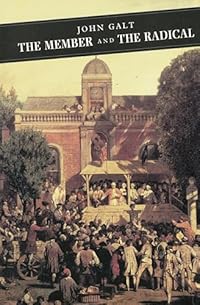
The Member and The Radical by John Galt

Canongate Classics, 1996, 263 p, including 2 p glossary, 6 p notes (The Member) and 4 p notes (The Radical) plus 8 p Introduction.

The Member and The Radical cover

Galt was a Scot born in Ayrshire whose novels mainly dealt with the impact of the industrial revolution and has been called the first political novelist in the English language. The Member was the first example of the Parliamentary political novel, The Radical deals with Parliamentary matters only towards its end. These two works of fiction were first published in 1832 (in January and May respectively) and subsequently in one volume as The Reform that November but apparently not republished till 1975 (The Member) and this edition (The Radical.) The two hundred year old idioms do take some getting used to but it is worth persevering.

The Member: An Autobiography.
This is prefaced by a “Dedication” to one William Holmes, wherein Scot Archibald Jobbry laments the imminent passing of the Great Reform Act and the inevitable depredations which it will bring in its train. Many years before Jobbry had returned from India where he had made his fortune and decided to purchase a seat in the House of Commons despite it being technically illegal to do so. He shows himself a sly and acute bargainer. During this process he opines, “a Tory is but a Whig in office, and a Whig but a Tory in opposition.” Some things don’t change. In this regard Jobbry later says MPs have been, “inveterate to retain the distribution of places and pensions – the natural perquisites of Members of Parliament” and, “The democratical think state salaries always exorbitant, and the aristocratical never think wages low enough.”

The shenanigans accompanying elections in those days are amusingly described. On this point Jobbry tells us, “It is by no means plain why paying for an individual vote should be so much more heinous than paying for a whole borough.” These vices are still with us, if in altered form. To my mind selling off state assets is an even higher category of bribe than either of those Jobbry mentions, promising lower taxes only slightly less so.

Galt often uses the utterly obsolete form “quo’ I” for “I said” when Jobbry is relating his own direct speech.

In talking to fellow Parliamentarian Sir John Bulky, Jobbry – despite being a Tory (even if of a restrained sort) – says, “It is not a time to reduce public appointments when there is a national distress; the proper season is when all is green and flourishing.” (Tell that to the present UK coalition!) Sir John replies, “lessening expenditure during a period of general hardship – is paving the way to revolution.” Fat chance.

We also have, “a wild and growing notion prevails that governments … are of less use than had always been supposed; a doctrine (in) which the most civilised and refined communities will be driven to the wall.”

The Radical: An Autobiography.
The life story of one Nathan Butt (try saying it in a Scottish accent,) an individual poles apart from Alexander Jobbry in outlook and here presented in a much less favourable light than Jobbry was in The Member – though he is much disturbed by his Radical friends indulging in bribery to get him elected. Again there is a dedication, this time to Baron Brougham and Vaux, late Lord High Chancellor. Butt’s enthusiasm for Napoleon turns to a feeling of betrayal by “that very bad man.” The narrator refers to his “friend” John Galt and quotes one of his poems. Metafiction in the 1830s. There is a harsh schoolmaster called Mr Skelper* – no doubt inspired by Mr Thwackum.

Several phrases resonate with the present day. “The age required that men who had large private properties should have resigned what they withdrew from the public purse.” (For this nowadays read Amazon, Google, Starbucks evading tax?) “The newspapers now and then tell us of this gentleman, who on his audit-day remitted so many per cents to his tenantry; but I doubt if the fashion has yet become common.” Quite! “There is something in their” – priests and clerics – “office which leads them to imagine themselves superior to the commonalty of mankind.” One of the characters has “a prophetic vista of the time when the English language, by the American States, and the Oriental colonies, would be universal all over the Earth.”

There is a glossary in the final pages which strangely only goes up to the letter “l” – at least in my copy.

*See skelp in the Dictionary of the Scots Language. Type in “skelp” in the search box and then click “skelp,v”.

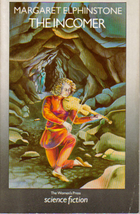
The Incomer by Margaret Elphinstone

The Women’s Press, 1987, 229 p

The Incomer cover

I picked this one up in a second hand bookshop in Edinburgh a few months ago. For two reasons. One, it was a Women’s Press SF publication I hadn’t bought at the time so it filled a gap and two, it fitted the Read Scotland 2014 Challenge. The book has the impeccably Scottish word incomer as part of its title. Though born in Kent, author Margaret Elphinstone has lived extensively in Scotland – in Galloway when the book was published – and has a professional academic interest in Scottish literature, especially of the islands. (She does have a character say, “Aren’t I?” though.)

As dark is falling a human figure falters through a vaguely menacing forest to a crossroads with a village on its north side. The village has several ruined houses but we are given to understand this is by no means unusual for the times. (Almost incidentally we find out some sort of change has reduced the human population compared to our time and advanced technology is conspicuous by its absence. Despite this, familiar things such as flower pots, nappies and sheep crop up from time to time. Heat is provided by burning wood, which seems to be a precious resource despite the surrounding forest. The North Sea is dangerous, referred to as dead, in contrast to the reviving Irish Sea.)

The figure, a travelling musician named Naomi, finds room at the inn. Her fiddle playing at a gathering a day or so later ensures her acceptance to stay for the rest of the winter. The village is called Clachanpluck (the novel has been republished as The Incomer or Clachanpluck) and holds a secret. A path through the forest leads to an entry into the earth hidden behind a waterfall. (No spoilers.)

Naomi’s presence has an impact on the relationships within the village but the main theme of the novel is mutual incomprehension, the lack of understanding Naomi has of the local norms, the assumed knowledge she doesn’t have, the care with which she has to tread. Her main driving force is her music but during her stay in the village she nevertheless – if somewhat unconvincingly – throws off her long-maintained celibacy in a relationship with fellow fiddle player Davey to whom she teaches tunes that she learned on her travels in Europe. Old, powerful music, written by Beethoven. Despite the almost unspoken matriarchy in Clachanpluck human nature hasn’t much changed. Other misunderstandings take place among those who have lived there all their lives.

This is a quiet, understated novel whose depiction of a restrained, unfussy, reticent lifestyle where people no longer exploit nature unsustainably and have a deep attachment to the land may be nostalgic and idealistic yet resists being idyllic.

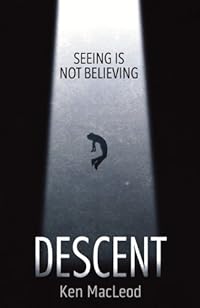
Descent by Ken MacLeod

Orbit, 2014, 407 p.

This book is dedicated to the memory of the author’s close friend, Iain (M) Banks, and may be considered as a tribute. It is topped and tailed by two of the protagonist’s dreams, titled respectively 0.1111 Recurring and 0.2222 Recurring. The first of these is very Banksian in tone.

Some time in the near(ish) future Ryan Sinclair and his friend Calum, who has a more demotic form of speech than Ryan, have a close encounter with a strange silver sphere in the hills above Greenock. Ryan thereafter experiences dreams/memories of the classic UFO alien abduction scenario. Calum does not. Both are subsequently visited by mysterious strangers – in Ryan’s case a man calling himself the Reverend James Baxter, a literal Man in Black. Thereafter Baxter figures intermittently throughout the novel. (Quite why MacLeod used the name of perhaps Scotland’s most famous footballer for this character is obscure; to me at least.)

Descent contains simultaneously an exploration and a debunking of the UFO abduction story but is also much more than this. Calum tells Ryan a family history about uniqueness and distancing. In his later life as a freelance science journalist, Ryan uncovers evidence, through fertility statistics, of speciation occurring within humans. This affects Ryan’s life directly in his relationship with Gabrielle, one of Calum’s relatives, whom he meets at a wedding. While Ryan is busy with his Highers* a worldwide change in economic arrangements called the Big Deal saves capitalism from itself by instituting what Calum refers to as a kind of socialism (but if it is, it is very dilute.) The pre-Big Deal revolutionaries evaporate away in this new dispensation where jobs are more abundant, while silver airships and smart fabrics make their appearance. Otherwise people’s activities, drinking, vaping (presumably of e-cigs,) buying, selling, work and relationships are more or less as we know them now. The UFO aspect of his story allows MacLeod to have some fun with government’s response to such manifestations.

The early scenes set in Greenock bear some similarities to Alan Warner’s The Deadman’s Pedal. Both novels have at their start a sixteen year old protagonist, a West of Scotland seaside town setting, a sudden attraction to a girl. The writing of the two novels is comparable also. Descent is a different beast altogether, however. While Warner’s book dealt with politics only obliquely MacLeod has always been a writer whose interest in political ideas has been foregrounded in his fiction. He never lets it get in the way of the story but his engagement with politics is distinctive among SF writers.

In character terms Descent deals with betrayal, revenge and redemption. While the SF elements are necessary to the plot, they could be considered as trappings, scaffolding on which to build the human story.

A nice touch was the inclusion of the phrase, “Gonnae naw dae that,” made famous in Scotland by the TV series Chewin’ the Fat.

*A Scottish educational qualification (originally the Higher School Leaving Certificate) and roughly equivalent to A-levels, but undertaken over one year.) Nitpick:- page 84 refers to Calum excelling at O-level technical drawing. O-levels were not a Scottish examination. Some Scottish schools did enter their pupils for them but I doubt that happened in Greenock. Nor will it. The Scottish equivalent, O-grades, were superseded in the 1980s by Standard Grades, which in their turn have this year been replaced by National 3, 4 and 5 qualifications. O-levels were replaced in England by GCSEs from 1988.

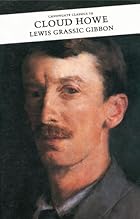
Cloud Howe by Lewis Grassic Gibbon

In “A Scots Quair,” Hutchinson, 1966, 156 p. First published 1933. The cover shown is of a Canongate edition.

Cloud Howe cover

Cloud Howe takes up the story of Chris Guthrie from Sunset Song at the point where her new husband, Minister Robert Colquohoun (strange spelling that, Colquhoun is more usual,) is about to try for the vacant post in the parish of Segget, still in the Mearns and not far away from the Kinraddie of the earlier book. Segget is a divided community, not to mention class ridden and status conscious, with the folks in the old part of town despising the spinners who work in the jute mills. Robert’s self-imposed mission there is to improve Segget. On their first walk in Segget Robert, gassed in the Great War, is horrified by Segget’s War Memorial, an angel set on a block of stone, “like a constipated calf.”

The story unfolds over the 1920s, covering almost incidentally the growth of socialism – and its first betrayal – the (lack of) industrial relations, the grinding poverty, the insensitivity of the rich. The narrative voice is not straightforward, shifting, but not obtrusively, back and forth from a tight focus on Chris – or on occasion someone else – to an unnamed kirkgoer of a conservative bent (small and large C.) Gibbon captures the smugness of that holier than thou voice perfectly, “The English aye needed the Scots at their head, right holy and smart at the same time,” is one of the milder observations. Also well captured is its hypocrisy, “You’d seen it all in the People’s Journal, what the coarse tinks did in Russia with women – man they fair had a time with the women, would you say ‘twould be easy to get a job there?”

Segget is replete with characters and nicknames. Ag Moultrie, prone to outbursts of weeping is known as the Roarer and Greeter, the mayor’s resemblance to a monkey has him dubbed Hairy Hogg. Old Leslie at the Smiddy is prone to reminisce, “I mind when I was a loon in Garvock.”

If Kinraddie thrived on gossip then Segget gloats in it. The morning after the Segget Show a farmer and his wife are delighted to come upon two couples “in such a like way” in their barn. “They’d be able to tell the story about them all the years they lived on Earth; and make it a titbit in Hell forbye.” It doesn’t take long after the Colquohouns’ arrival for tales detrimental to Chris to start to circulate – even before Robert attempts to change Segget for the better. Chris is damned either way. If she speaks in Scots she is common, if in English she is putting on airs.

Cloud Howe also begins to focus on Chris’s son Ewan, who is four times referred to in the text as grey granite. Ewan sees nothing wrong with either nakedness or sex and doesn’t take nonsense from anyone. When confronted by Ag Moultrie with a piece of gossip about himself he replies, “I’m sorry I don’t know what you’ve heard, Miss Moultrie, but no doubt Segget soon will. Good Morning.”

It struck me that when a farmer’s wife says she’s heard of Chris from her son, “he lived in London and wrote horrible books,” might be Gibbon referring to himself. I remember reading somewhere that Chris is intended as a metaphor for Scotland. Gibbon foregrounds this twice; once when the local toff, Mowatt, meets Chris and, “was to say later he felt he was stared at by Scotland herself,” and secondly when Robert refers to her as Chris Caledonia. I’m not quite sure whether the narrative is enough to sustain the metaphor.

As in Sunset Song Gibbon once again asserts that the Scots have never really BELIEVED in God. All that is real is the land. “Only the sky and the seasons endured, slow in their change.” The author’s eye and ear for rural and village life is acute. I have no doubt that this is how it was in the Mearns a hundred years ago.

One curio. The phrase, “leave me to twitter,” reads a little differently nowadays from the way Gibbon intended.

Sunset Song by Lewis Grassic Gibbon

In “A Scots Quair,” Hutchinson, 1966, 180 p. First published 1932. The cover shown is of a Canongate edition.

Sunset Song cover

The Scots Quair trilogy is widely seen as Gibbon’s major work, Sunset Song as one of the most important Scottish novels of the twentieth century. Set in the estate of Kinraddie, in the Mearns area, between Laurencekirk and Stonehaven, where Gibbon lived, the lyrical descriptions of the Mearns countryside speak of a deep attachment to the land.

Sunset Song in the main tells the story of Chris Guthrie, daughter of an overbearing father, John, and a mother, Jean, who is so ground down by childbirth that she kills herself and her young twins when she finds herself pregnant for the sixth time. Kinraddie is said by a new minister of the local kirk, a man called Gibbon, to be “fathered between a kailyard and a bonny brier bush in the lee of a house with green shutters,” despite their being no house with green shutters in the whole of Kinraddie. This of course is the author placing his novel firmly within the ongoing sweep of Scottish literature.

I have read nearly all of Gibbon’s novels – whether originally published pseudonymously as by “Gibbon,” or under his real name of J Leslie Mitchell. Sunset Song and The Speak of the Mearns are the most rooted in his home area, hence liberally sprinkled with Scots words. A prefatory note begs the indulgence of English readers in this regard. (I confess I have only a limited background in Scots – especially of words to do with agriculture – but found a lack of knowledge of precise meanings was not a barrier to comprehension. English or USian readers may beg to differ. However, I understand more modern editions contain a glossary.)

The novel is carefully structured to reflect the phases of Chris’s young life. It has a prelude, “The Unfurrowed Field,” which unfolds the history of and introduces the characters inhabiting the Kinraddie estate, followed by four sections, titled respectively Ploughing, Drilling, Seed-Time and Harvest, then an epilude – a word seemingly coined by Gibbon – also titled “The Unfurrowed Field.”

Kinraddie is depicted as a community that thrives on gossip. That would, in the old Scots phrase, be “minding everybody’s business” (which is in my experience immediately followed by the words “but their own.”) It also thrives on argument. At one point Chris tells her brother, “I don’t believe they were ever religious, the Scots folk. They’ve never really BELIEVED.” The kirk had just been a place to collect and argue, and criticise God.

In Kinraddie people are quick to think the worst of others – and never expect the same will apply to them – but still gather round to help in an emergency. Set in that pre-Great War era when mechanical devices were on the way but a rarity on most farms – though the small size of the holdings in Kinraddie make them more like crofts – life is hard and opportunities for harmless pleasure few, and savoured. The number of pages given over to Chris’s wedding (where everyone musical, and some who are not, give their party pieces or provide accompaniment to the dancing and Chris herself sings that great Scottish lament The Flowers of the Forest) – even though it did coincide with the arrival of a New Year – serves to highlight this. On music Chris reflects, “how strange was the sadness of Scotland’s singing, made for the sadness of the land and sky in dark autumn evenings, the crying of men and women of the land who had seen their lives and loves sink away in the years.”

In Harvest, all is ripped apart by the impact of the Great War. Not only are relationships within the community slowly eroded, the woods which protect the land are cut down to make aeroplanes and the like, and several young men do not come back from France. As its title implies the novel is a eulogy for the lost way of life. In the epilude, at the dedication of the War Memorial, a piper plays the tune of The Flowers of the Forest, the music of which is rendered in the text, a threnody to that now dead past. But the key sentence of the book is perhaps, “Scotland lived, she could never die, the land would outlast them all.” It has, it does, it will.

A couple of phrases appear which are unlikely to feature in a modern novel. After firing the whin bushes Chris’s brother Will is said to be “black as a nigger” and “fit to freeze the chilblains on a brass monkey” is nowadays usually expressed more scatologically. Yes, Sunset Song is a novel of its time – but it is also not of it. The Scotland that Sunset Song depicts may be no more, the people it describes are not.

The Deadman’s Pedal by Alan Warner

Alan Warner enjoyed critical success from his first novel Morvern Callar which was mainly set in a never named West of Scotland seaside town (but clearly identifiable as – indeed an almost undisguised – Oban.) He followed this up with These Demented Lands, The Sopranos and The Man Who Walks. I found all of these well worth reading but not quite fully successful. However his 2006 novel The Worms Can Carry Me to Heaven in retrospect worked very well, though I seem to have been excessively grudging about it in my post. I have not yet read The Stars in the Bright Sky from 2010 but his latest, The Deadman’s Pedal, while I have minor quibbles about it, is a very good piece of fiction indeed.

We are once more in Warner’s reimagined Oban. It is 1973 and 15 year old Simon Crimmons, son of the owner of a road haulage firm, is fed up with school and wants to leave. On his last school day, 8th June, (Really? That’s at least three weeks earlier than most of Scotland’s schools break up for the summer) he is awaited at the school gates by Nikki Caine who becomes his girlfriend. However, a few days before their first actual date, out on a walk in the hills he is tantalised by glimpses of Varie, the daughter of the local toff, Andrew Bultitude. Bultitude has the title Commander of the Pass and his family lives in the delightfully named house Broken Moan. Unusually, Bultitudes are buried in the house’s grounds, in glass graves, so that the dead can be seen. The book, apart from a small preamble evoking the sensations of driving a train through the Argyll night, starts off with a scene set in those grounds prior to a 1961 visit from the Queen. Though each chapter is given a date for a title and relates the events of a single day, the chronology isn’t linear. In particular chapter three flashes back to the funeral of a local railway worker in early 1973 where tales are told of a railwayman’s prank which took place on the royal train for that 1961 visit. Without really meaning to Simon ends up being interviewed for a job on the railway as a diesel locomotive driver to replace the deceased. This leads to passages devoted to the art of driving a diesel train – the novel could almost be a primer for that activity. A deadman’s pedal is of course the safety device which ensures that a train cannot be driven if the driver is unconscious – or dead at the controls.

The conversations of 1970s adolescent boys are very well captured, their bluster and crudeness, as is the banter between the railway workers. The parts of the book dealing with the train drivers could be a eulogy to that vanished sense of solidarity and socialism which James Robertson also touched on recently in And The Land Lay Still. A possible intrusion from the twenty-first century comes when staunch union man John Penalty says, “One day there’ll be nae union and they’ll be shovelling the management’s shite from under their arses as it comes out. Then they’ll be told to tip it over their own heids, and they will.” Pretty much a description of present day workplace conditions.

Not that other perspectives are omitted. Simon’s dad has the outlook of a small businessman; he is also a DCM and bar from the North African and Italian campaigns in World War 2, though unlike those who weren’t at the sharp end he is reluctant to speak about his experiences. Andrew Bultitude – as those in his social position do – assumes his own wishes will always prevail.

Warner portrays excellently the more or less stifling experience of growing up in the early 1970s in a West of Scotland town with only one cinema and dodgy television reception – the mysteries of STV are here known to only a few. Curiously, though, he refers to the transmitter mast on the hill above the town as an aerial. However his decision to transliterate part of the West of Scotland dialect by using “should of,” “would of” and “could of” irritated me immensely. More annoyingly he was not always consistent with this. His use of “nut” for the West of Scotland “no” also didn’t feel quite right. While the “t”s in button and so on are not pronounced – it is sounded more like “buh’n” – I still often read it as a kernel. It’s a pity too that there were infelicities like Scholl’s for Scholls, Balqhuidder for Balquhidder, calomine for calamine, lay for lie, snuck for sneaked, blaise for blaes. And we had the phrase the Queen of England; which is annoying on several levels. As I exemplified above, in these islands the woman in question is usually referred to simply as the Queen. In addition she is not merely Queen of England but of Scotland, Wales, Northern Ireland, Canada, Australia and loads of other places besides. Someone in Simon Crimmons’s shoes would surely have been aware of this.

A back cover puff from the Scottish Review of Books says, “This is the best Scottish fiction since Lanark.” While I wouldn’t go quite so far, The Deadman’s Pedal is, quibbles above notwithstanding, without doubt a superior work. It will be in my best of the year for sure.

free hit counter script