Archives » Read Scotland 2014

Mr Mee by Andrew Crumey

Picador, 2000, 344 p.

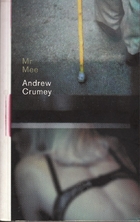
Mr Mee cover

Mr Mee bears several Crumey hallmarks; explanations of concepts from Physics (and, in this case, probability) in literary form, characters from the 18th century, ruminations on literature and philosophy. The narrative is triple stranded: that of Mr Mee himself, in the form of the eighty six year old’s letters to an old friend; the adventures of two Frenchmen, “the Gossips,” Ferrand and Minard, who meet Jean-Jacques Rousseau and precipitate his flight from France; and the meanderings of academic Dr Petrie whose main research interest is those same two Frenchmen. The epilogue introduces a fourth narrator who once installed a Théâtrophone in the bedridden Marcel Proust’s apartment. It casts further light on the preceding stories and has the potential to alter the reader’s perceptions of them, though is perhaps a little too eager to drop in literary allusions.

The unworldly Mr Mee, stuck in his ways and almost drowning in a sea of books, is prompted by his housekeeper, Mrs B, to discover that the worlds of literature and philosophy are available through the less space consuming medium of the PC and the internet. What he finds there intrigues him – and shocks Mrs B into leaving abruptly. His old fashioned attitudes to modern life and his misunderstandings are a source of light humour (“those nice folk at Dixons,” the joys of live video links – a bus stop in Aberdeen and a naked girl reading a book which is of course Dr Petrie’s on Ferrand and Minard, the “sensational and sentimental” fare that passes for Scottish literature in a modern bookshop) unusual in Crumey’s work. His encounter with practical and capable life scientist student Catriona leads the unmarried (and sexual ingénu) Mr Mee to new experiences.

Ferrand and Minard are copyists, whose latest project regarding a new understanding of how the world works is stolen from their flat and whose downstairs neighbour has been murdered. Fearing the blame for the killing they flee to Montmorency, come under the protection of a Bishop Bertier and end up living next door to Rousseau who is said to think the world would be a much better place without books.

Dr Petrie has been captivated by the sexual possibilities involved in his tutoring of a mature (twenty four year old) student called Louisa and imagines his disease symptoms are a reflection of his attraction to her. He believes Ferrand and Minard to have been invented by Rousseau whose Confessions he says are as much a fiction as was the novel Émile.

The text contains a lot of literary reference; not just to Rousseau and Proust but to mechanical poetry and the pitfalls of attributing what happens in a novel to autobiography, (“a person called ‘I’ who is not necessarily oneself.”) Other aperçus include, “the moment in which we live, like the self we inhabit, is the one we are least equipped to understand,” “when faced with an unfamiliar situation, we play the part as best we can; and our scripts come to us from many places,” the contention that “all men write for sex,” and the observation that “out of character” simply means unexpectedly. (Compare Allan Massie.)

Mr Mee is a kind of companion piece to D’Alembert’s Principle; some of that books preoccupations reappear – we hear again of D’Alembert and Diderot and their Encyclopédie – and there is a sly reference to the contents of Crumey’s earlier book Pƒitz. Dr Petrie tells Louisa that “Rousseau’s novel, like Proust’s, is intimately concerned with the nature of writing.” So, too, is Crumey’s, an engagement with what a novel is, or can be, the uses to which fiction can be put and an examination of the ways in which texts can be interpreted. While the book can be read solely for the stories contained within it these other aspects for me add value, elevate it beyond the level of just a novel but, curiously in such a well-crafted literary piece of work, we twice had “chord” for “cord,” even if I was also grateful to be introduced to the useful word “anacoluthon” (lack of syntactical agreement of the latter part of a sentence with the former.)

I had some misgivings about the way Mr Mee’s relationship with Catriona develops. She is depicted as being in control throughout (indeed she is by far the more knowing of the two, about modern life as well as in a sexual sense) but still. However, yet again Crumey has written an intriguing novel, well worth anyone’s attention.
Surviving by Allan Massie

Vagabond Voices, 2009, 208p.

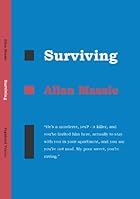
Surviving cover

This is the second book I’ve read this year eligible for the Read Scotland 2014 Challenge and the second not set in Scotland. The author has a large back catalogue some of them set in Scotland in various historical eras up to the present but he has also delved into the lives of ex-Nazis in South America, the legacy of the Vichy regime and later twentieth century Italian politics in addition to writing a series of very good novels on the lives of Roman Emperors.

Surviving takes place in modern(ish) Rome. It is undated but the currency being used is the lira which would set it before Italy adopted the Euro in 2002. The story unfolds over fifty short chapters, though since each is indicated by a Roman numeral in bold that should be L chapters.

A group of ex-pat Britons is just about surviving being alcoholics – with a few lapses – via their attendance at AA meetings. A new member, writer Tom Durward, – whose surname surely signals a Walter Scott connection – has guilty feelings due to his orphaned nephew, Jamie (entrusted to his care,) having drowned himself at boarding school years ago. Stephen Mallany spectacularly drops off the wagon just after the meeting where Durward introduces himself.

The web of relationships becomes further disturbed when Gary Kelly, a man acquitted of murder back in Britain, is taken into her home by Kate Sturzo. The book takes a strange turn indeed when the barrister who defended him, Reynard Yallett, also arrives in Rome. The consequences involve murder but the novel reads nothing like a detective story.

There are multifarous characters, perhaps too many. That there should be such neat connections between some of them stretches believability a bit but Massie’s writing is smooth and accomplished even if he puts into the mouth of one of them the sentence, “We make for ourselves impressions of people and if they act in a way that doesn’t fit that impression we say they’re acting out of character as if they were actors condemned to be typecast,” which is a wonderful get out of jail free card for any author to trot out. He also gives us a piece of metafictional trickery towards the end as Durward muses about writing the whole story up as a novel.

What kind of novel Surviving is, is not easy to pigeonhole. It’s worth a look though.

Not the End of the World by Christopher Brookmyre

Abacus, 2009, 388p.

Not the most profound book with which to start my Read Scotland Challenge; not typical Brookmyre either as it’s set in California. First published in 1998, it imagines a millenarian run up to the end of the century.

LAPD cop Larry Freeman has a strange disappearance or four to investigate, photographer – and Motherwell supporter – Stephen Kennedy is in town to cover the American Feature Film Marketing Board meeting and take the pics for an interview with erstwhile porn actress Madeleine Witherson (the daughter of a US Senator,) failed US Presidential candidate and evangelical preacher Luther St John is whipping up the faithful for the new millennium.

St John has dubbed Witherson “The Whore of Babylon,” a symbol of the moral degradation into which he regards the US to have fallen, stirred up by the film and television industry. He has also predicted God will send a tidal wave to inundate greater Los Angeles in early 1999 as a signal of His wrath.

As to the plot, the Gazes Also, a boat belonging to the California Oceanic Research Institute, has been found crewless, a latter day Mary Celeste. Four scientists are missing. Another, Sandra Biscayne, was murdered several months before. St John sponsored both their projects. It’s not difficult to join the dots…. In the meantime religious nut-job Daniel Corby has plans of his own to sway the godless from their wicked ways. Plans which involve murder and human (self)-sacrifice. It’s a Brookmyre novel, there’s bound to be mayhem in it somewhere.

It’s well enough constructed, if not difficult to second guess, and Brookmyre carries us along admirably. He does feel the need to fill in characters’ back stories at considerable length, though, providing psychological reasons for them being the way they are, which is a little at odds with the overall thriller nature. He also manages to insert into the narrative a description of the eruption of Thera, the volcano whose explosion and subsequent tsunami destroyed the Minoan civilisation.

Religious fundamentalists (of whatever stripe) are easy targets, but none the less deserving of censure. None of them seem willing to live and let live. All of them are in the business of justifying their desire to control the behaviour – and thoughts – of others. Brookmyre doesn’t spare them.

There aren’t quite as many jokes as in a more typical Brookmyre novel and there isn’t a great deal of his usual Scots vernacular, though Kennedy has some good lines.

A mildly diverting, relatively undemanding read, even if I did spot two continuity errors. If you’re a fundamentalist it isn’t for you though.

Projected New Year Reading

Happy New Year everyone.

As I mentioned before the good lady suggested I should take part in her blog friend Peggy Ann’s Read Scotland Challenge. This post is about what I intend to read. (Whether I will actually get around to it all is another matter. There is the small matter of a review for Interzone to be got out of the way as a first priority and other reading to be done.)

When it came up I looked on this project partly as a chance to catch up on Scottish classics I have so far missed. In the frame then is Lewis Grassic Gibbon’s A Scots Quair trilogy – I have read most of his œuvre but not this, his most well-known work. The televison series made of it in the 1970s has been in my memory for a long time, though. I also have his Persian Dawns, Egyptian Nights in my tbr pile and a collection of shorter pieces under the title Smeddum many of which I have already read. I have not managed to source his The Calends of Cairo and doubtless if I did it would be horribly expensive.

Another Scottish classic I haven’t read is J MacDougall Hay’s Gillespie, which lies on my desk as I write this but, according to Alasdair Gray, has the “worst first chapter that ever introduced a novel worth reading.” I consider myself warned.

If I can get hold of a copy then John Galt’s The Member and the Radical will go on the list.

As far as modern stuff is concerned there are multiple novels by Christopher Brookmyre and Allan Massie on my shelves and as yet unread, two by Alan Warner, Andrew Crumey’s Mr Mee and James Robertson’s latest The Professor of Truth.

Plenty to be going on with.

We’ll see how it goes.

free hit counter script