Archives » My ParSec reviews

Orphan Planet by Madeehah Reza  

Luna Press, 2025, 187 p. Reviewed for ParSec 14.

At the start of this novella Elif is the sole inhabitant of the apparently desert planet Maoira-I. At twelve years old she has hitherto known only the companionship of the AI, VAS-H, her Vital Auxiliary Support: H-unit, and her knowledge of other humans is derived solely from the films and shows available to her on screen.

Contact from Commander Isabel Aremu of the Interplanetary Mission, based on Polaris, who addresses Elif as Warden, comes to her out of the blue, as does the task she is assigned of growing, or attempting to grow, plants to see if Maoira-I might be a suitable future home for humanity. The Mission is on an indefinite space flight fleeing something unspecified back on Earth. VAS-H retrieves the seeds Elif will need, seeds she had not known were there, from the base’s storage freezer.

Part One centres on Elif via both a third person narrative tightly focused on her unfolding experiences and the log entries VAS-H asks her to compile. While these are not the reflections of an unreliable narrator they are those of one without knowledge of the full picture. Helping to fill in those gaps for the reader there are also two italicised sections dealing mainly with the consequences for Commander Aremu on Polaris of the Mission having to admit that Elif exists and its failures regarding her. This leads to Aremu’s replacement as contact by the much less sympathetic Lieutenant, later Commander, Julian Bishop.

In the meantime Elif uncovers a buried Transporter vehicle on the surface and learns to drive it while Maoira-I’s long-term climatic variations begin to manifest themselves.

Part Two makes a step change. Mission operative Rokeya Khan, whose grandfather Latif was on the original team to land on Maoira-I, has set off on her own to get to the planet and find out what happened. Her arrival shocks Elif but they learn to work together.

Rokeya’s presence is the catalyst for the discovery of what became of the original crew, one of whom, naturally, but against all protocol, must have been pregnant.

It also crystallises Elif’s feelings towards the rest of humanity and towards the only home she has ever known.

There are some caveats to this. The premise does stretch credibility a bit. Could an infant human really thrive under only the influence of an AI and old videos? Could she retain sanity even? Could the original expedition genuinely have been forgotten by the Mission for twelve years?

But Reza has written this well. She captures Elif’s initial ingenuousness and growing confidence. The claustrophobic atmosphere of an isolated environment comes across, as does the slightly sinister sway of an AI companion.

This is an impressive long form debut.


The following did not appear in the published review.

Pedant’s corner:-  shrunk (x3, shrank,) CO2 (several times. It’s CO2,) “wherever the fleet of ships were” (wherever the fleet … was,) fit (fitted,) “than several millions” (than several million,) “about to reach a crescendo” (you don’t reach a crescendo, you reach its end,) sunk (sank.) “Rokeya’s opened her mouth in shock” (Rokeya opened her mouth.)


Busy for ParSec Again

I recently sent off to Parsec magazine my review of Solstice by Ruth Aylett and Greg Michaelson, a book which I picked up* at the first Pictcon in Perth a month or so ago. A very successful first con it has to be said. Pictcon focuses on the Scottish SF and fantasy scene.

Editor Ian Whates has chosen to run it so that review will not appear here for a while.

Meanwhile he has sent me Reality Rift by Fred Gambino, a follow-up to that author’s first novel Dark Shepherd.

*By picked up I mean “blagged with the promise of a review on the blog and the chance of ParSec running it.”

If the Stars are Lit by Sara K Ellis

Luna Press, 2025, 198 p. Reviewed for ParSec 14.

Well. They do say you should start with a bang – and this novel does begin with a sentence reminiscent of the first in Iain Banks’s The Crow Road, though what unfolds is neither a bildungsroman nor (quite) a murder mystery but a decent enough piece of Science Fiction.

Viewpoint character Jocelyn Carsten (Joss,) is a hostage negotiator on the way home from managing a crisis on the planet Haitch when her passenger ship Tiktaalik suffers an explosion. She is still alive, just, but is injured, and is the sole survivor. All contact with the ship’s Central Hub – and the outside world – is lost. Only Harbour, the controlling intelligence of passenger mod Petal 4, is available to aid her.

After a trip to the med bay and an EVA to survey the damage to the ship, Harbour advises her to rest. When she wakes up there is another presence in the mod, a gemel; a holographic copy of Joss’s personality, but this has the physical appearance of her ex-wife, Alice Dray.

“A gemel” (the plural is also gemel) “is a sentient being generated from an individual’s psyche,” usually, but not always, taking on the appearance of their sires, “fuzzy copies of their progenitors, interpolated from memories and neurocircuitry, and can resemble their users to a disturbing degree,” but can be “warped by narcissists with fat wallets and the desire for more intimate personal assistants,” as had been the case with Gabrielle Vecher, on-site CEO for Haxen Mining Corps, and his gemel Malachi. Narcissus and Echo in the same package, thinks Joss. Gemel were not allowed physical bodies but, with safeguards, could patch into systems and control them from the inside. They “drew force from external sources, running off the excess electricity in the machines around them.”

This Not-Alice becomes a psychological prop for Joss and a device for the author to run Joss’s backstory past the reader, in instalments. Indeed, at times our access to Joss’s thoughts shifts between the present and her past memories with little or no signalling.

Joss’s rescue from isolation – when it comes (rather abruptly it must be said) – is by a military force co-commanded by none other than Alice Dray: the real one. Its mission is to investigate both why Tiktaalik and the tunnels on Haitch were blown up and to try to obtain the release of the humans still there held by gemel, an endeavour where Joss’s negotiating skills come to the fore. But Alice Dray’s co-commander – something of a loose cannon of the gung-ho military type – threatens to undermine Joss’s steps towards a solution of the situation.

It turns out Vecher had constructed a highly dangerous device deriving from mysterious markings on the tunnels on Haitch. And time is running out. “‘That thing Vecher made tore a hole in the fabric of the universe or whatever the hell you want to call it, and it’s growing, becoming less stable by the hour,’” says Joss during the negotiations.

Given her initial circumstances, Joss is unsurprisingly prone to periods of introspection and questioning both of herself and others.

Despite some problems with structure and pacing this is an engaging read and will push enough familiar buttons for SF readers to emerge satisfied.

The following did not appear in the published review.

Pedant’s corner:- Written in USian but with some British spellings. The planet Ross128 H’s nickname of Haitch is an egregious mispronunciation of that letter of the alphabet, “on a round-a-bout route” (roundabout – which was used elsewhere in the text for a meander -) once there was a single quotation mark where double ones are employed elsewhere, shlock (schlock,) back-peddling (back-pedalling,) hostage takers “174 million miles away” morphs to “140 million mile silences” during the communications gap, “sliding the stack of credits Joss had won back from her back across the table” (Joss was playing her opponent for the first time, so just ‘had won from her’.) “This is ….. based on …..?” (wasn’t a question so full stop, not question mark,) C02 (It’s not C zero two as was printed in the text, and the 2 ought to be a subscript,) “wracking your brain” (racking,) “sending some part of her ex’s upper-class snobbery would revolt” (sensing some part.) “‘Tell and I send you outside to repaint the serial number.’” (No clue. Who is Tell?) “what she can offer them are options” (I read ‘what she can offer them’ as a singular subject to the following verb; so ‘what she can offer them is options’,) “is different thing” (is a different thing.) “‘Ph damage right here’” (‘pH damage’ was meant and pH always has an upper case H and a lower case p – even at the start of a sentence,) “drowns out nothing but Callen’s voice” (everything but Callen’s voice,) “‘I pretty sure’” (I was pretty sure,) “for having sunken so low” (for having sunk so low.) “She doubts its convincing” (doubts it’s convincing,) “amid glow of the launch” (amid the glow of the launch,) a missing extraneous end quotation mark, a missing comma before the quotation mark at the end of a piece of dialogue. “‘How is that that they’ve got people down there?’”  (How is it that they’ve got…,) “‘if we so much get within the distance’” (if we so much as get within…,) “it takes her moment” (it takes her a moment.) “Alice takes her seat again and switching back to their private comm.” (and switches back to,) “the metal partition the separated them” (partition that separated them.) “A name that inferred family, and what she’d always been taught to mean trust, love and guidance” (and that she’d always been taught…,) “but do they do afford” (but they do afford,) “of the Florenz’ cargo bay” (the Florenz’s,) “breathing apparatuses” (the plural of apparatus is apparatus,) “nothing but the judder of the engine and the clatter of equipment as rattles against the bulkheads” (could be rewritten more clearly,) “‘I can’t let you can’t do this’” (either, ‘I can’t let you do this’ or, ‘You can’t do this.)

ParSec Review Again

ExilesThe latest book I have received to review for ParSec is Exiles by Mason Coile.

This was one of only two SF books in the most recent list of upcoming publications up for review.

I have not previously read anything by the author.

However, the accompanying blurb tells me Mason Coile is a pseudonym of Andrew Pyper, award winning author of William and ten other novels. These seem to be works in the thriller or horror genres. William was published as by Mason Coile, though.

Sadly, the blurb also says Pyper died in January 2025.

Andrew Pyper: 29/3/1968 – 3/2/2025. So it goes.


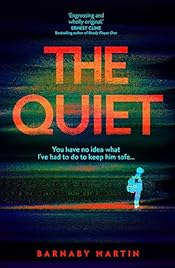
The Quiet by Barnaby Martin

MacMillan, 2025, 347 p. Reviewed for ParSec 13.

Twenty years ago the Soundfield appeared overhead. Ever since, temperatures have continued to soar, UV radiation makes going out in daylight all but deadly, food is short, parts of the world up to and including Italy are devoid of humans, and refugees are countless. People in Britain now sleep during the day and carry out whatever business they can at night.

Hannah Williams lectures on genetics at a college but her life is complicated by her son, Isaac, who cannot speak, only sign, must be kept occupied and also looked after by someone else if she is busy.

They are living in a dystopia. The Government is essentially authoritarian, dissenters can be shot, (refugees have been in the past when trying to come ashore,) agents of the Atavism Programme are ever vigilant, looking for children who connect with the Soundfield’s constant hum and its occasional musical calls. Isaac’s tendency to sing at these moments is why Hannah is so protective of him. She does not wish to lose him to the Programme. (How Isaac can sing when he can’t speak is unexplained.) The ongoing story of their lives in this harsh world has its menace heightened by the author’s use of the present tense. The passages where Hannah remembers her past life, before the Soundfield and when she was part of the first investigations into it, are in the past tense. Hannah’s part in that investigation was carried out in collaboration with a team led by Elias, a physicist, with whom she had a relationship.

Examination of the field showed it to contain the components of air, in the normal proportions, but also small dust particles, inert minerals and silica, some bacteria and fungi, “as if a microscopic layer of the ground had been scooped up and held in suspension thirty kilometres up, creating a dome that sealed the Earth.” Video footage revealed it to be moving, like waves. “A thin taut membrane that vibrates thousands of times a second.”

Hannah’s lectures centre on the FOXP2 gene. This is usually invariant and has been for millions of years – except for the (relatively) recent two changes which coincided with the development of language in humans.

Her breakthrough in trying to understand the Soundfield came with studying the EK family, who all had developmental verbal dyspraxia. In them, one of the bases on the FOXP2 gene had reverted to its previous state.

This is an unusual piece of SF as writers in the genre do not usually consider the evolution of language nor its connection to music.  Through Hannah, Martin tells us language and music are combinatorial, made up of individual units that stack together to give new structures, but are also recursive and innate. But as Hannah says to Elias, “We are biologically programmed to speak, but also to listen to and produce music.” She suggests speech and music co-evolved from a musical protolanguage and wonders if that might be what the Soundfield is producing. The publishing of her results, though, is the trigger for the Atavism Programme and Hannah’s present predicament.

The dystopian aspects of the novel are reasonably similar to other works in that vein (autocracies do tend to be similar in their repressions, as are people’s reactions to them) but Martin combines them with a concern for family and relationships. As in all human interactions, though, betrayal and jeopardy are never far away.

The following did not appear in the published review.

Pedant’s corner:- “on his hoody” (usually spelled hoodie, as it is later in the book,) “of the front frow” (front row,) “much more hands-on that it used to be” (than it used to be,) “a man with a short beard wearing a bullet-proof vest” (why would a beard wear a vest? Try ‘a short-bearded man wearing a bullet-proof vest,) “the old stationary store” (stationery store,) “‘what do you parents do?’” (do your parents,) “outside of” (x 2, just ‘outside’ no ‘of’,) “‘there was only once choice’” (only one choice,) “in Elias’ team” (Elias’s – which appears later,) phenomes (the passage was about phonemes,) sat (several times; ‘sitting’,) span (spun,) focussed (focused,) “in the middle of wide, open room” (of a wide, open room,) “‘to make sure your safe’” (you’re safe.)

Halcyon Years

Another book to review for ParSec.

This time it’s the latest by Alastair Reynolds, titled Halcyon Years.

Judging by the front cover blurb it’s a Space Opera.

Why not? Reynolds is rather good at them.


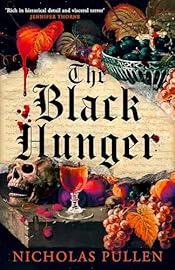
The Black Hunger by Nicholas Pullen

Orbit, 2024, 386 p. Reviewed for ParSec 13.
A list of some of the elements with which this novel is sprinkled – an ancient clandestine religious sect, a highly secret Government agency whose existence dates back to Tudor times, the Charge of the Light Brigade, ritual sacrifices, a sword imbued with dark powers, cannibalism – might suggest it leans towards the schlockier end of the fictional spectrum but Pullen’s writing style is far from that. Though at times it does lean into excess at others it even smacks of literary quality.

The book has an enleaved structure. As supposedly written down in 1921, the story of John Sackville, only son of the Earl of Dorset, of his male lover Garrett and their encounters with evil powers, top and tail the book in an epistolary narrative titled The White Baron. Within that, Sackville reads the diary of Dr Samuel Abravanel from September 1876 under the rubric The Red Circle, which itself contains letters from mid-Victorian General Ian Stewart to his wife Clara in a section named The Black Hunger. The settings range in location from that Dorset home to early twentieth century India, Tibet, China and Mongolia before taking in mid-nineteenth century Orkney, the Crimean War and a trip into Ukraine – then under Tsarist Russian rule.

In The White Baron, Sackville writes of his more or less idyllic childhood as the heir to Lord Dalwood and of his homosexual relationship with Garret, the son of one of his father’s tenants, a liaison which they managed to keep undiscovered for over ten years probably because “The privileged classes always give each other the benefit of the doubt.” Through these early pages Pullen leads us into his story slowly. Though in his time at Oxford, when he met Russian Count Evgeni Vorontzoff who is to reappear throughout the tale, he had heard of the Dhaumri Karoti, a shadowy organisation which is to prove to be the disruptor of his life, it is the discovery of Sackville’s homosexual relationship while serving in the diplomatic service in Sikkim that sees him blackmailed into doing the bidding of MI7, the King’s Constabulary of Astrology, Alchemy and Necromancy. “We deal in the defence of the realm against witchcraft, sorcery and black magic.” His task is to penetrate deep into Tibet and Mongolia to retrieve the sword which once belonged to General Stewart and fell into the hands of the Dhaumri Korati when he was taken prisoner by the Russians after the Charge of the Light Brigade but which has since become an object of power. Nominally Buddhist, the Dhaumri Korati believe that the only way to defeat suffering is to wipe out existence; to destroy all sentient beings. Their present-day adherents are certain that if they consume human flesh they will be granted great spiritual and physical power but be cursed by the desire for more and more of it, a hunger, the Black Hunger, that can never be satisfied. They try to control it through tantric meditation, thus gaining power over their own bodies, other people and nature itself.

Against them the King’s Constabulary must use golden weapons and golden bullets, or, rather, since gold is a soft metal, bullets made from an alloy of gold and platinum. These derive their holy power from being used in Christian church ceremonies before being seized and melted down in the English Reformation.

The Crimean and Indian episodes echo the so-called Great Game and the othering of Oriental societies and peoples which reads unfortunately these days. A man such as Sackville, despite his homosexuality, would no doubt have subscribed to those prevailing attitudes. (The book itself contains a prefatory list of trigger warnings relating to – in order – homophobia, antisemitism, violence, child physical abuse, class privilege, mental illness, racism and colonialism. Don’t say you weren’t notified.)

The Orkney scenes lack some verisimilitude. Ian Stewart’s brother, Finlay, the Earl, shoots a deer. Deer on Orkney disappeared long before modern times. His residence, Kirkwall Castle, was actually destroyed in 1614 and so would not have been occupied in 1876. Artistic license may excuse those examples but more egregiously Pullen – despite once living in Edinburgh – does not seem to be aware that Scotland has its own judicial and policing system as he has Samuel Abravanel say the Court of Chancery (an England and Wales only entity) would deal with Scottish lunacy cases and London’s Metropolitan Police would be invited to oversee sensitive matters. I wondered also if a similar caveat might be placed against the statement that the once mighty Tibetan Empire renounced its power because of conscience.

The fantasy and horror elements build up as the novel progresses. We learn of Pretas from the spirit realm which roam the countryside always hungry, always craving human flesh. A more supercharged version called a Mahapreta is able to manifest into the physical world and has great power.

Pullen carries all this off well, his characterisation and narrative drive pulling the reader through. What to make of its supernatural components depends on said reader’s capacity to suspend disbelief in them.

The following did not appear in the published review.

Pedant’s corner:- “without His Holiness’ seal” (His Holiness’s, another instance of Holiness’ later,) “onto Rawlins’ desk” (Rawlins’s,) “the hoi polloi” (‘hoi’ is Greek for ‘the’ so ‘the hoi polloi’ contains an unnecessary repetition,) a missing comma at the end of a piece of dialogue, a question rendered without a question mark, two sentences in present tense in an otherwise past tense passage, “the Laird of Stenness’ personal estate” (Stenness’s.) “I wracked my brain” (racked, another instance of ‘wracked’ for ‘racked’ later,) “we were flanked on three sides” (strictly flanks are on only the left and right of an army’s position, the enemy to the front is not on a flank,) “than either of those languages possess” (than either … possesses,) “rose to a crescendo” (the crescendo is the rise, not its culmination; there was another ‘rose to a crescendo’ later,) “my Wembley revolver” (Webley, I should think,) “the Ukraine” (true to its time, but the natives prefer just Ukraine,) “she struggled mightily” (twice in ten lines,) “the Crystal Palace exhibition” (the Crystal Palace Exhibition,) “Hermes Trismegistos” (Hermes Trismegistus,) “to bring back not just one, but hundreds of thousands of souls back from the netherworld” (has one ‘back’ too many.) “It was oblong with the end near us forming a perfect rectangle, and the farthest shore curved in a neat circle … it was shaped rather like a keyhole … or… a crude skull” (not oblong, then,) “ears perked up for further sounds” (the usual verb here is ‘pricked up’,) “a candelabra” (a candelabra is a candelabrum.)oliness’s,)

“When we was done, he raised his hands” (When he was done.)
Alien Clay by Adrian Tchaikovsky

Tor, 2024, 396 p. £10.99. Reviewed for ParSec 13.

Arton Daghdev was once a professor of ecology. (No-one can pronounce his surname. Don’t worry about it: he doesn’t.) We first meet him when he’s emerging from suspended animation and plunging from a disintegrating spaceship to the surface of Imno 27g, one of the eleven exoplanets humans have so far set foot on. It is known as Kiln and is thirty years from Earth. That’s how long the voyage took and how long it would take to get back. Arton is not going back. That ship was a fragmentation barge: deliberately designed to break up on arrival. He is a convict at the end of a one-way voyage and hopes to avoid being Acceptable Wastage either during the drop or once (if) he survives it.

Back on Earth he had taken part in a plot against the Mandate which rules there, an autocracy which brooks no opposition and wants black and white answers to complex questions, everything sorted into predetermined boxes. He had managed to escape capture for a year before being betrayed.

On arrival on Kiln he can’t help noticing the strange ruins, obviously built artefacts, which dominate the landing site’s surroundings. Brought to Commandant Terolan, his first question is, ‘Who built them?’ Prisoners with scientific expertise are prime candidates for trying to find its answer. But this is still a prison camp. That interview plus his year’s delay in arrival compared to his fellow conspirators means he will be subject to extreme suspicion by his fellow inmates. They can’t know if he betrayed them; or he if they betrayed him. Transportation to Kiln is above all a punishment. (It can’t be hell without fellow sinners to suffer amongst.)

Only Staff on Kiln have the best of what is on offer. The prisoners are divided up into Dig Support, General Labour, Excursions and Maintenance and supplied with only the products of shoddy printers, and recyclers processing just about everything, to sustain and protect them.

Excursions have the short straw, three-day sojourns into Kiln’s interior to investigate other ruins sites before being extensively and painfully decontaminated on return. Kiln’s biology is invasive and possibly deadly, a riot of parasitism and symbiosis run rampant, evolution on show in real time, adept at picking the locks of human biology and prising a way in. The howls of Ylse Rasmussen, infected by Kiln and kept in a cage like the mad woman in the attic, are warning enough to take care. Though with superficial resemblances to Earthly counterparts, organisms on Kiln are scarcely taxonomisable, latching on to each other as and when needed to perform any required function. “Kiln tissues spread throughout the body, with less reliance on discrete organs.”

Arton’s voice, self-deprecating, knowledgeable, humane, is a crucial part of this novel’s success. His tale is interspersed with ruminations on his situation and the Mandate’s justifications. “Human history is full of social conventions designed to salve the consciences of the mighty and curb the ambitions of the small. So we invent philosophies to tell us we were right to do what we did and we’re allowed to do what we want. Science, the science they” (the Mandate) “choose gives them their legitimacy.”

Arton will have none of that. He believes “Science, as a creed, should care about truth. It shouldn’t be bent for political aims. No group of people is naturally inferior, none has an innate ability to lead. We share the vast majority of our genetic inheritance with mushrooms.”

Arton’s fall from grace with the Commandant sees him deployed on Excursions and disaster strikes – as we knew it must sooner or later. His group is forced to trek back to the camp for days subject to whatever Kiln can throw at them. In the aliennesses here there are faint echoes of David Lindsay’s Voyage to Arcturus and Ian McDonald’s Chaga but Alien Clay is – unlike the creatures on Kiln – a thing only unto itself.

The infiltrations of Kiln biology into his group, the changes those bring about, cause Arton to reassess what he thought of evolution before he got there. It isn’t a boxing match, with the bigger and stronger prevailing: because you need everything else in order to survive. That’s how biology works. On Kiln evolution has demonstrated that.

Alien Clay is Science Fiction doing what it does best. It necessarily has overlaps with other tales set in a penal colony – or any colony – but its resolution absolutely depends on its Science Fictional element.

The following did not appear in the published review.

Pedant’s corner:- intermittent sprinklings of USian among British usages; eg ‘handed my ass’ but then ‘the maths’. Otherwise; “the welcoming committee are keen,” (strictly, ‘is keen’,) “the main body of my admissions class are being shown the ropes” (strictly, ‘is being shown the ropes’,) “the hoi polloi” (x 2. Strictly, since ‘hoi’ means ‘the’, it’s just ‘hoi polloi’,) “A knot of people shove” (a knot shoves,) Parrides’ (Parrides’s,) “had showed me” (had shown me,) “regular spiders” (they did not occur at intervals, they were conventional; similarly with ‘a regular fire, cave man style’, the fire did not go on and off on its own.) “There are a handful of” (OK it’s idiom, but strictly, ‘There is a handful’,) “there are a range” (there is a range,) “the tech team are working” (is working,) “None of us are” (None of us is.) “Everyone in the camp holds their breath” (breaths.) “None of us have any solid way” (None of us has any.) “When pause to eat” (When I pause to eat.) “None of them particularly want to go” (None … wants to go.)


Latest for ParSec

The Measurement Problem by David Whitmarsh arrived recently.  My latest review book. This will be for ParSec 16.

Mr Whitmarsh is new to me and is (according to the book blurb) the Science Museum SF Debuts Prize Winner.

We’ll see how things work out.

The Queen by Nick Cutter

Arcadia, 2024, 380 p. Reviewed for ParSec 13.

It is a usually unspoken assumption that it is the duty of a reviewer not to imbue a review with spoilers. Yet what to do if to give some flavour of the contents (something necessary to any review,) makes that all but impossible? Not that in this case any comments would really be much of a spoiler. The manner in which the story is told along with the structure of the book manage to do that without requiring any assistance. The main narrative is told in four Parts but its title (The Queen) is a hefty pointer to the contents, and the title page itself, plus those introducing the Prologue, each Part, the three separate sections of Part IV, plus the Epilogue, are blazoned with pale drawings of wasps. The Queen? Wasps? Some sort of vespine nightmare, pheromone driven, is surely being not merely hinted at, but promised. Moreover, the Prologue pretty much embodies the climactic scene, so anyone reading that already knows what the spoilers are. The rest of the text describes how the scenario got to that point.

The main action unfolds over a period of around twenty-four hours in June 2018 in the town of Saint Catharines, Ontario. Margaret June Carpenter (Cherry) has closeted herself at home since the disappearance of four students from her school, Northfield, several weeks before: three boys, Chad Dearborn, Will Stinson, Allan Teller, who are remembered fondly and worriedly, and Margaret’s best friend Charity Atwater (Plum,) who isn’t.

Margaret’s isolation is ended when a surprise package arrives containing a mobile phone. The texts on it appear to be from Charity as they mention things that only she would know. They insist Margaret follow the instructions she is given. These lead her to the school where in Margaret’s absence a mysterious girl called Serena – about whom the only thing anyone can remember is that she is ‘hot’ – has been instigating confusion. So far so High School story but there follows a very well written scene where a teacher, Mr Foster, is clearly under mental coercion while revealing to a shocked class avidly filming his confession on their phones an act of inappropriate conduct towards Serena. Here, too, Margaret is joined by Harry Cook, her boyfriend of sorts, and there is talk of a gathering remembered as Burning Van from the burnt-out vehicle where its events, the trigger for the plot, centred.

Another strand relates the back story of an Elon Musk-like billionaire called Rudyard Crate, who as a child witnessed his elder sister eaten alive by a swarm of dorylus, or siafu, ants while barely escaping himself, which has naturally haunted him ever since but given him an unhealthy fixation. He has instigated Project Athena, designed to introduce insect phenotypes (mostly of wasps, but also of other genera) into human DNA to produce a hybrid creature. The most successful of these is Subject Six, indistinguishable from a human child until triggered by a “time of dynamic bodily or neurological change like human teenage-hood.” Subject Six: a wasp in the nest of Northfield.

When she meets Crate, Margaret notes his Businessman’s laugh, a phenomenon her father warned her of. “‘It’s as fake as a three-dollar bill, Margaret. Never trust a man who’s perfected his Businessman’s laugh.’”

The June 2018 setting is, perhaps, an authorial mis-step given that in the book the climactic events are well publicised and discussed but of course readers in 2024 have never heard of them. In all, though, The Queen is a well written but curiously unconvincing tale from the area where Science Fiction, Fantasy and Horror overlap – at least unconvincing to those like me who normally don’t read horror stories – until we reach Part IV, Ever After, and a section where in an article reprinted from a magazine, Chris Packer, a journalist born and brought up in St Catharines, compares and contrasts the post-happening world-wide reactions to Margaret and Charity and so the novel begins to comment on itself and take on wider concerns.

Packer remembers from a case of abduction and killing years earlier that not all missing girls were treated equally. The one from the better-off families was spoken of with adoration: the one from the wrong side of town dismissed. It was ever thus.

Two more shorter bits of Part IV provide further perspective and reflections on the story’s events – even a touch of hope.


The following did not appear in the published review.

Pedant’s corner:- Written in USian. Otherwise; “He had no other companions other than” (has one ‘other’ too many,) sunk (x 5, sank, which did appear once,) “hung myself” (hanged myself.)  “Plum and me had been” (Plum and I had been,) “left raw wheals on its ankles and wrists” (raw weals.) “Queens force-feed it to her drones and attendants” (force-feed it to their drones and attendants.) “The larvae hatches” (The larvae hatch – larva was used correctly as the singular a few lines later,) “Mussorgsky’s ‘Night on Bald Mountain’” (usually translated as ‘Night on the Bare Mountain’,) sprung (sprang,) “their DNA helixes” (helices?) sanitarium (sanatorium,) staunch (stanch,) “she shrunk in the swing” (shrank.) “The song rose to its glittering crescendo” (the crescendo is the rise, not the end of the rise.) “Outside of” (no ‘of’ please, just ‘outside’.)


free hit counter script