Pimlico, 1995, 653 p, including ii p Contents, v p List of illlustrations, i p Acknowledgements, ii p Introduction, 32 p Notes and References, plus 19 p Index.
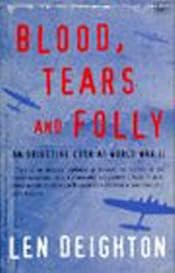 The author is more renowned for his spy novels but has written previous History books on aspects of the Second World War (Fighter, Blitzkreig and Battle of Britain,) my reading of which long pre-dated my blogging days. In this volume the cover page promises “an objective look at World War II.”
Deighton splits his book between the main theatres of war starting with “The Battle of the Atlantic,” going on to “Hitler Conquers Europe,” “The Mediterranean War,” “The War in the Air,” “Barbarossa: The Attack on Russia” then “Japan Goes to War” – all of which deal mostly with the early encounters – before concluding with ‘Went the Day Well?’ a short scamper through how they all turned out.
In order to illuminate the Second World War and its origins Deighton delves into earlier History in his start to each section and makes some often overlooked observations.
The pre-Great War British refusal to build new bigger dock yards meant that, individually, its ships were seriously inferior to German ones, especially in regard to using watertight bulkheads to resist being sunk, a difference which revealed itself at the Battle of Jutland. More contentiously Deighton says Germany might well have won the Great War had the US not entered.
(Aside; after the German Spring offensive ran itself out in 1918 when their troops overextended their supply chain and discovered how well supplied the Allies were – especially with wine, but also matériel – they were always on the back foot and defeat became inevitable. How much the US contribution affected this is at least debatable.)
As regards the later conflict he notes that in the 1939-45 war India contributed “the largest volunteer army that history had ever recorded.” (Indian troops made up the bulk of the “British” Army in North Africa.)
In the sea war German gun-laying radar (of which the Royal Navy were largely ignorant) gave the Kreigsmarine surface ships a considerable advantage. Coupled with HMS Hood’s lack of deck armour – another example of that Great War design inferiority – making it vulnerable to plunging fire its sinking was all but inevitable.
To avoid damaging the German economy Hitler wanted short sharp wars; the blitzkrieg technique was employed for that reason. As a result German munitions production was not maximised till after the advance into Russia bogged down, by which time it was too late. Germany had been plentifully supplied by the Soviet Union before June 1941. All its plunder from the invasion of Russia never equalled that earlier provision. That invasion was utterly senseless, but of course ideologically driven. Plus, the planning staff had “wrongly assessed their enemy and formulated a plan that could never have conquered him.”
A statement which may surprise most British (and indeed USian) readers was that “Rommel was not one of the war’s great generals.” In Germany he is thought of as a product of Nazi propaganda. “His fatal flaw was his inability to see the importance of logistics.” While good – exceptional – as a divisional commander Deighton says Rommel needed a superior to keep him under control and make him understand the less glamorous realities of supply and maintenance. Despite his blame of them Italian merchant seamen are described as “nothing less than heroic in their performance” (providing to the Afrika Korps 800 tons per division per day on average.) By contrast “voracious” US armoured divisions in North West Europe required only 600 tons per day including fuel. The Luftwaffe’s parachute army had been all but used up in Crete and so was not available for an attack to deprive the Allies of Malta.
“The war’s decisive battle was won in the factories.” For every ship the Axis built the Allies built ten and there was a crucial German shortage of trucks. German lack of a strategic bomber force meant the Soviet Union’s factories beyond the Urals were safe from harassment. However, the RAF’s belief in strategic bombing as a decisive war winning weapon was a delusion. It wasn’t accurate enough and didn’t demoralise the population.
The shift from coal to oil in the late nineteenth and early twentieth century had changed the strategic landscape. “It is tempting to depict the Second World War as nothing but a struggle for oil.” In Japan’s case that is undoubtedly true and Deighton stresses the importance of Zhukov’s victory over the Japanese at Khalkin Gol in 1939 in concentrating their efforts away from the far eastern Soviet Union. Indeed, their attack on Pearl Harbor dismayed German troops on the Eastern Front.
In Malaya, British troops were overloaded with equipment – heavy boots, steel helmet, webbing pack on the back, another at the side, gas-mask bag on the chest, all held together by webbing fitted with brass buckles (which if unpolished were punished severely.) Not to mention the ten-pound weight of a Lee-Enfield rifle and bayonet (a rifle not suited to jungle warfare.) This disadvantage, and a certain inability to perceive that a lighter, nimbler Army might not need the roads on which the British were fixated in order to operate, sealed Malaya’s fall.
Blood, Tears and Folly does supply, if not the promised objective look at World War 2 then at least a different one. It stresses the importance of supply and logistics, factors which still determine the outcome of wars.
Pedant’s corner:- “coal, -ammunition and” (no need for that dash before ammunition,) “the Atlantic Blue Ribbon” (Blue Riband,) “ships papers” (ship’s papers,) Hargreaves’ (Hargreaves’s,) “£650 millions,” “£7,435 millions,” “£1,365 millions” (in each case the plural of million is not necessary; the formulation ‘£650 million’ means ‘650 million pounds’. It would be ludicrous to say ‘650 millions pounds’,) “Britain followed suite” (followed suit,) Georges’ (x 4: the final ‘s’ in this French name is not pronounced so the possessive demands an apostrophe ‘s’, ‘Georges’s,) “the mixed bag of … were a far cry” (the mixed bag … was a far cry,) Menzies’ (Menzies’s,) “escaped to Britan and become a rallying point” (became,) “a small collection of transports were scraped together” (a small collection … was scraped together,) Polikarov (Polikarpov,) Junkers’ (Junkers’s,) Flak (in the middle of a sentence; ‘flak’,) “the Ukraine” (just Ukraine.) In 1900 Russian and the USA were producing” (Russia and.) “Gas pumps” (Petrol pumps,) “and of and” (and of.) Goebbels’ (Goebbels’s,) Keyes’ (Keyes’s.)