Archives » ParSec 3

Braking Day by Adam Oyebanji

Jo Fletcher Books, 2022, 365 p. Reviewed for ParSec 3.
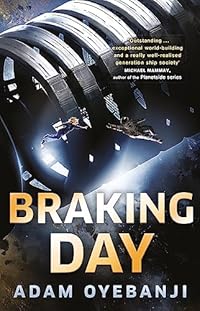
Every once in a while someone reinterprets an old SF trope, as if to show that newness isn’t necessarily a be-all and end-all, that even the hoariest of SF concepts can be dealt with in an altered light. Here, Oyebanji has taken the idea of the generation starship, stirred up its components and laid them out in a new configuration. And the result is something which for long-time readers of SF is almost nostalgic, but also verges on perfect.

The inhabitants of the Interstellar Space Vehicle Archimedes are onto the seventh generation on board but the ship is nearing its destination star Tau Ceti, and Braking Day is imminent. Lending distinctiveness to Oyebanji’s vision the ship has an unusual construction, between the forward shielding and the, for now silent, drive engine to the rear its body is made up of wheels named after old Earth countries, each rotating to produce artificial gravity but at different rates and in a contrasting direction to its neighbours’. Another divergence from the generation starship norm is the employment of those lift-like conveyances known as paternosters for movement between levels within a wheel.

Archimedes and its fleet companions Bohr and Chandrasekhar fled an Earth under the control of AIs with the (somewhat convoluted) acronym of LOKI, loosely organised kinetic intelligence, each “capable of reconfiguring itself as it learns and remembers” – dangerous both in and of themselves but also to their potential vulnerability to hacking. On board, these are anathema – unlike the implants all the ships’ inhabitants have inserted as children to allow them access to the hive and its information. Nevertheless the ship’s society is fairly rigidly stratified by occupation, especially between officers and crew, but its organisation means there is little but petty crime and there has been no conflict as such for generations.

The viewpoint character is Ravinder T MacLeod, whose family is a traditional thorn in the officers’ side but who is training to be an engineer and is the butt of remarks about his origins and frequently scruffy appearance. Water is a precious resource and used as a currency and his lowly status ensures he goes from one pay day to the next trying to conserve it. A trip to the officers’ wheel, Australia, where water abounds, marks a huge contrast between his existence and theirs. His best friend in training, Vladimir Ansimov, is also of humble background but his main companion is his perennially rebellious – albeit in a relatively minor way – cousin Roberta, known as Boz, a coding wizard. Her habitual smoking of cigarettes annoys Rav not only since it’s against ship regulations but also because he knows how knackered the recycling systems are. He takes a fancy to fellow trainee Sofia Ibori, unattainable due to her high-ranking lineage.

There is some dissent in the fleet in the form of a group known as BonVoyagers, who wish not to contaminate the Destination World as their ancestors did Earth but instead hope to journey the spaceways forever. Unlike the invocation of the ship’s name in the favoured expression of exasperation, “for Archie’s sake,” shipboard slang – sarding, gullgropers – is a little cloying at first but later contrasts effectively with usage on another ship.

Enough scope there you might think for any novel, but Oyebanji has still more for us. For a while it feels like he might even be about to give us a ghost story as down in the deepest part of the ship’s engines where Ravi has been sent on a repair job he hears a tapping sound which seems to be coming from outside the hull. On peering out of a porthole he sees a woman with dyed hair – something never seen on board – but also apparently impossible as she has no space suit. Blink and she is gone but he glimpses her the next day on one of the companionways. Ravi also begins to experience a recurring dream (or a recurring start to one.) In addition, memories that are not his and where the name indicators for genders appear to be reversed intrude into his consciousness. There is, though, a rational explanation for these events.

Further elements of mystery are added when Ravi sees the Captain and Chief Engineer examining an underfloor duct, he feels the drive turned on at low power late at night, discovers adaptations to the ship’s hull where rudimentary weapons have been attached, Boz is conscripted to devise software for a torpedo and the fleet is set to silent running. Something is out there and it is a threat.

Not the least of Braking Day’s pleasures is that its characters are rounded, with entirely human hopes, fears, motivations and flaws – and it is superbly plotted. Along the way Oyebanji conveys the attitudes imbued by growing up in a specific environment when Vlad compares the safety of shielding, bulkheads and life support to the exposure of life on a planet right next door to a star, with an atmosphere likely to be stripped away at any moment, and rhapsodises on the fifty square metres on Destination World he might enjoy – an almost unimaginably (to him) large amount of living space. Oyebanji makes this all real for us. This feels like how life on such a starship would be.

There is conflict here to be sure, even ordnance being set off, but what a pleasure it is (an unusual pleasure these days) to read an SF novel whose protagonists’ first resort is not to violence but to talking, diplomacy if you will. I doubt I’ll read a better SF novel this year.

Pedant’s corner:- When a chapter begins with a piece of dialogue the opening quote mark is missing, Petrides’ (Petrides’s,) Archimedes’ (Archimedes’s,) maws (these were mouths, not stomachs,) a missing comma at the end of a piece of dialogue, another at the beginning of a different piece, “the quiet whirr of power tools did their job” (whirr is singular, the pronoun ought to be too, ‘its job’, but then the sentence would need rejigged, ‘there was a quiet whirr as power tools did their job’,) andnightclubs (needs a space,) crewman (not crewmember, I note,) Outside the ship there are bits of ice on the superstructure. Since water is a currency on Archimedes these would surely be harvested, but in any case, exposed to vacuum would more likely sublime away before that could be done,) also drones for working outside the hull expend puffs of vapour as they manœvre, surely a waste of precious resources. “‘It’s has to be’” (It has to be,) “waiting for answer” (an answer,) “with the all the ship’s barristers” (that first ‘the’ is unnecessary.) “None of them were easy” (None of them was easy.) “He heard her a yell” (He heard her yell,) “of what had had once been” (only one ‘had’ needed,) grill (grille,) the Newton crewman (was a woman.) “If worse came to worst” (in my youth was always ‘if the worst came to the worst’.) “The cloud of numbers surrounding Ao Qin were already changing configurations.” (The cloud of numbers surrounding Ao Qin was already changing configuration’,) “theBohr” (needs a space,) “the use drugs to lower heartrate” (the use of drugs; heart rate,) “by LOKI’s” (LOKIs,) “‘you wanting it to different’” (it to be different.) “‘But,, sir –’” (has a comma too many.)

The Last ADVENTURE of CONSTANCE VERITY by A Lee Martinez

Jo Fletcher Books, 2022, 373 p. Reviewed for ParSec 3.

Sometimes all a reader wants is something undemanding. Nothing heavy. Just a light-hearted romp through all the clichés of the speculative fiction universe, and a few more besides. (Universes, as well as clichés.)

Well, for that reader, Constance (Connie) Verity, a woman to whom adventures simply happen, could be just the ticket. While the phrase “soon to be a major motion picture” (in this context are there never any minor motion pictures?) emblazoned on this book’s front cover might make the heart sink, the conceit speaks for itself. But it has to be handled well. And Martinez does so. Hitch yourself up, strap yourself in and go along for the ride. Suspension of disbelief is not necessary. It’s all a game, after all. Here be goblins, ogres and elves, the fae, monsters of all kinds, humans included. Especially humans. No dragons, though.

We start with Constance (pseudonymous since she wants to keep a low profile) at a job interview but her fame is such that she is too easily recognised and it ends with her being forced to a pit housing a many-toothed God rising up from the centre of the Earth where she has to deal with her captors – and the God. It’s a final straw for Connie. Too many times has she been drawn into such escapades without her consent. As she tells her friend Tia, “‘It’s not really up to me. It’s out of my hands. Always has been.’” But now she wants out.

In the meantime she meets Byron, the brother of Dana, the woman in the flat across the landing, and sets out to have a normal relationship with him: not easy when you’re constantly having adventures or your exes die in unfortunate ways. I note here that Martinez’s straightforward treatment of the fact of sex as simply part of normal life is not too common in fantasy.

Connie resolves to try to break the spell put on her at birth by her fairy godmother, Grandmother Willow (Thelma) – by killing her. Constance was one of many treated in this way, but it took with only a few and of the rest only Connie has survived to keep saving the universe. To break the spell is not in Thelma’s power, though. It turns out the Engine in control of the universe – or whoever controls that – is the key.

On Thelma’s death her consciousness gets trapped in a pen (which is a pretty good metaphor for limbo when you think of it) though she can still speak. Now and again Connie clicks her off to shut her up, but several times Thelma later speaks up without having been clicked on again. Still, this is all magic anyway. What has continuity got to do with it?

Tia, who has Constance to thank for the several times she has been rescued from danger, “‘That’s your thing, isn’t it Connie? Always in the nick of time,’” demands to be taken along as a sidekick. Constance hums and haws but later admits, “‘There’s a dynamic. You don’t make it far in the adventuring game as a lone wolf. Even the Lone Ranger had a partner.’” Tia makes a good foil, especially when they encounter Connie’s old flame, Hiro, sneaker up on people extraordinaire – and serial betrayer, once leaving Connie suspended over a crocodile pit. (Many such past adventures are alluded to in the text.) Tia takes it on herself to obstruct Hiro’s attractions for Connie, “‘You’re not the first woman to have a thing for drama and bad boys,’ said Tia, ‘Doesn’t mean you can’t change,’” by being more obviously available.

Somewhat belying its lightness of touch, The Last ADVENTURE of CONSTANCE VERITY nevertheless has useful things to say about relationships, friendship, betrayal and what constitutes a normal life as well as commenting on the practices of fantastical fiction writing.

Finally, you may disregard the book’s title. This is not Verity’s last adventure. Constance might initially have wanted it to be and Martinez may even originally have intended it to be, but two other books featuring Connie have been published in the US.

Pedant’s corner:- “didn’t get always get along” (get rid of first ‘get’,) claxon (klaxon,) “it spurt” (spurted,) imposters (I prefer the spelling ‘impostors’.) “‘What’s the hell’” (‘What the hell’.) “None of the other pedestrians were interested” (None … was interested,) staunch (stanch.) “‘I’ve known more beautiful woman’” (women,) Leningrad (has for about thirty years now been known as St Petersburg,) Columbia (that South American country is Colombia.)

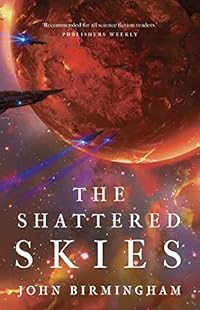
The Shattered Skies by John Birmingham

Head of Zeus, 2022, 509 p. Reviewed for ParSec 3.

While there are some scenes in this second instalment of Birmingham’s trilogy (for my review of the first see here) which feature Lucinda Hardy’s father Jonathyn, whose term in a debt defaulter’s prison on Batavia has been ended by the Sturm, the bulk of the text remains focused on the five main characters surviving from Book One, though four extra viewpoints also come into play: Sturm Captain Anders Revell, Sub-Commandant Domi Suprarto of the Imperial Javan Navy (whose organisation and command style seem to be modelled on that of the Japanese armed forces of the 1930s and 40s,) his superior, Imperial Volume Lord Juono Karna, plus Rinaldo Pac Yulin of the Yulin-Irrawaddy Combine. In the Natuna system the Javan and Combine ships of the latter three were running silent to weather a solar storm just as the Sturm attack on the Greater Volume’s zero point network occurred and so mostly avoided the fate of all those connected to it. Like Hardy, Suprarto finds himself unexpectedly in command after his officers’ brains were scrambled when they switched online again.

While the others, being adult, remain true to their earlier selves it is noticeable that Princess Alessia undergoes character development here in that she begins to blossom into her aristocratic heritage. Her tendency to use swear words does perhaps occur a mite quickly though. She drives most of the plot in this volume as, due to her revelation that her family maintained illegal and therefore secret engram vaults to restore their consciousnesses in case of the type of disaster which has just occurred, the occupants of the Defiant and Sephina’s new ship Arianne (named after her dead lover) set off to find such a cache at the space habitat called Lermontov in the Natuna system but first stop off at Descheneaux Station to rescue the few inhabitants and Armadalen Navy regulars who had not succumbed to the Sturm strike. Body strewn encounters ensue with the zombiefied but bloodthirsty remnants of humanity whose minds had been destroyed. (Why they do not turn on each other rather than seeking out “normal” humans is not explained. But then, of course, we would have had no gory battle scenes.) Hardy, though now a Commander, herself forms part of the rescue team, for which McLennan chides her as an unnecessary risk for a leader.

Hardy and McLennan put pressure on Princess Alessia to sign a declaration which would emancipate the many inhabitants of the Greater Volume who were de facto slaves. Despite the likelihood that if her family were to be revived they would declare it null and void she eventually agrees. This almost throwaway aspect of the book puts a gloss on our heroes’ determination to combat the Sturm. It smacks of a kind of desperation to show their cause is just. (Birmingham presumably intended this to stand comparison with another war during which an emancipation proclamation provided a higher purpose to its continuation. It doesn’t.) Alessia herself perceives later on that living conditions on Lermontov are harsher than she could have imagined. This is one more indication to the reader that the society for which her companions are fighting is probably not really worth defending.

As is common in second parts of trilogies there is a degree of marking time here. In particular the animosities the Javan Empire and the Combine have with the Armadalen Navy, even in the face of the advancing Sturm, take up most of the narrative.

Again we have an indicator of what may be Birmingham’s inspiration for the Sturm in that Pac Yulin (not the best example of a good guy it has to be said) says of them, “‘They do not just distrust the science. They despise and repress it.’”

In the climactic scene Birmingham plays a trick on his characters, and perhaps the inattentive reader. The logic of it was however implicit since early on in The Cruel Stars.

I suppose it is a defining feature of military SF but there is a degree of having and eating cake in describing scenes of mayhem and violence while insisting they are necessary. The Sturm are certainly monomaniacal and vindictively brutal to those with opposing views but Hardy, MacLennan, Sephina L’Trel and Booker are hardly less so.

There are nevertheless some pleasing grace notes. Intellect Herodotus’s interjection of, “‘I have no mouth and yet I must scream’” slightly misquotes Harlan Ellison, while the designation ‘SPY 7 sensor hooks’ may be an oblique reference to James Bond.

Again, the epilogue is a teaser for the next book in the trilogy. Despite the usual wallowing in carnage of the sub-genre and a tendency to overdo banter between his characters Birmingham has invested enough in them to make the reader persevere.

Pedant’s corner:- “he would have shook his head” (shaken,) “the conn” (always this spelling here. In The Cruel Stars it was spelled ‘conne’ but is usually given as ‘con’,) zero-point (elsewhere ‘zero point’.) “there were a couple of people like that” (there was a couple,) “less beatings” (fewer beatings,) “the hauler, which displaced less than one-quarter of the mass of Sephina’s luxury cruiser” (I am at a loss to see how a space-ship can displace any mass whatsoever. Unlike a boat, which displaces water, in space there is no material to displace. Why not just say ‘the hauler was only a quarter the size of Sephina’s luxury cruiser’,) sprung (x 2, sprang,) “‘We’re nae going to Earth’” (‘nae’ appeared like this several times. In the context of ‘not’ this should be, ‘We’re no’ going to Earth’ or more realistically, ‘We’re no’ goin’ tae Earth’,) “‘G’orn then, s’good for what ails you’” (That ‘r’ in ‘G’orn’ would not be there. He would have said, ‘Gaun, then’,) “H3 mines” (He3 mines,) “the dark maws of a dozen smaller hangars” (not ‘maws,’ these were not stomachs; they were mouths,) “Zaitsev Corporation” (elsewhere always ‘Zaistev’,) “bachelor party” (McLennan would have said ‘stag do’,) “half a millenia” (half a millennium,) “Muntions Sub-Intellect Number Six” (Munitions Sub-Intellect Number Six?) “the plane of the elliptical” (x 3, ‘the plane of the ecliptic’. An error like this somewhat undermines trust in Birmingham’s other astronomical terminology,) wracked (racked,) “3X normal” (3 x normal; as in ‘3 times normal’,) “none of them were protected” (none of them was protected,) “the castle atria” (there was only one, ‘the castle atrium’,) nannite (nanite,) a missing comma before a piece of direct speech. “‘They’ll puts boots on the deck to take them’” (put.)

The Cruel Stars by John Birmingham

Head of Zeus, 2020, 489 p. Reviewed for ParSec 3.

Centuries ago a hardline segment of humanity, the Sturm, implacably opposed to genomic interventions, implants and bioware, was defeated and took itself off to far-flung reaches of space. In the interim the majority of humanity – at least its wealthier portions – has become used to relifes, their consciousnesses at intervals being decanted into younger cloned bodies, with neural backups held in case of accidents. Robotic artificial intelligences known as Intellects, each “an impossibly dense tear-drop of exotic matter and nanoscale wormhole processing matrices” perform many tasks. The human domain of the Greater Volume sprawls over the galaxy but even the quickest interstellar travel – carried out by folding space – takes subjective months to span it, though communications, through a zero point wormhole network, are much faster.

Birmingham’s story is told from five main viewpoints. Lieutenant Lucinda Hardy of the Royal Armadalen Navy, newly posted to a spaceship named the Defiant, is a first lifer with a pronounced case of impostor syndrome despite being decorated in her first military action during the Javan War; Frazer McLennan, of Scottish descent, is a veteran of the Terran Defence Force, on his seventh body and lately a prizewinning astroarchaeologist spending his time on the otherwise obscure planet Batavia where the Sturm had once crash-landed a ship; Sephina L’Trel is a kind of pirate whom we first meet in a firefight when her attempt to doublecross a group of Yakuza failed to go to plan; Princess Alessia Szu Suri sur Montanblanc ul Haq is a scion of a powerful family, much resentful of the apparently useless education to which she has been subjected; Corporal Booker 3-212162-930-Infantry is on death row, with a sadist as jailer. Occasional chapters are seen through the mind of Sturm Archon-Admiral Wenbo Strom.

This abundance of viewpoints is a little unwieldy at first as the shifts from one to the other tend to interrupt the flow and invites the question as to how they are all going to come together in the space of one book. The action soon kicks in though as a Sturm attack scrambles the minds of anything and anyone linked to the zero point network while their ships materialise in force.

Only the instant action of the Defiant’s Intellect to isolate itself from the ship’s systems to fight the intrusion saves its company but the commanding officers have been turned into ravening beasts and Lucinda has to take command. She gives orders for everyone to dump their neural mesh, without which the crew are left unconnected and face the risk of truly dying. The dumping involves expelling the mesh into the intestinal tract for removal in the usual way. Sephina barely escapes the Sturm attack with her life but her lover Arianne dies. Princess Alessia’s family is executed. She is captured and forced to cooperate with the Sturm but bravely uses eye-blinks to signal her resistance to the oral message she has to read. McLennan is also taken prisoner. But he and the Sturm have history. Booker brokers his life in return for helping his companions get away from the Sturm but only by having his consciousness decanted into a mechanical war rig. This moving of his consciousness from one machine to another neatly allows Birmingham to sideline the character for a while in an emergency external storage unit (a black box) but it is instrumental in the finale, wherein our heroes attempt to rescue the Princess.

Like the military characters here McLennan’s speech can tend to the earthy but personally it was delightful to see in an SF novel those less extreme but still expressive Scottish words numptie, walloper, dobber, skuddy and munter, (with jobbies perhaps a bit less relishable) but for true verisimilitude McLennan’s, “aren’t I?” really ought to have been, “amn’t I?”

Birmingham’s awareness of SF’s past is alluded to by his employment of the word soylent as a term for basic sustenance, and his alertness to present day concerns by a Sturm soldier’s assertion to McLennan, “But you will not replace us.”

Yet while the Sturm are frequently referred to as Nazis by our heroes, The Cruel Stars suffers from the flaw of most military SF in that the good guys are all but indistinguishable from their opponents in their willingness to resort to violence.

The Cruel Stars is incident packed, well plotted and has some relatable characters but the Sturm have not been beaten and the epilogue seems a bit too crudely designed to draw the reader towards the second of Birmingham’s trilogy.

Pedant’s corner:- a mixture of USian and “gaping maw” (it’s a stomach, not a mouth,) behooves (behoves,) “the chances …. was vanishingly small” (either ‘the chance … was’ or ‘the chances …were’ vanishingly small,) “the conne” (usually spelled ‘con’.) “Sirens and Klaxons sounded” (there’s no need for that capital ‘K’,) skuddy (usually spelled scuddy,) “the series of booms that followed were louder” (the series …was louder,) “that none of the deaed were about to reanimate” (none … was about to,) spit (spat.) “None of them were there by choice” (none of them was there by choice.) “There were a number of personal items” (there was a number.) “With that one convulsive leap he was free” (I couldn’t quite make up my mind if this cliché was exactly that or an ironic nod to the past of periodical fiction.) “Darkly complected” (is complected a proper word? ‘With a dark complexion’ would work fine,) “one ship, broken and venting flames” (venting flames in space? I don’t think so; flames require an oxygen supply to sustain themselves,) “if they try to scuttle the ship” (I would submit you can not scuttle a space ship. Destroy it, yes; scuttle it, no,) “but nae” (this was McLennan; that negative should be ‘but naw’,) “the Cub Scouts” (known in the UK as simply ‘the Cubs’,) “but we dinnae get them all” (didnae.)

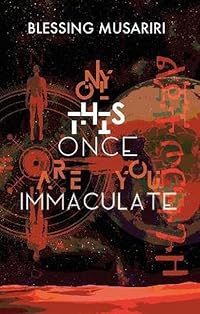
Only This Once Are You Immaculate by Blessing Musariri

Solaris, 2021, 432 p. Reviewed for ParSec 3.

“Every traveller begins his journey in the Valley of Souls; the very first gift of new life. It is only this once he is Immaculate.” So we are told in the first chapter “The Beginning.” From then on narration is in four hands. Those of Azad, whose emergence from the Primary Cycle identified him as a spirit keeper, so therefore guardian to Immaculate travellers; of twins Aftab and Afya, Immaculate travellers at first inseparable and acting as one but later forced apart (they also have the ability to be so still they can avoid being seen;) and of their adopted brother Khaled, a Foundling, brought back to the valley through its single entrance/exit from a previous journey by the twins’ Uncle Azad.

Immaculate travellers are on their first journey, Foundlings’ journeys are renewed and redirected. There are other travellers – Intermediaries, Interconnectors, Meanderers, Sleepwalkers, Interruptors, Interlopers and Infiltrators – whose particular characteristics are enumerated in a kind of glossary. Part of the mythology of the background here involves the Uunu who know “the way of the Human, Being, Ancient Traveller. All Ancients are the guardians of the secrets of being, the last custodians of the pathway to the true Valley of Souls.”

Our narrators are on a quest, then, with Afya and Aftab having particular significance since they each carry hidden about their bodies a certain type of powerful stone.

In this scenario an Empire has fallen some time ago and the land is divided into Seven Territories over which various Generals rule, and squabble. It is through this landscape of potential conflict that Azad, Afya, Aftab and Khaled set out on their journey. The stones have importance as one of the Generals is keen to acquire them. On the travellers’ way they experience various hiccups, their trip on the ship the Nairobi Queen (which is captained by a woman called Wangui,) is hijacked by Kasim, the son of General Demissie, as a result of which the twins are separated, then they fall into the protection of perhaps the most interesting character, Zinhle, daughter of General Dingane, who is keen to impress on her father that, as leader of the Sons of Kalano, she is worthy of serving at his side, by way of winning the Donga torunament at Ishunka.

The fantastical adornments of all this are somewhat at odds with the main thrust of the narratives which are for the most part resolutely familiar in form, with the technology totally recognisable – motor vehicles, guns and ships are not described as in any way different from those of our present day. There is a prefatory map of the setting which appears to be the area taking in the Horn of Africa but barring one mention of the Gulf of Aden (and the name Nairobi Queen) the geography might as well be invented. The setting’s relationship to our time as readers is also undetermined; it could be the future, a completely different timeline but is more likely an outright fantasy world.

References to Bereko Mountain as the cradle of mankind, the navel of the world, might be a reflection of historical reality but the star ruby, whoever possesses which has the power not only to conjure up beings from other worlds but also the power to send them back; Infiltrators as mortal beings simply travelling at a different frequency, and so, as a result, difficult to see; the tree at Uunu guarding the entry to the vault of the Ancients’ power of Banishment, to which the Uunu, Custodians of the way, were granted the secrets and so managed to banish the Infiltrators once before; and that a second banishment will destroy all portals, all lie more in the fantastical sphere. Time itself is somewhat fluid; occasionally Azad harks back to a previous journey involving Hiro, Riitho and Anahita, of whom Kasim, Azad and Wangui are reincarnations (of a sort.)

Musariri’s approach is manifestly African, rightly making little or no concession to other literary traditions. Her background as a poet is often in evidence but her decision to structure the narrative in short chapters seen from four different viewpoints at times tends to hinder its flow. Her totally human characters are well drawn but those with fantastical attributes can suffer from that genre’s inherent tendency to lack of full roundness. As an overall vision, though, Only This Once You Are Immaculate is notable.

Pedant’s corner:- the text has many unusual placements of commas. Otherwise; Immaculate in the context of traveller is sometimes not capitalised, “Somewhere beyond that village begins the fortresses, the barbed wire..” (and many other objects of the verb; hence ‘begin’,) “in the hopes that” (in the hope that,) “outside of” (several times; ‘outside’.) None of those on board believe his words” (none … believes his words,) “you will have moulded yourself to bark and began to slip” (and begun to slip,) “‘What to do want with this man, brother?’” (‘What do you want with this man’) “method of hacking of a long slim offshoot” (method of hacking off a ..,) “making their way to and from” (to and fro,) “in the hopes of” (in the hope of,) “a metal grill” (grille,) “as I flit in an out” (in and out,) “and all is else is shades of darkness” (and all else is shades of.) “‘What is there?’ One of the Sons of Kalano asked’” (is one sentence; ‘What is there?’ one of the Sons of Kalano asked.’) There were at least two other instances of a capital letter in the middle of a sentence, or after a comma,) Rawha (elsewhere Rahwa,) “lead by” (led by,) “the Marauders fleets” (Marauders’,) a paragraph in a continuing speech not preceded by quote marks. “A short crop of curls frame her face” (a short crop … frames her face,) sunk (sank,) miniscule (minuscule.)

ParSec 3

ParSec 3 has become available.

I’ve made lead review!

That’s for my take on Adam Oyebanji’s Braking Day.

Also in ParSec 3’s pages are my reviews of:-

The Last Adventure of Constance Verity by A Lee Martinez

Absynthe by Brendan P Bellecourt,

Only This Once Are You Immaculate by Blessing Murariri

and the first two books of a trilogy by John Birmingham, The Cruel Stars and The Shattered Skies

free hit counter script