Archives » ParSec

City of All Seasons by Oliver K Langmead and Aliya Whiteley

Titan Books, 2025, 288 p. Reviewed for ParSec 15.
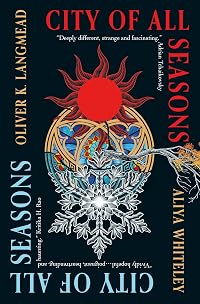
Ever since something known as the weatherbomb hit it, cutting it off from its past and erasing some of its inhabitants, Jamie Pike’s Fairharbour has been a city enveloped in everlasting winter. All contact between its island and the mainland has been severed, any expeditions sent out over the frozen wastes of the sea never heard from again. Black-clad officers called Doormen patrol the streets enforcing order, sealing entrances and windows to keep heat inside buildings. Jamie spends a lot of his time tinkering in the workshop of his vanished uncle by marriage, Pawel, a mechanical whizz, and watching what remains of the work of his grandmother Carmen, a famous film-maker.

By contrast, after the weatherbomb, Esther Pike has lived in a Fairharbour bathed in perpetual summer, with sunlight a relentless presence. In her Fairharbour too, an authoritarian regime, The Fenestration, exerts power, forever cutting holes in the walls of buildings. She, too, strains against the restricted life of her city.

With this premise of a city with a doubled character, City of All Seasons has a superficial similarity to China Miéville’s The City and the City but is in the end much more interesting than his novel (which was really only a murder mystery with an unusual setting.)

Both Jamie and Esther wonder what has become of the other and of their lost family members but both have encounters with the city’s mayor, a curious apparition always dressed in a diving suit yet who seems to be able to bridge the divide between the two manifestations of the sundered city. Their two stories are told in strictly alternating first person narratives as their interconnections begin to mount.

One of those connections lies via an atypical Tarot deck, three of whose cards are involved in the exchanges between the winter and summer city. Illustrations of those, The Two of Fish, The Stage, and the Nine of Smiles, preface three of the book’s four sections.

To plot, though. Jamie catches a glimpse of greenery and begins to wonder if there is another existence just out of reach. He constructs a kaleidoscope from some glass fragments, wing mirrors and a tube, and leaves it where he hopes it might be found by Esther.

The story delves into Jamie and Esther’s past lives and of their family before the split (crucially their uncles Jan and Remi were forever unable to share) while also gradually revealing the lore and customs of the city. In this, the tale of the city’s emblem, the smiling knight, assumes significant importance. In an old interview with Carmen she told of this as her inspiration for an intended film about a man who uses his death for the benefit of the city and prophesies, “‘When I die; it will be spectacular.’”

Also prophetic are a suit worn by her, black on one side, white on the other, slashed diagonally from right collarbone to left ribcage, and a two-handed saw made by Pawel. All of this comes together in the city’s Lavender Theatre, the source of the divide.

Though there is a slight imbalance between the two strands Langmead and Whiteley let their tale unfold at just the right pace, the similarities and differences between the situations of Jamie and Esther counterpointing and emphasising each other, the influence of their extended family to the past and future gradually becoming clearer in this well-written and characterful novel elegantly resolved.

One final note. Very few fantasy novels have as a plot point the construction and subsequent playing of a glass harmonica. A pleasing touch.

The following did not appear in the published review.

Pedant’s corner:-  “the orchestral pit” (usually ‘the orchestra pit’,) “to keep him a state of permanent uncertainty” (to keep him in a state of,) “crow’s feet” (crows’ feet,) “but Fairharbour’s artist population were never meant to” (Fairharbour’s artist population was never meant to.) Descendent (Descendant,) Esther has dyslexia [“the alphabet still runs away, even now”] but she is narrating half of this story with no apparent difficulty. “Hardly a shard of its enormous windows remain” (Hardly a shard … remains,) “one less eyesore” (one fewer eyesore,) “none of the Fenestration guards … have spotted” (none … has spotted,) “with nine people stood upon it” (standing upon it; there were more instances of ‘stood’ for ‘standing’,) a single opening quote mark at the beginning of a piece of direct speech; all other such marks are double. “The fishing fleet are out already” (The fishing fleet is out.)  “The crowd of Doormen part around him” (The crowd … parts around him,) “golden candelabras” (candelabra is already plural,) a new sentence without an initial capital letter, focussed (focused – used later,) “at the far end of the lawn were a large group” (was a large group,) “I dove” (I dived,) “-together, intense,” (- together, intense,) a missing comma before a piece of direct speech. “It lays open on the wooden bench” (It lies open.) “The rippling of all the droplets dripping from the ceiling distort it” (The rippling …. distorts it,) “at the peripheral of the city” (at the periphery.) “They put her hands to her throat” (‘They put their hands to her throat’ makes more sense,) “they sweat” (‘the sweat,) “untameable enormity” (it wasn’t a terrible thing, just a large one; so ‘untameable size’ or ‘untameable extent’,) fit (fitted.)

The Rouse

The Rouse book cover

The latest book to arrive for review in ParSec is The Rouse by China Miéville.

This is something of a doorstop; coming in at over 1000 pages.

In fact it’s such a size that the ARC (proof copy) I have received in fact comes in two paperback volumes. The first has a pagination ending at 646, the second’s starts at 649 (minus title page and publishing information, so fair enough) and ends at 1244. Heavy lifting.

The blurb calls it The Masterpiece Twenty Years in the Making. A big claim.

Miéville is of course known to me. I have reviewed nine of his books on A Son of the Rock.

The review of The Rouse ought to appear in ParSec 17.

ParSec 16

Issue 16 of  ParSec magazine is available.

This one contains my reviews of:-

Project Hanuman by Stewart Hotston

Reality Rift by Fred Gambino

No Man’s Land by Richard Morgan

Green City Wars by Adrian Tchaikovsky

If We Cannot Go at the Speed of Light by Kim Choyeop


Everything Happens So Much

You may have noticed on my sidebar I am reading a book with the above title.

It is my latest review book for ParSec.

Written by Andrew H Murray, another writer new to me though it seems he has published four previous novels, from its blurb it may be intended to be humorous.

I assume the review will appear in ParSec 17.

Ian Watson

I have just seen from various sources that SF writer Ian Watson has died. I’m so sad to hear about this.

I knew he had been ill recently but had been under the impression he was recovering.

I have thirty of his books on my shelves, the most recent of which was The Chinese Time Machine which I reviewed for ParSec in 2023.

The first time I met him was when I attended the signing event for my first short story publication, The Face of the Waters, in New Worlds 2 way back in 1992.

He was a gentleman and had a particularly sharp wit.

Ian Watson: 20/4/1943 – 13/4/2026. So it goes.

BSFA Award Nominees 2026

Again I’m late to this.

The BSFA Award winners will be announced at Eastercon on Sunday.

The nominees are:-

Best novel-

The Salt Oracle by Lorraine Wilson

Edge of Oblivion by Kirk Weddell

When There Are Wolves Again by E J Swift

Project Hanuman by Stewart Hotston

A Granite Silence by Nina Allan

Of these I’ve read only Project Hanuman since I reviewed it for ParSec.

There are now two awards for short fiction: best short fiction (short stories) and best shorter fiction (novellas, novelettes etc not novel length) too many nominees to list here, plus best translated short fiction and best fiction for younger readers. There is also a category for best collection.

I have received a link to the BSFA Awards Booklet but haven’t yet got round to looking at it.


Here We Are Again

Book cover for Green City Wars

Another title to be reviewed for ParSec has duly arrived.


This time it’s the latest from Adrian Tchaikovsky.


It’s called Green City Wars. I’ll get on to it soon.

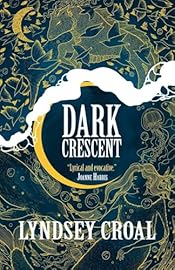
Dark Crescent by Lyndsey Croal 

Luna Press, 2025, 176 p including Author’s note on Finding Inspiration in Scottish Folklore. Reviewed for ParSec 14.

This is a collection of one novella and 22 short stories – some very short; the title story is barely three pages long, a couple are only two, with the longest, The Frittening, just twelve – all taking inspiration from Scotland’s folklore, superstitions, or landscape.

The short pieces are loosely bunched under headings for the four seasons with each section’s stories prefaced with a wood- (or lino-)cut engraving of one of the Moon’s principal phases and a scene illustrative of a story within it. A ‘Bonus Section’ at the end outlines those particular tales and legends which sparked Croal’s imagination.

An individual story here can contain relatively familiar apparitions or hauntings – selkies, kelpies, hagstones, seer stones, magpies, omens and shape shifting, Will-o’-the-Wisp, the Otherworld, Changelings – but others like the Sluagh, the Frittening or the Boneless, the Cat-Sith, the Ghillie-Dhugh, Baobhan Sith and the Fiddlers of Tomnahurich Hill, the Cailleach, the Nuckelavee, the Marool, the Ceasg, Bee-telling, the Sea-Mither, Each Uisge, the Wulver, the Bride and Angus, may be less so. Some are set in depopulated post-disaster worlds and border on Science Fiction; others touch on gothic, weird horror, dark fantasy, and solarpunk. Many draw stimulus from nature, climate, and the environment, with feminist and eco themes prominent. Croal’s Author’s Note informs us three of her tales do not have a specific derivation but are original to her.

Hence, among others, we have omens in the sky, tappings on windows, a strange puddle emerging on a doorstep, pebbles appearing in a nest in the night, a will-o’-the-wisp manifesting more strongly each day, a fiddler finding his muse in a painting whose scene gradually changes, the green man as a malevolent influence, the thoughts of the last surviving whale as it roams the deserted seas. Except for a common thread of the sea there is little beyond the Gaelic names of the various phantasms to mark these stories out as specifically Scottish.

The novella, Daughter of Fire and Water, with its intermingling of gods/goddesses and mortals in fact reads more like a Greek, or perhaps Norse, myth – except for the prince in it being named Angus.

Taken individually the stories here are perfectly fine but the cumulative effect of Croal’s general style tends to the dry. She has a fondness for italicized paragraphs, especially in throat-clearing beginnings, and there is the occasional odd choice of verb, which can be jarring. There tends to be a kind of distance between the tale and the reader and the stories are too often told rather than shown while some are not really given enough room to breathe fully. There is not much emotion evoked in these tales but then stories of weird creatures and the whole apparatus of fairy tale have always been admonitory in intent.

This is a collection to be sipped rather than quaffed. (Not really an option available to a reviewer.)

Curiously, a few lines on Content Notes and Warnings come dead last in the book though a signal to them does lie on the publishing information page. Surely if such warnings are needed they ought to be more prominently placed?

The following did not appear in the published review.

Pedant’s corner:- focussing (focusing,) maw (more than once. A maw is not a mouth,) several USianisms (cookies, snuck, dove [for dive,] inside of, etc,) sunk (several times; sank.) “The only muscle the woman moved was her mouth” (a mouth is not a muscle,) razor—sharp (razor-sharp,) sung (x 2, sang.) “She lay the Seer’s map on the table” (She laid the Seer’s map on the table.) “She was his only companion, his confidant” (she; therefore ‘confidante’,) “Then she said with sharp cruelty, ‘no. Not if you…’” (she said with sharp cruelty, ‘No. Not if you…’,) “Everyone knelt and lay the offerings at her feet” (and laid the offerings,) “all that kept me company were layers of clouds” (all that kept me company was ….) “If I wanted so bad not to be alone” (If I wanted so badly not to be alone,) “and lay it over my chest as a pendant” (and laid it over my chest,) “and lay her in blankets” (and laid her in.) “When the sea witch, turned away and disappeared” (doesn’t need the comma, which in fact detracts from the sense,)  “that I’d wove so carefully” (woven,) “mouth scrunched up into an eclipse” (only makes sense if ‘ellipse’ was meant,) a new paragraph that was not indented, a missing full stop, “span” (spun,) “as if expecting me turn into” (to turn into.) “‘Your association with them isn’t exactly customary’” (sense expects, ‘Your association with them isn’t exactly exemplary’,) sat (seated; or; sitting.) “The fall made the landscape blur, and then a screech” (needs clarification,) “there were no sign of burns or marks” (there was no sign.) “then he swept out the room” (as written this means he cleaned the room with a brush; what was intended was ‘he swept out of the room’,) “the hot water stung into my legs” (the hot water stung my legs,) focussed (focused, annoyingly used two pages earlier.) “They looked between one another” (looked at one another,) galivanted (gallivanted.) “Much of these stories are inspired by” (Many of these stories are.) “I became fascinated in the dark, strange, and rich folklore” (became fascinated by,) “rife with unexplained phenomenon” phenomena makes more sense.) “Hagstones are stones with natural holes bored in centre are thought to be,” (the holes can’t have been bored; plus the sentence needs an ‘and’ before ‘are thought’.)


ParSec 15 Update

ParSec 15 is indeed live and I now have my copy.

I found it does contain my reviews of City of All Seasons by Oliver K Langmead and Aliya Whiteley along with The History of the World by Simon Morden but not that of Project Hanuman by Stewart Hotston.

I have four other reviews there though:-

The Measurement Problem by David Whitmarsh,

Halcyon Years by Alastair Reynolds,

Exiles by Mason Coile,

plus Solstice by Ruth Aylett and Greg Michaelson.

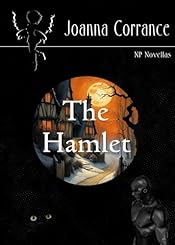
The Hamlet by Joanna Corrance

NewCon Press, 2025, 115 p. Reviewed for ParSec 14.

This was published as a novella but reads more like an assemblage of short stories with characters which cross over from one to the next, though outwith their own tale, usually only in brief appearances. Its background premise – something strange (but unspecified) has happened and people have been advised to remain indoors – may be a literary response to Covid. The setting is a small village in Scotland – locals call it a clachan but incomers have used the description hamlet (which I note is actually a particularly English designation) for so long that it has become more common. The village ‘spinsters,’ however, still frown upon it. Apart from the first, very short, chapter which introduces the strange event, each section is given over to the experiences of different characters, Beth, Polly, Helen, Eve, Robyn and Jeanie, with the novella ending with a sort of epilogue from the point of view someone called the Spaceman.

The stories’ time scales are not always immediately apparent as some chapters start before the strange event or more or less ignore it happening. However, there’s enough oddness going on even without it.

Responding to a voice calling to her, Beth, who has inherited her home from her mother and not improved it in any way, instead letting it run to squalor, manages to move through the pipes in her plumbing, whether by her shrinking or the pipes expanding is moot. Eventually she is drawn down to an underground chamber to chat with the spinsters about the end of the world. The chapters which follow may represent different ways in which that end happens.

Thanks to the green-suited spaceman who appears at her window one night, schoolgirl Polly travels the universe and becomes both a witch and a princess.

Helen begins to produce videos which attract internet followers but increasingly show her lack of control of her life.

To escape the locked down city Eve has come to the cottage she rents out to Matthew (known locally as the Pest.) Not a good choice.

At Helen’s request Robyn builds a doll’s house as an exact replica of Helen’s home but realizes it also needs a doll’s house inside it and then another inside that and so on down.

Jeanie begins to act strangely and eventually locks herself away from everyone. She is however revealed to be a figment, a skin the narrator wore to make her life more amenable. The implication is that all the viewpoint characters are such skins. (But this is the essence of fiction. The reader temporarily becomes – or at least empathises with – a book’s characters.)

The Spaceman is from another world.

The Hamlet has aspects of a fairy tale (but there do not seem to be any happy ever afters, except perhaps for Polly,) has some of the heightened sensibility of magic realism (with a faint echo of John Burnside’s Glister,) moments of horror, and makes a foray into Science Fiction. Whether the disparate elements necessarily cohere into a unified whole is a matter for the individual reader. Corrance can write though.

The following did not appear in the published review.

Pedant’s corner:- “The McIvor’s lived in” (the McIvors lived in,) sat (x 2, sitting, or, seated,) “Mums washing machine” (Mum’s,) “paper mâché” (paper mache:  if its ‘mâché’ then it’s papier mâché,) “it sloped passed me” (past me,) airplane (aeroplane,) “the High-lands” (the Highlands,) curb (kerb.) “‘So where did you learn to cook?’ She asked.” (‘So where did you learn to cook?’ she asked,) “when they played drafts” (draughts,) dollhouse (doll’s house,) “most Saturday’s” (most Saturdays,) “and come pick me up” (come to pick me up,) miniscule (minuscule,) “the little girls’ eyes” (it was only one girl; ‘little girl’s eyes’.)

free hit counter script