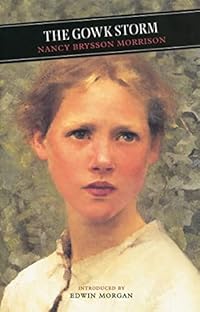
Canongate Classics, 2005, 178 p plus vi pages introduction by Edwin Morgan. First published 1933.
Another from the list of 100 best Scottish Books. It is best to avoid Edwin Morgan’s introduction, as I did, till after reading the main text.
Despite its first appearance being in the 1930s there is a Victorian quality to this novel; not so much Dickensian as Hardy-like, or, given the author’s interest in those sisters (among other non-fiction works she wrote Haworth Harvest: The Lives of The Brontës) perhaps Brontëesque.
The narrator, Lisbet Lockhart, is one of three sisters, daughters of the manse in a rural parish. Their father is withdrawn and mother unobservant but there is a Nannie who is full of old Scots sayings. It is she who provides the meaning of gowk storm – strictly an unseasonal fall of snow in spring, an occurrence which actually is not too rare in Scotland even now – as, “Something o’ ill chance that micht fa’ to ony o’ us and that willna bide.”
To complete her education Lisbet’s father arranges for her to have Latin lessons with the local dominie, Mr MacDonald, after his normal schoolday is finished. Her eldest sister, Julia, makes excuses to come along with her. The attraction between Julia and MacDonald is kept secret but Mr Lockhart comes across them while they are sheltering from a storm. It is revealed the dominie is a Roman Catholic and the girls’ father hastens to ensure he is removed from his post. Julia is distraught, especially when MacDonald departs the village without a word to her and leaving all his possessions behind. Suddenly he is said to have been doing all manner of uncanny things though nobody had said ill of him till they discovered he was a Catholic. He is later rumoured to have joined a monastery. This part of the book highlights the sectarian prejudices which have blighted Scotland for centuries and have still not died out. For Julia this turns out to be only a passing disappointment as she accepts the proposal of (the much older and widowed) Mr Strathern just over a year later. As Nannie says, if in a later context, “It a’ passes, if ye only bide lang enow.” The focus then shifts to Emily Lockhart and her embroilment with Stephen Wingate, who is already engaged to Emily’s best friend, Christine. This entanglement is not a passing storm and provides the novel’s emotional impact.
The tight viewpoint employed by Morrison means that some of the characters – Wingate, Nicholas Strathern (who almost out of the blue professes a liking for Lisbet and is kissing her a short walk to the gate later,) even Mrs Lockhart – are less fleshed-out than would be ideal. The same cannot be said for the egregious Mr Boyd, the locum for Mr Lockhart when he is taken ill.
Before I read this I also read a prescription for good beginnings of stories one of which was to avoid exposition. “Nothing makes readers close a book faster than a long opening paragraph describing a mountain range.” Both the Prologue of The Gowk Storm and Chapter One of Book One begin with descriptions of landscape. Neither is particularly detrimental to reader engagement. In “classic” books written by Scots and set in Scotland it is rather a feature that a feeling for the landscape, as well as for its inhabitants, pervades them. Here Morrison has Lisbet muse that “Perhaps the shadows of things were like the lives of people…. The changeless thing of which we go so unaware from cradle to grave.” In the novel’s elegiac Epilogue a curlew’s call has “All the world’s sorrow, and all the world’s pain, and none of its regret.”
Not every ill chance fails to bide.
Pedant’s corner:- liteary (literary: this was in the biographical info prior to the title page,) span, Scotch for Scots (this must have been okay in 1933,) a vivid green fungi (did this mean fungi of a vivid green?) before he axed her (the only other time I’ve ever seen “axed” for “asked” is in “urban” speak,) over and river (over the river?) And in the introduction: observent (observant,) unsuitableness (unsuitability surely?)