Archives » Joseph Conrad

Heart of Darkness by Joseph Conrad

(And two other stories.) Folio Society, 1997, 295 p (including 11 p Introduction by Jeremy Hardy,) plus 12 p illustrations by Francis Moseley and 3 p Author’s Note.

 Heart of Darkness cover

This is one of a uniform Folio Society edition of Conrad’s works. Despite its title the book actually contains three stories, Youth, Heart of Darkness itself and The End of the Tether.

Youth
The fairly short Youth is one of those ‘as told to’ stories, by someone called Marlow to a group with knowledge of seafaring about his trip as a Second Mate on a ship whose charge was the Captain’s first, carrying coal to Bangkok from Newcastle. Before the ship can leave port it has to be caulked, then it is bashed by another steamer while still in dock and more repairs are required. On setting out the pumps have to be manned constantly and they are forced to turn back. It by now has such a reputation no crew can be found locally and men have to be fetched from Liverpool. The repairs are finally finished.

But, before she sets sail, the rats start to leave.

Heart of Darkness (In the list of 100 best Scottish books, but only Scottish because it was first published by Edinburgh based Blackwood’s Magazine.)

This long short story is another tale told by Marlow (this time accorded the first name Charlie) telling a ship’s crew in the offing off Gravesend of his trip as a steamboat captain up an unnamed African river – the Introduction says it’s the Congo but that is not in the text – to find the successful but rogue ivory trader Kurtz.

This ‘telling’ style is more obtrusive here than in Youth and erects a barrier between the reader and the text. The actual narrator regurgitating Marlow’s tales – both here and in Youth – is neither named nor makes much of an impression on the reader. The story is therefore rendered opaque (okay, it’s titled Heart of Darkness, a degree of opacity is perhaps required) but it makes disbelief more difficult to suspend.

Caught in a thick white fog near Kurtz’s station the boat is attacked with spears and a crew member is killed but blasts on the ship’s horn disperse the attackers. Marlow observes near Kurtz’s station a row of posts with severed heads on them. The natives seem to want to attack the boat again but Kurtz’s influence on them prevents that. When he is finally brought on board it seems to Marlow’s eyes that Kurtz has ‘gone native.’ He is in any case very ill and dies on the trip back.

(The) Heart of Darkness was first published in Blackwood’s Magazine in 1898/9 (a book containing all three stories in this volume appeared in 1902) and despite Marlow’s expressed disillusion with the trading company’s methods it is representative of the attitudes of the time, presenting the Africans as ‘others.’ Even the story’s title is emblematic of a disregard both for the land- and riverscapes and for the accomplishments and society Africans of the time had. However, Conrad was writing at that time and for an audience who had those prejudices.

The End of the Tether is much the longest story here. In it, ship’s Captain Whalley had made a fortune (and promised it to his daughter who in turn had married a no-hoper) only to lose it in a stock market crash, leaving him with only a ship called The Fair Maid to sell. The proceeds go partly towards his daughter but the rest he invests in a ship called the Sofala whose main owner is its engineer, famous for getting rid of Captains at short notice. The arrangement is to last for three years after which time Whalley will regain the stake he put in. The time is almost up when Whalley begins to show signs of losing his touch. The second mate comes to the conclusion that Whalley is actually letting his Malay helmsman direct the boat and tries to blackmail him. The truth is more nuanced than that.

Note. Modern sensibilities may quail at the use of the word nigger(s) and ‘Marlow’ also describes native Africans as savages.

Pedant’s corner:- “to come abroad” (to come aboard,) curb (kerb.)

Bookshelf Travelling for Insane Times Again

My contribution this week to the meme started by Judith Reader in the Wilderness is the lower portion of that bookcase which contains my collection of recent Scottish fiction.

The upper of these two shelves features Alan Spence, Alan Warner and Louise Welsh – plus to the right William Boyd whom I am never sure whether to count as Scottish or not. At the extreme right are two books on football, Jonathan Wilson’s The Outsider and A Season with Verona by Tim Parks.

On the bottom shelf is my collection of books by Joseph Conrad (the favourite writer of my grandfather, the original Jack Deighton.) These are beautiful Folio Editions, a matching set. To the right of them are various history books plus Periodic Tales and a couple of the good lady’s books.

Books Again

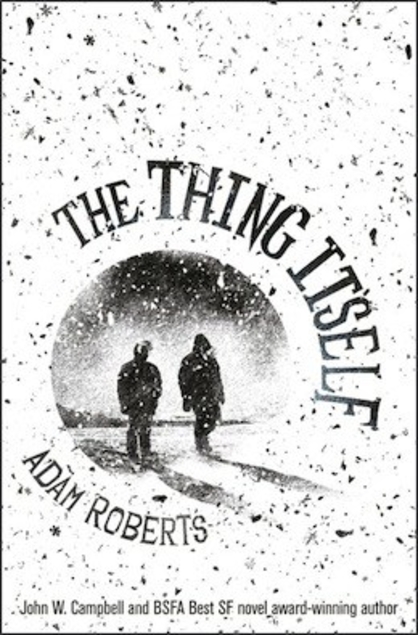
The Thing Itself by Adam Roberts

Gollancz, 2015, 333 p

The Thing Itself cover

I’ve read quite a few novels by Roberts now and there was always – New Model Army perhaps excepted – something lacking about them which nagged a little but what exactly that something was hadn’t crystallised till partway through this one when he alluded to a famous Joseph Conrad phrase. Then it struck me. He was telling the reader what to feel. But, and this is the point, he hadn’t managed to evoke that feeling in me. It was all too distanced, too formalised, not emotionally compelling. Admittedly this novel is one of Roberts’s more abstruse efforts, being an attempt to render Immanuel Kant’s Critique of Pure Reason into fictional form, to speculate on the Dring an sich, the world as it is – as opposed to the one we perceive through our senses.

It may be Roberts has an inkling of this himself as he has posted about the novel’s lack of award nominations or indeed much notice within the SF community and has said he intends in future to produce fiction that is less challenging to the reader. He may be slightly off-beam there. It’s not the challenge that niggled me, it’s the lack of connection. I still haven’t got round to Roberts’s Yellow Blue Tibia from 2009 (which Kim Stanley Ronbinson opined ought to have won the Booker Prize that year.) It’ll be interesting to read it with this thought in mind.

As to the plot here, Charles Gardner and Roy Curtius are on an Antarctic research base in 1986 when something weird happens. The effects of this are to dog Gardner for the rest of his life as he becomes gradually less employable before he is finally embroiled into a (deniable) government attempt to render Curtius and a recently evolved AI named Peta harmless. Breakthrough into the Dring an sich is way too dangerous to allow uncontrolled access. As it is, ripples backward and forward through time from the events of Gardner’s life have already occurred.

Gardner’s story chapters are alternated with others with settings ranging from Mayence (Mainz) in 1900 to a future time war via 19th century Gibraltar (where the rock changes its dimensions every time a couple has sex,) the late 1690s, a list of 89 numbered paragraphs and the days of Kant’s dotage.

With many allusions – the novel’s first sentence, “The beginning was the letter” suggests the first sentence of the Gospel of John, there is a Joycean section, a chapter in Restoration style, that reworking of Kant’s last days – the novel is undeniably dense; but it is not difficult to read. Emotionally, though, it is scanty.

There is a lot to admire in Roberts’s work, it is certainly impressive; but I suspect it is much more difficult to love it.

Pedant’s corner:- “Say what?” (I don’t recall people using this formulation in 1986,) sprung (sprang,) scilla (cilia made more sense,) protruberances (protuberances,) nineties and naughties (noughties, but then again it may have been a sexual pun,) “I was in the verge of something” (on the verge is more usual,) “not eager to say” (to stay.) “And her she held up a single finger,” (And here,) my stomach clenches sharply (all the other verbs here were past tense so; clenched.) “Spaces is,” (Space,) “the torn stitched removed” (stitch,) shuggle (this Scots word is usually spelled shoogle) another Scotticism was “fair” as an amplifier, as in, he fair shrieked. “The sole window right beside the door I had just come in through, and so I took a look outside.” (??) “didn’t phase the clerk” (faze,) Curtus (Curtius,) “who can do as the please” (as they please,) meters (metres, but this was in a future scenario along with the spelling vodka,) Valzha (spelled twice this way, otherwise Valzah,) sphereoids (spheroids,) “in which both paries were male” (parties,) he is sat (seated.,) appeared drunken (appeared drunk, surely?)

free hit counter script