Archives » EL Alamein

Stonehaven and Dunnottar War Memorial (iv) – World War 2

The names of some World War 2 fields of miltary operations are inscribed on the base of the pillars supprtoing the lintels of Stonehaven War Memorial.

“North Atlantic, Narvik”

Stonehaven War Memorial Second World War Stone

“Dunkirk, Battle of Britain”

Second World War Stone, Stonehaven War Memorial

“El Alamein, Cassino”

War Memorial, Stonehaven, Second World War Stone

“Normandy Beaches, Burma”

Second World War Stone, War Memoria, Stonehaven

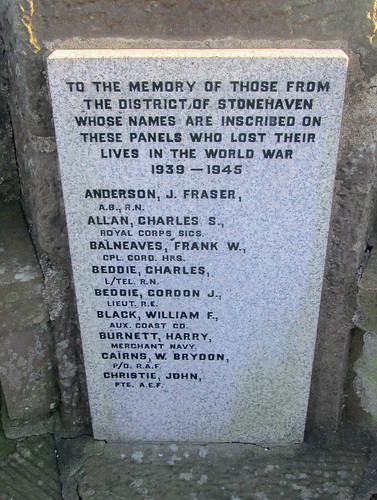
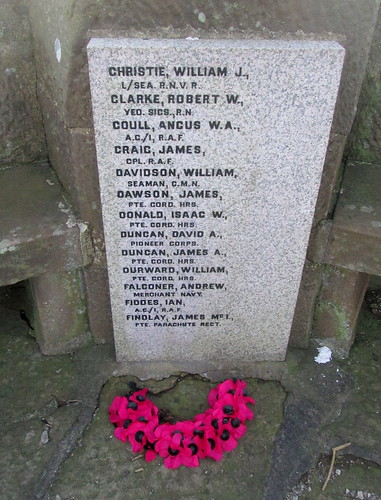
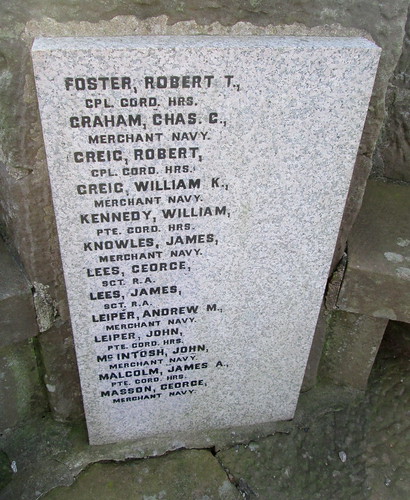
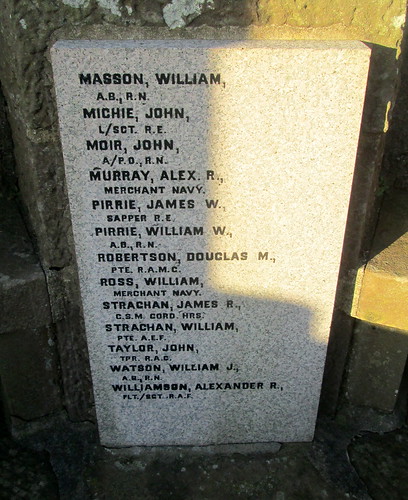
The World War 2 dead are commemorated in a series of four granite panels sitting by the Memorial’s pillars. The first is also inscribed with the dedication, “To the memory of those from the District of Stonehaven whose names are inscribed on these panels who lost their lives in the World War 1939 -1945,” as well as the names.

J Fraser Anderson – John Christie:-

Stonehaven War Memorial World War 2 Dedication and Names

William J Christie – James Mc I Findlay:-

Second World War Names, Stonehaven War Memorials

Robert T Foster – George Masson:-

Stonehaven War Memorial, World War 2 Names

William Masson – Alexander R Williamson:-

Second World War Names, Stonehaven War Memorial

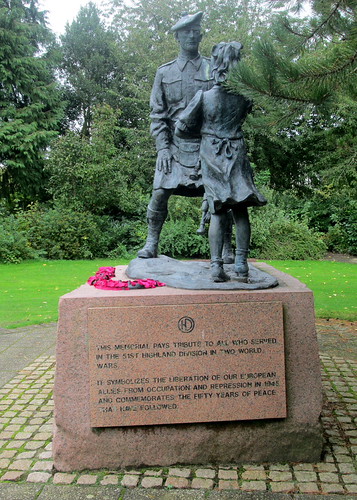
51st Highland Division Memorial, Perth

Also at the south end of Perth’s North Inch is a memorial to the 51st Highland Division. It takes the form of a bagpiper being thanked by a young girl.

51st Highland Division Memorial, Perth

Dedication:-

Dedication, 51st Highland Division Memorial, Perth

To either side of the memorial are two cairns with inset plaques.

El Alamein 50th anniversary plaque:-

51st Highland Division Memorial, Perth

51st Highland Division final reunion commemoration. Plaque donated by the people of Genner, Holland:-

Plaque, 51st Highland Division Memorial, Perth

On the memorial itself are several additional reliefs.

51st Highland Division Battle Honours:-

Battle Honours, 51st Highland Division Memorial

Remembrance of our liberators:-

51st Highland Division Memorial Remembrance Plaque

Poem on the Memorial (by Andrew McGeever):-

Poem on 51st Highland Division Memorial, Perth

Friezes of military scenes:-

Frieze, 51st Highland Division Memorial, Perth

51st Highland Division Memorial Frieze, Perth

Weaver by Stephen Baxter

Gollancz, 2008, 321 p.

Unlike the previous volumes in Baxter’s “Time’s Tapestry” series which were spread over several centuries and as a result had a disjointed feel, the action in this one is spread over only a few years in the late 1930s and early 1940s. The tale is tighter and more cohesive as a consequence.

The prologue features an Irishman called O’Malley who at MIT has invented a machine he calls a “loom” with which – with the contribution of the dreams of an Austrian Jew called Ben Kamen – he has managed to send a message back to pre-Roman Britain. It isn’t long before both the loom and Kamen have been snatched by the Nazis and incorporated into their greater plan of altering history to ensure the triumph of the Reich.

The meat of the book is set in and after the invasion of Southern England by German forces once the BEF had been destroyed on the shore at Dunkirk. A hasty (and to my mind unlikely) deal by Churchill with the US sees them given military bases – US sovereign territory – south of London. As Hitler is seeking to avoid war with the US the German advance halts when they encounter these. This struck me as more of a sop to possible US readers of the book than something that would have occurred in such a scenario. The presence of a female US newspaper correspondent and her son in the cast of characters also points in this direction. A demarcation line cutting off South-East England is where the war situation settles down.

Off-stage Churchill falls as Prime Minister, to be succeeded by Lord Halifax who nevertheless continues the war – which goes on more or less as in our timeline; Barbarossa, Pearl Harbor, Stalingrad, El Alamein all get a mention, Japan’s invasion of Australia is new though. Again it may be more likely that Halifax would have sued for peace, but perhaps that would have been unthinkable with a substantial part of the UK – not just the Channel Islands – under German rule.

While Weaver can be read as a one-off with no detriment to the reading experience there are several nice touches where Baxter has his characters travel to locations which appeared in earlier books in the series; places like Birdoswald on Hadrian’s Wall and Richborough in Kent (Roman Rutupiae.)

This is the sort of thing that Harry Turtledove essays so frequently. Baxter’s characters are more rounded than Turtledove’s generally are and the extra twist of the loom makes for an added commentary on the contingency of historical events.

Rommel by Desmond Young

Fontana, 2012, 387p.

Rommel

To anyone familiar with the film The Desert Fox, starring James Mason, the outlines of Rommel’s story will be familiar. The movie, though based on this book – the author even plays himself in the film – concentrates less on Rommel’s military career than his last days; with Rommel’s unwitting contacts with the July plotters leading to his forced suicide.

This biography, written after contact with Rommel’s family and first published in 1950, inevitably tends to be admiring. The author’s personal experience of Rommel’s conduct towards him as a PoW helps in this regard and there were no accusations of war crimes committed by the Afrika Korps. Winston Churchill himself regarded Rommel as a worthy opponent. Rommel’s anti-Nazi credentials are taken for granted by Young. (However recent reassessments in Germany have called this into question.)

In a military sense Rommel’s career speaks for itself. Though criticised as lacking in the strategic sense, his tactical ability, his capacity to see an opportunity and exploit it, to take risks even (especially?) when on the back foot paid off time and again. He had what the Germans call Fingerspitzengefühl, “intuition in his fingers” and a sort of sixth sense for avoiding death.

Not a typical Prussian General (he was in fact a Württemberger and liked nothing better than talking to soldiers from the locality in the thick Swabian dialect) and not from a military family, in the Great War he won the Pour le Mérite for exploits on the Italian Front where he first displayed the qualities which made his troops so willing to follow him. He was in the forefront of the German breakthroughs in the defeat of France in 1940, but his commanders and colleagues thought him too reckless and/or selfish – and too willing to take credit for wider success. Part of this may, of course, have been professional jealousy. It was the Western Desert, with its wide open spaces, that allowed him to show himself as a master of motorised/armoured warfare. He recognised that such battles were more akin to sea warfare than land and he criticised the British for their more rigid approach while acknowledging that their training for more static warfare was excellent.

I had not realised before how nearly General Auchinleck‘s Operation Crusader came to defeating Rommel completely a year earlier than Alamein. That the British/Empire forces did so well considering their inferior equipment (poorer anti-tank guns, lower quality tanks – some Grants were available at this time but Shermans not until the next year) speaks volumes for their tenacity and endeavour. Rommell eventually turned the tables but his race to Egypt seriously overstretched both his army and his supply lines.

It was his contention that reinforcement could have resulted in him capturing Egypt and the Suez Canal. Once held at Alamein, and facing a well supplied and trained opponent with overwhelming superiority, he and his staff knew the jig was up.

He was bitterly aggrieved that, in the subsequent retreat and the aftermath of Operation Torch, reinforcements were then rushed in to Tunisia in what was by the time a lost cause.

After his first inspections of it he also knew that the much vaunted Atlantic Wall was anything but impregnable yet nevertheless – even through his disillusionment with Hitler and the upper General Staff (he had inspired the enmity of Kietel and Jodl in particular) – he threw himself into efforts to improve it.

British people who lived through the Second World War have a tendency to refer to the Italian army as a byword for uselessness (making jokes about tanks with only reverse gears for example.) It is noteworthy that Rommel himself had a greater appreciation of their qualities. “The Italian soldier was willing, unselfish and a good comrade and, considering his circumstances, his achievement was far above the average.” He goes on to add that their army’s performance exceeded anything the Italian Army had done for over 100 years. He attributes any failure to their military and state system, their poor equipment and lack of interest from Italian politicians.

free hit counter script