Archives » Edith Grossman

Of Love and Other Demons by Gabriel García Márquez

Penguin, 1996, 166 p. Translated from the Spanish Del amor y otros demonios, (Mondadori, Spain, 1994,) by Edith Grossman.

In a prefatory note Márquez tells us this tale was inspired by his first journalistic assignment – to cover the emptying of the crypts of the old Clarissan convent dedicated to Santa Clara where from one of the tombs tumbled a mass of copper coloured hair, attached to the skull of whom the name on the tomb said was Sierva María de Todos Los Ánǵeles. This reminded Márquez of a story told by his grandmother of a young girl with hair that trailed behind her like a bridal train who had died after being bitten by a rabid dog many years before.

In Márquez’s telling this child is the daughter of Don Ygnacio de Alfaro y Duenas, the second Marquis de Casalduero and Lord of Darien, whose second wife Bernarda Cabrera did not like Sierva María, so she was brought up with the slaves in their quarters and took on many of their beliefs and attitudes. She is indeed bitten by a dog one day in the market and the dog is found to have rabies but Sierva María displays no symptoms even months after and the family’s Doctor Abrenuncio is of the opinion she does not have the disease.

Nevertheless, the local Bishop de Cáceres y Virtudes thinks rabies is an example of demonic possession and insists Sierva María must be exorcised, delegating the task to Cayetano Alcino del Espirítu Santo Delaura y Escudero.

Sierva María is taken to the Clarissan convent where her unconventional (sorry, no pun intended) behaviour convinces the nuns she is indeed possessed. Cayetano soon becomes obsessed with her but can do little to help. Their growing love for each other (even it is not explicit whether or not it was consummated) is a Romeo and Juliet story doomed to fail and her young age coupled with Cayetano’s maturity renders it even more dubious to modern eyes.

In one of many instances here where Márquez implicitly criticises the Church and its practices Dr Abrenuncio says to the Marquis about exorcism, “There is not much difference between that and the witchcraft of the blacks. In fact, it is even worse, because the blacks only sacrifice roosters to their gods, while the Holy Office is happy to break innocents on the rack or burn them alive in a public spectacle.”

The novel also reflects the time in which it is set. About Sierva María’s habit of lying for pleasure Delaura says, “Like the blacks” to which the Marquis replies, “The blacks lie to us but not to each other.”

There is the usual sense of dislocation when reading a Márquez novel. Partly here this is due to Sierva María’s treatment by most of the characters, the main exception being Cayetano, though the Marquis is a lesser one. The background of the Marquis’s life – via his unusual marriages – is tinged with magical realism while Sierva María’s copper hair is an exemplar of the form.

The title suggests love is a demon. Whether it is or not, without it what would literature be?

Sensitivity note: one character thinks of Dr Abrenuncio as a grasping Jew.

Pedant’s corner:- Plus points for ‘autos-da-fe’. “The only security she had left were two urns filled with gold” (The only security she had left was two urns…,) confectionary (confectionery.)
 

Edith Grossman

I saw in Saturday’s Guardian that Edith Grossman, translator into English of the works of Gabriel García Márquez and Mario Vargas Llosa (among others including Miguel de Cervantes) has died.

I have read at least seven of her translations of novels – four of Márquez’s and three of Llosa’s. Ther are more on my tbr pile.

Translation is an art and Grossman was an advocate of translators far from being all but anonymous ought to be considered as at least equal to th eauthor swhom they translate and their names ought to be on the covers of the books they have translated.

Llosa has said of her work: “It doesn’t seem to be a translation of a novel, but something that gives the impression that it has been written originally in English.” For someone reading in English that, of course, is how it should be.

Edith Marion Grossman: 22/31936 – 4/9/2023. So it goes.

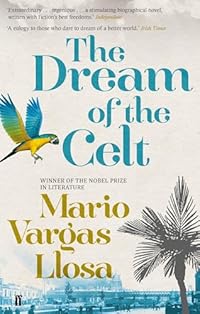
The Dream of the Celt by Mario Vargas Llosa

faber and faber, 2013, 504 p. Translated from the Spanish El sueño del celta by Edith Grossman.

 The Dream of the Celt cover

On the face of it this seems an unlikely endeavour. A Peruvian novelist focusing on a relatively obscure incident in British – and Irish – history? (Then again the Peruvian Jorge Luis Borges was fascinated by Scotland.) But this novelist’s protagonist, (Sir) Roger Casement, was instrumental in exposing the barbarous practices of colonial exploitation in the Congo and later the Amazon, wherein he made his name and for which he received his title, before he took up the cause of Irish independence and was subsequently arrested for treason after visiting Germany during the Great War to seek its government’s help in that endeavour.

The odd numbered chapters here focus on Casement’s life in prison after his trial, in the run-up to his execution. These are the most novelistic parts of the book, displaying his relationship with the guards and the visitors who come to see him, outlining their efforts to obtain a commutation of his death sentence. The even numbered chapters tend to be longer and cover his career in the years leading up to his arrest – and often read more like a history book than a novel. Llosa discounts a large portion of Casement’s diary entries (which many contend were forged by his captors) relating to his homosexual encounters with various men – which damned him not only in the authorities’ eyes, but more crucially in those of the public – as imagined or else wish fulfilment fantasies, giving a novelistic alternative account of several of these incidents, though he treats others as veracious. As Casement’s priest says to him about the suggestion the stories about him were put in the newspapers to counteract the petition for clemency, ‘Nothing can be excluded in the world of politics. It’s not the cleanest of human activities.’ Yes, indeed.

In what is perhaps a comment on the motives of campaigners, a consul in S America tells Casement, “‘I don’t have much admiration for martyrs, Mr Casement. Or for heroes. People who sacrifice themselves for truth or justice often do more harm than the thing they want to change.’”

It is in the ‘historical’ (in the sense of predating the events in the odd numbered chapters) sections though that it is set out how Casement’s experiences in the Congo and the Amazon led him to the idea that Ireland too was a colonised country, albeit with its inhabitants now less harshly treated.

Despite Casement’s conclusion in South America that, We should not permit colonisation to castrate the spirit of the Irish as it has castrated the spirit of the Amazon Indians. We must act now, once and for all, before it is too late and we turn into automata, Llosa also suggests Casement’s trip to Ireland on a U-boat was to try to forestall the Easter Rising rather than encourage it, or even to bring it weapons, as it would not be supported by German action to neutralise the British Army and Royal Navy. When Joseph Plunkett tells him in Germany the Rising is imminent Casement thinks, “No matter how heroic and intrepid they were, the revolutionaries would be crushed by the machinery of the Empire. It would use the opportunity to carry out an implacable purge. The liberation of Ireland would be delayed for another fifty years.”

Plunkett’s response is that, “‘of course we’re going to lose this battle. It’s a question of enduring. Of resisting. For days, weeks. And dying in such a way that our death and our blood will increase the patriotism of the Irish until it becomes an irresistible force.’” Which it did.

The novel’s title The Dream of the Celt comes from that of a poem Casement wrote in 1906 about Ireland’s mythic past. While as a novel it is a little unbalanced and not, perhaps, Llosa at his best, it does act as a useful primer on Casement’s life and times.

Pedant’s corner:- sheriff (illustrates the drawbacks of translation into USian. There are no sheriffs in British prisons. We have prison officers or, at a push, warders. And it wasn’t the prison Governor, since he appears later in the book.) “In Brixton Prison” (in the context of an earlier mention of Pentonville a British translator would just write ‘In Brixton’ here,) “Dr Livingstone, who never wanted to leave African soil or return to England” (return to the UK? Livingstone was Scottish after all.) “The Irish historian ……. she had been” (even though there are 34 words in between ‘historian’ and ‘she’ that ‘she’ is not needed,) “gave Walla a week to fulfil their quota” (its quota,) “where a formation of African soldiers were marching” (a formation … was marching.) “There were also a good number of” (There was also a good number,) “Perhaps one, some of his colleagues” (one, or some, of his colleagues?) “with the Irish insignia on their visors” (I suspect this refers to cap badges. These do not sit on visors,) Casement refers to the British Army as “the most powerful army in the world” (in 1916 the British Army wasn’t. The German one still was,) “the Court of Appeals” (it’s the Court of Appeal.)

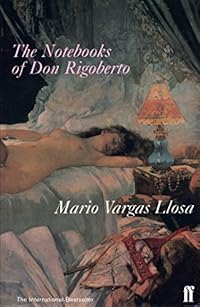
The Notebooks of Don Rigoberto by Mario Vargas Llosa

faber and faber, 1999, 308 p. Translated from the Spanish Los Cuadernos de Don Rigoberto by Edith Grossman

 The Notebooks of Don Rigoberto cover

A very odd piece, this. I’m tempted to add very South American; but it does focus on love and sex (especially the sex) – two of the triumvirate of big novelistic concerns.

Don Rigoberto is a legal director of an insurance company with an interest in collecting books and works of art but he never has more nor less than the same amount of either. Each new purchase must be balanced by the disposal of a previous one. Rigoberto has an extensive set of notebooks where he has inscribed his reflections on all he has seen or read. At the book’s start Rigoberto is estranged from his second wife Doña Lucrecia due to an indiscretion involving Alfonso, Rigoberto’s son from his first marriage, still a schoolboy but one who has an unhealthy fascination with the life and work of the artist Egon Schiele – to the extent he believes he may be a reincarnation.

The novel depicts sessions where Alfonso is visiting Lucrecia with a view to effecting a reconciliation between his father and stepmother, mixed in with Rigoberto’s memories and fantasies of life with Lucrecia and his notebooks’ polemics against aspects of modern life and the timid aspirations and attitudes of the general mass. One of these is a railing against pornographers, who pervert the higher aspects of love and sex, commodify the impulse and therefore desacralize the act of love and make it banal. In the same piece he absolutely nails Margaret Thatcher “not one of whose hairs moved for the entire time she was Prime Minister” (though it has to be said describing her as a delectable source of erotic desire is a perversion far too far.) Another of the Don’s reflections is an aside on the difference between a eunuch and a castrato.He also thinks, “The obligation of a film or book is to entertain me. If … I begin to nod or fall asleep when I watch or read them, they have failed in their duty and they are bad books, bad films.” By this criterion The Notebooks of Don Rigoberto could be a bad book, as I began to nod or fall asleep several times while reading it. Mind you I had been dotting about the country like a blue-arsed fly during the week when I read it and consequently was prone to tiredness. But that’s my fault, the book is still worth reading.

The Notebooks of Don Rigoberto is a consciously literary work, scenes are described from different viewpoints simultaneously, the shifting taking place from sentence to sentence, signalling a certain unreliability in narrative viewpoint (or a touch of magic realism.) Those with a prudish sensibility might want to give it a miss, though.

Pedant’s corner:- maître d’s (surely the plural of maître d’ is maîtres d’?) ambiance (x2, ambience,) a missing full stop before the quote mark at the end of a piece of direct speech x2, depilitated (x3, depilated,) corolla (x2, used in the sense of areola, but corolla is a botanical term,) Saint Vitus’s dance (x2, Vitus’s,) motorcross (motocross.) “They had know each other” ~(known,) “the American Harley-Davidson and Triumph” (implies Triumph is an American marque,) checked flag (the usual term in motor racing is chequered flag,) CD’s (there is no need for that apostrophe, there is no letter missing; CDs,) “the only anthem that can move me to tears are the sounds” (“anthem” is singular; so, is. On the other hand “sounds” is plural and the verb to be implies equivalence; so, are. Better to have something like “expresses the sounds of”,) “a sort of cowl, even, even, the head” (one of those “even”s is extraneous,) a missing end quote mark, “pubises trimmed and dyed” (the pubis is the bone, not the hair of the pubic region. Pubes is the noun to depict the region or its hair, though in English it’s liable to mispronunciation. I assume its plural is “pubes” still, compare the plural of sheep,) offpring (offspring,) a supposed newspaper report has, “A twenty-four year old teacher in New Zealand was sentenced to four years in prison for carnal relations with a ten-year old boy, a friend and classmate of her son’s” (that implies she would have given birth when she was fourteen; possible I suppose, but unlikely,) will-o’-the-wisps (wills-o’-the-wisp.)

Strange Pilgrims by Gabriel García Márquez

Twelve Stories, Penguin, 2013, 195 p + 7 p Prologue. Translated from the Spanish Doce Cuentos Peregrinos by Edith Grossman. First published by Mondadori España, S A, 1992.
Borrowed from a threatened library.

 Strange Pilgrims cover

In the Prologue Why Twelve, Why Stories, Why Pilgrims? Márquez describes the genesis of this collection in a series of notes for 64 stories – some of which became newspaper articles or films – and their final conception as a thematic whole. After many false starts, vicissitudes and throwings-away it came to the point where, “Sometimes I felt as if I were writing for the sheer pleasure of telling a story, which may be the human condition that most resembles levitation.” Most of the twelve concern South Americans adrift in a continent inhabited by those strange people with their strange ways, Europeans.
The opening story, “Bon Voyage, Mr President”, features a deposed President in search of medical treatment in Geneva, where he is recognised by a countryman. They come to regard each other warmly. South America is said to be, “A continent conceived by the scum of the Earth without a moment of love: the children of abductions, rapes, violations, infamous dealings, deceptions, the union of enemies with enemies.”
In The Saint, a man spends twenty-two years in Rome trying to secure the canonisation of his daughter, who had died of an essential fever. When the cemetery back home was relocated to make way for a dam her exhumed body was found to be uncorrupted and weightless.
The narrator of Sleeping Beauty and the Airplane is waiting for his flight when he catches sight of the most beautiful woman he had ever seen in the lobby of Charles de Gaulle airport. She turns out to be on the next seat to him on the plane but not a word is spoken between them.
I Sell My Dreams is the story of the strange intersections its narrator had with a Colombian exile in Vienna who had a talent for dreaming who uses this to make her way in life. Whether or not the talent was charlatanic is up to the reader to decide.
In “I Only Came to Use the Phone” a woman’s car breaks down. She is desperate to phone her husband to tell him she’ll be late. She finally gets a lift from a bus but unfortunately its destination is an asylum.
The Ghosts of August sees a family visit the castle in Tuscany built by Ludovico, who killed his lady in their bed then turned his dogs on himself. The bedchamber has been preserved, bloodstained bedsheets and all. Nevertheless they stay overnight.
Maria dos Prazeres is an old woman who has a dream she will die and spends the next three years preparing for it. Among other things she teaches her dog to weep.
In Seventeen Poisoned Englishmen, after her husband dies, Señora Prudencia Linero makes a journey to Rome to see the Pope. On landing in the country she does not like Italy nor the prospect of the seventeen Englishmen in the lobby of the hotel she is shown to. She dines elsewhere.
The Tramontana is a days-long wind which blows through Cadaqués, the effects of which (even the prospect of which) drives people to suicide.
Despite her surname, the Miss Forbes of Miss Forbes’s Summer of Happiness is a German governess hired to look after two boys spending summer in the Island of Pantelleria. She is strict and they resent it.
Arising from a chance remark about the poetry of household objects Light is Like Water (“You turn the tap and out it comes”) is a very magic realist tale of two boys transforming light into the ocean of their dreams.
The Trail of Your Blood in the Snow is a tragic tale of two young lovers, Billy Sánchez and Nena Daconte. At a reception on arriving in Spain on their honeymoon she pricks her hand on a bouquet of roses. At first this does not seem serious but the bleeding will not stop. When they eventually reach a hospital – in Paris! – he is not allowed to accompany her and told there is no visiting except on Tuesdays, six days away.
These are tales of misfits, delusion and misunderstandings mostly seen from aslant. Good stuff.

Pedant’s corner:- organdy (organdie,) detact (detect,) spit (spat,) carabineriere (carabiniere?)

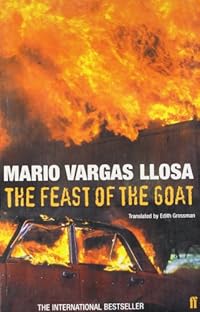
The Feast of the Goat by Mario Vargas Llosa

Translated from the Spanish, La Fiesta del Chivo, by Edith Grossman.

faber and faber, 2003, 475p.

After thirty five deliberately estranged years making her way in the world as a lawyer in New York, Urania Cabral returns to Santo Domingo in the Dominican Republic to confront her invalid father, Agustín, once a well-connected member of the brutal regime surrounding the dictator Rafael Leonidas Trujillo Molina, whose times and legacy are the book’s focus.

Apart from Urania’s there are several other narrative viewpoints. Rotating in a strict sequence through the first sixteen chapters are sections detailing Urania’s memories and experiences, Trujillo’s thoughts and actions in his last days and those of the people lying in wait to assassinate him. The latter end of the book focuses more on other co-conspirators and Trujillo’s successor as President, Joaquin Balaguer. The final chapter reveals the extent of Agustín’s betrayal of Urania after he fell into disfavour.

Some of these play tricks with time. The narration of Urania’s memories to her extended family is intercut with third person accounts of what occurred in the past, the time frame jumping back and forward without warning. Trujillo’s thoughts and those of his assassins also mingle reminiscence with the imminent action.

Despite his position Trujillo has insecurities; he feels betrayed by his prostate (its cancerous state can cause him to urinate involuntarily, his manservant always has a change of clothes available just in case) and harbours bitter feelings towards a woman with whom he couldn’t achieve an erection. His almost hypnotic, paralysing, effect on others is emphasised in the sections narrated from others’ viewpoints.

The everyday paranoia, the second guessing, engendered by living close to a dictator is well depicted, the apparatus of state repression and control shown us quite graphically, but the book focuses entirely on the elite in Dominican society. While ordinary Dominicans are mentioned, very little sense is given of their lives.

The Feast of the Goat is, though, clearly a book by a writer who has chosen to grapple with big themes – not just love, sex and death, but man’s inhumanity to man and to woman – and has the ability to handle them.

The translation was into USian, which is understandable given the larger potential readership there, but two thoughts arose. Does Spanish have the same distinction between being hanged and being hung as exists in English? Hung was use twice here in the wrong sense, firstly by a soldier who might perhaps be expected not to know the difference, but the second was in the body of the narrative. Also men’s lower outer garments were sometimes referred to as pants but at other times as trousers.

free hit counter script