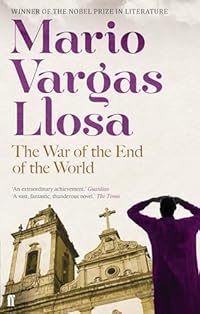
The War of the End of the World by Maria Vargas Llosa
Posted in Other fiction, Reading Reviewed at 11:00 on 23 February 2016
faber and faber, 2012, 758 p. Translated from the Spanish La guerra del fin del mundo with no translator’s name given, merely a translation copyright notice for the book’s first US publisher. Returned to a threatened library.
An itinerant mystic, Antonio Conselheiro, called the Counsellor, wanders the Brazilian province of Bahia gathering adherents. He preaches against the recently formed Republic of Brazil as the Antichrist, stuffed with Freemasons. In Llosa’s account he has the ability to transform an assortment of unfortunates, misfits, and the misshapen – not to mention the worst of bandits – into followers of the Blessed Jesus (whose every mention among the Counsellor’s adherents is replied to with “Blessed be he”.) Eventually he sets up a community in the town of Canudos against which a succession of ever larger military expeditions is sent by the Republic as the “rebellion” defeats each in turn. All this is based on a historical event, the War of Canudos, the most bloody civil war in Brazil’s history.
The early part of the novel is taken up with sections relating to how some of the Counsellor’s most important followers come to fall under his spell interspersed with the machinations of local politicians in Bahia – both for and against the Republic. Here we also meet a socialist (and red-haired) Scotsman on the run from authorities in Europe – where he had indulged in seditious activities – who goes by the name of Galileo Gall (but whose real name is never given) and has a belief in phrenology. Gall is framed by the editor of the Jornal de Notícias, Epaminondas Gonçalves, to make it look as though Britain, referred to by most characters as England, is involved in gun-running to, and support of, the rebels of Canudos. (“Gall” does put Gonçalves right, though, when he says, “I’m a Scotsman. I hate the English.”) A near-sighted journalist – again nameless – goes along with the third military force to be sent against the rebels and witnesses most of the later fighting; at least until his spectacles get broken.
Entrants to Canudos were made to swear that they were not Republicans, did not accept the expulsion of the Emperor, nor the separation of Church and State, nor civil marriage, nor the new system of weight and measures, nor the census questions. (The devil is obviously in the way you count the spoons.) Mostly though, the Counsellor was playing on the faith of the poor and their fears that slavery would be reintroduced.
Gall thinks of Canudos as, “A libertarian citadel, without money, without masters, without politics, without priests, without bankers, without landowners, a world built with the faith and the blood of the poorest of the poor,” (though part of that is his own idealism projected onto it) and wonders about the – to him – curious code of “Honour, vengeance, that rigorous religion, those punctilious codes of conduct….. a vow, a man’s word, those luxuries and games of rich, or idlers and parasites – how to understand their existence here?” that so prevailed on the husband of a woman he raped that he pursued Gall there.
About a third of the way through the book we find the nameless journalist has survived the war as he talks to the Baron de Canabrava about his experiences. This has the effect of defusing some of the tension as we readers are still to meet them for ourselves.
In Canudos the near-sighted journalist thought to himself, ‘culture, knowledge were lies, dead weight, blindfolds. All that reading – and it had been of no use whatsoever in helping him to escape.’ The baron is disgusted by the journalist finding amid the chaos of Canudos love and pleasure with a peasant girl. “Did those words not call to mind luxury, refinement, sensibility, elegance, the rites and the ripe wisdom of an imagination nourished by wide reading, travels, education?”
Army doctor Teotônio Leal Cavalcanti’s image of humanity abruptly darkened in his weeks seeing to the wounded during the siege, observing of the able-bodied, “‘It is not what is most sublime, but what is most sordid and abject, the hunger for filthy lucre, greed, that is aroused in the presence of death.’”
The novel feels like it has a cast of thousands. There are multiple viewpoint characters and a narrative which shifts from present to past tense and back in section to section. This makes for a dry and slow start as the life stories of the Counsellor’s adherents prior to their falling in with him and those of the politicians of Bahia are told to us rather than shown. But, as the near-sighted journalist tells Baron de Canabrava, “‘Canudos isn’t a story; it’s a tree of stories.’” In telling his tale, Llosa tries to encompass this world of many branches. Some characters return again and again, others only appear in the scene in which we are given their viewpoint. 758 pages are a lot to fill after all. At times it becomes almost too much; but to recount a tree of stories does require length, a length which adds to the impression that this is a very male book. After all, war and revolution attract a certain kind of attention and are accorded an importance that other aspects of human endeavour are not.
Nearly all human life is in The War of the End of the World. Nearly all.
Aside:- In the scenes dealing with military men there are several references to Brazil’s war with Paraguay, which took place in the days of the Brazilian Empire. In Colin Wilson’s history of the goalkeeper, The Outsider, he stated that Brazil had never fought a war. That would be the Brazilian Republic rather than “Brazil” then.
Pedant’s corner:- The translation is into USian but curiously we had “fitted” once and “trousers” twice. Otherwise there were Jesus’ (Jesus’s,) “the Scotsman thought to himself: ‘The Republic has as little strength in Bahia as the King of England beyond the Aberfoyle Pass in the days of Rob Roy Macgregor.’” (The King of England? At that time the King was King of Scotland too. And it’s MacGregor.) “A host of questions were running riot in his head” (a host was,) laughingstock (laughing stock,) rear guard (the military terminology is usually rearguard,) ipso facto is used in the sense of “immediately” (it actually means “as a result of that fact”,) “a group of servants were” (a group was,) dumfounded (I prefer dumbfounded.) “They finally learn a little about what was gone on” (has gone on,) “he’s just dying little little, second by second” (little by little,) sunk (sank,) in a cross fire (crossfire,) chasseurs were mowed down (mowed down appeared at least twice; is this USian? In English it’s mown down.) Quite a few instances of “time interval” later.