Archives » 2009 » October

East Fife 0-1 Dumbarton

League goals against predictor:- 100

New Bayview, 10/10/09

Well; in the “spot the formation” game it seemed to be 3-4-1-2.

The first half was a bit turgid, Vojacek never had a save to make and Chaplain came closest for us with a snapshot which their keeper dealt with well. Why, though, was Chris Craig one of the front two?

Second half was much better. After his goal – a break at last, the ball fell for him in the box – Dennis McLaughlin suddenly looked a good player and when Roddy Hunter came on we were full of menace. (He’s a forward, Chappie – Craig isn’t.)

I was worried that we would sit back and let them on to us – which they tried to do and the game spread out a bit. The failure to convert the two very good chances we had after the goal I thought might come back to haunt us. Vojacek had a couple of good saves but we didn’t concede. No need for Chappie to make impact subs. Alan Cook was impressively solid, if showing his inexperience at times, and Chissie worked hard.

No failures today but Ben Gordon’s confidence in his ability means he takes a few too many risks.

Since Clyde also won, it was a great three points.

Onwards to Alloa next week.

Edited to add:-

I was well prepared, took gloves and hat….
And I didn’t need them! I didn’t even do up my jacket.
What’s happened to New Bayview? It’s usually Arctic – never mind Baltic – there. (It doesn’t help that the stand is built with its back to the winter sun.)

More Names

As far as misleading names are concerned the worst offender in British football (in the link to geography sense and in all other respects too) comes from outwith Scotland.

It was/is the Welsh League side, Total Network Solutions, an amalgamation of teams from Llansantffraid-ym-Mechain in Wales and Oswestry in England. Since the sponsorship that gave them that name has lapsed, they have now morphed into The New Saints – much better, but still uninformative.

The Welsh League made up for this lapse by having the best named club in the UK.

Big Rab mentioned in a comment the now defunct Glenbuck Cherrypickers who might have got this accolade. The famous Liverpool manager Bill Shankly (and his brother Bob – who has a stand named for him at Dundee’s Dens Park ground) once played for them.

Ultimately, though, I must say take a bow, the once Newi, but now Elements, Cefn Druids.

[Edited 12/3/2019: And back to Cefn Druids AFC again, I see.] See wiki article.

Dunfermline’€™s Art Deco Heritage 3. Linburn Road

Unlike the Fire Station and the Glen Pavilion this is not a public building but a domestic dwelling. It doesn’€™t quite have the swagger of the house in Bennochy Road, Kirkcaldy -€“ no cylindrical staircase for example -€“ but it’s nice to come upon by surprise; as I did the first time I saw it.

Dunfermline, House On Linburn Road

The windows have definitely been replaced – typical modern double glazing.

The rear view is a bit obscured by trees but it shows the balcony and railing.

Dunfermline, House On Linburn Road, Rear

The aspect from the left also shows the balcony which may be a car port.

Dunfermline, House On Linburn Road, From Left

Here’€™s a close up on the tall and porthole windows.

Dunfermline, House On Linburn Road, Windows</center.

Porthole windows were something of a thirties staple.

The Troggs

For a short while in the sixties The Troggs were my favourite band. (I was young, OK? My musical tastes were relatively unformed.) They have, however, left a lasting legacy – not least on REM, see Athens Andover and this video, which I have featured before – and are credited by some on You Tube as being punk ten years before it happened. To my mind that description’s a bit simplistic, though.

In retrospect they were quite a peculiar band. Their catalogue is actually a strange mixture of stripped down raunch (I Can’t Control Myself, Give It To Me) and the sentimental (Anyway That You Want Me, Love Is All Around, Little Girl.)

Usually these two strands were kept separate with different tracks falling into one category or the other but they could make the jump between them in the one song. Wild Thing has a crude, thumping but insistent beat and a more than suggestive breathiness in the “Come on. Hold Me Tight,” bits but then suddenly in the middle it breaks off into an almost delicate ocarina solo.

I remember a film of the single below from the time of its release with the group walking about in a forest or something in their trademark striped jackets but that doesn’t seem to be on You Tube any more. (I’m sure it was, the last time I looked.) Anyway, here’s the creeping menace that is Night of the Long Grass.

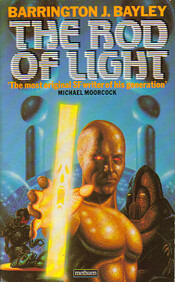
The Rod Of Light by Barrington J Bayley

Methuen, 1985, 193 p


On an Earth where robots are commonplace Jasperodus is the only such construct with consciousness -€“ a fact which he* has to hide.

Free robots are hunted by the Borgor – a hegemony of robot-hating humans. After an encounter with the custodian of the last Temple of Zoroaster on Earth and a Borgor disruption of an architectural dig with which Jasperodus is involved he flees along with another robot, Cricus.

During their travels they meet various others of their kind including Dr Viss who imitates all things human – even down to eating, drinking and evacuation. This section contained a passably amusing never ending football game between teams of black and white robots (latest score: 49,543 -€“ 51,038.)

With Cricus’€™s promptings Jasperodus is drawn into the quasi-religious orbit of Gargar, a robot who wishes to induce in all robots full consciousness, as opposed to mere awareness of self. He wishes to give them souls: the superior light as he calls it. This necessitates experimenting on human captives to extract their essences. Jasperodus views the project as dangerous and from this point on the book concentrates on his efforts to thwart Gargar; which necessitates his entering Borgor land to seek their help, with all the attendant dangers that entails.

And The Rod Of Light of the title? This is the mechanism – a tube containing coherence modulated light (which is thus conscious of itself ) – by which Gargar intends to decant full awareness into himself and other robots.

Partly due to the various discussions of the nature of consciousness the book is somewhat dry, a drawback which is reinforced by the absence of the normal invocations of sensory impressions that usually obtain with novels; all of which makes it difficult to warm to the protagonist. There are also diversions into Zoroastrian philosophy and a deal of telling rather than showing.

Apart from its brevity the book shows other signs of its age, then, but it is still worthwhile to experience Bayley’€™s take on what it means to be (not) human.

*I have used male personal pronouns throughout, even though robots cannot be said to be gendered, as this is what Bayley himself does. Perhaps this is why the constructs depicted here all seem to have masculine dispositions.

Dumbarton 2-3 Stirling Albion

League goals against predictor:- 103

The Rock, 3/10/09

Well, yesterday for the first time this season we scored first. But we lost three again. Twice in the lead, at home, we should be winning it.

I suppose in other circumstances this might have been not too bad; Stirling are the league leaders, after all. But we’re in pretty dire straits.

I’ll reserve final judgement till I’ve seen the game on Sons TV.

However, that’s only two points out of a possible fifteen at home, which is nowhere near good enough.

I’ll be at Methil on Saturday, though, masochist that I am.

More Peculiarly Named Scottish Football Teams

Further to my post on the weirdnesses of nomenclature within Scottish football my friend Neil pointed out in the comments that playing in the less well known leagues in Scotland there are also not a few non geographically specific names of football teams.

These examples are from the Highland League.

Non-geographical:-
Cove Rangers (Cove Bay, Aberdeen)
Formartine United (Pitmedden)

Vaguely appropriate:-
Deveronvale (the team is located in Banff, on the river Deveron)
Strathspey Thistle (Grantown-On-Spey)

Note, here, that the geographically informative but still strangely named Inverurie Locos, are unfortunately not called this because they (or their fans) are mad, but as a shortening of locomotive works.

However, in this league the belter of a name is undoubtedly Clachnacuddin (meaning the stone of the tub – a landmark in Inverness apparently.)

Remarkably (since I have not seen Dumbarton play north of Brechin/Montrose) I have actually attended a game at their ground, Grant Street Park. I was in Inverness one summer and caught a pre-season encounter with East Fife.

The Guardian newspaper a few years later reported the result of a friendly game between a Scottish League team and Clach (as they are known) but printed their name as Inverness Clerk McCudden.

See here for pictures of the respective home grounds of the above, and other, clubs.

Dunfermline’€™s Art Deco Heritage 2. The Glen Pavilion

This is far from High Art Deco but the frieze above the entrance is a beauty and there are some Deco flourishes inside. It is definitely of its time, though; very thirties in appearance.

Glen Pavilion, Dunfermline, South Aspect, West Side
This is the west side of the South aspect with entrance doors.

Glen Pavilion, Dunfermline, South Aspect, Centre

This is the centre of the south side. It houses/housed the cafe.

Glen Pavilion, Dunfermline, South Aspect, East

South aspect, east side.

Entrance, Glen Pavilion, Dunfermline

Close up on entrance and stairs leading up to it.

Glen Pavilion, Dunfermline. Detail Above Entrance

This is the frieze above the entrance.

Detail On East Part of Glen Pavilion, Dunfermline

A similar embellishment above the east side block.

Glen Pavilion, Dunfermline, From West

West side of Pavilion.

Glen Pavilion, Dunfermline, East Side.

East side. Fairly Deco.

Fanlight

Fanlight above window on east side.

External Stage, Glen Pavilion, Dunfermline

External stage to rear (north side.)

Bellwether by Connie Willis

Harper Perennial, 2008, 247 p

I zoomed through this even though the book could be subtitled “A Short History Of Fads And Crazes.” Each chapter begins with a description of some historical fashion or trend – hula hoops, tattoos, chain letters, coonskin caps, angel food cake, etc – which Willis must have had fun researching. (Or not.)

Our narrator, Sandra Foster, is interested in such crazes since she is trying to find out why they start as part of her work at HiTek, an interdisciplinary scientific enterprise with various projects on the go and whose administration is keen for one of these to win a prestigious Niebnitz Grant. The HiTek environment allows Willis to satirise the systems, management initiatives and staff interactions of large workplaces. This is an easy target, of course, but in the mix we also have discursions on the nature of scientific discovery as related to the roles of serendipity, chaos and distraction.

At HiTek all are lumbered with an admin assistant from Hell – a woman known as Flip, who loses papers, delivers mail to the wrong people and generally stirs things up. Through Flip’s incompetence Foster encounters the biologist, Dr O’Reilly, who wishes to study information diffusion patterns in macaques but is having trouble with the paperwork for his funding. Both he and Foster are hampered in their subsequent endeavours by the “never there when you want her but always when you don’t” Flip who is also annoyingly in the forefront of the latest “thing” whatever that might happen to be; anti-smoking initiatives, unusual accessories, pointless facial adornments etc.

To help O’Reilly, Foster arranges for a farmer friend of hers to deliver (instead of monkeys) sheep but it is not till they realise the flock’s bellwether is missing and have it delivered that the project shows signs of success.

There are opportunities in among all this comedy stuff for Willis to contrast the human urge for conformity vis-a-vis fads with herd instinct in animals.

Some order is eventually brought to proceedings when Flip gains an assistant who is surprisingly efficient and the plot’s strands are all tied together successfully.

Where in all this is the Science Fiction, you may ask? Well, it is set in a scientific research establishment and it is unlikely a mainstream story, even a mainstream comic novel, would treat the subject of crazes in the way it is done here.

While Bellwether is a light read (despite some philosophical underpinnings) it is also reasonably entertaining. Willis is able to get you turning the pages. Sometimes it’s great to get through a book in a short time.

free hit counter script