Posted in Andrew Crumey, Eric Brown, Orhan Pamuk, Other fiction, Reading Reviewed, Science Fiction at 12:00 on 31 December 2012
I don’t usually do end of year round-ups – mostly because most folk write theirs before Christmas and that offends my sensibilities. The year ends on 31st Dec, not before.
Whatever, I looked through all the fiction books I read this year and found twelve that stood out. In order of reading they were:-
PfITZ by Andrew Crumey
Zoo City by Lauren Beukes
The Master and Margarita by Mikhail Bulgakov
The Song of Achilles by Madeline Miller
The Kings of Eternity by Eric Brown
the Tiger’s Wife by Téa Obreht
And The Land Lay Still by James Robertson
The Museum of Innocence by Orhan Pamuk
Redemption in Indigo by Karen Lord
New Model Army by Adam Roberts
Galileo’s Dream by Kim Stanley Robinson
D’Alembert’s Principle by Andrew Crumey
That’s four by women and eight by men, which is a pretty high strike rate for the distaff side compared to my fiction reading as a whole, 12:45 – is that shockingly low or a reflection of publishing? Four were SF, eight not; though that ratio alters if you count the fantastical – the Lord, the Obreht, the Bulgakov, and the Crumeys which feature stories from a city made up within one of the two. Only the Robertson and the Pamuk lie wholly within the realm of the naturalistic.
I don’t propose to rank the twelve in any way.
No Comments »
Posted in Reading Reviewed, Science Fiction at 12:00 on 26 June 2012
Angry Robot, 2009, 314p.
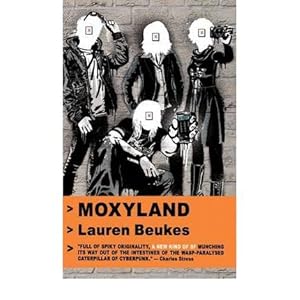
Like Beukesâs second novel Zoo City – a nominee for the BSFA Award last year – Moxyland, her first, is set in South Africa, which does add an unusual flavour; but whereas in Zoo City that seemed an important element Moxyland could really be set anywhere. It is almost a 1984 in reverse; it is not the state so much as corporations that exert power. How 21st century. How timely.
In Moxyland not only the conversations but also the wider narrative are in a stripped down demotic (eg a vid chat sesh.) This adds to immediacy and the sense of future shock but takes a little getting used to. In this regard the multiple viewpoints employed to tell the story add to the dislocatory effect.
In its totally phone-connected, over-surveilled society where semi-cyborg police dogs called Aitos make your average Alsatian look like a tame poodle and mobile phones are the conduit for everday transactions but are fitted with âdefusersâ to administer taser-like electric shocks as a public order or restraint mechanism, to be âdisconnectâ is a punishment, to be switched off an act of resistance intrepretable as terrorism. Not that there arenât terrorists aroundâ¦.
The plot circles round the insidious nature of totalitarianism, the illusion that free agency is possible, that you matter.
The Moxyland of the title is a throwaway, an online game for children, heavily moderated. Adults do access it but any player can be denounced anonymously as such an illicit user. While the game is mentioned (we are shown one of the characters playing it) it really has no part in the plot and as such is rather too obvious a metaphor for the wider society of the novel.
Moxyland is a hyped-up, near future, thriller light, seeped in creeping paranoia – but where they really are out to get you – or at least get you to conform – but the characters donât quite breathe as they might. The many viewpoints donât help with this, even when we see the same events from differing perspectives. It was Beukesâs first novel though, and still an interesting read; a good pointer to the more polished tale she gave us in Zoo City.
No Comments »
Posted in BSFA Awards, Fantasy, Reading Reviewed, Science Fiction at 13:00 on 15 January 2012
Angry Robot, 2010, 349 p
(Plus 4 pages of acknowledgements, 1 page “about the author” and 24 pages containing three short stories from winners of a competition to set a story in the milieu of Beukes’s previous novel Moxyland, an unnecessary addition to my mind.)
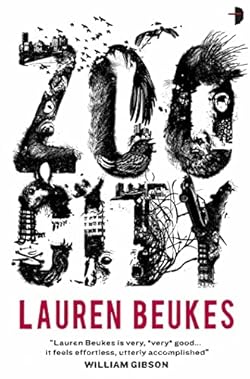
I have previously lamented the fact that the general run of fantasy novels seem to be set in a default mediævality and that no-one is trying to write fantasy in a contemporary setting. Well Zoo City is taken by some to be SF – it was on the BSFA Award shortlist for best novel last year – but to my mind fantasy would be a better description. In particular magic is an essential component of the setting and plot. Yet the novel takes place in the present day! (Albeit a present day thoroughly transmogrified.)
Zinzi December is an aposymbiont – who are derogatorily termed as animalled. Aposymbionts are individuals who, as a result of committing a serious crime, have gained an animal companion with whom they have a psychic link, in the process acquiring an attribute. This is not quite the same as in Philip Pullman’s His Dark Materials trilogy, which Beukes does refer to in the text, as in his universe the animals begin attachment at birth. Zinzi’s companion is a sloth and her attribute is sensing lost objects. She can follow psychic threads to recover things. This is her apparent job but to pay her debts she moonlights as an email scammer. She is engaged by two rather unsavoury individuals (both animalled) to find a lost pop star and is drawn into a world of intrigue, backstabbing and murder.
Narrated in an urgent present tense, apart from the interpolations of cod press articles and psychological papers fleshing out the background, the novel is of a piece with the thriller feel of much near future SF. But Beukes is good at this – very good indeed – the gritty realism makes her scenario entirely believable while you’re immersed in it. That the novel takes place in South Africa may be one factor in its appeal. African phrases and words are utilised frequently but not so as to obfuscate or confuse. The acceptance of magic is a given (as it may be in “our” South Africa.)
Where the story veers away from thriller SF into fantasy is that the transformation of the world to one where animals can become “familiars” is not given much of a rational explanation.
Zinzi and her boyfriend Benoît, whose animal is a mongoose, are well drawn, nuanced characters with full backstories which mercifully emerge from the story as it is told rather than being dumped on the reader. Others are equally believable.
This was fun, sharp and (the misuse of pre-empt aside) well written stuff.
No Comments »
Posted in BSFA, BSFA Awards, My Interzone Reviews, Reading Reviewed, Science Fiction at 22:00 on 5 March 2011
The latest BSFA mailing dropped onto my doormat today.
As well as the usual review magazine, Vector, which (unusually, since I’m normally slow at catching up with the latest thing) contains reviews of three books I’ve already read – Hannu Rajaniemi’s The Quantum Thief which I reviewed for Interzone, Ken MacLeod’s The Restoration Game and Ian McDonald’s The Dervish House – the envelope also spilled forth the A4 magazine of those short stories on the ballot for the BSFA Awards for 2010 and an A5 booklet published as a memorial to Robert Holdstock.
Apart from the book reviews this edition of Vector is a special Stephen Baxter issue.
Much of my reading for March is now more or less scheduled. As well as the short stories mentioned above, I have one more of the five novels shortlisted in the BSFA Award novel category in my to be read pile. I’ve just finished Paolo Bagicalupi’s The Windup Girl – review to come. For my thoughts on Ken MacLeod’s The Restoration Game and Ian McDonald’s The Dervish House see previous posts. Tricia Sullivan’s Lightborn awaits. Only Lauren Beukes’s Zoo City will escape my attention.
In addition Interzone has sent me Dominic Green’s Smallworld to review by the end of March. Busy, busy.
No Comments »