Wild Harbour by Ian Macpherson
Posted in Alasdair Gray, Art Deco, Iain (M) Banks, Lewis Grassic Gibbon, My Interzone Reviews, Reading Reviewed, Reviews published in Interzone, Science Fiction, Scottish Fiction at 12:00 on 26 January 2022
British Library, 2019, 220 p, including a v p Introduction by Timothy C Baker, and Wild September a vi p article by MacPherson. First published in 1936. Reviewed for Interzone 290-291, Summer 2021.
In the mid- to late twentieth century Science Fiction by Scottish authors was all but invisible. Only four names spring to mind as being much in evidence at the time; J T McIntosh (who did though manage to publish over 20 SF novels,) Angus McVicar – whose output was aimed at YA readers (such books were called juvenile at the time) – and a reprint in the early 1960s of David Lindsay’s 1920 novel A Voyage to Arcturus, which despite its impeccably Science-Fictional title was arguably more of a fantasy than SF as such. Alasdair Gray produced his monumental Lanark in 1981 but that was such a unique novel (or four novels) that it hardly represented a trend or a model practicable to aspire to. And again it leaned towards fantasy, though some of his short stories were more recognisably SF. A tendency towards fantasy and horror in Scottish fiction had always been present – taking in George MacDonald’s Lilith etc and some of Robert Louis Stevenson’s stories (notably of course The Strange Case of Dr Jekyll and Mr Hyde) – as was the tale of the supernatural or, at least, encounters with the devil, whose origins go back even further than Victorian times. Forty to fifty years ago though, of evidence of SF either in that present or from earlier decades, there was barely a trace, neither as reprints nor on library shelves. Not until Polygon’s republishing of the novels of Lewis Grassic Gibbon – some of them published originally under his real name of J Leslie Mitchell – did I become aware that there had indeed been a Scottish tradition of writing SF before the appearance of Iain (M) Banks. Ken Macleod swiftly followed him. That dam having been broken by their success in the field, there are as of now a fair few Scots active in the genre.
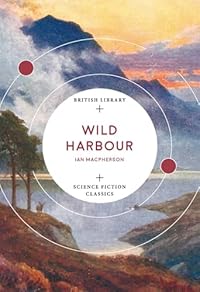
With Ian Macpherson’s Wild Harbour, the British Library, whose new editions of British Crime Classics from the 1930s have brightened up bookshop shelves with vibrant Art Deco style covers redolent of the railway posters of that decade, has pulled another long languishing work of Scottish Science Fiction out of obscurity.
The book was written in the shadow of the looming Second World War. In it, something has happened in Europe and war has been declared, exactly what and between whom is unspecified. The novel starts sometime after with protagonist Hugh and his wife Terry being woken up in the middle of the night by the sound (and sight) of gunfire in the distance, towards Inverness. It soon becomes obvious they are taking refuge in a cave – the text goes on to lay out how well they had customised it to the requirements of living in the wild – as an escape and hiding place from the outside world. Hugh had had no inclination to fight in a war, had refused to follow the instructions of his call-up papers and the pair made off into the country to fend for themselves. Despite his aversion to war Hugh nevertheless has to kill animals to survive, hunting deer, fishing, snaring the odd rabbit.
The text takes the form of diary entries by Hugh with chapter titles which usually consist only of dates (from 15 May 1944 – 11 October) except for the final one, Night. Oddly, despite numerous mentions of salting of deer for the winter, when October comes we are told they have run out of meat.
In an observation on modern humans’ capacity to get by unaided that has even more relevance these days Hugh remembers an acquaintance from before the war telling him, “Our senses are blunted. We depend on a multitude of people to make our clothes and food and tools for us. We have noses that can’t smell, ears that are deaf -”
The pair’s struggle to survive and maintain their seclusion is threatened by human intruders into their surroundings, intruders whose shadowy nature and motivations only heighten the sense of threat. In this context Wild Harbour prefigures British SF’s “cosy” catastrophes of the 1950s.
The Introduction tells us, “Place is formative in all Macpherson’s novels, but the human relationship with place is never an easy one.” That is a statement that could be made about the Scottish novel in general. Another Scottish novelistic trait displayed here is a close attention to depiction of the land.
The writing is of its time, though, and the feel very reminiscent of Gibbon’s slightly earlier SF novels Three Go Back and Gay Hunter, both of which involve sojourns in almost deserted countryside, but also of John Buchan’s John Macnab, (plus there is the merest whiff of Geoffrey Household’s Rogue Male.) Macpherson, however, has an absurd overfondness for the phrase “commenced to” and from the perspective of over 80 years after publication it is noticeable that Terry’s contribution to the pair’s survival is confined almost entirely to the domestic sphere, within the cave.
In valediction, Macpherson offers us the thought that, “We are victors over fate when we choose well, though it destroy us.”
A subsequent article by Macpherson, entitled Wild September, which was published in September 1940, rounds off this edition, and in it he reflects on the actual war which started in 1939.
As Science Fiction, though, Wild Harbour on balance falls down. Its background is too sketchy and there is no real necessity for such a story to be placed in a putative future (except for the international situation at the time it was written.) It could as easily have been a present-day narrative with a more mundane reason than dodging conscription for escaping to the hills. However, that might be argued to be an unwarranted criticism as it projects twenty-first century ideas onto an older text and a work of SF is always about the time it was written, never the future. As a historical curiosity and a reminder that SF by Scottish writers has an extended history Wild Harbour is welcome. Modern SF readers, though, might prefer more meat on its bones.
Pedant’s corner:- in the Introduction; “depictions of violence in books bears little relation to” (depictions …. bear little relationship to.) Elsewhere; a lower case letter at the start of a sentence after a question mark at the end of the previous one, ditto after an exclamation mark, digged (dug,) “‘there didn’t use to be’” (used to be,) a switch of tense from past to present then back, “where I sunk his rifle” (where I had sunk his rifle,)

