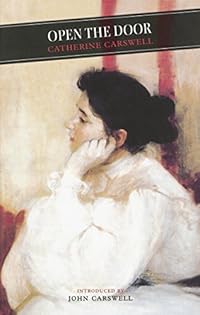
Canongate, 1996, 431 p + xii p introduction by John Carswell. Borrowed from a threatened library.
On the spine plus the front and back covers the title is written as above but the title page and other mentions have it as Open the Door! (as did a Virago reprint I saw yesterday in a charity shop.) One of the 100 best Scottish Books.
Joanna Bannerman has had a strict religious upbringing in Glasgow. Her father dies on an evangelising trip to the US, but didn’t really love anyone. “Better than his curbed enjoyment of his wife’s virginal freshness” was his love of public speaking: hence his ministry. Joanna’s mother, Juley, might have had a religious vocation – so much so that had she been a Roman Catholic she would have entered an order; “But to her the Church of Rome was the Scarlet Woman.” And there it is again; that stab of religious intolerance that blighted Scotland for so long and, partly, still does. However, Joanna’s life is a long attempt to throw off this background. Not that the novel focuses too much on religion, it’s more concerned about her wish to shake off restrictions (to open the door to living) and her relationships with the men in her life, Ben Ranken, Mario Rasponi, Lawrence Urquhart, Louis Pepper, whom she strings along, or is strung by, in one manner or another. The first she enters into an engagement with then breaks it off, the second she marries but he dies not long after they move (in his case, back) to Italy, the third is an intermittent presence, the fourth is a much older married man with whom she has a years long affair.
In Italy Mario also restricts her, not wishing her to appear in public where “she carried on her the lovely bloom which comes to some women when they are first possessed.” But she does notice a sunken door in a wall which she is told admitted a lover to the house of the Renaissance courtesan “La Porziuncula”. Mario’s death in a crash on a motorcycle of his own construction is something of a release. Her return to Glasgow to live with her mother is only relieved by her meeting with Pepper. Her mother’s friend Eve Gedge is described thus, “Barren of life herself, her deepest passion was to balk and defeat the entering of others into life.” I’m sure we’ve all met one of them.
On seeing her sister Georgie with her son Joanna thinks, “Their mother had done this for them, and her mother for her, and all with the same eager and touching confidence in the next generation. And what was to come of it? Nothing! Nothing because it was based on a lie..…… No! If the children, born and unborn were to be served fairly, one must utter clearly and fearlessly one’s own word of truth in one’s own lifetime.” She feels that, “‘evil’ (in the Christian sense of the word) quite as much as ‘good’ had made her alive ….. had made her an individual,” and her thought, “She remembered the words – ‘In sin did my mother conceive me,’ Why not – “In sin did my father beget me’?” shows that feminism is by no means a recent conception.
Mainly due to her affair with Pepper Joanna seems to drift through life. This gives the novel for most of its length the trajectory of a tragedy but Carswell seems to resile from this for the dénouement. Perhaps this was because, as her son John’s introduction reveals, a large part of the book is autobiographical in origin. Already less than overwhelmed by the novel – among other things it is overlong and too full of introspections – I must confess I was all the more disappointed by this (as usual I left the introduction till after I had read the book) as, while of course an author’s life experiences will feed into the work produced, it is better to rely on imagination to create something completely fictional in order to address deep truth. Towards the end there is a strange passage about the attractions of Fife towns. “Cupar, Falkland, Auchtermuchty, Strathmiglo! Such promising names as they had!”
I’m glad I read this and I suspect it was more of a ground-breaker when it was first published in 1920 but for me there were too many longueurs.
Pedant’s corner:- in the blurb page; annulment (annullment,) Observerand (space is missing,) Boccocio (Boccaccio,) Hugh Macdiarmid (Hugh MacDiarmid.)
In the main text:- first pain them was past (has a four character gap between pain and them,) Asias’s Millions (Asia’s Millions,) an end quote mark where none had been opened, sewed up (sewn up,) or his Easter Holiday (for,) thig (thigh,) students were too shy speak (the s and t of students are underprinted with t and o respectively and the word “to” is missing,) an opened pair of quote marks where no speech followed, pigmy (pygmy,) showed (shown, x 2,) “o return home” (to return home,) ay one (anyone,) beams o the guttering candle (the space between “o” and “the” suggests “of” was meant,) forment (foment,) missing quote marks at the beginning of a piece of dialogue at a chapter’s start, a missing full stop, to day (today,) eveybody’s (everybody’s.)