Archives » steampunk

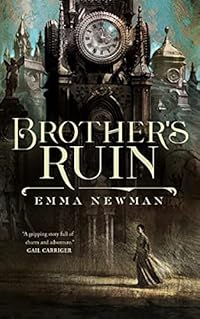
Brother’s Ruin by Emma Newman

Tor.com, 2017, 195 p.

This is a fantasy story with a steampunk vibe, as it is set in pseudo-Victorian times. Charlotte Gunn is an artist with a recent success in selling illustrations for a book. She has to keep this success secret from her family for fear of undermining her father’s breadwinning status and from her fiancé for similar reasons. Her biggest secret though is that she is an unregistered magus. (I feel that in her case it should really be spelled ‘maga’.)

The Royal Society of the Esoteric Arts is an all-powerful organisation protecting Queen and Empire through the magical powers of the magi. The earliest scene in the book sees Charlotte and brother Ben witness the tracking down of a baker’s son by the Society’s Enforcers using a magical implement known as the gauntlet which detects clandestine magical ability. Since untrained magi are said to be a danger to the Crown (and public) it is an offence to conceal such abilities. Adepts are routinely taken from their families (who are compensated for their loss on a sliding scale of talent) and trained up as servants of the Crown, though forbidden to marry. Those who conceal adepts are prosecuted. Charlotte feels her situation keenly but Ben’s faint traces of magical talent give her a possibility of masking her own from the investigators when her father calls them in to test Ben as due to a slight error on Charlotte’s part he perceives evidence of magic activity in the house.

Ben is in poor health, and it turns out their father took out a loan to allow Ben to go to University, from which his illness forced him to return. The calling in of the loan leads Charlotte to investigate the lender and thereby to knowledge of a conspiracy against the Society. Magus Thomas Hopkins, one of Ben’s testers, the most beautiful man Charlotte has ever seen, enlists her help to thwart the conspirators.

The tone of all this suggests an intended YA audience. There’s nothing to frighten the horses nor ground-breaking here but it’s entertaining enough, if a little slight.

Pedant’s corner:- span (spun,) “Archie’s hold tightened” (both before and after this no Archie is ever mentioned, but her brother is described as Archie on the book’s back cover,) “but that wouldn’t be for months and now, and Father had only days” (has one ‘and’ too many,) “she returned to Ben’s side who had lit the candle” (this phrase has its syntax severely awry,) bannister (banister,) a missing comma at end of a piece of direct speech where the sentence continued, “the most handsome man Charlotte had even seen” (‘had ever seen’, surely?) sprung (sprang,) “she hadn’t fully taken what he was doing in” (doesn’t need the second ‘in’.)
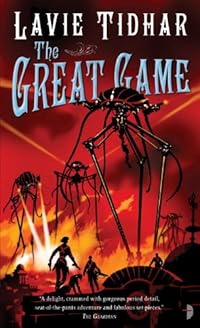
The Great Game by Lavie Tidhar

In “The Bookman Histories”, Angry Robot, 2012, 303 p. Originally published 2012.

 The Great Game cover
 The Bookman Histories cover

This is the third in Tidhar’s Bookman Histories wherein Les Lézards were roused from their Caribbean island by Vespucci’s trip to the New World and subsequently became monarchs of Great Britain. See my reviews here and here. It is again to Tidhar’s credit that familiarity with either of the two previous books is not necessary to follow events in this one as it stands alone quite easily.

It’s all a very readable romp, a steampunk/altered history mash-up but Tidhar again goes over the top with his references. One of the joys of altered history is seeing familiar names in situations for which they are not best known but he really does take it too far with this one – among the characters from literature we have Mycroft Holmes (and his brother, retired to the village of St Mary Mead [where a busybody twitches her curtains] not to mention Irene Adler) we have a hunchback named Q who lives in Notre Dame cathedral, a scientist called Moreau exiled to a Pacific island, Van Helsing, a Miss Havisham, a thiefmaster called Fagin and his pickpocket protégé Oliver Twist, a Doctor Victor Frankenstein, Harry Flashman. And at the novel’s climax tripods begin to devastate – okay it wasn’t London – Paris. Real life intruders into the story include the Mechanical Turk, Karl May, Harry Houdini, Bram Stoker, Jack London, Charles Babbage and Friedrich Alfred Krupp.. Of a Dickens’ book in three volumes an unnamed character observes, “You should never write a third volume.” Perhaps Tidhar was commenting on his own situation as in his afterword he says publisher Angry Robot asked him for two more novels after accepting The Bookman.

Hokum, but entertaining, a plot summary would be fatuous, as well as sounding mad.

A quibble. The first lizard-king was Henry VII, followed by another Henry, an Edward, and later the great Gloriana. How come then they ended up in the timeline of the novel with a lizard Queen Victoria? Our Queen Victoria was descended primarily from Hanoverians, not Tudors. Why would the naming of lizard-monarchs follow that of the real world?

Pedant’s corner:- In Tidhar’s introduction to the omnibus volume; “I wanted to tribute the wuxia tropes” (pay tribute to.) Elsewhere; “eThe last one” (typo; The,) Market Blandings’ (Market Blandings’s,) “who often said a ‘Honesty is a gun’” (said a ‘Honesty’? surely “said ‘Honesty is a gun.’”) “There are a number” (There is a number,) not to be found on the British Isles (“in the British Isles” is the more usual formulation,) “that only now he was beginning to identify” (that only now was he beginning to identify is more common syntax,) automatons (many occurrences – it’s an acceptable spelling but stick to it; there were also at least four instances of automata,) snuck (a London street boy of the time would have said sneaked,) her team were outnumbered (her team was outnumbered,) mortician (USian, we British say undertaker,) “Something to scare children by” (“to scare children with” makes more sense.) “They sat and sipped their drink,” (drinks, I think. They weren’t sharing the one cup,) then the one in Europe (than the one in Europe,) “one… being…. who had made it their life’s ambition” (a singular being; so, its life’s ambition,) Paris’ (Paris’s,) had showed up (shown up,) “undistinguished from his cover story” (indistinguishable from his cover story,) “like that persistent feel that she was being followed” (okay, the author uses feeling two lines later and maybe wanted to avoid complete repetition but it’s still awkward.) “But no one was going to act until the airship had landed, safely. Weren’t they?” (should be “Were they?”) as for the recipe (as to,) “in a rather quite threatening manner” (choose from ‘in rather a’, ‘in quite a’ or ’in a quite’ not ‘a rather quite’,) sat (sitting, or seated,) “running down a narrow mountain pass that led upwards” (???) “the sound of motors sounded” (use another verb?) Vlad epe ? (remove gap before the question mark,) “moving, now that he knew to look for it, moving in a single direction” (second “moving” not necessary,) a vast antennae (antenna,) taking no mind (taking no heed; or, paying no mind,) “Van Helsing, rode shotgun” (no comma required,) all manners of (all manner of,) had indeed deducted the observer’s arrival (deduced,) Mr Spoons’ (Mr Spoons’s,) no full stop at the end of chapter forty-six, a simulacra (a simulacrum,) “he’d brought his own people in” (he’s brought.) “There was a string of miniature model cars strung together” (use a different verb, coupled?) “paid her no mind” (“no heed” sounds more natural,) there is much work to do (lots of work,) Victoria Rex (Victoria Regina.)

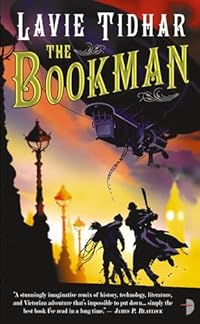
The Bookman by Lavie Tidhar

In “The Bookman Histories”, Angry Robot, 2012, 303 p. Originally published in 2010.

 The Bookman cover
 The Bookman Histories cover

This is the first of Tidhar’s “Bookman” trilogy (original book cover left) and constitutes steampunk at its flashiest. Amerigo Vespucci’s trip to the New World – here known as Vespuccia – has aroused a set of marooned extraterrestrial lizards, Les Lézards, who have since taken over the throne of Great Britain but been thrown out of France.

Our hero is Orphan (he knows no other name) and the plot is kicked off with a pair of exploding books, one of which kills Orphan’s girl-friend, Lucy, to whom he was newly engaged. He is drawn into a web of intrigue laid by the enigmatic Bookman by the implication that she is not dead – or at least he can be reunited with a version of her. The action ranges from a Victorian London to the Caribbean – where Caliban’s island of Les Lézards is located (and where he discovers his true lineage) – back again to London and finally to Oxford.

Now, one of the joys of altered history is the chance to encounter well-known names – real or otherwise – in unfamiliar settings but, really, Tidhar throws the kitchen sink at it. Apart from frequent sly allusions, we meet not only newspaper reports from Rudyard Kipling but Persons from Porlock; and Henry Irving, Beerbohm Tree, Mrs Beeton, Jules Verne – plus his ship (and submarine Nautilus, what else?) Not to mention, among others, body snatchers, the Mechanical Turk, Karl Marx, Sherlock Holmes, Mycroft and Moriarty – who is Prime Minister no less. We also encounter various simulacra, pirates (with keel-hauling, plank-walking and all) that mysterious island, an interplanetary probe (which is actually potentially more sinister) and a vast hidden library. Breathless isn’t the word.

Had I not already read the second book in the series, the much better Camera Obscura, I would perhaps not have bothered doing so on this evidence. But I have the third in this volume, The Great Game, still to go, so I will get round to it.

Pedant’s corner:- In Tidhar’s introduction to the three collected books “it was the obvious end for the arc began by Orphan’s choice” (begun.)
Otherwise:- to go see her (to go to see her – or just “to see her”,) “no sooner had Maskelyne departed that the door chimed again” (than the door chimed,) overlaying the grief (overlying,) “his face were strangely peaceful” (was,) indistin-guishable not at a line break, “bound with Les Lézard” (Les Lézards,) whiskey (whisky,) “he left his drink on the table besides Jack’s glass” (beside,) automatons (automata,) “at the bottom off…” (of, surely?) Gibbons’ (Gibbons’s,) go see it (go to see it,) flamingos (flamingoes?) “from his momentary surprised” (surprise,) “us humans need to stick together” (“us need to”? That would be we humans,) outside of (outside; no “of” necessary, though “outside” appeared two more times in that same five line paragraph,) sail-ships (sailing ships,) the Nautilus’ deck (Nautilus’s, a page later Moses’s was fine but one more page on we had Aramis’,) “like the unmixed paint on an artist’s palate” (did the artist mix the paint by mouth, then? Palette that would be,) “not sure what he had let himself into” (not sure what he had got himself into; or, not sure what he had let himself in for,) the King of England (yes, but also the Empire,) the fungi (it was singular; so fungus,) “he felt exulted” (exultant, I think,) “you knew were you were with them” (where you were,) “Orphan was glad for that” (glad of that,) a group of men… were standing (a group was standing.)

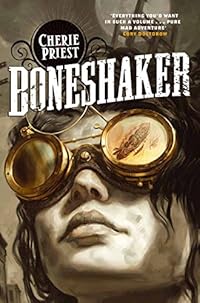
Boneshaker by Cherie Priest

Tor, 2012, 416 p.

 Boneshaker cover

In 1863 Dr Leviticus Blue’s Incredible Bone-Shaking Drill Engine undermined Seattle and let loose an invisible gas dubbed the Blight, whose effects are (slowly) deadly. As a result Seattle’s old city centre has had a two hundred feet high wall built around it. Sixteen years later (and incidentally with the War between the States still raging back east – which makes this an altered history: then again I suppose all steampunk is) his son, Zeke, convinced his father is innocent, sets off into the forbidden area to prove it. His mother, daughter of hero Maynard Wilkes, goes after him, scrounging a ride on an airship. (Ah, the glories of steampunk.) Inside the city various adventures befall them both before they (separately) encounter the mysterious technical wizard who effectively rules the walled city, Dr Minnericht.

Despite the Blight being described as invisible Priest has the air inside Seattle’s walls as brownish-yellow in colour. Some of the people who succumb to the Blight come back to animation as zombie-like things called rotters which roam the streets of the walled city in search of live human flesh which apparently they like to feed on. (I gather this is typical of zombies more generally.) The logic of this escapes me. Granted, Priest’s rotters will need an energy source, but why would this need to be meat and how, given that their own flesh has decayed, would they digest it anyway?

The scenes inside the walled city ought to conjure up a feeling of claustrophobia but somehow, despite constant references to the discomfort of facemasks and the necessity to replace their filters, doesn’t. The chapters featuring Zeke understandably read like a YA novel as does the pace of events. At times the atmosphere is reminiscent of Phillip Pulman’s His Dark Materials but these characters are much less memorable. I’m glad I’ve sampled Priest’s work but I don’t think I’ll seek out more.

Pedant’s corner:- amuck (I prefer amok,) if you had mask (a mask,) from whence (whence already means from where,) off of, sprung for sprang, but least they weren’t bleeding (at least.) stunk for stank (x 2,) shined for shone (x 2,) who was seemed on the verge, wadded it into ball, lay of the land.

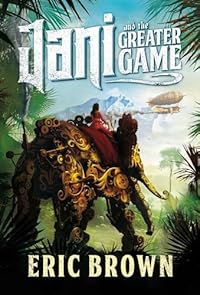
Jani and the Greater Game by Eric Brown

Solaris, 2014, 384 p.

This book is dedicated to Jack and Katrina Stephen. Those of you who know me will realise how pleased that makes me.

 Jani and the Greater Game cover

Janisha Chatterjee, daughter of an Indian Father and (deceased) English mother, is on her way back from England – where she is training in medicine – to her father’s deathbed when the airship in which she is travelling is brought down by Russian artillery fire. For this is India in 1925, and the Great Game is still afoot. Even though the Great War of our era does not seem to have happened the Russia contesting with the British Empire is Communist. China is also involved though only in the background here.

The Greater Game of the title concerns the prisoner on the airship, a creature known as a Morn, who saves Jani from the Russians mopping up after the attack. He gives her a coin and her entanglement in the plot follows. Other viewpoint characters are Durga Das, a priest of Kali, who is searching out the coin for reasons of his own, and Lieutenant Alfie Littlebody of the British Army, tasked by his superiors to spy upon Jani.

Echoes of Brown’s Bengal Station trilogy are never far away, this is India after all. But this is also steampunk. The wonder material Annapurnite not only powers superfast trains and airships but also weapons to keep the Russians and Chinese at bay; in a James Bond film-like touch Littlebody is given a photon blade and a Visual Camouflage Amplifier, both of which come in handy. There is also a mind-reading device. Oh and a Mechanical Man and even bigger mechanical elephant. And this is before we get beyond steampunk to the parallel worlds and the threat to humanity from the Khell.

The pleasure of this is in the journey. The author piles on the jeopardy and the intrigue and handles the politics of the British presence in India well – from both sides. Despite the steampunk trappings this comes out as a very Eric Brown type of story, if not quite reaching the heights of his The Kings of Eternity then less pulpy then the Bengal Station series. If Littlebody is a bit of a twit and Jani’s childhood companion Anand perhaps too cloying, Jani is engaging enough. And there is ample scope for a sequel (which I understand is in the works.) I’ll look forward to it.

Satellite 4

So. That was Eastercon.

The Convention hotel (the Crowne Plaza, formerly the Moat House) was hard by the River Clyde. It’s the tall building. The footbridge is called the Bell’s Bridge.

The bridge is in its swung open position here.

I met quite a lot of old acquaintances and made some new ones. Plus I bought two books.

The two panels I was on went well and I didn’t make a fool of myself (I think.) The one on steampunk had an unexpected extra panellist.

Yes, a steam driven dalek!

Well, a dalek made to look steam driven by fellow panellist Peter Harrow, a fount of information on all things steampunk. It was actually radio-controlled. The chocolate rabbit was a nice touch.

free hit counter script