Archives » Short Stories

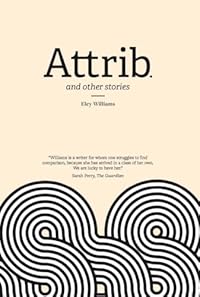
Attrib. and other stories by Eley Williams

Influx Press, 2017, 171 p.

The first impression on reading this collection of short stories is that Williams has an abiding interest in words – see two of the story titles, not to mention aphaeresis* and apocope. That is all to the good, authors ought to have such an interest. So here we find Williams using stark and spectrum as verbs, giving us an unusual meaning for the word ‘boggling’ to do with the movements of rat’s eyes and also the pleasing coinage Timbucktootle. However she doesn’t appear to know that ‘staunch’ is not the spelling used to indicate suppression of blood flow.
*Aphæresis?

The stories themselves are short, none is more than fourteen pages long and the typeface is quite large, but all say what they need to.

The Alphabet (or Love Letters or Writing Love Letters, Before I Forget How To Use Them or These Miserable Loops Look So Much Better On Paper Than in Practice) is narrated by someone who has lost the plot – and her glasses – describing the disintegration of her world after a diagnosis of aphasia. It has a list of the letters of the alphabet and the shapes they each describe.
Swatch features a boy worried about the multi-coloured flecks in his eyes – even after his father has shown him the definition of the Scottish word glaiks (flashes) on his phone screen.
In Attrib. a Foley artist commissioned to provide the sound effects for the audio of an exhibition of huge reproductions of Michael Angelo’s works is annoyed by the sounds she has been asked to add to the description of The Creation of Eve.
Smote (or When I Find I Cannot Kiss You In Front Of A Print By Bridget Riley) is a stream of consciousness of someone in a gallery standing before that artist’s Movement in Squares – “a painting the surface of which itches with vertigo” – being too self-conscious to kiss their companion. The story is shot through with black-and-white images.
Bs are the thoughts of a half-awake woman in her partner’s bed as she is disturbed by the noises of a bird outside and a bee trapped the night before in a used Nutella jar.
Alight at the Next has non-standard typography. It presents the thoughts of someone about to get off a tube train beside their lover, who is standing very close, but a man obstructs them by trying to get on. Our narrator places a finger on the man’s forehead to stop him.
Concision invokes words from Finnish, Bantu and Rapa Nui to describe the feelings of the recipient of a telephone call staring at the dots on the receiver while being unable to respond to the caller, whom we assume is a lover or spouse.
In And Back Again the answer to an easy question about love brings to the responder’s mind a lyric from the musical Oliver! and conjures the fantasy of a trip to Timbuktu to prove the extent of devotion.
Fears and Confessions of an Ortolan Chef is exactly what its title says, an enumeration of the thoughts of a chef who – highly illegally – “drowns ortolan in Armagnac” before cooking them to be eaten by diners who cover their heads in blankets while doing so.
Synaesthete, Would Like to Meet is narrated by someone who had the Yellow Pages dropped on her head aged 8 and ever since suffered from synæsthesia. Until, that is, a reply on a dating service and the subsequent date provides relief. Her therapist is not so happy about that.
Bulk sees a group of people with varied purposes converge on the carcase of a whale washed up on a beach early one morning.
In Platform, someone recalls the moment their friend left them forever via a poster made from a blown-up photograph taken at the time. The photograph reveals details of the scene unnoticed at the time.
Rosette Manufacture: A Catalogue and Spotter’s Guide is exactly what its title says. An employee of a rosette manufacture describing its wares.
Scutiform follows the thoughts of a museum attendant on their habitual route taken on their daily break past three particular statues.
Mischief features the consciousness of someone in charge of rats which have been trained to detect landmines.
Spines describes a small incident involving a hedgehog in a swimming pool on a family holiday to the south of France.
Spins opens with Johnson’s Dictionary definition of the word ‘spider’ complete with the letter ‘s’ rendered in that old style I can only reproduce as f. The fpider concerned is noticed by someone lying on a bed for hours trying to think of what could have been after a lover had slammed the door on their way out following an argument.

Pedant’s corner:- “millions of potentials colours” (potential colours,) Blu-Tack (x 2, Blu-Tak,) “the chew of a maw” (maws do not chew; they are stomachs,) “the Tube doors, doors shut” (the repetition is not needed but may be an attempt at ) “lickerish plastic” (lickerish means dainty, tempting or lecherous. Williams has her spellings confused; she had previously described the plastic as having the colour of liquorice,) “the hotel might provided” (might provide,) Areopagitca (Areopagitica,) “pulled the door close behind me” (closed?) “the woman with the urn ask the group” (asked.) Synaesthete (I’d prefer Synæsthete,) “you are not here any more to remind me that the plural should be croci” (the character has this wrong, the plural of crocus in English is indeed crocuses. In any case, crocus is derived from Greek [krokos] not Latin: the Greek plural would be krokodes.) “‘The bakers was shut’” (baker’s,) staunch (stanch,) “is an ‘an insect’” (has ‘an’ once too many.) In the acknowledgements; skillfully (skilfully.)

Hawkfall by George Mackay Brown

Triad Granada, 1983, 253 p.

This a collection of stories all set in the author’s homelands of Orkney. Each is a beautifully rendered snapshot of life in those Northern islands

The title story, Hawkfall, is told in five parts, illustrating the history of Orkney in stages, showing aspects of life – and death – there from ancient times through those of the Vikings, the brutal, rapacious Earl of Birsay, the Napoleonic Wars and the early twentieth century.

The Fires of Christmas relates two historical violent confrontations in the Great Hall of Ophrir, which occurred eighty nine years apart.

The subtitle of Tithonus, Fragments from the diary of a Laird, outlines its structure. The Laird in question had inherited the Hall (a big house) on Torsay from his great uncle, along with two hundred pounds a year. By the end of the story, among many other changes, that sum is exiguous and the Hall is falling apart. It is his interactions with the locals that have most attention, particularly those with the schoolmaster, the Minister, the local gossip and Thora Garth, the only child of Armingert and Maurice, arriving after twenty-one years of marriage, who later causes a scandal by jilting her fiancé and shacking up with a ferryman. The tale has a neat twist at the end.

The Fight at Greenay occurred after the men of Harray, on their way to the sea to harvest seaweed to use as manure, had been insulted by the men of Birsay, reluctant to let strangers across their lands, in the halfway inn where the Harraymen had stopped for refreshment.

The Cinquefoil is told in five parts (Unpopular Fisherman, The Minister and the Girl, A Friday of Rain, Seed, Dust, Star and Writings,) in which are laid out the various relationships over time of the narrators of each and their acquaintances/friends/lovers. As a result it encapsulates the closeness and complexity of island life as a microcosm of life in general.

The Burning Harp is described as a story for the eightieth birthday of Neil Gunn. In 1135 a cottage is set on fire by intruders, who decide to let out, in turn, children and servants, a priest and finally a poet whose singing they heard and recognise as that of Niall of Dunbeath. (His songs mirror those of Gunn’s stories.)

To anyone familiar with Scottish folklore Sealskin’s title tells the reader more or less all. It is impeccably told though. A man finds a sealskin on the beach and stores it in his barn. A day or so later he encounters a naked woman swimming by the shore. She has no knowledge of the language and he takes her in; to the great ire of his mother. Marriage and children ensue. Years later he discovers the skin again and the inevitable happens. An afterword mentions the tale was inspired by a famed Orkney musician, Magnus Olafson.

The Girl spends an afternoon lazing on the sea-bank almost in earshot of a group of men gossiping while repairing fishing nets and such, till she hears the approaching sound of a motor-bike.

In The Drowned Rose, William Reynolds, the new schoolmaster on Quoylay, is visited on his first night on the island by a young woman in a red dress, looking for a man named John. Reynolds befriends the local minister, Donald Barr, who refuses to elaborate on the woman’s history. She had been the previous schoolmistress, Sarah McKillop, well remembered by her pupils, and it is only a spiteful neighbour called Henrickson who reveals her tragic end, taking great relish in describing what he regards as the scandalous goings on which preceded it and why the islanders had resolved on a male as her successor.

The Tarn and the Rosary shows episodes in the life of Colm, a writer, from his grandfather’s death, through his first trip to the small Loch Tumishun in the centre of the island of Norday, the burgeoning of his confidence and aspirations when his first composition is praised by his teacher, his overhearing a group of men bemoaning the superstitions of Catholics, to his sojourn in Edinburgh trying to write but also attending mass. It’s an almost haunting evocation of Northern Island life.

The Interrogator has set out from Leith to Norday to question the locals about the death of Vera Paulson, found in the sea a month after she disappeared. None of them is very forthcoming. When the girl herself appears – as a ghost – her story does not quite match with any of theirs.

Pedant’s corner:- “and the shore of Firth” (of the Firth,) “a gonner” (goner,) bissom (usually spelled besom,) “it muirburn (its muirburn.) Suppper (supper.)

Republics of the Mind by James Robertson

Black and White, 2012, 280 p.

The first eleven stories in this collection were originally published in The Ragged Man’s Complaint (which I reviewed here) so I started this book on page 155. Throughout the other eleven tale shere Robertson’s writing is crisp and economical, capturing the situations and his characters in all the words required and no more. This is good stuff.

Opportunities is the tale of one evening in the lives of a pair of couples when various interpersonal dynamics swirl under the surface.
In The Shelf a couple has moved into a new smaller home and need to remove a shelf to place a flat-pack wardrobe against the wall. It turns out to be a bigger job than expected. In the meantime, strange things are going on in the street outside.
One day The Dictionary stops working. The words slide about all over the place, disordered, making it impossible to find the one our first person narrator is looking for. Even the new ones in the bookshop have the same defect.
The Dayshift worked by a border guard takes on even more meaninglessness when the regime changes and people can move to and fro across the border without being checked.
Don’t Start Me Talkin’ (I’ll Tell Everything I Know) features an old lady entering a specialist record shop wanting to buy music with some feeling. The guy there introduces her to the blues. But he’s not the owner and doesn’t work there.
Willie Masson’s Miracle. Willie is a housebound man, barely able to move and whose wife is in a Home. His neighbour, Mrs Bovie, drops in from time to time and a nurse comes in to see to his needs. One day he manages to get his arm to jerk.
Mr Meiklejohn has just left the dentist when The Rock Cake Incident occurs as he relaxes in a café afterwards. As a result he will need to visit the dentist again.
Old Mortality is set in an old, apparently deserted, graveyard where a man has taken his pregnant partner to see the headstone of his ancestors. They come across an old man whose purpose in life seems to be chipping the names from the monuments.
Christie lives alone in a house overlooking the field wherein lay MacTaggart’s Shed and imagines he sees ghosts there – but they may only be sheep. There is some kind of civil war still going on and not long ago an atrocity took place in the shed which was then burnt down.
The Future According to Luke is a repeat of the past. Luke Stands Alone is a native American living on a reservation. He, Dean and Johnny’s only entertainment is to cross the reservation’s border to Jubal’s Buffalo Saloon, situated between Bombing Range Road and the highway to Custer. Luke’s predictions all come true but that’s because they’ve already happened.
A man goes to visit an old building where everything is at Sixes and Sevens. His grandfather, a casualty of the Great War, once lived there, but it is now being sold off. The two caretakers treat him as if he’s a patient.

Pedant’s corner:- not a single thing to note. Remarkable.

The Rental Heart and other fairy tales by Kirsty Logan

Salt, 2014, 153 p.

Within this collection are twenty stories of varying length but none could be said to outstay their welcome. Logan’s inspiration here is clearly derived from fairy tales; but only one of them, the last, begins with “Once upon a time.” Apart from the usual admonitory accounts, some are celebratory and some have tints of magic realism. In general Logan’s writing here is more satisfactory and tighter than in her two novels The Gracekeepers and The Gloaming. Then again it ought to be. In a short story no word should be wasted.

The Rental Heart revolves around the renting of clockwork hearts easily returned to the rental place when they get broken, as hearts always do.
Underskirts has no fewer than ten narrators in its eleven pages each adding their own perspective to the tale of the local Lady who has a taste for young girls from the neighbourhood.
In A Skulk of Saints Lauren works as a medic “peering at the insides of people” in a hospital under the gaze of representations of saints, while in her personal life negotiating her relationship with heavily pregnant partner Hope.
The Last 3,600 Seconds is the stream of consciousness of a woman whose memories crowd in on her during the last ever 3,600 seconds of the universe.
The Broken West is the story of two unusually close brothers searching for their father through a series of dead-beat US towns.
Bibliophagy features a man struggling to conceal from his family his addiction to eating words, words which, like an alcoholic with booze, he hides in various locations.
Coin-Operated Boys are clockwork male escorts hired out from a shop called A Man for All Seasons. Set in Paris, the story has a fin-de-siècle feel.
Girl #18 is the latest to offer sympathy after our narrator’s sister has died.
In Una and Coll are not Friends the pair are put in a room separate from their peers to sit a maths test. Una is distracted by Coll’s tail. She herself has antlers.
In a water-drowned world The Gracekeeper tends to her charges, the Graces of the title, kept in cages. Logan expanded this tale into her first novel.
Sleeping Beauty is a taut tale of sexual assault; told backwards.
In Witch a young girl goes into the woods to spook her friend and meets BabaYaga.
Barely over a page long, All the Better to Eat You With is a kind of Little Red Riding Hood in reverse, a warning to look out for yourself.
The Man from the Circus rather literalises the metaphor of taking a leap into the unknown. A girl allows herself to be picked up by a man from the circus, a trapeze artist.
Feeding is set in the Australian outback where a couple have set up home, soon after they have lost an expected child. The woman spends her time obsessively in the garden but in the drought conditions nothing will grow.
Momma Grows a Diamond is written as one fragment each from the life of a girl at age ten, eleven, twelve and thirteen, as she becomes a woman. Her mother, who provides services for wounded soldiers, tries to turn her into a diamond so that she will not be broken by men.
Less than a page long, The Light Eater has a titular character who begins to consume light bulbs as a means to guide a lost lover back home.
Matryoshka riffs on Cinderella. Its narrator is the prince’s sister, who loves her servant Matryoshka, the one who sees to her whims day and night and sews her slippers for the great ball.
In Origami a woman whose partner works on the rigs assuages her loneliness by making a man out of folded paper.
Tiger Palace explicitly plays with the conventions of story telling as a (female) traveller works her way through the “impenetrable” forest to the Empress’s palace and finds there no crocodiles disguised as stepping stones for crossing the moat and no tigers inside the palace. Both characters refuse their allotted roles.

Pedant’s corner:- The title page reads “The Rental Heart and other stories” (The book cover has ‘The Rental Heart and other fairy tales’.) More than a few Usian usages. “Before the Resting party arrive” (arrives,) fit (fitted.)

There Are No Ghosts in the Soviet Union by Reginald Hill

Harper, 2009, 363 p.

This is not my normal reading fare but the good lady knew I’d recently read Jane Austen’s Emma and wondered how I’d react to this author’s take on the characters from that book. Hill is the creator of the detective duo Dalziel and Pascoe about whom he has written twenty-four books. This is a collection of his shorter works and was originally published in 1987. That “Featuring Dalziel and Pascoe” is emblazoned on the front cover is a bit of a cheek. Only one of the six stories here does so and that tangentially at best. Also irritating is that all the story titles are rendered entirely in lower case.

there are no ghosts in the soviet union is a detective tale featuring Inspector Lev Chislenko. (I admit that my first thought with that name was of the famous Igor who played for Dynamo. Being questioned whether he is related to that footballer becomes a running joke through the piece.) Chislenko has been called in to resolve the case of a man being pushed into a lift and immediately falling through the floor, which remains as solid as it always was and there is no trace of him at the foot of the shaft. The obvious explanation is that the man was a ghost. Consequently ideological considerations beset Chislenko. “There are no ghosts in the Soviet Union,” is apparently the set-up line to a Soviet joke but also an assertion that he must find a way to uphold. The story is obviously intended as a satire on the Soviet Union – or at least on how Hill imagined the Soviet Union to be – but is equally applicable to any authoritarian regime anywhere. The resolution depends on Chislenko’s delving into the lift’s origins. It was manufactured in Chemnitz (renamed Karl-Marx Stadt after World War 2) in the 1920s and installed in a now demolished building elsewhere before being re-used in a money skimming scam. His investigations also bring him into dangerous contact with powerful figures in Soviet circles.

In bring back the cat! Joe Sixsmith is a balding West Indian (with a balding jacket) who has just begun his career as a private detective. He is called in by a Mrs Ellison to find her cat which has been missing for three weeks. In the course of his investigations all over one afternoon, he uncovers various family secrets and solves another case entirely, thus making his name. There’s an overt consciousness of racism to some of the exchanges. (Sixsmith was later to become the protagonist of another series of Hill’s books.)

the bull ring is set in the British military training camp at Étaples during the Great War. One of the instructors is excessively harsh on recruit Harry. For Harry’s own good he would say; but Harry doesn’t see it that way.

Dalziel and Pascoe do not appear as such in auteur theory. It is the actors who are playing them on a film set who do. The one playing Pascoe has long been on the way down as an actor and is now saddled with a tyro leading lady who is the director’s new wife. It also includes the bearded writer of the novel which is being filmed (we are, I suppose, meant to assume Hill is writing about himself,) who is becoming more and more annoyed at changes to the script. The story starts with a warning injunction, Nothing in this story is what it seems. You should remember that. The metafictional games in it do not lift it above the category ‘diverting’.

poor emma takes up twenty or so years after Jane Austen left off her tale of Emma Woodhouse and her misguided attempts at match-making. The intervening years have not been kind, though Mr Woodhouse continues, like a creaky gate, to, as we Scots say, “hing lang”. Mr Weston has died and his widow, in a sentence carved from early nineteenth century attitudes and would-be Austen impersonation “eventually declined into religion, to such an extent that it came as no surprise, though an incalculable shock to most decent people, when she embraced the doctrines of Rome.” Mr Knightley has neglected his affairs, indulging himself as a bon vivant and taken up a seat in Parliament (which allows him various other indulgences.) His brother John has lost the confidence of his legal clients and now runs Donwell Abbey on George’s behalf. The conflict comes from the wishes of both to protect that inheritance. All the main characters from Emma reappear, save Jane Fairfax, except for mention of her death. Her husband Mr Frank Churchill is involved in the dénouement. The Mr Knightley shown here is far removed from the one Austen portrayed and so too is Emma herself as she indulges in an action which that younger self would surely never have contemplated but which does have the effect of giving the tale a condign ending.

crowded hour concerns the invasion into her home by two armed men of a woman whose husband is somewhat obscurely rich and has absences from home. It begins, “At twelve noon there were three people in that house. By the time the clock struck one, two of them would be dead and the life of the third would have changed for ever.” The story lies in the journey that beginning implies.

Pedant’s corner:- “led him out in to” (into,) humourously (humorously,) “‘How’s you mother?’” (your,) smidgeon (smidgin; or, smidgen,) a missing comma before a piece of direct speech, “his legal practise” (the noun is practice, as used later, I note,) “a codicillary convenant” (covenant, surely?) “had showed” (this may have been an attempt at Austenism; ‘had shown’.)

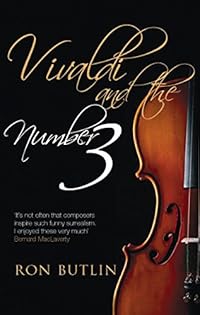
Vivaldi and the Number 3 by Ron Butlin

Illustrated by John Sibbald. Serpent’s Tail, 2004, 210 p, including 14 p Notes about the composers and philosophers. Plus vi p of Acknowledgements and lists of contents and illustrations.

This is a collection of 26 short stories, none of which is longer then twelve pages and even that includes one of the illustrations. Their tenses shift from past to present and back again. Trappings of the present day irrupt into the past or vice versa, modern day phenomena like pizza deliveries precede composing by candlelight with quill pens. Within the context, though, it all makes a surreal heightened sense. Unlike a lot of Scottish fiction the writing is laced with humour. Seventeen of the stories are listed under the heading “The lives,” four under, “The letters,” three are “The thoughts,” and, finally, one is “The last word.”

All of it is delightful stuff.

The lives:-
Sheep being scarce in Venice would-be priest Antonio Vivaldi – familiar with McDonald’s, TV and spaghetti westerns – tries to sleep by counting cardinals jumping off the papal balcony, one of whom brings to him both God and music via the number 3. 500 concerti later Vivaldi tries to go on holiday but is caught up in a war. A later incarnation learns to walk on water by channelling his anger at a Stravinsky comment that he always writes the same concerto.
In the glass box of her marriage Alma Mahler writes down the notes of the string quartet she is composing only for them to disappear from the paper as soon as she’s finished. Bach, who in his youth had aspired to be a professional footballer until a retired player suggested his true vocation, struggles to respond to the deluge of parcels he receives following the publication of an article titled ‘If Only Bach Had a computer’ in the previous month’s Digital Digest. Beethoven anticipates the benefits due to flow to him from a pyramid scheme while striding the mean streets of Edinburgh till he comes to “the Zone-of-Everything-and-Nothingness” that is South Bridge, which always defeats him. A Hamburg perpetually mist-bound and stuck at 4.45 in the afternoon due to the composer’s previous failures waits for Brahms to complete his first symphony: a fantastic interlude brings resolution. Antonin Dvořák finds his knowledge of Science Fiction and fairy-tale useful while stalking the Bohemian wilds for musical inspiration. Fresh from an invitation onto The Jerry Springer Show, Haydn hears a voice telling him just how many trios he still has to compose. Enthused by a cable channel film noir series, Mozart decides on a new career as a private investigator in a story which also features him bicycling through the air like the ident scene at the start of a Dreamworks© film. Schubert glides through the streets of 1828 Vienna on his skateboard before being given a magic business card. In a manifestation which may be an indication of Schumann’s state of mind Liepzig morphs its architecture daily: then he takes the underground to Herr Wieck’s flat where he meets Clara. An aged Sibelius is in his last hours invited to join the circus by three clowns. Richard Strauss and Amenhotep IV share their dreams of finessing Nazi racial policies and building pyramids respectively. Tchaikovsky laments the madness of his marriage as he considers a last ballet. Georg Telemann writes his best-selling concertos amongst the mountain of mail order goods he has requested (or not) while his agent adopts his identity. One of the Mighty Handful of Russian composers who form a five-a-side football team conceives the idea of introducing passing to their game; their results get worse.

The letters:-
Composer Q makes a compact with the Mr Sinclair who turns up at his door: thereafter the music flows and Q’s domestic life becomes blissful. There is a catch of course. Composer X’s career creating music for films has given him all the trappings of success – girls, glamour and real estate. He flees the Calvinistic persecutions of messages in the Edinburgh sky to Tenerife only to find the stars have rearranged themselves into a message in Spanish. Composer Y labours under the affliction of coming between “the celebrated X and the no less renowned Z” (perhaps due to his fondness for the double-bass) till one day the world pauses and the sky becomes a Tiepolo-style ceiling of angels; suddenly he is in constant demand. Composer Z gazes from his window into the vista beyond the end of the alphabet through the large plate-glass window installed for just that purpose. In one universe the glass becomes insubstantial and he is pulled through. (This story contains a comparison between Scottish midges and the dead in Hades – both are summoned by human blood.)

The thoughts:-
A drunken David Hume cosies up to a woman “who had come so close to freezing to death on the pavement outside the Caledonian Hotel she had never warmed up again” before he is, in a phrase which could summarise this whole book, “stranded in this makeshift world put together from the sweepings of history.” Nietzsche tries to break free from monetisation at the hands of his University by keeping chickens. Seneca settles on Edinburgh’s Southside as the perfect place to prove Stoicism firmly as number one of all the world’s philosophies. Socrates attends the opening of Greece’s first supermarket, ‘Zealous Hellas’.

The last word:-
On her death bed Nadia Boulanger is visited by other female composers – her sister Lili, Hildegard von Bingen, Elisabeth-Claude Jacquet de la Guerre, Fanny Mendelssohn and Clara Schumann.

Pedant’s corner:- “Time interval later” and “within seconds” count; substantial – a few had gone by before I noticed the prevalence but they soon become extremely intrusive. Otherwise; crochets (crotchets,) manoeuvering (manoeuvring,) vermillions (vermilions,) “a set of garden furniture say with no memory of ever having ordered them” (ordered it,) extendible” (extendable,) the text implies the great Real Madrid team of 1959 had invented the passing game (they didn’t. It was the mighty Sons of the Rock in the 1880s/90s who did that,) “Puskas, Di Stefano, Santa Maria … [were] … to secure the European Cup for Real Madrid three years in a row” (Real won that cup five years in a row, the first five of its existence; those three players may not have been present for all five, of course.) “A few second’s later” (seconds,) “duvetted by straw and feathers” (should the spelling be ‘duveted’?) An unindented paragraph, Socrates’ (Socrates’s.)

The Assassination of Margaret Thatcher by Hilary Mantel

Full title: The Assassination of Margaret Thatcher and Other Stories Fourth Estate, 2014, 252 p.

The ten stories this collection contains are all exquisitely written, in them every word counts. Mantel shows her mastery of the short story is as good as her novel writing.

Sorry to Disturb is narrated by an Englishwoman living in Jeddah as her husband works there. One day a man in import-export rings her doorbell, lost, asking to use her telephone. This is Ijaz, who returns next day to thank her and thereafter calls regularly – nothing untoward but he seems as lonely as she is. Her loneliness is not eased by her female neighbours. Her state of mind is illustrated by the fact that Ijaz may well be a figment of her imagination, though that is not the only possible interpretation of the text.

In Comma a woman remembers her childhood friendship with a girl her mother considered unsuitable and the pair’s clandestine visits to the grounds of the local big house.

The Long QT describes the moment a man starts to dally with another woman and the unexpected effect this has on his wife.

Winter Break describes the taxi journey a woman and her resolutely anti-children husband take from their destination airport to their holiday hotel. What it is about, though, is not seeing what’s in front of you.

Harley Street is narrated by a female receptionist in one of the premises there, where the doctors are all nicknamed for their specialty – and who to a man (and woman) all hold their patients in contempt. It is more concerned however with the relationships between the ancillary staff.

Offences Against the Person tells of the interactions between the daughter of a conveyancing solicitor, taken on as a junior clerk in his office one summer when she is seventeen, with his main secretary, Nicolette, soon to be the cause of her parents’ marriage break-up.

How Shall I Know You? examines the trials and tribulations of a jobbing writer asked to speak to reading clubs – the seedy hotels, the usual questions, the tiresome small talk afterwards – but is more concerned with the employee at the hotel where she stays on one visit, a young woman with a facial deformity but a kindly disposition despite her treatment at the hands of the regulars.

The Heart Fails Without Warning anatomises the relationships within a family where the elder daughter is anorexic.

In Terminus a woman sees her dead father in the carriage of a train on a parallel track. At the terminus she tries to find him, fails, yet nevertheless gains a sort of contentment.

The Assassination of Margaret Thatcher: August 6th 1983 is an account of the intrusion by a gunman intent on killing the PM into the home of a woman expecting a plumber to call on the day Margaret Thatcher is to leave the private hospital the back of which the woman’s bedroom overlooks. He seems to be an IRA man. In reply to something the woman says he replies, “‘You’re right. They’re Englishmen,’ he said, sadly. ‘They can’t remember bugger all.’”

Note to the sensitive: at one point a character says, “White nigger, isn’t it?”

Pedant’s corner:- “whether the house is quiet as I left it” (‘quite as I left it’ would be more usual but quiet does make sense in context,) sunk (sank,) typically there are missing commas before pieces of direct speech which begin within a sentence, “computer disks” (I stll rebel at spelling ‘disc’ with a ‘k’,) “against front window of bookshop” (against the front window,) “a row of … were marked out” (a row was marked out,) sat (sitting.)

Latest Interzone – Issue 289

 Hold Up the Sky cover
 Interzone 289 cover

It’s that time again. The latest issue of Interzone – 289 of that ilk – landed on my doormat this morning.

This one contains my review of Cixin Liu’s collection of short stories Hold Up the Sky which I mentioned receiving here.

Once again the cover is a wraparound. See below:-

Interzone 289 full cover</center

All the Rage by A L Kennedy

Jonathan Cape, 2014, 217 p.

 All the Rage cover

This is Kennedy’s fifth collection of short stories. Most of the contents tend to utilise short sentences. Sometimes verbless. Often with a second person style of narration.

Late in Life recounts the emotions of a younger woman and her older lover the day they have a lawyer’s meeting to determine the details his will. Of a student ahead of them in the queue at the Building Society where they are about to pay off her mortgage she thinks, “Young men are easily confused. They lack resources.”
In Baby Blue a woman wanders into a sex shop to get away from the cold outside and escape thoughts of the medical procedure she has undergone. As she finds herself dogged by the assistant’s efforts to help she ponders her attitude to love. “The real experience of love is of having unreasonably lost all shelter.” Chocolate-flavoured condoms inspire the thought that her experience of oral sex is not “intended to be primarily culinary,” and that “Use of such a device might imply “your penis is inadequate and ought at least to taste of chocolate to compensate, so here you go and roll on one of these.”
Because it’s a Wednesday. Wednesday is the day for the viewpoint character’s domestic help to do the cleaning. Because it’s a Wednesday they are doing what they always do – at her instigation. Because it’s a Wednesday he’s shagging Carmen. (Not a spoiler, it’s the story’s first sentence.)
In the run-up to Christmas a man drops into a church in These Small Pieces. The service prompts thoughts of the unreliability of God and the occurences which have hurt him.
The Practice of Mercy sees a woman take a stroll from her hotel room through an unfamiliar town and return to find her lover, with whom she’d had a disagreement, has come to join her.
The person who has been Knocked is a young boy recovering in hospital from being trampled by a horse, who imagines he can see into the future in a small way.
In All the Rage a married man in his forties who serially tries it on with women finds his match in a twenty-two year-old woman.
In Takes You Home a man who “never intended to grow up and have to be adult” but “did. Naturally,” (although on several occasions had heard it said he’d simply got taller and faked the rest,) ponders the times he had in the flat he’s selling.
The Effects of Good Government on the City features a woman on a visit to Blackpool questioning her relationships.
In Run Catch Run a boy caught up in the throes of his parents’ divorce plays with the dog his father has bought him and his mother says they can’t afford.
The viewpoint character of A Thing Unheard-of is seemingly afraid of contact and runs through the many ways in which they could deliver a message, in person, on the phone, in a letter, electronically.
This Man is the story of a lunchtime first date which is an awkward encounter – until suddenly it’s not.

Pedant’s corner:- potassium added to water is described as wasping “back and forth on the liquid’s surface in a tiny blur of lilac flames , too angry to sink.” (The reason potassium doesn’t sink is because it’s less dense than water. It would float even without the flames,) wisht (several times but once as whisht. This Scottish word is usually spelled wheesht.)

Where the Apple Ripens by Jessie Kesson

B&W, 2000, 192 p, including xii p Introduction by Isobel Murray.

 Where the Apple Ripens  cover

Kesson drew on her early life for inspiration in much of her fiction, which in the Introduction we are told was always composed in the form of a play for radio first. Several of the stories here reflect rural life, some are set in institutions, all are unmistakably Scottish. Most are adorned with page centred quotations from poems or hymns or songs. The characters within them are vibrant and individual; depicted economically, vividly and with compassion. This is good stuff.

The longest tale here is the first, Where the Apple Ripens, a novella describing two days in the life of Isabel Emslie, set to take up a place in service the next week in the big town. Her last schoolday is marred by its coincidence with the funeral of Helen Mavor, who had let herself waste away after the birth of her illegitimate baby. The novella is perfused with the contrast between Calvinist rectitude and human impulse, her mother’s admonishments, the prurient comments Isabel overhears as she passes the local bus stop, the thinly veiled innuendos and warnings, her poetic sensibility – illustrated by copious quotations from poems and hymns – her youthful exuberance and desire to dance (a heavy signal, this,) the bravado she expresses when she says she’s ‘not feared’ of Alex Ewan, the local man with a reputation, a bravado which is later revealed to have face value.
In Stormy Weather such inclemency is the only reason Matron can muster not to allow the older orphanage girls out to go to the Band of Hope meetings on Friday nights. The story, however, is more about the compromises, the quids pro quo, the petty revenges the inmates have with and over one another.
Set in 1923, ‘Once in Royal…’ relates the excitement around the scramble for tickets for the Chief Constable’s Christmas dinner for poor children as felt by Sarah, who does not consider herself the ‘poor, wee soul’ of others’ opinion.
The Gowk, Jockie Riddrie, is the local simpleton, forever hanging around the school fence, drooling, or exposing himself. After allowing herself to be enticed up into the woods young Liz Aitken becomes pregnant but steadfastly refuses to reveal to her family who the father is. For the village folk and especially the gowk’s stepmother, Kate, Jockie becomes the obvious candidate to blame. But his father Hugh knows better.
Having caught the biggest tiddler in a jam jar The Bridge is where the local boys span, hand over hand on its girders, across the river below.
Until Such Times is the interval during which narrator ‘you’ are staying with your Grandmother and the Invalid Aunt away from your Aunt Ailsa (who, we infer, is not your aunt) whom the Invalid Aunt says is man-mad and that ‘you’ would clip her wings. Invalid Aunt never has a good word to say about anyone but ‘you’ are devoted to ‘Aunt’ Ailsa, who is actually trying to do her best for ‘you’.
Another story narrated by an unnamed ‘you’, Good Friday is not the religious festival but the tale of a sufferer from acute neurasthenia longing for the day she’ll be released from mental hospital.
As its title suggests Life Model is about a sitter for Art Students, one who could hold a pose better than most, and of her secret for being able to do so.
In an intimation of mortality Road of no Return sees a woman come back to her childhood village overlooking Loch Ness and finds it deserted. But her memories remain.
Set in an old people’s home and with a kind of time-slipping narrative Dear Edith … describes the letters Mrs Cresswell composes to her dead friend Edith, interspersing these with the conversations of the staff.
This Wasted Day is the last of a tinker, arraigned at the Pearly Gates by those who looked down on her during her life with all their misconceptions and prejudices. The Big Man turns out to have different ideas from them but there is still a twist to come.

Pedant’s corner:- In the Introduction; Alex Ewen (the book’s text has Ewan,) “Never had Isabel ran so fast” (the passage was in standard English not vernacular Scots, so, ‘run’,) paeon, (paean,) an opening quotation mark that was unclosed, sang (again, the passage was in standard English, so, sung,) ommission (omission,) court yard (courtyard,) a missing comma before a piece of direct speech, another missing after one, momentoes (the correct ‘mementoes’ appeared two lines later,) descendents (descendants,) vocal chords (cords.)

free hit counter script