Posted in China Miéville, Fantasy, Reading Reviewed, Science Fiction at 12:00 on 26 April 2020
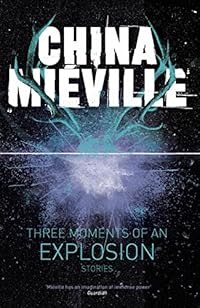
Macmillan, 2015, 443 p.
This is Miéville’s latest collection of short stories. Like with all such collections the interest varies but the stories are all readable.
The very short Three Moments of an Explosion consists of three fragments all describing explosions, some of which are used for advertisemants.
In Polynia Cold Masses – icebergs – appear in the sky over London (while coral sprouts on the walls of buildings in Brussels.) There’s a Wellsian feel to it but the end result is still distinctly Miévillean.
The Condition of New Death is that all dead bodies orient with their feet pointing directly towards to any observer (including cameras) at all times. Apparently this is linked to a feature of early First-Person Shooters.
The Dowager of Bees is narrated by a card player, inducted one day into the phenomenon of Hidden Suits, where a card (such as the Dowager of Bees) will manifest during a game – and in the rule books – only for both to disappear again once the game ends, with forfeits to be fulfilled. The reader can guess which card the climax will involve but there is still a resolution beyond its appearance.
Narrated by an immigrant shopkeeper on the island where it is set In the Slopes is the story both of two rival archæological digs in the shadow of a volcano which are uncovering evidence of extraterrestrials living alongside humans and of a new resin for preserving the remains.
The Crawl is the text of a trailer for a zombie film.
Watching God is set on a peninsula cut off from its mainland by forest and a ravine. Ships appear from time to time but never come ashore, instead wrecking themselves just out to sea as if forming words with their arrangements.
The title of The 9th Technique refers to a form of torture but the story itself is about the uncanny manifestations attached to the techniques – the cloth from the first waterboarding now having unusual properties – and their value as objects of desire. The 9th technique is confinement with an insect. Viewpoint character Koning acquires it.
The Rope is the World is a history of the girdling of Earth – a thin-spoked wheel – by space elevators and their subsequent inhabitation and decay. Money for old ….
Containing some fables particular to its setting The Buzzard’s Egg is the address of an enslaved member of a defeated city, whose job it is to look after the captured gods of conquered peoples, to one of those gods.
Säcken is a tale of supernatural apparitions arising from an ancient punishment for parricide, the poena cullei, where the criminal was sewn into a bag with a dog, a cockerel, a viper and an ape and then thrown into water.
Syllabus is what it says, an outline for an academic course on the detritus left by time-travellers, the ramifications of the arrival of alien insects for global poilitics and the implications of the privatisation of sickness in the UK.
In Dreaded Outcome a therapist has an unusual proactive role in the restoration of her patients to well-being using what she calls traumatic vector therapy. She also has her own therapist.
After the Festival is a gruesome tale about a new entertainment – the public slaughter of animals and the subsequent wearing of their heads by people chosen from the crowd.
The Dusty Hat starts as a tale of political leftist factionalism but soon veers off into weirdness and a discussion of geological deep time (which gives Miéville the opportunity to make a neat pun with the description glass struggle. He also for some reason finds it necessary to italicise the word stramash.)
Escapee is another text of a film trailer, this time for a horror film.
The Bastard Prompt’s narrator’s girlfriend was a jobbing actor not getting many parts so took a post as a Standardised Patient – helping trainee doctors to recognise diseases from their ‘symptoms’. She’s very good at it but then starts to describe symptoms for diseases that don’t exist – yet.
Rules is a short list of, em, rules for as yet unknown games and also a reflection on imitating an aeroplane with spread arms and making that “now-familiar” noise.
The estate of Estate is a housing one which Dan Loch’s family had to leave one day. When he comes back there is an outbreak of incidents involving drugged deer staggering around with their antlers on fire.
Keep relates the evolution of a new epidemic where, if the afflicted remain too long immobile, trenches appear in a circle around them, and the scientific efforts to discover its origins and possible cure.
A Second Slice Manifesto is that of an art movement which constructs and displays slices through prior paintings; slices which reveal more of the originals than was apparent to the naked eye.
A father and daughter enter a militarily embargoed area around Covehithe. They have come to watch the emergence of a damaged and sunken oil-rig from the sea. It has come to drill down and deposit eggs from which new rigs will grow.
The Junket is narrated by a hard-boiled media journalist describing the controversy around a film (made by Jews) which displays every anti-Semitic trope in the book, and its aftermath.
Four Final Orpheuses gives us four different versions of why Orpheus might have made that turn and fateful look towards Eurydice.
A picture frame turns put to have unusual properties in The Rabbet.
Listen the Birds is another storyboard for a film trailer.
A Mount is a meditation on the ubiquity of porcelain animals and why some seemingly out-of-place people, not their owners, might be fascinated by them.
A sense of understated eeriness hangs over The Design in which a medical student between the wars discovers designs etched into the bones of the cadaver he is dissecting. He concludes that God is a scrimshander.
Pedant’s corner: vortexes (strictly the plural of vortex is vortices,) “a plethora of ceremonies are emerging” (a plethora is singular; a plethora …. is emerging,) indices (yes, it’s an acceptable plural but when it is for book contents it’s usually spelled indexes,) sodium pentothol, (sodium pentothal,) Cheevers’ wife (Cheevers’s,) crevace-spiders (crevice-spiders?) “There were a series of percussions” (there was a series.) “Most of the town were already gathered” (most of the town was gathered.) “None of them leave.” (None of them leaves,) snuck (sneaked.) Pangea (Pangaea, or, even better, Pangæa.) “A line of police block the road” (A line … blocks the road,) “wracks his brain” (racks,) “or that it be not shown” (or that it not be shown,) “Baron von Richtofen” (if it’s that baron, it’s Richthofen,) fit (fitted,) trash (rubbish.)
No Comments »
Posted in Lewis Grassic Gibbon, Reading Reviewed, Scottish Fiction at 20:00 on 15 April 2020
Penguin, 1945, 123 p.

The back cover says this book was mostly edited by Theodora Hendry but she was killed in the London Blitz. The criteria for selection in the volume was Scottish stories with a Scottish setting or else it “would almost certainly have assumed an international aspect.”
The first, The Coasts of Normandy by George Blake, is the story of a tragedy which befell the narrator’s childhood friend and its effect on the child’s mother as reflected through the prism of a chance encounter with a stranger many years later on the coast of Normandy. It takes a slightly circuitous route to its revelation (which the reader intuits well before the narrative gets there) but this allows for such thoughts as, “The simple feel as warmly as the clever and the learned.” Another of its observations is a reminder that, for some soldiers at least, the Great War was not only a horrific trial and ordeal but also an opportunity to remake their lives in its aftermath.
In A Sunday Visit by Colm Brogan two boys are dragged along by their mother to the Mortons’ house, where the family has just suffered a bereavement. Amid all the whispering, the boys are left to their own devices.
A Hike to Balerno by Ronald McDonald Douglas sees two boys on the titular hike, the escapades they get up to, the banter between them, “daft, just plain daft.”
Clay by Lewis Grassic Gibbon is the story of Robert Galt, a man from a chancy background who takes a farm and devotes all his time to it, to the neglect of his wife and his daughter’s prospects.
Beattock for Moffat by R B Cunninghame Graham tells of the last journey of a dying Scot on the train up from London with his cockney wife and his brother come to take him home to die. The author observes of the accomodations married couples make with each other that “usually … good points, seen through prejudice of race, religion, and surroundings, appear … defects,” and refers to the Cockney wife’s reticence being explained by, “the English theory, that unpleasant things should not be mentioned, and that, by this means, they can be kept at bay.” The prose evidences that Scottish authors’ eye for landscape.
In The Sea by Neil M Gunn a twelve-year-old overcomes his fears, staggering through the night down to the harbour to witness the perilous return of his father’s and brother’s boats during a great storm. Here it is seascape (or land-meets-sea-scape) which the descriptive powers bring to life.
J F Hendry’s Chrysalis is a fragment of the childhood of a boy who wants to be good but fears he is bad because he sometimes is too enthusiastic in his activities.
Clock-a-Doodle-Doo by Willa Muir is set in a room full of clocks (all wag-at-the-wa’) which can speak to each other, having theological discussions over whether the Son or Moon is the primum mobile and aspiring to Pure Horological Thought.
Neil Munro’s The Lost Pibroch could be characterised as a Scottish version of the Pied Piper of Hamelin. Two pipers come to Half-Town. After a night of musical vying with the blind piper there he finally plays them the titular pibroch he “got from a man in Moideart.” It has “something of the heart’s longing and the curious chances of life” and sets up a wanderlust in those who hear it.
In The Matinee by Fred Urquhart a fifteen-year-old newly graduated into long trousers reverts to shorts to get into the cinema more cheaply, dragging his younger brother along for corroboration. Engrossed in a film where a factory owner exploiting the workers is presented as virtuous he fails to acknowledge his brother’s increasing personal discomfiture.
Eric Linklater’s Kind Kitty is an old woman who likes a drink, then dies through lack of it a few days after throwing a party for Hogmanay. She inveigles her way into heaven but finds the company there uncongenial, and the beer far too poor.
Pedant’s corner:- a missing full stop, “brigh” (is missing a final ‘t’,) missing commas before pieces of direct speech.
No Comments »
Posted in James Robertson, Reading Reviewed, Scottish Fiction, Scottish Literature at 12:00 on 25 February 2017
B&W Publishing, 1993, 158 p.
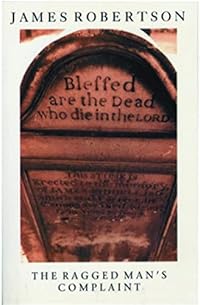
This is Robertson’s second collection of short stories, after Close.
Giraffe is told from the viewpoint of a worker in a Safari Park and gives a picture of all the dodgy practices that go on there.
In Plagues a man who works in a bookshop sees frogs everywhere and is worried that’s only the beginning.
Screen Lives displays a woman and a man developing their relationship by acting out lines from the film Notorious.
In The Jonah one of two men hitch-hiking in a backwater reflects on how to turn his life around.
The Claw is the withered appendage of the HIV positive narrator’s grandfather, “caught between hope and history,” in a care home. A monitor of his future.
Squibs contains four vignettes a couple of which approach the style of Iain Crichton Smith’s Munro stories.
Bastards relates an encounter in a pub, where a man mistakes another for “the cunt my wife ran off wi’.”
Facing It is a vignette even shorter than those in Squibs wherein a man sees his innards cascade into the toilet bowl and realises he can no longer ignore his medical problem.
The unarguably apocalyptic The End is Nigh, told in almost biblical cadences, has a Science-Fictional feel as a prophet extends his sermon while wandering the countryside.
There are reflections on writing, relative privilege and Scotland in The Mountain, where for a few months in the winter following his grandfather’s death a man occupies the ancestral croft.
What Love Is examines the distance between married couple Dan and Joan, between men’s lives and women’s. “Dan isn’t frightened of other lives. He imagines them all the time. The only life he is frightened of is his own.”
Portugal 5, Scotland 0 (the comma is Robertson’s – or his publisher’s.) During the game concerned two men in a pub take to discussing Hugh MacDiarmid, poetry and Scotland’s cultural reawakening, turning back only after the game is finished, since the football has begun not to matter so much.
In Tilt Alan’s friend Mike tells him the only question in the world worth asking is, “What’s it about?” (Note the absence of “all”.) Alan’s increasingly shiftless feeling comes to a head one day after an encounter with a recalcitrant pinball machine and Mike’s sister, Mona.
Surprise, Surprise. A man accompanies three girls to a party and while there finds his evening is described in a book he picks from a shelf.
In the absence of the real thing, the Tories having won a General Election again (the book’s publication date suggests the 1992 one) Robert occasionally retreats into The Republic of the Mind. “I just think what a waste of time it is, having to wait to be a normal country, having to waste all this energy identifying ourselves. So I bugger off anyway. To the Scottish Republic of the mind.” On an epiphany he thinks, “You had to come upon it, or it came upon you.” He also realises, “how nobody ever assumed their neighbour was a Tory in a public house in Scotland,” and “We’re a nation of philosophers … at the end of the day. A nation of fucking philosophers.” That expletive is a brilliant piece of emphasis by Robertson. It demonstrates both the glory and the despair of the thought it qualifies.
Someone, perhaps homeless, perhaps not, is Pretending to Sleep. For all the ones who cannot do it for themselves. It is a strange existence. “Funny how in the cells they come to check if you’re not dead. Out here, out in the open, nobody checks” but, “Just by lying there, pretending to sleep, you get under their skin …. deep into them.” It’s a horror story. But not for the pretender.
Pedant’s corner:- staunch (stanch,)
No Comments »