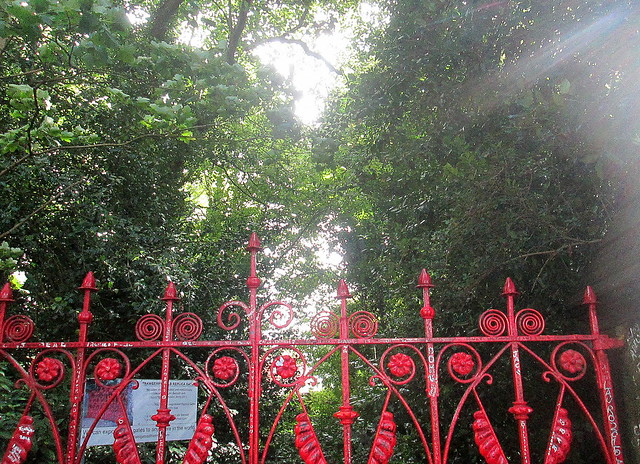
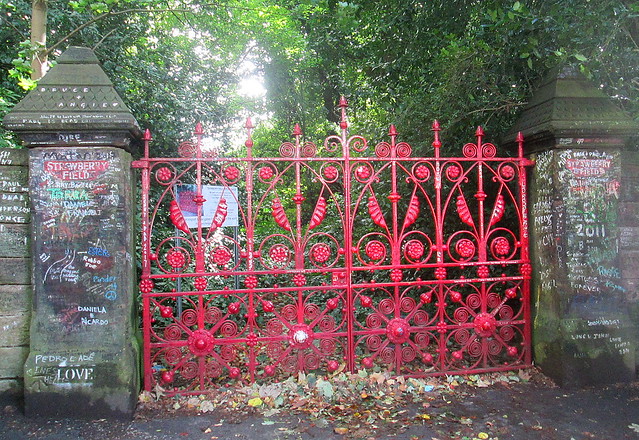
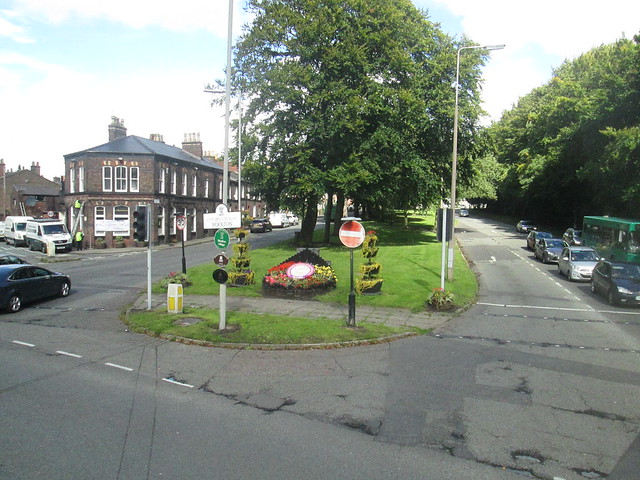
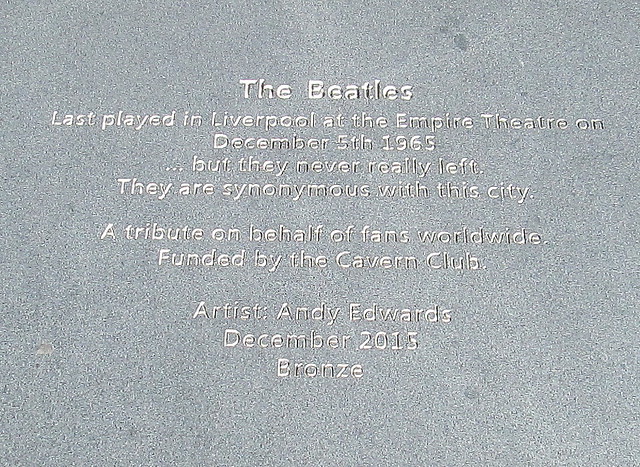
…. because I’ve been to Strawberry Fields. (Or more correctly it seems Strawberry Field.):-
Behind these gates was apparently a children’s home and though Wikipedia has John Lennon climbing into the place to play with them the guide on the bus tour our friends had booked said he would play truant from his own school hoping to catch a glimpse of girls beyond the trees behind the gates.
The present gates are replicas:-
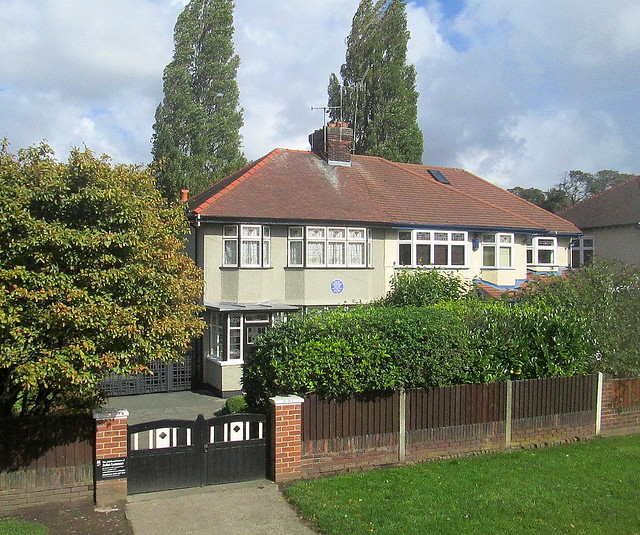
When Lennon’s parents’ marriage fell apart he was taken in by his Aunt Mimi.
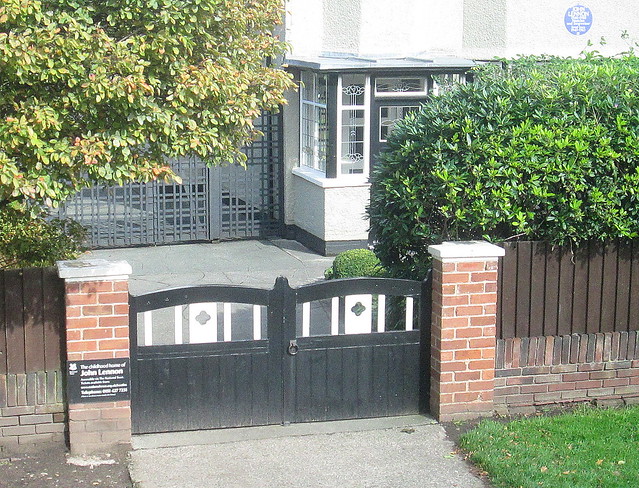
This is her house. They had a reasonably comfortable existence here you’d think:-
Note the notice on the gate post and the blue plaque on the house:-
In Liverpool reminders of the Beatles are never far away. Sgt Pepper flower bed:-
What do you say about the man who brought us The Beatles? The man largely responsible for the soundscapes of those ground breaking recordings of the mid-sixties starting with Revolver and continuing through Sgt Pepper (please note; not Sgt Pepper’s; not in Britain, anyway) and Magical Mystery Tour. By the time of The White Album a lot of that sonic experimentation had gone (Revolution No 9 excepted) though the album for the Yellow Submarine film stemmed from the same seam.
Martin was a crucial part of the Beatles’ sound, his facility with arrangements and classical accompaniment giving them a dimension – or dimensions – which on their own or with a different producer might never have arisen. I remember seeing him on a TV documentary saying he had come up with and played the piano interlude on a well-known song which I think was Lovely Rita.
The Beatles: Lovely Rita
I also seem to recall that the “final” version of Strawberry Fields Forever was a mix of two takes which had originally been played in different keys. One was slowed down slightly the other speeded up so that they would synch, which gave it that weird effect that it still has all these years later.
The Beatles: Strawberry Fields Forever
Then there was all that stuff with looping and playing tapes backward. Think of the swirling accordion/funfair sound in Being for the Benefit of Mr Kite.
The Beatles: Being for the Benefit of Mr Kite
Immense.
George Henry Martin: 3/1/1926 – 8/3/2016. So it goes.
Way back in the day there was a book published – I forget its name and author – that had photographs of rock/pop stars of the 1960s (or early 70s) appearing above a line from a song lyric that was vaguely appropriate. This was an attempt of sorts to sum up the late 1960s zeitgeist.
The image/line combination that most struck me – it has remained in my mind all those years – was the last one in the book.
The line was, “Hope I die before I get old,” from, of course, The Who’s My Generation.
And the star whose image it illustrated?
Frank Sinatra.
That sentiment is doubly ironic now that The Rolling Stones have celebrated 50 years in “the business” and The Who themselves continue to tour. Not their fault, of course, that the line was used in such a way. It did reflect though the disregard – even contempt – in which “old men’s music” was held by the generation that grew up in the long shadow of World War 2; a generation whose 1960s efforts were partly an attempt to shuffle off the stifling shackles of that conflict and define a future for themselves. In Britain too there was the nagging sense of loss that the disappearance of the Empire caused – something no-one, quite rightly, gives a stuff about now.*
I could never understand Sinatra’s appeal myself. I still can’t. The man could not hold a note. He always, always, sang flat and could ruin a song’s rhythm and meaning by eccentric phrasing.
One of the purveyors of old men’s music, indeed he was said to be Sinatra’s favourite other singer, was Matt Monro. Matt Monro was an English singer who made his name in the 1950s and 60s before moving to the US, from where, because his wife was homesick he later came back.
Monro was one of the first singers to perform a Bond movie theme in From Russia With Love and also had a biggish hit with another song from a film, Born Free. A couple of years ago I happened to catch a TV documentary about his life and came to a deeper appreciation of his gifts as a singer. His voice has a crystal clarity with great diction and he can carry a note, or a phrase, seemingly effortlessly. The good lady heard him on the radio recently and wondered when he actually took a breath!
His image in the 60s though was deeply uncool; early LPs merely had his photo and a list of some songs as a cover design, a practice pop and rock abandoned even before the Beatles’ Sgt Pepper. I would not normally have listened to him at the time. There was one song he performed, however, which really stuck with me.
It was released in 1970 and more or less topped and tailed that attitude of the 1960s I described earlier, that intuition of something different (which, naturally enough, never came to pass; it never does.)
The song was called We’re Gonna Change The World and considering who sang it was quite a counter-intuitive choice to be put out as a single.
Judge for yourselves.
Matt Monro: Were Gonna Change The World
*Edited to add:- well the Brexit vote showed how wrong that perception was.