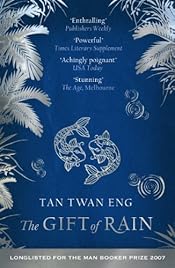
The Gift of Rain by Tan Twan Eng
Posted in Other fiction, Reading Reviewed at 12:00 on 3 February 2024
Myrmidon, 2007, 508 p, including 2 p maps of Penang and Malaya.
 Fifty years after the end of the Second World War a Japanese woman, Michiko Murakami, comes to visit Philip Hutton at his home in Penang, bringing with her the katana which his sensei, Hayato Endo, a follower of Morihei Ueshiba, had had made for him. Endo is buried on a small island just off Hutton’s land and Michiko was once his inamorata before circumstances meant they could not be together. Over a few nights Hutton relates the course of his relationship with Endo-san, being taught the martial art of aikijujutsu, and his unwitting participation in the preparations for the Japanese invasion of Malaya in 1941.
Philip was the last child of Noel Hutton, owner of a large trading company. Philip’s mother was his father’s second wife, a Chinese woman, but who died. He grew up a misfit, not quite belonging to the British set but yet not Chinese either. He is doubly estranged since his mother’s family did not approve of the match and he has had little contact with them. In a weak moment his father does let slip that the pair had been very much in love.
The rest of his family, father and half-siblings William, Edward and Isabel, are away on a visit to England in 1941 when Endo-san, to whom the small island had been let, befriends Philip and decides to induct him in the way of aikijujutsu. This not only involves combat training – even though the emphasis is on defence and never killing – but requires that they trust each other fully. This trust will, of course, be stretched to breaking point by world events.
In the course of their friendship Endo-san asks Philip to take him on trips round the island. It is here the reader gets somewhat ahead of the narrative with the suspicion that Endo-san is a Japanese spy. He does admit that he is serving the Japanese government because his father had implicitly criticised the Emperor and his service is to prevent harm coming to his father.
The invasion when it comes still seems sudden and shocking, the British response shamefully inadequate. In its aftermath Philip is plunged into a quandary: loyalty to Endo-san or to his family (and its prospects) and to his friend who has joined the British resistance movement, Force 136. His acquiescence to the Japanese authorities, his acceptance of a translating job with them is seen as a betrayal by some but in other respects allows him to soften some of its harshness; albeit only in a small way.
There is much more nuance to this novel than the above might imply. Philip makes a relationship with his Chinese grandfather, colludes with the resistance while maintaining cooperation with the Japanese authorities but in the end, despite Endo-san’s shielding, is unable to safeguard everything that he would wish. The brutality of some Japanese actions contrasts vividly with the non-violent aspects of Endo-san’s instruction.
One thing that struck me as odd was that there seemed to be a large Japanese presence in pre-war Penang; not just Endo-san but also consular officials – and soldiers, who still seemed to roam free unarrested after the invasion of Malaya had begun but before the invading forces had reached Penang itself. Eng is more likely to be on top of these details than I am though.
This is a very good novel indeed, aspects of the writing are exemplary, the characters agreeably shaded (apart from the out and out cruelty of some Japanese soldiers; which is of course a matter of historical fact) the examination of aikijujutsu philosophy illuminating, but it fell from the absolute highest drawer of literature when it tumbled over into the spying aspect. Moreover, it was unreasonable for Philip to have provided (even if unwittingly) just about all the information about the Malayan peninsula which informed the tactical elements of the Japanese invasion. Yet without that Eng’s story would have been different.
Its core is the relationship between Philip and Endo-san. But is this a meeting of minds or an example of a kind of grooming? Endo-san is older and (apparently) wiser but there is a strand – which is not overly stressed – where the relationship between Philip and Endo-san apparently goes much deeper than mere friendship as their fates have seemingly been entwined through various incarnations in history.
Pedant’s corner:- “was roused out his stupor” (out of his stupor,) “and and” (only one ‘and’ was needed,) “gave smile” (gave a smile,) whiskey (whisky?) a missing end quote mark, “Kon make a move” (made a move,) “round the bend was hidden spot” (was a hidden spot.)