Archives » Scottish Fiction

Something Like Breathing by Angela Readman

And Other Stories, 2019, 245 p.

This novel of adolescent friendship is told in alternating sections from two viewpoints, one written in retrospect by Lorrie who at the book’s start has just moved from further south to live on a Scottish island that is her family’s ancestral home, and the other as extracts from the diary of Sylvie Tyler, who lives in the next door property.

Sylvie’s mother is strict with her and reluctant for her to make friends – with anyone. It is only gradually, through an incident which Lorri witnesses and the episodes Sylvie confides to her diary, that we learn exactly why.

Both strands are well written and capture their character’s viewpoints all but perfectly. That ‘all but’ is one major caveat, which I shall come to.

The island is certainly Scottish. (Lorrie’s grandfather – Grumps – owns the distillery there.) Her observation that, “‘they’re alright’ was the most glowing review I’d heard anyone on the island give anyone. Compliments were spat out as reluctantly as saying the weather looked fine; acknowledging anything was okay was tempting fate,” could not encapsulate the national character of the 1950s (and later) any better.

Sylvie and Lorrie have their ups and downs but at one point as they grow older and boys begin to come into the equation Lorrie is swayed towards the more outgoing and freer spirited Blair Munro as a potential friend. Sylvie is the one who is more sensible, though. Adults and their ways are suitably mysterious.

Two things did not ring true for me. Despite no apparent connection with the place beyond her mother’s correspondence with someone living there and through them introducing tupperware to the island, Sylvie employs US terms such as ‘ain’t’ and ‘assignment’ (for homework) but above all, ‘kinda’. Sylvie also mentions a hound dog – not a traditional Scottish or even British usage – yet has the word fearty in the same sentence. These also bleed into Lorrie’s narrative – raise instead of rise, snuck for sneaked. Jarring. Then we had Lorrie’s mother and a workman, albeit one she’d known in school (and with whom it is obvious both still hold a torch for each other,) sit out one afternoon and sip beers. A woman drinking beer in public on a Scottish island in the 1950s? No. Just no. It wouldn’t have happened.

Though in both strands the writing is resolutely realistic Sylvie’s secret lends an element of the fantastical to the tale. Without it, though, the overall story would have to have been utterly different as it is the catalyst for the novel’s dénouement and Sylvie’s later fabled status on the island.

Pedant’s corner:- On the back cover blurb “two complimentary styles” (complementary.) Otherwise; span (spun,) fit (fitted,) Grumps’ (x 2, Grumps’s,) “agreeing to play for same stakes next week” (for the same stakes,) “tartar sauce” (tartare sauce,) “Sylvie begged Seth to let stay”(let us stay?) “We lay on our bellies” (the rest of the passage is in present tense; so, “We lie on our bellies.) “And none of them are good” (none of them is good,) “for as long possible” (as long as possible,) assignment (homework,) raise (rise,) snuck (x 2, sneaked,) “though they’d never spoke till that day” (spoken,) “take her hand and be lead” (and be led,) bannisters (banisters,) a missing comma before a piece of direct speech, imbedded (embedded,) lay (laid,) “be furious at me for me for getting her boyfriend in trouble” (no need for that ‘for me’,) “sour plums” (in Scotland these sweets were always ‘soor plooms’.) “Neither of us move” (moves.)

The Young Team by Graeme Armstrong

Picador, 2020, 391 p.

No question of cultural appropriation could possibly be held against Graeme Armstrong in this his debut novel. The Young Team is firmly rooted in his background and experience of growing up in a working class housing estate in Airdrie in the West of Scotland. The book is written in language steeped in those surroundings. Raw, visceral and confident, it is profoundly demotic and could be called dialect (some may even dub it slang) but is certainly far from the genteel prose of the usual literary novel. Yet it is also undeniably expressive, and capable of handling all the nuances of a novel.

The first person narrative follows Alan Williams (aka Azzy Boy,) member of the Young Team Posse gang, from the brash bravado of barely teenage youth, “Obviously, A’ve hud ma hole,” looking up to the previous generation of gang members, through young adulthood, the creeping influence of hard drug dealers and a more reflective sense of time passing, of putting away childish things, “Yi huv tae break free fae aw these demons n live tae the fullest yi kin.”

There are several accounts of violent confrontations with the Young Team’s rivals the Toi (‘defendin yir scheme’.) Here we might comment on the narcissism of small differences; one West of Scotland housing estate is much like another, to construct rivalries on the basis of which side of a road you live is an exercise in nit-picking, but nevertheless the thing that gives the Young Team – Wee Broonie, Kenzie, Azzy, Danny, Addison, Finnegan and Wee Toffey – a focus for living, for anticipating Friday night. Girls, while part of the extended gang, are peripheral to its main activities but still strange creatures, with their own motivations. Azzy holds a lingering torch for Monica Watson, a bright girl flickeringly receptive to Azzy’s charms but always destined to leave the estate and not willing to settle for less. (Late on in the book when the prospect of a new life beckons Wee Broonie tells Azzy, ‘Yi pure luv her so yi dae.’)

Music is a more constant companion. Many passages refer to the sound track to Azzy’s life.

In one brilliant descriptive passage Azzy expresses what it’s like to be at a rave. “Everycunt is yir pal in here. Maybe it’s cos we’re aw fuckin oot oor nuts on pills that we’re feelin the love. The ecktoplasmic euphorian fellowship wae our common man. Harmony wae aw humanity. A love the strangers next tae me n they love me back. Peace n love tae aw mankind. Utopian society,” where there is, “No a sea, but a fuckin ocean ae people aw bobbin n weaving, knitted together by sound, ecstasy and passion fur the tunes. … The crowd is a single entity, a cult, n our deity behind the decks,” and the effects of the drugs and adrenaline on cognition, “A’m pushin against the current, goin against the grain, The rain in Spain falls mainly on the plain. Pure random thoughts n mince n tatties in the brain.”

Azzy doesn’t ignore the down side of such indulgence, depicting the aftermath of imbibing a cocktail of drugs and alcohol – “A come down is beyond roughness. Stomach cramps, cracked lips, a white sandpaper tongue, a blocked nose, chest pains and feelings ae total run-down deterioration. Yi feel sad, depressed n on the verge ae total misery, cripplin longin and melancholy. It’s a confusin n paranoid pathos tappin intae hardwired emotional issues, fears and desperation ae aw forms. There’s nae escaping the ecstasy blues” – more terminal velocity than gentle drift back to earth. “Yi sink further doon than the place yi left fae. …. Ironic, in’t it? The place yi were so desperate tae escape wid noo be a near paradise.”

The indulgence eventually takes its toll and Azzy succumbs to panic attacks, forswearing drugs and seizing the chance of the always likely tragedy to move to Gateshead with Nicola, who’d always had her eye on him. When the inevitable happens and he comes back, “Aw the normal folk hud been driven oot ae the town centre, fadin one by one. The rest ir stuck here, forever wheelin roon this nightmarish carousel ae degradation that used tae be a proud n thrivin market town. Any dreams ae that huv vanished.”

Background is not so easy to avoid, gang culture sucks him in again, made more dangerous by the intrusion of drug cartels and the concomitant brutal enforcement of their will, culminating in a hospital vigil. “This is where it always ends. Sittin in a fuckin magnolia room, waitin.”

Azzy, like Armstrong, comes to the understanding that, “Our conditionin, two hundred years ae hard labour, made us believe this shite is aw there is fur us – our lot, the drink n drugs, anaesthetic n elixir tae this social nightmare. A didnae believe that.”

The content and language of The Young Team may not be to some readers’ tastes but Armstrong’s illustration of that conditioning, his use of a means of expression totally true to its origins, his depiction of characters normally dismissed by literature, is eloquent demonstration that their, his, language is as expressive – and nuanced – as any other, as capable and worthy of delineating the world.

Pedant’s corner:- Williams’ (x2, Williams’s,) “in elder cunts motors” (cunts’,) “bang tae rites” (rights,) “takin mare pills” (mare is usually spelled ‘mair’.) “A’m thinking A’ve just huv a brush wae death” (just hud a brush.) “The polis’ words” (polis’s.) “‘How yi hoddin up, son?’” (hoddin is usually spelled ‘haudin’.) “The rumours aboot developers building flats hus finally come tae pass” (huv finally come to pass.)

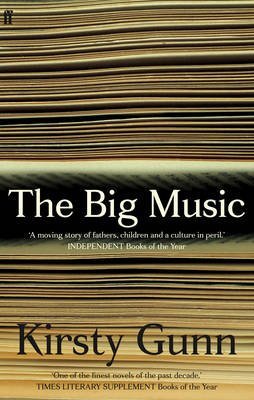
The Big Music by Kirsty Gunn

faber and faber, 2013, 380 p, plus i p Table of Pipers at The Grey House, i p definition of piobaireachd, iv p Foreword, lxvii p Appendices, ii p Glossary, v p Bibliography, xix p List of Additional Materials and i p Index.

 The Big Music cover

This is a variation on the ‘found manuscript’ novel – or in this case manuscripts, being the papers left behind by bagpiper John Callum MacKay Sutherland in the little hut he had built for himself in the hills beyond the Grey House at Ailte vhor Alech (the End of the Road) in Rogart, Sutherland, (turn left somewhere between Golspie and Brora and keep going to the unmarked fork in the road then follow it to the right.) This is the house, expanded and extended over the years, where the Sutherland piping dynasty set up its school of bagpiping and later, in an attic room, also a proper school for children from the area, now all defunct. Other relics, transcripts of radio and TV broadcasts and illustrative extracts from monthly journals contribute to the overall mix.

The human story in the book concentrates on the latest Sutherlands to be brought up in the House, those from the twentieth century to now, the aforementioned John Callum MacKay Sutherland and his son Callum Innes MacKay Sutherland. Both had left this Highland home to pursue careers in London, both were/are drawn back to confront the imminent death of a parent, in John’s case his mother’s and in Callum’s his father’s.

The novel itself begins early one morning with John taking from her cot Katherine Anna, the grand-daughter of his housekeeper Margaret, and spiriting her away with him. He intends to take her to the little hut as inspiration for part of the final piobaireachd he is composing. This act of kidnapping persuades the household – Margaret, her husband Iain Cowie, and daughter Helen – that Callum must be summoned back from London.

It becomes obvious (though heavily foregrounded earlier in the footnotes by invocations to note the increasing intrusion of the word ‘I’ to the text) that the guiding hand in the assembly of the text is meant to be that of Helen. This is highlighted by the information that the title of her dissertation was, “The Use of Personal Papers, Journals and other Writings in the Creation of Modernist and Contemporary Fiction.”

The family dynamics are complicated. Margaret and John had had a long-standing affair that produced Helen. While John was away down south Margaret had married Iain who now looks on Helen as his own daughter and on John’s return to the house resolutely tried to avoid any knowledge of his wife’s past (and rekindled) affair with Helen’s true father. Helen and Callum had become lovers when she was seventeen – some time before they both moved away for further education. Thankfully Katherine Anna is not Callum’s child.

The narration is not straightforward. It often adopts that form of Highland speech heavily influenced by Gaelic (to which is not difficult to accommodate) but it is interspersed with passages on the history of the Sutherlands, the Grey House itself, and of bagpiping. And it has copious footnotes.

Now; I love a footnote. But there are footnotes and footnotes. In a novel they are ideally used sparingly but here they appear very frequently – almost, but not quite, on every page, sometimes three or more to contend with. There is such a thing as overkill. Moreover, many of these impart the same information as previous ones or recapitulate something that has already appeared in the text. In some of them, too, there are comments on the text, as if the author is telling us how to interpret it, what to look for, which smacks of hubris and reads as if the author does not respect us as readers.

However, The Big Music is a bold venture. It attempts to set out in novelistic form the characteristics of the apotheosis of the art of bagpiping, the piobaireachd (usually rendered in English as pibroch,) while also making the case that it is an extremely complicated and worthy musical form, requiring a large amount of training by previous pipers as its essence is not truly captured by any musical notation. To that end we have sections of the overall story relating to the structure of piobaireachd, the ground, Urlar, a variational development, Taorluath, more variation, Crunluath (the Crown,) and a conclusion, Crunluath A Mach, which returns to the Urlar and ideally fades away as the piper recedes over the horizon.

But therein lies its main flaw. The playing of piobaireachd necessarily entails repetition, of notes and phrases. While some recapitulation and some emphasis by repetition may be necessary in a novel, it ought not to be taken to extremes. “Running over the same old ground” is not generally desirable. Mirroring piobaireachd unfortunately obliges it. That tendency in this novel may not quite be ad nauseam but certainly leans towards ad irritatem.

Occasionally the footnotes contain snippets that read as comments on the text. In piobearachd “Like in a story, one may return to a central idea that is never quite resolved, as in a fable or a myth there may seem to be an ending but the ending is not there.” A piobeareachd has no formal conclusion and in its performance, “The two extremes to be avoided are dragging and hurrying. …. Steadiness is more important than speed.” This commenting is made explicit when we are told “the idea of music that sits behind the words, of entire lines and phrases that sound rather than represent … Is at the very heart of the project here in hand.”

We are told that at the heart of John McKay Sutherland’s attitude to the music of his forefathers is “A loneliness that some might describe as a quality of mind that won’t let anyone in, come close. A loneliness that may be described as a quality of heart that can’t admit love.” I read this as a reflection of the influence of Calvinism on the Scottish male’s soul. In this context the observation that “The history of women in these places is always a quiet story, it’s quietly told” holds a harsh mirror up to history.

As a novel The Big Music certainly has ambition – especially in its attempt to extend the limits of the form. In its execution, though, it strays too far from the reason why people engage with novels. Its concentration on its characters – well drawn as most of them are – is too episodic, too sparse, too smirred, to resonate as it might.

A note on the book’s title. Within the piping fraternity piobaireachd is known as the big music, Ceol Mor (as opposed to strathspeys, reels etc which are regarded as Ceol Beag, little music.)

Pedant’s corner:- missing commas before and at the end of a piece of direct speech embedded in a sentence, “post offices” (Post Offices,) fine’ness (why the apostrophe?) green’ness (again, that unnecessary apostrophe,) stubborn’ness (ditto,) clean’ness (ditto,) Arogocat (elsewhere Argocat,) “someone taking over on a bad corner” (someone overtaking on a bad corner,) scared’y (‘scaredy’ would be fine,) “Then Callum hears his father’s breath starts coming again” (hears his father’s breath start coming again,) “smirring of the tune” – a footnote says “the glossary defines smirring as a general smudging but it is often used in the Highlands as a metaphor for light rain” – (the dictionary definition of smir is ‘light rain’ not ‘smudging.’ Smir is in widespread use in Scotland as a description of rain so light it can hardly be seen but nevertheless soaks through to the skin. I suspect the word’s use in piping actually derives from that rather than the other way round. Aside: when I visited Bilbao I was delighted when a local said a particular similar weather condition there – now, with climate change, no longer so prevalent – and had been called ‘smirri-mirri’ and I told her of the Scottish equivalent.) “Slowly, year by year, in every country except one the bagpipe either disappeared completely or was left ‘to the lonely hill-men or the occasional crank’.” The text says this is because mediæval conditions lingered in the Highlands longer that elsewhere in the world. (Yet later parts of the book acknowledge that different bagpipe traditions than Scotland’s still exist. Off the top of my head I can think of the uillean pipes, the Northumbrian pipes not to mention Galician and Cornish versions,) “the general lay of it” (lie of it.) “The connection between piobaireachd and lyric ….. and come to bear” (comes to bear,) footed’ness (again; what’s with the apostrophe?) Eric Richards’ (Richards’s,) “and how you could call someone a wife who doesn’t look to the man she’s married?” (how could you is the usual word order in English.)
In the Appendices: “the boundary between the districts of Sutherland and Caithness were slightly redrawn” (the boundary …was slightly redrawn,) an extraneous apostrophe, “the area of grounds and land surrounding the Grey House amount to some 400 acres” (the area … amounts to,) “the earliest references to a MacCrimmon (who was also a piper) appears in Campbell lands” (the earliest reference,) “a good representation of the terms of tuition etc that is available” (of the terms .. that are available.)

The Thistle and the Grail by Robin Jenkins

Polygon, 2006, 296 p, plus vi p Introduction by Harry Reid. First published 1954.

The thistle of the title is the local team of the small town of Drumsagart, Drumsagart Thistle Junior Football Club, whose blue shirts have a red thistle crest. The grail is the ultimate quest for a Junior* football team, the Scottish Junior Cup.

Despite the apparent thrust of the title that the novel will be about football, it isn’t really. There may one day be a definitive novel that deals with that perennial Scottish obsession but this isn’t (quite) it. The quote from John Cairney on the cover to the effect that this is “easily the best book written on the relation between football and society in Scotland” may well be true but the novel’s narrative more or less skirts football. Instead, it is more about a small town, the characters who inhabit it, and the distraction from their lives that football represents. Bill Shankly is supposed once to have said, “Football isn’t a matter of life and death; it’s more important than that.” While at times, in the throes of a match, it can perhaps seem that way, it really isn’t. But as a distraction from life’s tribulations it can be a temporary balm – even while adding to them.

At the start of the novel Drumsagart Juniors are hopeless, suffering regular drubbings – usually to nil – every week. This culminates in a mass protest after a 7-0 humiliation at the hands of their fiercest local rivals, Lettrickhill Violet, wherein the committee members are the subject of intemperate threats and club president Andrew Rutherford is in danger of being dismissed. Mysie Dugarry, granddaughter of the club’s most famous player, who had gone on to play for Scotland, suggests they try one Alec Elrigmuir whom she describes as the best centre forward in Scotland. (He plays for a pit team and she is sweet on him.) Under pressure Rutherford agrees. Committee member and local pub owner Sam Malarkin offers to provide a free drink to everyone should the Thistle go on to lift the Cup, safe in the knowledge it won’t happen.

Apart from the possibility of Elrigmuir, a further potential hero arrives when Turk McCabe, a former centre-half, returns to the town from a sojourn in England. Now in his mid-to-late thirties he is an unlikely saviour but has determination and turns out still to have positional sense. And so the journey to the grail begins. There is a brief description of the first-round game at Carrick Celtic but Jenkins’s writerly gifts are not convincing here. (I suspect this may be true of any attempt by any novelist to depict an imaginary football match.)

There is a whole cast of minor characters each of whom is drawn realistically and sympathetically. Sam Malarkin’s interest in Alec Elrigmuir is more than football related as is his sister Margot’s – a source of dismay later on when Mysie gets to hear of it and Elrigmuir threatens not to play as a result of her displeasure. Elrigmuir himself may be a good footballer but off the field he is all but a simpleton.

Despite not being published till 1954 this reads like an interwar, even a 1920s, novel. Harry Reid’s introduction tells us, though, that Jenkins was a reluctant author with many manuscripts kept in his locker.

The attitudes to women of the male characters in the book read as being decidedly off-kilter these days. “The apple had been a gift. Eve’s to Adam had been free too, and it had soured the world,” and, “With women it was, of course, different; their brains were lighter, no-one could expect them to be as serious as men.” At a club committee meeting discussing the team’s problems we have, “‘Have you noticed, gentlemen,’ said Wattie Cleugh, ‘how it’s women causing all the trouble? …. It would seem that what started in Eden’s still going on.’” However, Agnes Elvan’s observation that, “‘There’s not a woman in Scotland doesn’t know the importance of football is exaggerated,” is probably still widely applicable. There is also a wonderful Scotticism when a character describes another as having, “the mind of a five-year old lassie whose backside was underskelped.”

That the times have changed in other ways too is illustrated when a doctor – called in to examine Turk after his put upon mother had poured boiling water over his feet – says of the offer of a cigarette, “‘Do him good.’ The doctor intercepted the packet and took one himself. ‘Do me good.’”

Turk is of course an habitué of the pub. When the local minister, who does not like football – or pubs – came to proselytise, Turk, in his eagerness to berate religion but wanting to show some knowledge, responded with a misquote, saying, “‘I am become a sounding brass or a tingling simple.’ That’s Bible.” A few lines later Jenkins transforms this double Malapropism into an inspired pun. On leaving the pub McCabe castigates those who remain as, “A shower of tingling simples.’”

The novel does not neglect wider issues. There is a small diversion into Politics. Rutherford’s father is a long-time socialist councillor, while Rutherford himself runs on behalf of his brother-in-law a biscuit factory, producing Drumsagart Bannocks in their distinctive blue and red liveried packets. His dismissal of Lizzie Anderson for theft, leaving her and her mother to likely penury excites his father’s ire. That Lizzie has falsely implied Rutherford had got her pregnant does not weigh in the balance for him. In his turn Rutherford interprets his father’s concern for the poor as a desire not to have the latter’s grandson well provided for. Poverty and the misery of unemployment are described but presented as matters of fact. Fecklessness on the part of impecunious men spending money on a triviality like football is implicitly deplored.

Yet it does not escape Scottishness. On a trip to an away game Rutherford reflects, “Scotland was a country where faith lay rotted like neglected roses, and the secret of resurrection was lost. We are a dreich, miserable, back-biting, self-tormenting, haunted, self-pitying crew, he thought. This sunshine is as bright as any on Earth, these moors are splendid: why are not the brightness and splendour in our lives? Seeking them, here we are speeding at fifty miles an hour to see what – a football match, a game invented for exercise and recreation, but now our only substitute for faith and purpose.” But there is still the lingering shadow of Calvinism, “too much pleasure on Earth weakened the promise of heaven and strengthened the threat of hell.”

*This designation does not mean for young players. It was a peculiarity of the Scottish footballing landscape that up until a year or so ago there were two separate non-amateur grades of football in Scotland; the Seniors, all those whose names are familiar from the Saturday football scores plus some in four non-national leagues, and the Juniors, still (semi-)professional but playing in a different set of closely geographically-based leagues – except for the all-encompassing Scotland-wide Junior Cup. The former Junior sides have now all joined the Scottish football pyramid system.

Pedant’s corner:- In the Introduction; “fifty miles and hour” (miles an hour.) Otherwise; “Wheehst” (Wheesht,) “‘They’s come flocking in’” (they’ll come flocking in,) “crotcheted tie” (x 2, crocheted,) Saunders’ (Saunders’s,) a missing comma before a piece of direct speech (x 2,) “as any owner at potential Derby winner” (at a potential Derby winner.)

Chronicles of Carlingford: The Perpetual Curate by Mrs Oliphant

Virago, 1987, 544 p with viii p Introduction by Penelope Fitzgerald. First published 1864.

Frank Wentworth (who appeared as a minor character in The Doctor’s Family) is the permanent curate of the title, in charge of St Roque’s church. As well as his ecclesiastical duties he is engaged in good works, evangelising the bargees of Wharfside in which endeavour he is aided by Miss Lucy Wodehouse. Their appearances together are the subject of warnings to her by an older woman as being liable to gossip. As a perpetual curate Wentworth’s prospects are dependent on either a living turning up elsewhere or the good will of the parish’s Rector.

Unfortunately the new Rector of Carlingford, Mr Morgan, has taken a dislike to Wentworth precisely because of those good works, since he had not sanctioned them. That the previous Rector, Mr Proctor, had done so is neither here nor there. Morgan’s wife has no such objections; her strictures are directed at the hideous carpet installed in the Rectory by the previous incumbent. Of her, Oliphant tells us in an odd unsisterly phrase, “Though she held that elevated position” (wife of the Rector of Carlingford) “she was only a woman, subject to outbreaks of sudden passion, and liable to tears like the rest.” But this is a Victorian novel after all.

Frank’s high church tendencies are somewhat looked down on by his aunts who have the living at Skelmersdale in their gift. Their extended visit to Carlingford coincides with the of the plot.

Frank lodges at Mrs Hadwin’s where he has vouched for a mysterious man going by the name of Tom Smith, who comes and goes by night. Also lurking round Mrs Hadwin’s is Rosa Elsworthy, an orphan taken in by her shopkeeper uncle. She is referred to as a child but later revealed to be seventeen. Finding her at the garden gate as he comes home one evening Frank makes the mistake of escorting her straight home, instructing her uncle to take more care where she is concerned, but is of course seen by those who are out and about. Carlingford is a rumour mill at the best of times and this is a juicy morsel.

A message from his brother’s wife calls him home to Wentworth where Gerald Wentworth, the vicar there, has decided to turn to Rome. Their father is the local squire and greets Frank by “holding out his hand to him as became a British parent.” (Wentworth senior has had various families with successive wives.) With Gerald’s situation not resolved Frank is recalled to Carlingford by a mysterious missive from their elder brother Jack, the black sheep of the family. In the meantime Rosa Elsworthy has disappeared and Frank is given the blame.

The attentive reader notices several thematic and plot similarities to the author’s other Carlingford novels – especially Salem Chapel – and her continuing interest in ecclesiastical doings.

The unravelling of the above plot strands, the identity of the mysterious lodger and his connection with other characters, the resolution, all take some time. The book’s wordiness is of a piece with the Victorian novel and is exacerbated by Frank throughout the book being referred to not only as Mr Frank Wentworth, but at times as the Perpetual Curate, or the Curate of St Roque’s, and even the Evangelist of Wharfside. This is one of Oliphant’s stylistic tics. She far too frequently refers to characters with phrases such as these or attributions like “said the disturbed monitor” instead of using a character’s name. Was this to add to the word count or perhaps to avoid close repetition? In any case, less here is more. In addition Oliphant has Aunt Leonora Wentworth objecting to things “‘ending off neatly like a novel in this sort of ridiculous way,’” thereby bringing attention to the fact that it does.

This is not great literature, but it is serviceable. Oliphant had an audience and catered to it. Presumably they liked what they read.

Pedant’s corner:- “the Miss Wentworths” (many times; the Misses Wentworth,) “the Miss Wodehouses” (also many times; the Misses Wodehouse,) “the Miss Hemmings” (a few times. The surname here is Hemmings, its plural would be Hemmingses; the formulation ‘the Miss Hemmings’ does not make either part plural. Utilising ‘the Misses Hemmings’ would have got round that,) “‘did not use to be so’” (did not used to be,) villanous (villainous,) “upon whom a curious committee of aunts were now to sit” (a … committee … was to sit,) “a group of ladies were visible” (a group of ladies was visible,) “which almost drive that troubled citizen to his knees” (the narrative is in past tense; drove,) “neither here not there” (nor there,) “Virginian creeper” (x 2, Virginia creeper,) “the trouble which has overtaken his brother” (had overtaken,) several instances of a comma missing before a piece of direct speech,) “wiled the night away” (whiled,) receipt (recipe,) unbiassed (unbiased,) “the entire family were startled into anxiety” (the entire family was,) “he put up his handkerchief to this eyes as he spoke” (to his eyes,) “was quite stanch and honest” (an unusual case of ‘stanch’ for staunch’; it’s normally the other way round,) cruelest (cruellest,) dulness (dullness,) fulness (fullness,) mantlepiece (mantelpiece,) “could in this pleasant condition of mind he went down-stairs” (that ‘could’ sticks out oddly,) trode (trod.)

A Summer of Drowning by John Burnside

Jonathan Cape, 2011, 333 p.

It is not uncommon for Scottish literature to deal with the supernatural (mostly meetings with the Devil) and Burnside himself had a sideways look at the topic in his earlier novel The Devil’s Footprints. What is uncommon is for the story to be set, as this one is, in Norway. The Norwegian Arctic to be precise, where the midnatsol night sky is white. More precisely, the story takes place on Kvaløya, one of a string of islands north of Tromsø to where our narrator Liv’s mother, Angelika Rossdal, has gone in search of the perfect place to compose her paintings.

The pair have an equable existence, no father on hand (by Angelika’s decision,) moreover one whose existence is barely acknowledged, but near neighbour (in as much as they have neighbours) Kyrre Opdahl has acted as a very distant surrogate. Kyrre’s nearby hytte, which he lets out to visitors, plays a significant part in the tale.

This novel is a gem, Burnside draws you in and maps out the circumstances which forged a life with a pin-sharp eye.

The summer of the title is described from the perspective of years later by narrator Liv. Its strangeness began with the drowning of her school contemporary Mats Sigfridsson who had borrowed a boat on a flat calm night and whose body was found washed up in a day or so. His brother Harald, with whom he had formed an inseparable pair until in the recent past Maia, “a dark-eyed, mocking girl with a loose tomboy walk who had always been the outsider,” had begun to hang out with them, suffers a similar fate within a fortnight. Kyrre, who is steeped in local myth, begins to link their deaths to the old beliefs. “It was like one of those tales people in the old days made into legends, stories about wraiths and seal people and mermaids, all of them dark warnings about what the woods or the sea or the mountains can do, if you don’t show them enough respect.” He suspects Maia is a manifestation of the huldra, a phantom who lures men to their doom.

The last portrait Angelika ever painted before she began more abstract work was an unfinished one of Liv, which, with no warning, she eventually hung on the wall outside Liv’s bedroom. The two’s mutual communication is often unspoken, “Some gifts are like that. They are given and received in silence, almost secret and, no matter how inexplicable or strange they may seem, they are never mentioned again.”

Liv likes to observe the world around her. She describes the arrival of Martin Crosbie, the latest tenant of Kyrre’s hytte, and his entanglement with Maia. At the same time she is aware that “this is the first law of the observer: never be a witness. The true observer is permitted to see what no one else sees on one condition, and that is that she never tells.” But of course, Liv, as narrator, is telling us, albeit at a remove.

There is one interpolation into the novel that sits obliquely to it. Liv receives a letter from England from a Kate Thompson who is living with Liv’s father, Arild Frederiksen, whose name up to this point was unknown to her. She is told he is dying and wants to see her. Liv is neither up nor down about this person she’d never seen and had no relationship with but in the end decides to go to see him despite Angelika not pressuring her to. Of course she arrives too late and Kate is confused by her lack of concern.

A Summer of Drowning is also a story about stories, about how we see the world, and the comfort fiction can bring. Another of the island’s inhabitants, Ryvold, tells Liv, “stories are really about time … once, in a place that existed before we were born, something occurred – and we like to hear about that, because we know already that the story is over.”

It is also about disruption, about the world(s) we don’t see, “no matter what form we give it, or how elaborately it is contrived, order is an illusion and, eventually, something will emerge from the background and upset everything we are so determined to believe in. Or that’s how it is in stories – in real life, that something is always there, hidden in plain view, waiting to flower. A turn of phrase, a blemish, an unspoken wish – it doesn’t take much to open the floodgates and let the chaos in.” They are “invention, in the old sense, which is to say: revealing what there is, seen and unseen, positive and negative, shape and shadow, the veiling and the veiled.” Through Ryvold we hear that, “That’s how the stories work. They remind us that anything can happen. Everything changes, anything can become anything else – and there’s nothing supernatural about it.”

The crucial scene of the book, when Martin Crosbie goes off onto the lake watched by Maia and Liv, and they both do nothing (Maia understandably as an incarnation of the huldra but it could just as easily be as a normal human being) is about choice, or about what we wish to tell ourselves. Alternatively, “it wasn’t a dream, it was a story – and that’s different.” Or else, “Maybe everything was already decided, the way it is in fairy tales.”

Perhaps it was why Liv came to have “no career, no husband, no lover, no friends, no children,” but it is what she remembers for us. Then again; “remembering is a choice if it’s done well, and nobody can make you remember what you choose to put out of your mind.”

However, everything might just be a story; with Liv’s narration unreliable. How could it not be when the odd, the weird, the uncanny intrude into her life? On the edge of the world, where the forces of nature are capricious at best, it might be hard to resist the thought that fate is a matter of luck, that demons lie in wait for the unwary.

However interpreted, Liv’s story stands “to try to give a sense of the world beyond our illusory homelands,” what she seems to consider the real world behind the everyday.

Pedant’s corner:- “Struwwlepeter hair” (Struwwelpeter,) “she couldn’t quite leave go of the world” (‘couldn’t quite let go of the world’ is a more natural way to say this.)

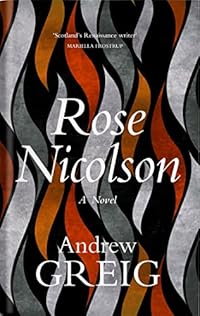
Rose Nicolson by Andrew Greig

Memoirs of William Fowler of Edinburgh: Student, Trader, Makar, Conduit, would-be lover in the early days of our Reform.

Riverrun, 2021, 458 p

Greig has been described as Scotland’s first post-Calvinist writer. With this book it seems he has decided to run with that designation. In many ways a companion volume to Fair Helen, this is the second time he has examined the genesis of the country’s immersion in that stern, moralistic creed. We also find references to Montaigne again, not to mention Walter Scott of Branxholme and Buccleuch. For added measure we are given a glimpse of Giordano Bruno and extended encounters with George Buchanan, Jamie the Saxt and the political struggles of the times.

Above all though, as a novelist Greig is the great expositor of love, the grand theme that runs through all his prose work, but with a poet’s eye for its joys and sorrows. And of course, where would literature be without it?

The love in question here is that of narrator William Fowler of Anchor Close, Embra (“Fowler” always designates Edinburgh in this way,) for Rose Nicolson, the sister of his companion scholar, Tom, at the University of St Andrews, to whom he is drawn one day as he sees her mending fishing nets, down by the harbour. He becomes a friend of the family but Rose has an understanding with John Gourlay, a fisherman with boats and, more crucially, prospects. He also discovers Rose’s remarkable intellect, which distances her from her peers, and her unusual views about God, which could threaten her survival.

Given their times the book shows us debates about free will and predestination and Fowler says that “Humanism and the Reform were brothers locked in a deadly embrace, for one was destined to destroy the other.”

This historical era, for so long unexamined, has become ripe for novelistic consideration. It was a more foundational moment for Scotland than the Jacobite rebellions much more harped on by Scottish literature. It was the time when the country plunged into the dark umbra of Calvinism from which it has only emerged, blinking – and astonished at itself – during the last fifty years. As Will says in his last words to Rose, “‘But you’ll be back some day? …. When times are fit?’” She replies, “‘In five hunner years they may be fit.’”

The book also encompasses 16th century Scotland’s JFK moment – hearing of the death of John Knox. Of that firebrand preacher’s style Tom says, “‘Aye, he was the great rebuker,’” before adding, “‘It’s a sair fecht, to keep men rightly building our New Jerusalem.’”

The politics were dark and messy. Adherents of the old faith – Will’s mother for one – have a strange belief they work towards that the exiled Queen Mary might return at the head of a French army and be restored, perhaps to share the throne with her son, Jamie Saxt. In his minority various regents had come and gone; most by violent or nefarious means. Even the great survivor, Regent Morton, will fall while Jamie Saxt is forever prey to threats of kidnap and manipulation.

The fanaticism of statements like, “‘This is now a Protestant nation. Dissent will not be tolerated,’” is contrasted with the situation in England. “We had no theatre in Scotland, on account of the Kirk.” Fowler asks, “A Reformed Kirk indeed, but of what kind? And who would limit its reach? The King?” On his trip to Paris he notes the sumptuousness and brilliance of the stained glass in Paris churches. All such fripperies had been stoned out of Scotland, and the Cathedral in St Andrews pillaged of its stone. The town’s once thriving economy, dependent on pilgrims, has vanished, the University is on its uppers.

Nevertheless, that reform, since it believed women had souls, had ensured the teaching of girls up to the same age as boys. (Much good it did them. They were still liable to be denounced as witches or pawns of the Devil.)

But human impulses always survive. “What a piece of work I am,” Will says, “that can encompass fleshly desire, tenderness, sorrow and soul, and the impulse to violence, all within one afternoon. Did Aristotle know of this? Did the risen Christ?” The melancholy that rests in the Scottish soul is expressively conveyed in his response to a song. “I kenned the bleak melody and the story, as did everyone in the hall, for it was ours.”

Though he denies it to his mother, “‘No. Absolutely not,’” the text could be read as if it was Will rather than Gourlay who fathered Rose’s child. “But a stranger I must be.” He certainly exhibits a fatherly interest in Lucy. But he was in love with her mother and notwithstanding her comment to him about her marriage, “‘There were pressing reasons,’” their later conversations argue against that interpretation.

Will’s life, though, and much of the narrative, becomes embroiled in the machinations of the high heid yins and affairs of state, his profession of trader allowing him to be a conduit (a spy in plainer terms,) Walter Scott of Buccleuch’s indebtedness to him for the loan of a dirk on their first meeting and for a subsequent intervention a major factor in his – and eventually Rose’s – fortunes. Lives can be messy and unpredictable. Only in fairy tales does everyone live happily ever after.

Yet some tranquillity can be found. Tom says, “‘Our Stoic masters spend o’er much attention to making a good death, and not enough to living beforehand.’” On which the later in life Will, narrating from the vantage point of old age, reflects, “I felt those words lodge, quivering, somewhere near my heart. Despite everything, they remain there still.”

There are sly allusions; such as to Shakespeare “‘I had not dreamed of such philosophy’” and Larkin “Love and memory remain, to hurt us into life” and many incidental pleasures, little vignettes of Scottish habits and attitudes. When greeted after a beating with, “‘Man, ye look an awfy mess,’” Fowler tells us, “This was what passed for affection in these parts.” It still is.

Greig is always good on what it is to be human. “Perhaps the course of one’s life is made by the particular manner in which we never quite resolve ourselves.”

Rose Nicolson is a magnificent, learned, wise book, imbued with sensitivity and grace, and in its elegiac sense of loss, Scottish to the core.

Pedant’s corner:- “One of the old woman” (women,) “Slainte var” (Usually spelled Slainte mhath.) “For a while I believed there was some sounds behind us” (were some sounds,) Averroes’ (Averroes’s,) “window of main house” (of the main house,) Lucretius’ (Lucretius’s,) “he’d auction his grannie were she were still alive” (that second ‘were’ is superfluous,) “before agreeing marry to young Bothwell” (either ‘before agreeing marriage to’ or, before agreeing to marry’,) “but none were her” (none was her.) “Now she truly looked me at me” (the first ‘me’ is superfluous,) “we all dreamed off” (of,) maw (used in the sense of mouth; a maw is a stomach,) our gang were back (was back,) a missing comma at the end of a piece of direct speech, a missing end quote mark at the end of another, “Kirk o Fields” (usually Kirk o Field,) uses the Scots word ‘baffies’ in its correct sense of ‘slippers’ in the text but the glossary has a baffie described as a golf club, Ulysses’ (Ulysses’s.) “The kirk had lost one of their own” (one of its own.) “The recent intake of Kirk ministers were poorly trained and credulous” (the … intake … was poorly trained,) “the Presbytery were resolved” (was resolved,) Tollbooth (Tolbooth,) “came through the St Andrews” (came through St Andrews.) “We crossed the Forth by boat” (the previous scene was set in St Andrews. Starting from there to go Perth – especially going via Falkland as they do – there is no need to cross the Forth. Indeed had they done it once, they would have had to do it again, in reverse,) a missing full stop.) In the glossary; supervisr (supervisor,) narow (narrow.)
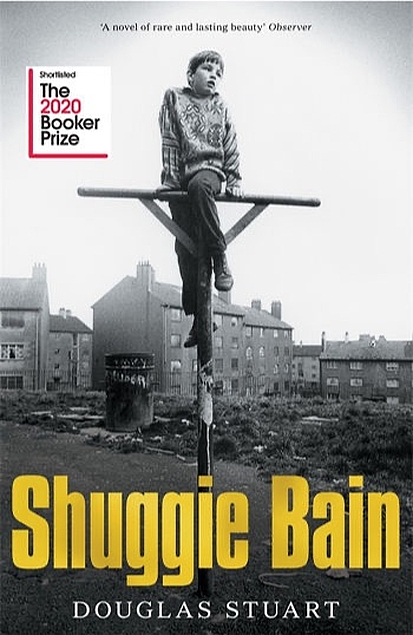
Shuggie Bain by Douglas Stuart

Picador, 2020, 451 p.

Shuggie Bain cover

Firstly, I can understand why this won 2020’s Booker Prize. It’s very well written – and its subject matter, alcoholism, is one of those such prizes historically find worthy of honour. But the devil is in the detail. Most readers would probably have no problem here, but for me personally, the detail detracted from the overall experience. It wasn’t that there was a lot of USian usages – annoying though that can be, it would be fair enough in this case, Stuart has lived in the US for twenty years and the book was first published there – but some of that did not ring true to its West of Scotland setting, even though it was peppered with Scottish words such as crabbit and weans and is otherwise very recognisable. Neither is it the case that Picador simply went with the original transatlantic text; colour is spelled the British way and the characters wear trousers, not pants, but crucially some of the dialogue has USian phrases which Scottish speakers simply would not utter. Moreover, ‘zipper’ for ‘zip,’ ‘prior’ for ‘before’ and ‘aluminum,’ being untrue to its milieu, immediately haul a British reader completely out of the tale.

The novel is told in five sections, topped and tailed by “1992 The South Side” with “1981 Sighthill,” “1982 Pithead” and “1989 The East End” sandwiched between them. The first and last are relatively short, dealing with Shuggie Bain’s first steps in life without his mother Agnes. Sighthill was where Agnes had gone back to live with her mother and father having divorced her first husband, Brendan McGowan, to take up with Shuggie’s father, (big) Shug. This is a source of contention as Agnes’s family is Catholic and Shug is not. Pithead is the village to which Shug hauls the family off before abandoning them while the East End is where Agnes and Shuggie move to in his young adolescence.

Stuart makes much of the fact of Agnes’s Catholicism and the differences she perceives between her own diffidence and the apparent easy confidence of Protestants. I found it odd, though, that her mother Lizzie and Agnes herself should refer to Brendan as “that Catholic” and “the Catholic” rather than the more natural “Brendan.” At one point Agnes reveals Brendan only wanted a slave and a housekeeper. By contrast Shug is charismatic even though balding. He is also an inveterate womaniser, not the least of Agnes’s triggers for alcoholism.

The novel is an acute (the usual word deployed in these circumstances is unflinching) examination of alcoholism and its effect on Shuggie’s family. Even though she likes to keep herself as immaculately dressed as possible, loves her children and would do anything for them, nothing gets in the way of Agnes’s need for booze. The constant need to be alert, the awareness of the slightest nuance, the necessity to guard against Agnes harming herself, drive away both Shuggie’s sister, Catherine, and brother, Alexander, (Brendan’s children from Agnes’s first marriage) – in Catherine’s case as far as South Africa. There is a brief year’s respite helped a little by AA meetings but once precipitated off the wagon by her well-meaning but misguided new boyfriend Eugene, Agnes is doomed. As if that wasn’t enough to cope with Shuggie also has his fondness for dolls and figurines, lack of ability at football and even to walk like ‘normal’ boys to cope with.

There was one further odd note; Lizzie’s revelation beside Wullie’s death bed of an incident that had occurred on Wullie’s return from the Second World War. It seemed like an interpolation from a different book entirely. As to this one, it really ought to be titled Agnes Bain. Though it does require Shuggie to tell it, it is her story rather than his.

It’s very good though, bound to be in my books of the year.

Pedant’s corner:- “ignorant to the fact” (ignorant of the fact,) snuck (sneaked,) stour (several times; usually spelled ‘stoor’,) doubt (the usual spelling of this word for a cigarette end is ‘dout’. Stuart uses ‘doubt’ throughout,) sat (many times; sitting, or, seated,) “was stood” (was standing,) aluminum (aluminium, please,) trouseless (trouserless,) “four months prior” (four months previously,) “off of” (off; no ‘of’,) gotten (is an old Scottish usage but has nearly always now been replaced by ‘got’.) “‘Will you come visit us when we live in Africa?’” (the British usage is, ‘Will you come and visit us’; or ‘come to visit us’,) “‘he’s not showed up’” (shown up,) math (maths,) one character says ‘whant’, (this may have been an attempt to render the pronunciation of ‘want’ as ‘wahnt’. Scots would pronounce ‘wh’ as hw however, so ‘whant’ would be hwant, not ‘wahnt’,) “‘carrying on lit that’” (‘carrying on lik that’,) “the Kelvingrove Hall” (there is no such place. There is a Kelvin Hall, an erstwhile entertainment venue and latterly home to the Glasgow Museum of Transport before it moved to a purpose-built site, but this wasn’t it. By its description here the “grand building” concerned is the Kelvingrove Museum and Art Gallery, commonly referred to simply as Kelvingrove,) bisim (usually spelled besom,) “the rotary” (this was on a telephone; and usually called the dial,) “‘It was nice of you to come visit with us’” (just ‘visit us’; no ‘with’,) “plated neatly” (plaited; spelled correctly three lines above,) “‘I’d could be sure’” (I could be sure,) anyhows (x 3; I’ve never heard anyone from the West of Scotland put an ‘s’ on the end of ‘anyhow’,) a missing comma before a piece of direct speech, “the clumsy, thick gusset of her black stockings, (stockings do not have a gusset. Here, and a few times later, Stuart uses ‘stockings’ when he means ‘tights’,) foustie (usually spelled foosty,) plimsolls (the West of Scotland term for these is ‘sandshoes’,) “When they banned the cane a few years before” (in Scotland the cane was not used for corporal punishment. What was used instead was the tawse, commonly called ‘the belt’,) “lit what” (lik what,) “closer in age with to Leek” (no ‘with’ needed,) “he gave her small round of applause” (a small round,) “Chernobyl and the nuclear explosion that had happened there” (it wasn’t a nuclear explosion. It was a normal, chemical explosion which blew the lid off the reactor and so released radiation.) “New Year’s in Scotland” ([x 2] is actually New Year; with no apostrophe ‘s’.) “Each of the buildings were identical” (Each of the buildings was identical,) “none of the drunks were his” (none …. was his,) zipper (zip,) “her held tilted back” (her head,) finger-er-ed (this was over a line break; finger-ed,) “corporation bus” (Corporation bus.)

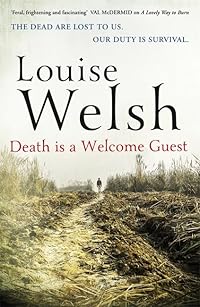
Death is a Welcome Guest by Louise Welsh

John Murray, 2015, 380 p.

This is the second in Welsh’s Plague Times trilogy (see here for my review of the first) written pre-Covid. To read it in the midst of a pandemic is odd but the similarities are outweighed by the differences. “The sweats” is at once both more virulent but more forgiving than Covid. Those who die succumb quickly, those who survive do not experience lingering symptoms.

Avoiding the usual hazard of middle books of three Welsh cleverly has a different viewpoint character from A Lovely Way to Burn. This is Magnus McFall, sometime comedian, who witnesses the first manifestations of “the sweats” while playing down the bill to a much more successful comic. His reflection that “London had not closed for the Blitz, the IRA, or al-Qaeda. It would take more than a few germs to shut down the city” is of course not borne out by our own pandemic experience.

On his way home after a gig he prevents the rape of a girl but is himself mistaken for the rapist and so finds himself in jail awaiting trial. Not a good place to be at the outset of a pandemic. When his cellmate dies he is placed in with Jeb who is in the sex offenders wing and garb. It later transpires Jeb is in solitary because he was a policeman found guilty of murdering the woman whom he had a relationship with on an undercover assignment.

Their breakout of jail is brutal – not least to other inmates – and they make their way into the country on motor bikes using back roads, with Magnus aiming to return to his home in Orkney. Several close encounters ensue before the pair end up at Tanqueray Hall, a big house containing a small religious group led by the elderly Father Wingate. We have here almost the perfect closed community, the setting for many a crime story. And the murders have already started.

The breakdown of civil life is a staple of apocalyptic tales, as is attempts to restore order by harsh actions. To a certain kind of mind catastrophes are soon latched on to as a manifestation of God’s punishment for wickedness. The ideas that a Supreme Being could be benevolent and that disasters can occur to the innocent, are beyond that mind set. The fact of survival is no guarantee of innate goodness, and it can of itself unhinge the survivor.

Character is a tricky aspect of the post-apocalypse tale. Norms of behaviour may change as a result of the event, but some human constants will remain so. Welsh’s scenario is the classic one of the SF so-called ‘cosy’ catastrophe, albeit with a modern twist and an added dash of crime (which itself is a concept liable to undergo change in the aftermath.) There are inevitable echoes of John Christopher in Death is a Welcome Guest even if Welsh has never read him (though I suspect she has.) She certainly knows how to keep the reader turning the pages. It remains to be seen whether in the third of the trilogy the expectations of that sub-genre are fulfilled.

Pedant’s corner:- “(how many hours ago?).” (that full stop after the bracket is unnecessary. The question mark acts as a marker for the end of the sentence.) “A series of tabloid headlines were riffling through Magnus’s mind” (A series was riffling. Extra points for ‘Magnus’s’ though.) “Wylie Coyote” (that cartoon character is Wile E Coyote,) “vodka and tonics” (tonic is an adjective here so cannot be made plural; ‘vodkas and tonic’, or ‘vodkas with tonic,) snuck (sneaked. Please,) “hooching with them” (usually spelled ‘hoaching’ or sometimes ‘hoatching’,) staunch (stanch.)

Hawkfall by George Mackay Brown

Triad Granada, 1983, 253 p.

This a collection of stories all set in the author’s homelands of Orkney. Each is a beautifully rendered snapshot of life in those Northern islands

The title story, Hawkfall, is told in five parts, illustrating the history of Orkney in stages, showing aspects of life – and death – there from ancient times through those of the Vikings, the brutal, rapacious Earl of Birsay, the Napoleonic Wars and the early twentieth century.

The Fires of Christmas relates two historical violent confrontations in the Great Hall of Ophrir, which occurred eighty nine years apart.

The subtitle of Tithonus, Fragments from the diary of a Laird, outlines its structure. The Laird in question had inherited the Hall (a big house) on Torsay from his great uncle, along with two hundred pounds a year. By the end of the story, among many other changes, that sum is exiguous and the Hall is falling apart. It is his interactions with the locals that have most attention, particularly those with the schoolmaster, the Minister, the local gossip and Thora Garth, the only child of Armingert and Maurice, arriving after twenty-one years of marriage, who later causes a scandal by jilting her fiancé and shacking up with a ferryman. The tale has a neat twist at the end.

The Fight at Greenay occurred after the men of Harray, on their way to the sea to harvest seaweed to use as manure, had been insulted by the men of Birsay, reluctant to let strangers across their lands, in the halfway inn where the Harraymen had stopped for refreshment.

The Cinquefoil is told in five parts (Unpopular Fisherman, The Minister and the Girl, A Friday of Rain, Seed, Dust, Star and Writings,) in which are laid out the various relationships over time of the narrators of each and their acquaintances/friends/lovers. As a result it encapsulates the closeness and complexity of island life as a microcosm of life in general.

The Burning Harp is described as a story for the eightieth birthday of Neil Gunn. In 1135 a cottage is set on fire by intruders, who decide to let out, in turn, children and servants, a priest and finally a poet whose singing they heard and recognise as that of Niall of Dunbeath. (His songs mirror those of Gunn’s stories.)

To anyone familiar with Scottish folklore Sealskin’s title tells the reader more or less all. It is impeccably told though. A man finds a sealskin on the beach and stores it in his barn. A day or so later he encounters a naked woman swimming by the shore. She has no knowledge of the language and he takes her in; to the great ire of his mother. Marriage and children ensue. Years later he discovers the skin again and the inevitable happens. An afterword mentions the tale was inspired by a famed Orkney musician, Magnus Olafson.

The Girl spends an afternoon lazing on the sea-bank almost in earshot of a group of men gossiping while repairing fishing nets and such, till she hears the approaching sound of a motor-bike.

In The Drowned Rose, William Reynolds, the new schoolmaster on Quoylay, is visited on his first night on the island by a young woman in a red dress, looking for a man named John. Reynolds befriends the local minister, Donald Barr, who refuses to elaborate on the woman’s history. She had been the previous schoolmistress, Sarah McKillop, well remembered by her pupils, and it is only a spiteful neighbour called Henrickson who reveals her tragic end, taking great relish in describing what he regards as the scandalous goings on which preceded it and why the islanders had resolved on a male as her successor.

The Tarn and the Rosary shows episodes in the life of Colm, a writer, from his grandfather’s death, through his first trip to the small Loch Tumishun in the centre of the island of Norday, the burgeoning of his confidence and aspirations when his first composition is praised by his teacher, his overhearing a group of men bemoaning the superstitions of Catholics, to his sojourn in Edinburgh trying to write but also attending mass. It’s an almost haunting evocation of Northern Island life.

The Interrogator has set out from Leith to Norday to question the locals about the death of Vera Paulson, found in the sea a month after she disappeared. None of them is very forthcoming. When the girl herself appears – as a ghost – her story does not quite match with any of theirs.

Pedant’s corner:- “and the shore of Firth” (of the Firth,) “a gonner” (goner,) bissom (usually spelled besom,) “it muirburn (its muirburn.) Suppper (supper.)

free hit counter script