Archives » Russian Fiction

Death and the Penguin by Andrey Kurkov 

Harvill Press, 2001, 234 p. Translated from the Russian Смерть постороннего (Smert’ postoronnego; Death of a Stranger) by George Bird

This book is an example of why I find translated fiction so attractive. It is difficult to see its premise appearing in a book by an Anglophone author.

Viktor Alekseyevich Zolotaryov lives alone – except for a king penguin named Misha. The local zoo in Kyiv had been giving animals away to anyone who could feed them and Viktor obliged (with fish he keeps in his freezer.) Misha has an enigmatic existence in the book, wandering about the flat lugubriously. But his presence is treated matter-of-factly. No-one bats an eyelid at him: all accept the situation as normal.

Viktor has aspirations to being a writer or at least to seeing his writings in print. Opportunity comes his way through a man called Misha (to prevent confusion referred to as Misha-non-penguin.) This Misha has a murky background but puts Viktor in touch with the editor of a paper for whom he is to write obituaries of people of VIP calibre, from State Deputies to Ministers and factory managers, people who were shady in some way but not liable to normal justice – either through immunity or corrupt judges. After a few of the subjects have died it becomes clear to Viktor that his pieces are the basis for a hit list by an organisation he has no clue about.

Then he is left in charge of Misha-non-penguin’s daughter Sonya, after her father has to disappear for a while, leaving Sonya a large sum of money. Eventually Viktor hires a nanny, Nina, for the child, and she, Viktor and Sonya in effect become a family.

Warnings come from the paper’s editor to lie low for a while and as a result Viktor thinks he may be being followed: Sonya and Nina definitely are. Viktor’s reactions to this read as a hangover from the Soviet era. He knows instinctively what to look for to discern someone  tailing him.

In the meantime he is prevailed on to attend the funerals of some of his obituary victims. Accompanied by Misha, he does so. Soon Misha becomes a desirable accessory at burial ceremonies. Where in an Anglophone novel would anything so bizarre as this appear?

A touch of meta fiction intrudes when Viktor confronts the “fat man” who has been following Sonya and Nina, and he is given his own obituary to read. “His contribution to the political history of Ukraine may well become a subject for research not only by a Committee of Deputies, but by his fellow writers also. And who knows, a novel on that theme may enjoy a longer and more successful life than that of Viktor Zolotaryov.” Is this an invitation to assume that Death and the Penguin is that novel?

However, Misha has become ill and needs a heart transplant. For which the heart of a three to four year old child would apparently be suitable. Viktor arranges for the operation and also to transport Misha to the Ukrainian research station on Antarctica.

Kurkov’s treatment of this surreal scenario is resolutely straightforward; there are no flights of fancy, no purple prose. This, of course, only heightens the surreality of the scenario. Or is the perception of that surreality a result of being a reader from a country whose history has not been authoritarian nor overtly corrupt?

Note: this edition uses the pre-Russian invasion spellings Kyev, Kharkov, Odessa, Donyetsk and Lvov rather than the now preferred Kyiv, Kharkiv, Odesa, Donetsk and Lviv.

Pedant’s corner:- a missing comma before a piece of direct speech, a missing end quotation mark after a piece of direct speech, two new paragraphs were unindented, “where he came from and he was after” (where he came from and what he was after,)

One Day in the Life of Ivan Denisovich by Alexander Solzhenitsyn 

Gollancz, 1963, 190 p. Translated from the Russian, Один день Ивана Денисовича, (Novy Mir, Moscow, Nov 1962), by Ralph Parker.

I bought this many (many) moons ago but had resisted reading it so far it as I thought the subject matter may have been too depressing. Reading about life in a labour camp is not overly appealing after all. It was still familiar, though. There are many similarities here to Primo Levi’s account, If This Is a Man, of being in Auschwitz.

Despite those reservations I found One Day (as the book’s spine has it) remarkably readable – a testament to the original writing and to the translation. This is also true of Levi’s books.

Ivan Denisovich Shukhov has been imprisoned for ten years in effect for being captured by the Germans. The main aim is to get through each day with as little friction or attention as possible. This particular day starts with Shukhov feeling unwell and thinking of reporting to the sick-bay but the day’s quota of the ill has been filled and he has to return to work.

He is in the 104th squad and, despite the novel being relatively short, the relationships between its members are carefully illustrated. Even (especially?) given his circumstances he still takes pride in doing a job well (today’s is brick laying which can be tricky as the mortar is liable to freeze) – though it helps that if seen to do so they may get extra food – Shukhov is careful to savour, or husband and hide for later, each item of food.

There are petty indignities such as the incessant counting at roll-calls to be endured, the fact that even thoughts aren’t free as they always cycle back to the same things. Each small achievement, that extra item of food, the finding of a piece of metal which might be fashioned into a knife, is a victory, but you must never set your sights beyond what is in front of you.


Pedant’s corner:- “sleepy heads propped again their rifles” (against, surely?) “fivefifty grams” (fifty five? [And grammes if we’re British],) “tommy-funs at the ready” (tommy-guns,) [this next was in a footnote] “a percentage of the plan t amounts to” (of the plan it amounts to,) a missing end quotation mark at the finish of a piece of dialogue.

The Gift by Vladimir Nabokov

Penguin Modern Classics, 2001, 407 p, plus iii p Foreword. Translated from the Russian, Дар (Dar), by Michael Scammell and Dmitri Nabokov in collaboration with Vladimir Nabokov, with a new Addendum translated by Dmitri Nabokov. First published in English in 1952.

This novel is an odd one to try to review. Its structure is not conventional, five – very long -chapters, one of which was not published in The Gift’s first appearance in print (in a Russian émigré journal,) and an addendum labelled here as the second such but in this edition there isn’t a first (unless it is that originally unpublished chapter.) Its narration slides between first and third person with no apparent reason for it (unless our protagonist is merely contemplating or remembering doing things.)
It is the last novel Nabokov wrote in Russian before switching to English and illustrates the author’s passion for poetry. (There is an extensive discussion of the use of different kinds of metrical feet and stresses in lines of verse.) In his foreword Nabokov says his novel’s heroine is Russian literature. The chapters are apparently written in the styles of different Russian literary figures.

What story there is is set among the Russian émigré community in Berlin in the 1920s where Fyodor Konstantinovich Godunov-Cherdyntsev, a poet, is trying to make a name for himself with his first book of poetry. He takes lodgings with fellow émigrés the Shchyogolevs. For Marianna, Mrs Shchyogolev, this is a second marriage, her daughter, Zina Mertz, was the product of her first, to a Jew – a fact which her second husband obviously resents. Shchyogolev throws about the words ‘kike’ and ‘yid’ unthinkingly and is obviously anti-semitic. Zina has no time for him, possibly because he is too interested in her. A friendship develops between Fyodor and Zina but they never converse in the apartment, only in parks and cafés.

The uncertain life of an émigré is illustrated by Fyodor’s thought on boarding a tram that “The Russian conviction that the German is in small numbers vulgar and in large numbers unbearably vulgar was, he knew, a conviction unworthy of an artist but nonetheless he was seized with a trembling.”

Fyodor’s father was a lepidopterist who made several trips to Siberian and Asia before and during the Great War and whose present whereabouts are unknown. The 2nd Addendum I mentioned above is titled Father’s Butterflies, and deals extensively with the subject of butterflies.

After reading an article in a chess magazine about the nineteenth century Russian writer Nikolai Gravilovic Chernyshevski Fyodor proposes to write a biography of him. This book within a book comprises the whole of Chapter Five of The Gift.

A review of Fyodor’s book says, “Everything would have been all right if the author had not found it necessary to equip his account of it with a host of unnecessary details which obscure the sense, and with all sorts of long digressions on the most diversified themes.” (This could be a comment on The Gift itself.) We are also told that “The most enchanting things in nature and art are based on deception.”

In a discussion about the book Fyodor says, “Suppose that I so shuffle, twist, mix, rechew and rebelch everything, add such spices of my own and impregnate things so much with myself that nothing remains of the autobiography but dust….” A review calls it an “incomprehensible essay.”

A measure of the density of the prose here can be assessed from this example; “but of course the main thing is that he had intended, at his leisure, to dedicate a separate study to the question raised here, and at the same time believed that, if the precariousness of human life, and the fog settling on Russia, and the danger of a new hunt far afield projected in such an unpropitious year thwarted it, a maximally accurate exposition of the principles of such a study would still allow minds that at last understood them a chance to consummate the plan outlined by the author.”

All these interpolations and additions make The Gift far from straightforward to read or review. I did not have a similar positive response to it as I had to the same author’s Pale Fire, which I read in 2020. Nabokov’s renderings of relationships between characters are as you might expect from a novel but tend to be sidelined by all the gubbins that surround them.

Pedant’s corner:- Translated into USian; “St Peterburg” (St Petersburg,) “Brockhaus’ Encyclopedia (Brockhaus’s – and, incidentally, Encyclopaedia.) “And in these talks between tamtambles, tamtam my spirit hardly knows” (I have no idea what tamtambles or tamtams are,) mimiking (mimicking,) “what did he use to think about” (what did he used to think about,) “at a Russian small railway station” (at a small Russian railway station,) Mortus’ (Mortus’s,) “a Ukranian” (Ukrainian.)

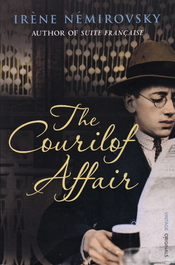
The Courilof Affair by Irène Némirovsky

Vintage, 2008, 174 p. Translated from the French L’Affaire Courilof, (Éditions Grasset, 1933,) by Sandra Smith.

The Courilof Affair cover

The narrative here has a prologue set in Nice in the 1920s which acts as a framing device but the subsequent chapters are delivered to us in the form of Léon M’s memoirs. The son of would-be Russian revolutionaries, Léon was brought up in exile, and assigned by the Revolutionary Committee to kill the Russian Education Secretary, Courilof, a notoriously harsh man, known as the Killer Whale. To enable this and to worm himself into Courilof’s household he takes up a position, under the name Marcel Legrand, as Courilof’s physician. At once warming to his charge and disgusted by him, “Legrand” has a ringside seat at the ins and outs of the higher echelons of the pre-revolutionary system, watching Courilof fall from favour as a result of his marriage to his second wife (who has a past) before his restoration following a scandal involving his successor.

Despite Courilof’s elevated position he nevertheless has the capacity to observe, “‘An ordinary man has the right to be greedy, because he knows that otherwise he would starve to death. But these people who have everything – money, friends in high places, property – they never have enough! I just don’t understand it.’” Plus ça change.

This is the only one of Némirovsky’s novels to be set more or less entirely in her native Russia – and (almost certainly non-coincidentally) it is the most concerned with politics and the usage of power. Affairs of the heart are incidental here as it is the wielding of, and manœvring to maintain, influence, and the single-mindedness of those opposing the regime which are the book’s main themes. Léon’s subsequent acts as an instrument of the revolutionary government – a far more implacable proposition than Courilof ever was – are related briefly and quite off-handedly, simply as things that had to be done. Léon’s fall from grace is glossed over, we never quite find out why he ends up living in exile – though we can guess.

This isn’t Némirovsky at the peak of her powers but it is an interesting examination of the mind-set of would-be revolutionaries eager to be seen to be activists (the assassination requires as big an audience as possible) but more in thrall to the idea than the action – as well as, in Courilof, the exigencies of assiduous service to a monarch who doesn’t warrant devotion.

Pedant’s Corner:- “the Pierre and Paul Fortress” (usually Peter and Paul Fortress in English,) hung (hanged, x3, though there was a ‘hanged’ and one of the ‘hung’s on page 168,) Nevsky river, (it’s the Neva river that flows through St Petersburg,) “fishermen ….must have the same feeling as they contemplate their dazzling catch” (catches, surely, since its fishermen, plural,) sterling (as a fish. Is there such a creature?) “A great crowd of people were silently listening to music” (a crowd was silently listening,) Léon as Legrand is referred to in speech as ‘Monsieur Legrand’ (the English would be Mister Legrand, but then back in the day educated Russians spoke French and the speaker thought ‘Legrand’ knew no Russian so would be addressing him in that language,) hiccoughs (hiccups, it’s not – and never has been – a cough of any sort,) “I wanted to lay down right there” (lie down.) In the translator’s Afterword: Camus’ (Camus’s, x2.)

Path Into the Unknown: The Best of Soviet SF

McGibbon and Kee, 1966, 185 p No translator’s name given.

Path Into the Unknown cover

The first story in this collection, The Conflicta by Ilya Varshavsky is dedicated, To Stanislav Lemm (sic) “in memory of our argument which will never be resolved”. It focuses on a mother distraught at the affection in which her child holds the robot household help, an extremely intelligent machine but not without its own emotions.

A household robot also features in Robbyb again by Ilya Varshavsky. This one becomes increasingly cantankerous as it tries to apply logic to everything.

In Meeting my Brotherc by Vladislav Krapivin a young boy sees himself as the brother of a cosmonaut on a mission from long ago. When the mission returns his wish is fulfilled in a roundabout way. This story is less focused on the SF set-up than Varshavsky’s two, and more on human relationships.

A Day of Wrathd by Sever Ganovsky sees a journalist go seeking a group of artificially produced reasoning creatures called Otarks who may be more intelligent than humans but uncompassionate.

In An Emergency Casee by Arkady and Boris Strugatsky a spaceship returning from Titan to Earth is plagued by an infestation of eight-legged flies.

Arkady Strugatsky’s Wanderers and Travellersf features a scientist investigating a new type of cephalopod who meets a spacefarer who in turn has become the source of radio signals.

The Boyg by G Gor is the tale of an unusual school classmate whose father claims to have found evidence of aliens on Earth in the Jurassic period, one of whom may have survived to the present day.

In The Purple Mummyh by Anatoly Dneprov, said mummy is an artefact convolved (printed) from radio signals emanating from across the universe – its colour a manifestation of the Doppler Effect – and (barring a reversal of internal organs,) an exact replica of the narrator’s wife. This is taken to be proof of the existence of anti-matter worlds.

Reading this was a strange experience. Whether any infelicities are due to the nature of Soviet SF, to the translation(s) or to the times in which the stories were written is difficult to discern. It was interesting though.

Pedant’s corner:- patronymics are throughout spelled with “ich” at the end, the modern style is “ic”. Otherwise; aStanislav Lemm (now more usually written in English as Stanislaw Lem,) bDescartes’ (Descartes’s,) “watching the telly” (felt far too prosaic for the rest of the narration; “watching TV” might have fitted better,) paperbooks (paperbacks is the accepted term.) c”too late for Alexander to change their plans” (yes it was the group’s plans but the construction feels clumsy,) an ice-locked land, devoid of any life” (yet it has a breathable atmosphere? That requires oxygen – which requires …. life. Later we find it has plants – of a sort. But still one of the cosmonauts says ‘if it wasn’t for the sheet of ice there would be life here,’) milleniums (millennia,) one of them refers to himself as an astronaut (he seems to be Russian so would be a cosmonaut.) dTranslated into USian, “there was not a single trail of chimney smoke or a stack of hay” (nor a stack of hay,) sprung (sprang,) sybernetic (now spelled cybernetic,) staunch (stanch,) Nubio (context implies Nubia.) d“the spaceship lost speed and deviated from its course” (??? Not in any kind of orbital mechanics that I know,) unvoluntarily (involuntarily,) one end quote mark was missing. “.. go round sprinkling them with alcohol. Then set fire to them.” (deliberately set a fire? On a spaceship?) f“your onboard wireless” (reads very oddly nowadays; radio is referred to later,) ampule (is this USian for ampoule?) “the less chances there were “ (the fewer chances.) gseomthing (something,) “part were very much in doubt” (part was,) prgramme (programme,) “things that that there weren’t the slightest mention of in our textbooks” (that there wasn’t the slightest mention of,) a missing end quote for a piece of direct speech. “Everyone he had ever known were all here” (everyone was all here,) philosophere (philosopher,) “hydrogen links” (may be a direct translation from the Russian but the term in English is hydrogen bonds,) “a dinosaur which had small front teeth with very stressed grasping functions and no teeth” (small front feet.) Whether I could stomach him or not?” (That isn’t a question so does not require a question mark,) “the diing room” (dining room.) hparallelopiped (parallepiped,) radio-eradiation (seems to be a somewhat clumsy attempt to render into one word the radiation masking caused by a Faraday cage even though eradiation has an opposite sense.)

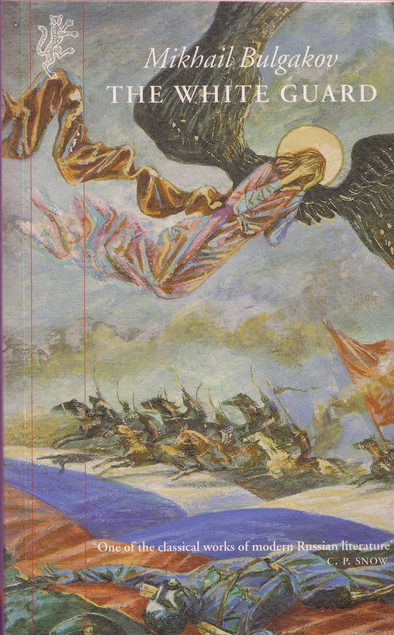
The White Guard by Mikhail Bulgakov

Harvill, 1996, 302 p. Translated from the Russian Белая гвардия, (Belaja gvardija, first published in 1925,) by Michael Glenny.

The White Guard cover

There is a sense in which – like Tolstoy’s happy families – all Russian novels are alike. A blizzard of polysyllabic names potentially confusingly embellished with the corresponding patronymics not to mention the seemingly obligatory diminutives, with always a sense of foreboding in the background, if not the foreground. You certainly don’t turn to them for sweetness and light. Then again, love, sex and death are the wider novel’s perennial preoccupations.

To be sure there isn’t much focus on love in The White Guard, no sex at all, and I can recall only three actual deaths described in the text; but the prospect of death hangs over everything. Here there can be, too, as I also noticed when reading War and Peace, a sudden lurching through time from a particular chapter to the next. One surprising thing I discovered from it is that a Ukrainian clock seems to make the sounds tonk-tank rather than tick-tock.

The novel is set in Ukraine, in “the city” (only once identified as Kiev,) amid the turmoil that followed the 1917 revolution and centres round the affairs of the Turbin family and those who live in the same building. During the novel the city starts out under the rule of the Hetman – in whose army the male Turbins serve as officers – but is threatened by Ukrainian Nationalist forces led by Simon Petlyura; and beyond that, the Bolsheviks. The disorganisation and unpreparedness of the defending forces is well portrayed – a bit like Dad’s Army but without the laughs – and the mist of rumour and counter-rumour accompanying the situation when the city falls to Petlyura conveys the commensurate sense of febrility.

Bulgakov’s first novel and the only one to be published in the USSR in his lifetime, The White Guard is an insight into an all-but forgotten moment in an interregnum of upheaval and change and is worth reading for that alone. But a marker of the futility of it all is the thought that, “Blood is red on those deep fields and no one would redeem it. No one.”

While it has touches of the fantastic, including several dream sequences, The White Guard does not (cannot) touch the heights of the same author’s The Master and Margarita but it is well worth reading on its own terms.

Pedant’s corner:- While at the end of a piece dialogue a full stop, question mark or ellipsis is included inside the quote marks; if the sentence carries on and so requires a comma this, against the accepted practice, is almost – though not quite – invariably set after the quotation. Otherwise; the Ukraine (when first translated this usage was common, but nowadays its inhabitants prefer “Ukraine”.) “As if at by unspoken command” (“As if at”, or “As if by”, not “As if by at”,) Karas’ (Karas’s,) négligé (usually négligée,) Tubirn (Turbin,) hung (hanged, but it was in dialogue,) Toropets’ (Toropets’s.) Exct ed (????) a missing start quote mark, french window (French window,) I thought earlier on I had spotted a waggon but did not note its place (later on there were wagons,) St Nicholas’ church (St Nicholas’s.)

The Master and Margarita by Mikhail Bulgakov

Penguin Red Classics, 2006, 563p. Translated from the Russian, Master i Margarita, by Richard Pevear and Larissa Volokhonsky, 1997.
The Master and Margarita

The Master and Margarita displays its oddness from the start. A stranger appears to two men in the Moscow district of Patriarch’s Ponds and makes predictions of weird events – including the death of one of the pair. These predictions, of course, come true; and in short order. For the stranger – accompanied by someone who appears as a large black cat – is the Devil. Thereafter we are treated to all sorts of wonderful happenings: instant transition to Yalta, various illusions disguised as fantastic stage tricks, flying witches, a man transformed into a donkey, a party at the Devil’s house.

The Master of the title is a would-be author whose novel about Pontius Pilate has been roundly trashed in the press (despite it not having been published.) Margarita – married to a man she does not love – is the Master’s mistress, resentful of the effect the novel’s reception has had on him and of those who caused it. Extracts from this novel (an account of the torment Pontius Pilate undergoes as he is forced to condemn one Yoshua Ha-Nozri – who avers that all men are good – for comments about Cæsar) are intermittently included in the larger narrative. This is an excellent piece of writing in its own right, especially the descriptions of Yershalaim (Jerusalem.) Other recognisable names here include the priest Kaifa and one Judas of Kiriath. This internal novel (whose manuscript has been burned by the master) is apparently responsible for the Russian phrase “manuscripts don’t burn” – as the Devil tells the master in the main narrative when returning it to him – but its contents intrude into the main body only twice, when Matthew Levi, Ha-Nozri’s sole follower, pops up in modern Moscow and when Pilate is finally reconciled.

Reflecting the Stalinist era in which The Master and Margarita is set there is much talk of possible arrests (some of them for foreign currency violations, though, which could be irregular in any polity) but the apprehension of the police and the necessity for secrecy are never far away.

Any work of fiction is an attempt to describe circumstances to which the reader has no other access but whether the full flavour of a novel such as The Master and Margarita is ever captured by any translation is problematic. The cultural assumptions under which it was written are always different to those of the reader. In the end, for me, the characters lacked sufficient agency as the fantastical elements of the book overpowered all the others. As a metaphor for lack of political and judicial accountability, though, violation of cause and effect is fair enough.

free hit counter script