Archives » Roman Catholicism

Pandaemonium by Christopher Brookmyre

Abacus, 2010, 397 p.

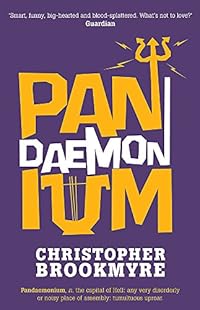
 Pandaemonium cover

I’ve mentioned before that distinct similarity in the set-up of most of Brookmyre’s non-Jack Parlabane or Angelique Di Xavia stories (and even in some of them) wherein a group of more-or-less innocents come to a confined place – usually in a remote part of Scotland – and are brought into confrontation with others intent on criminality or mayhem, who are overcome in the end. Pandaemonium conforms to these parameters precisely, except in one respect.

The innocents here are a cohort of schoolmates on an Outward Bound type expedition to help them come to terms with the violent deaths of two of their contemporaries. The danger they meet is of an extraordinary kind though, as it is not human. Scientists funded by the US military have been conducting experiments to find the graviton but instead broke the boundaries between the different worlds of the “many worlds” interpretation of quantum mechanics whereby each decision ever made spawns an alternative universe and less than a molecule’s width separates us from universes not our own. In this case daemons – horns and tails and all – have been brought through the portal between the worlds and kept in captivity under the former Fort Trochart. On the basis that the Church knows most about the potential threat from such creatures a Catholic Cardinal has been brought in to help investigate them. It turns out that demons have been “coming through into our world for centuries, most probably for millennia” and the Vatican knows all about it.

At the outset the disconnect between the two story strands is jarring. After a prologue set in the laboratory where the scenes are par for that sort of course, but with the usual conflicts between scientist and soldier exacerbated by the presence of Cardinal Tullian and his acolytes calling the shots Brookmyre’s tone alters considerably as he illustrates the pupils’ attitudes to the other sex and the prospect of the act itself; or, more pertinently, the lack of it. The peculiar mixture of bravado and innocence of the teenage boy is portrayed well enough as is the girls’ cliquishness and stoking of ammunition for point-scoring against each other but there are too many characters and they are insufficiently distinguished. Throw in among the adults in the party a martinet of an older teacher, a youngish Priest unsure of his faith and an unmarried woman of his age and parts of the story could write themselves. The balance between the two strands is also off-kilter.

Brookmyre illuminates the pressures of a Scottish Catholic upbringing and schooling. His clearly left scars. To his three dedicatees he says, “Be glad you went to PGS.” PGS is of course not a Catholic school. The baddies in his scenario are not the daemons – they are merely innocent victims of the project to find the graviton and only cause the destruction and bloodshed that they do because they have been starved of their soul food and in any case see us as the daemons, bent on their destruction. The real villain is the man who lets the daemons out of their confinement.

His later novel Bedlam was presented as Brookmyre’s first foray into SF. In fact, in its serious consideration of the many worlds theory, higher-dimensional space and expounding thereof, this has a greater claim to the title: even if the treatment more belongs to the coming of age and, perhaps, horror genres.

Pedant’s corner:- sat (placed,) crenulated (crenellated,) “none … are” (none is,) rarified (rarefied,) Rocks’ (Rocks’s,) “epicentre of this beam-quake” (not off-centre; so hypocentre,) “gas at peep” (at a peep,) gotten (got,) “an acid and an alkali, these last two of corresponding pH” (an acid and an alkali can not have corresponding pH; one must have pH lower than seven, the other greater than seven,) “a record altitude below sea level” (altitude is a descriptor of height; not depth,) “a strong alkaline solution” (a concentrated alkaline solution: chemically ‘strong solution’ means ‘fully ionised solution’ – it is possible to have a dilute solution that is nevertheless strong, and similarly to have a concentrated solution of a weak [only partly ionised] alkali or acid,) “close enough to the centre” [of the galaxy] “to allow the higher elements to form” (the higher elements form in supernovae, I’m not aware proximity to the galactic centre is pertinent,) Jimmy Hendrix (Jimi,) adrenalin (adrenaline,) Copernicus’ (Copernicus’s,) “when the situation behove it” (behoved,) “‘the most binding non-disclosure agreement outside of Cose Nostre’” (Cosa Nostra,) “‘Our sun isn’t actually hot enough to fuse hydrogen to helium’” (it is and it does,) epicentre (centre,) “and show up all the pooks on their clothes” (???) Miss Ross’ hand (Miss Ross’s.)
Annals of the Parish by John Galt

Or the Chronicle of Dalmailing during the Ministry of the Rev Micah Balwhidder, written by himself.
Oxford University Press World’s Classics, 1986, 272 p – including xiv p Introduction, 1 p Note on the Text, 2 p Select Bibliography, 3 p Chronology of John Galt, 3 p Textual Notes, 29 p Explanatory Notes.

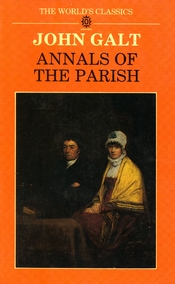
Annals of the Parish cover

Not just one of the 100 Best Scottish books but a World’s Classic no less, and set in the interesting times of the late eighteenth and early nineteenth centuries so taking in growing industrialisation and, at a distance, the American War of Independence and The French Revolution. The book is couched as the parish memoirs of the Rev Balwhidder who is at first not welcomed by his new congregation as being imposed on them by the parish’s heritors but wins them over soon enough. Initially he refers to Dalmailing as the clachan (village) but the town grows in size when manufacturing begins.

While, as Galt himself admitted Annals of the Parish is not a novel since it has no plot, the book still has enough human activity to sustain interest. Characters are sketched economically and develop by repeated exposure to their doings. Mrs Malcolm in particular engages the narrator’s and hence the reader’s sympathies. Some of the lesser characters’ names are playful. Mr Cayenne has a temper, the mason is a Mr Trowel, there is a Mr Toddy who owns a drinking establishment, Mr Cylindar is an engineer, the doctors Tanzey and Marigold are named after medicinal plants.

There are many biblical allusions and several animadversions against Roman Catholicism – to be expected of a Presbyterian minister of the time, though the Parish elders and Rev Balwhidder himself mellow in this regard later in the book as a consequence of the French Revolution. At one point he observes that, “The world is such a wheel carriage that it might properly be called the WHIRL’D.” (If someone 200 years ago could write that how much more would their disorientation be now?)

Modern sensibilities may be a little shocked by the mention of a “blackamoor” servant named “Sambo” (my quotation marks.) And there is the phrase “avaricious Jew” – though that epithet is directed at the Rev Balwhidder when he seeks an augmentation of his stipend.

In the notes it is said that the word Utilitarian – and thus its ism? – might have been lost (Jeremy Bentham gave it up for ‘greatest happiness principle’) had not John Stuart Mill recovered it from Annals of the Parish.

For a piece of fiction with no plot Annals of the Parish is surprisingly readable, even two centuries on. As a portrait of small town Scottish life at the time it is admirable and its lessons not applicable to Scotland alone.

Pedant’s corner:- David and Goliah (Goliath,) but if was one of misfortune (it.) Once again I noticed dulness with one “l” and there was “when I now recal to mind.” There is one use of the word bairns for children but otherwise weans is used throughout.

Deep River by Shusaku Endo

Peter Owen, 1994, 220 p. Translated from Japanese by Van C Gessel.

Deep River cover

I read Endo’s Silence (published 1966) and The Samurai (1980) years ago now but this is the first book of his I have read since. Endo’s writing is unlike most Japanese authors in that it is coloured by his Christianity, specifically Roman Catholicism. Silence dealt directly with the missionary times in Japan, The Samurai with the cultural differences between Japan and “the West.”

Deep River engages with yet another culture, that of India, mainly following a group of Japanese tourists there ostensibly to visit Buddhist sites but each of whom has his or her own concerns. Isobe has lost his wife to cancer but on her deathbed she whispered she was convinced she would reincarnate; he has learned of a possible candidate in India. Mitsuko has a connection to Ōtsu, a man she tormented in her college days who is now doing good works in Varanasi (the book spells this city’s name as Vārānasī throughout.) Numada is a children’s writer who wants to set free a myna bird as an act of restitution. Kiguchi is haunted by his experience on the Highway of Death in the retreat from Burma and wishes to have a reconciliatory memorial service to the fallen of both sides.

(Aside:- It is perhaps understandable that little of the hideousnesses that Kiguchi remembers from the retreat is remarked on in non-Japanese writings. In the aftermath of an ill-advised offensive which duly went wrong the soldiers were left to their own devices and suffered accordingly. But then even in their good times Japanese soldiers were notoriously ill-served by their superiors. In retreat they were just forgotten.)

While the first part of the book chronicles the back-stories of the four main characters it is India that is the true centre of the novel. All four encounter the overpowering nature of that country. The deep river is not only the Ganges at Varanasi but the mass of humanity. Yet even here Endo’s Catholicism makes itself felt. Ōtsu has his own particular take on theology, failing his seminary education by being unable to accept European views and seeing God in all religions not exclusively in one. Nevertheless he clings to what he sees as his Christian beliefs.

The trip coincides with Indira Gandhi’s assassination. This coupled with his experiences on the Highway of Death makes Kiguchi come to the somewhat jaundiced conclusion that, “It was not love but the formation of mutual enmities that made a bonding between human beings possible.”

While the manifestations of Japanese, and indeed Indian, culture may appear odd to western eyes, reading books like this shows that at their hearts people really do not vary much the world over. Here it is religion that is the biggest estranging factor.

Refreshingly the translation is into British English but there were some entries for Pedant’s Corner:- négligé (négligée,) when he laid (lay) in wait, her name in Rajini (is,) when… gets me alone this (like this,) resembling that of his dead wife’s (a possessive too far,) we’d better just lay low (lie,) of the the taxi, “a harmonium, an instrument resembling a harmonica” (it isn’t clear whether this is supposed to mean two different instruments or if a harmonium resembles a harmonica – which it doesn’t,) to eat they daily bread (their.)

free hit counter script