Archives » Princes Street

Impressionism in Edinburgh

Last week we attended the Exhibition titled A Taste for Impressionism: Modern French Art from Millet to Matisse at the Scottish National Gallery on Princes Street. The exhibition has been on for nearly two months and finishes on 13/11/22.

Some of the pictures on show weren’t quite what I would describe as impressionistic but all were worth looking at.

Two of the interesting ones for me were this Cézanne, Montagne Sainte Victoire, in which the abstract nature of the depiction of the fields in the flesh/paint looked to me to prefigure Cubism.

Cézanne, Montagne Sainte Victoire

Thsi painting, The Open Window by Edouard Vuillard, reminded me of John Henry Lorimer:-

Vuillard, The Open Window

Scottish Design, V&A Dundee

Further to my post on Abbotsford, Walter Scott must be one of the few writers to have such a legacy, which I mentioned here.

In the section of the new V&A Dundee (posts passim) devoted to Scottish design there is a model of the Scott Monument the original of which stands in Princes Street, Edinburgh.

Model of Scott Monument:-

Model of Scott Monument

There is also a Robert Adam chimneypiece:-

Adam Fireplace

Some Arts & Crafts furniture:-

Arts and Crafts Furniture

A brooch designed to resemble a galaxy:-

Galaxy Brooch

A poster for the Festival of Britain‘s Industrial Light and Power Exhibition at the Kelvin Hall Glasgow:-

Poster for Festival of Britain Industrial Light and Power Exhibition

And a bookcase/cabinet by George Logan:-

Cabinet by George Logan

Royal Scots Greys Memorial, Princes Street, Edinburgh

This memorial stands above Princes Street Gardens, to the south side of Princes Street, Edinburgh, and was originally erected to commemorate the men of the Royal Scots Greys who died in the Boer War, 1899-1902.

Royal Scots Greys Memorial Princes Street, Edinburgh

Dedication plaques facing Princes Street. The top one is the commemmoration of the dead of the Boer War (the Second Boer War, aka the South African War.) The lower plaque is to the Scots Greys fallen of the Second World War.

Dedication Plaques, Royal Scots Greys Memorial, Edinburgh

There are further dedication plaques on the western and eastern faces of the monument. The upper plaque here names privates of the Royal Scots Greys who died in the Great War. The lower states, “This memorial was erected in 1906 in memory of the Royal Scots Greys who gave thier lives in South Africa during the Boer War 1899 -1902. Tablets were added after the First World War 1914 to 1918 and after the Second World War 1939 to 1945. In 1971 the Royal Scots Greys amalgamated with the 3rd Carabiniers to form the Royal Scots Dragoon Guards (Carabiniers and Greys.)”

Royal Scots Greys Memorial, Dedication Plaques

Here the upper plaque names officers, NCOs and men who died in the Great War. The lower plaque commemorates the dead of conficts since 1945; in Korea, Northern Ireland and Iraq.

Further Dedication Plaques, Royal Scots Greys Memorial, Edinburgh

Edinburgh’s Art Deco Heritage 4. Princes Street Gardens: Addendum

In June 2017 we actually had a wander through a part of Princes Street Gardens where we hadn’t ventured before – or at least I can’t remember doing so.

I saw this delightful lamp standard at the foot of the stairs leading from Princes Street to the gardens.

Art Deco Lamp Standard, Princes Street Gardens, Edinburgh

Rembrandt Exhibition, Edinburgh

The latest exhibition at the National Gallery of Scotland, Princes Street, Edinburgh – Rembrandt: Britain’s Discovery of the Master features quite a lot of paintings by the artist as well as many prints made from his etchings/engravings, along with other artworks by those who were influenced by him.

Of the two perhaps most famous of the paintings featured I found Belshazzar’s Feast to be somewhat overblown. (In the flesh it is a bit brighter than it seems here.) :-

Rembrandt: Belshazzar's Feast

The Mill is more restrained but an imagined Dutch scene I’d have thought. That promontory is just a bit too high, though the picture seems to have inspired many other artists.

Rembrandt: The Mill

His portraits, though, are stunning. Among those whose representations I could find on the net – these may disappear after the exhibition ends – are:-

An Old Woman Reading – originally thought to be a portrait of the artist’s mother:-

Rembrandt: An Old Woman Reading

and Girl at a Window which is said on the caption to be so lifelike that passers-by at Rembrandt’s studio would speak to its subject. (That seems a bit unlikely, why would the painting be near or in a window?)

Rembrandt: Girl at a Window

Two pictures in the exhibition capture light very well. Rembrandt’s own Landscape with the Rest at the Flight into Egypt:-

Rembrandt: Rest at the Flight into Egypt

(The English artist Joshua Reynolds is on record as complaining that Rembrandt painted light rather than the objects which it reflects from. Each to his own.)

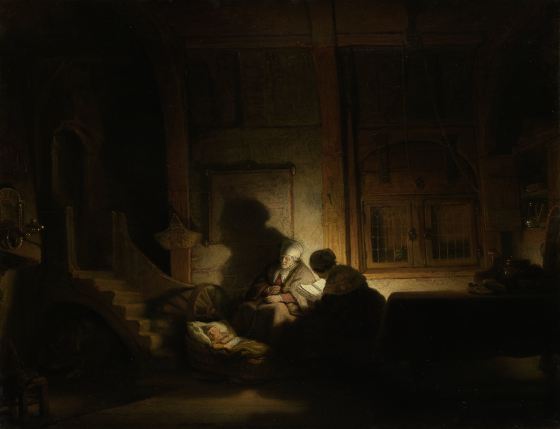
The Holy Family by Night – thought now to be school of Rembrandt rather than by the artist himself:-
The Holy Family by Night

An example of his etching is The Three Crosses (more properly Christ Crucified Between the Two Thieves):-

Rembrandt: The Three Crosses

I must confess I preferred his etchings of rural scenes such as The Three Trees to the religious ones as in Christ Presented to the People.

He was the first (or among the first) artist(s) to recognise the commercial possibilities of the limited edition, altering plates to make variorum prints. The popular title given to the one below reflects the price it is said to have achieved.

The Hundred Guilder Print:-

Rembrandt: The Hundred Guilder Print

One of the most interesting exhibits, in a glass case in one of the rooms, was an actual etched copper plate set alongside a print made from it.

An introductory video to the exhibition can be found at https://www.youtube.com/watch?time_continue=141&v=F1pjZqg5fTM.

Edinburgh’s Art Deco Heritage 18: Fraser’s, Princes Street

On corner of Princes Street and Hope Street.

From Shandwick Place:-
Frasers, Edinburgh

Note clock on corner. Rule of three on windows above:-

Frasers, Edinburgh 2

From Princes Street. gain rule of three on windows:-

Frasers, Edinburgh from Princes Street

The Persistence of Scott

My previous post’s title was of course a reference to the alternative title of Sir Walter Scott’s first novel Waverley otherwise known as Tis Sixty Years Since.

I am of course reading that author’s The Heart of Mid-Lothian at the moment which means he has been on my mind.

Scott’s influence continued to be felt long after his death. Edinburgh’s main railway station is named Waverley in his honour and there is of course the huge monument to his memory on Princes Street.

Scott Monument

On seeing this Belgian author George Simenon is supposed to have asked, “You mean they erected that for one of us?” then added, “Well, why not. He invented us all.”

Also named after him is the main steamer on Loch Katrine in the Trossachs, the SS Sir Walter Scott, which was built by Denny’s of Dumbarton, dismantled, its pieces numbered, then the whole transported by horse cart to Stronachlachar on Loch Katrine where it was reassembled.

SS Sir Walter Scott
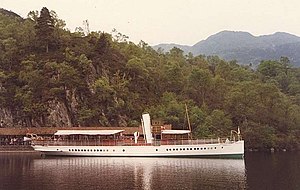
SS Sir Walter Scott

She is by no means the only ship with a Scott connection which I have sailed on.

The Heart of Mid-Lothian‘s main female character is named Jeanie Deans, a name previously familiar to me – at least in her second steamship incarnation – from several of those trips “Doon the Watter” that used to be so much a part of a West of Scotland childhood.

PS Jeanie Deans
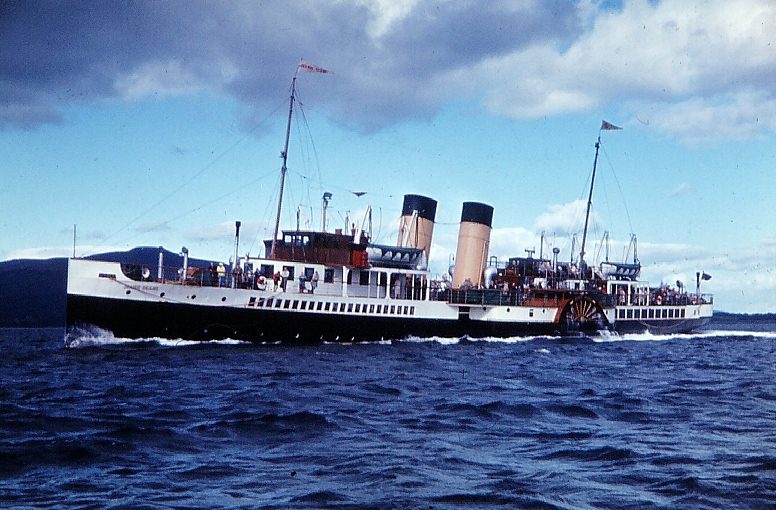
PS Jeanie Deans

There was a short branch line (now long gone) off the main-line station at Craigendoran (about 8 miles from Dumbarton) which took trains right up to a platform on the pier where the ship would be waiting for its passengers to detrain and embark – usually for Rothesay. I believe something similar pertained at Wemyss Bay.

One of the delights of the trip was to descend into the lower parts of the ship to see the engines; mesmerising visions of gleaming, oiled steel and brass, powerful flywheels spinning, pistons thundering, regulators twirling. “Taking a look at the engines” was also used as a euphemism by those suitably aged gentlemen patrons who wished to avail themselves of the licensed facilities on board.

There was also an earlier PS Jeanie Deans. Indeed the North British Packet Steam Company and North British Railway seem to have named their ships almost exclusively after Scott characters. Have a look at this list of their ships, some of which were transferred to later operators.

Only one of these floating mini-palaces still exists. The second PS Waverley (built in 1949) is now the sole ocean-going paddle steamer left in the world and still carries out excursions from its base on the Clyde near Glasgow Science Centre, in the Bristol Channel, from London, the South Coast and Wales under the auspices of the Paddle Steamer Preservation Society.

PS Waverley at Ilfracombe

Waverley at Ilfracombe

If you can avail yourself of the opportunity to take a trip on the Waverley (or indeed the SS Sir Walter Scott, though she is much smaller and does not quite afford the full experience) I would urge you to do so.

Boer War Memorial, Edinburgh

On a sudden impulse we went to Edinburgh on Sunday morning. (Well the good lady wanted to return an item to a shop.)

It was a pleasure not to have to fight our way through crowds on Princes Street as we would have on a Saturday.

I had the camera along and ended up taking 46 photos.

This is the war memorial that stands on North Bridge (the one above Waverley Station.) The uniforms are of the South African War/Wars.

If you read the writing (click on the picture to enlarge) it’s not just to commemorate those wars but also engagements in Afghanistan (nothing changes, eh?) Egypt, Chin Lusha, Chitral and Tirah.

This bottom picture is of the plaque below the memorial. It commemorates the laying of the foundation stone of the North Bridge by some local worthy.

free hit counter script