Archives » post-apocalypse

More Reviews

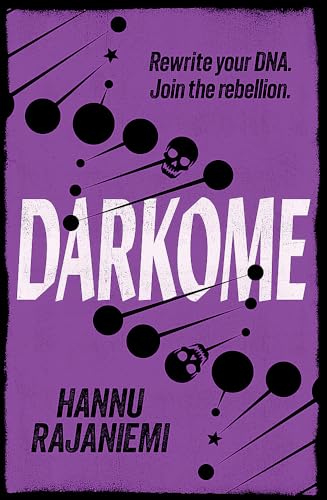
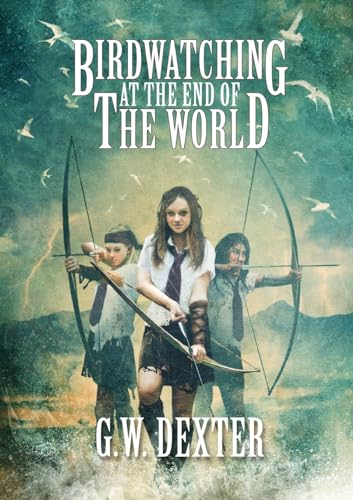
Hot off the presses and to be read for ParSec, come Birdwatching at the End of the World by G W Dexter – a post-apocalypse novel with a twist – and Darkome by Hannu Rajaniemi, seemingly another post-apocalypse novel this time in a world of multiple pandemics where an implantable mRNA vaccine factory will protect you from new viruses.

The twist in Birdwatching at the End of the World is that the survivors are the pupils of a girls’ school located on an island. The pitch writes itself.

Hannu Rajaniemi I know. He used to be part of the same writers’ group as I was before his day job as a microbiological researcher took him to the USA. His expertise in the field will doubtless lend authenticity to his story. I have reviewed several of his books already; here, here, here, and here.


Earth Abides by George R Stewart

Black Swan, 1985, 362 p.  Cover art by Eduardo Paolozzi.

During the late twentieth century this was considered as a classic Science Fiction novel of the post-apocalyptic variety.  I bought it many moons ago but somehow never got round to it till now.

Our protagonist Isherwood Williams is bitten by a rattlesnake when out on a hunting expedition. When he recovers he finds the human world has succumbed to a disease of some sort. Cities and roads are mostly deserted (the book was first published in 1950 when cars were much scarcer than they are now) but infrastructure – electricity, water, fuel – is still working. Overcoming his reluctance to use what wasn’t his property he takes a car and rides from his home in California across what was the US to the east coast and finds very few people have survived. Those who have, are disorientated and demoralised though three “negroes” have gone back to living off the land. Williams (in what is to modern eyes clearly a racist assumption) thinks they are more suited to this due to the way they lived before.

Back home in California he sets about life on his own but one day, when the electricity has finally failed and the street lights have faded away he notices a light at night. This leads him to a woman called Emma and the pair get together. Emma is of black ancestry so Williams’s racism is not too overt. (But then again in such a situation you could not afford to be overly choosy.) Emma is a resourceful and wise woman so it is just as well.

The pair set about surviving as best they can and even decide to have children. Along with a man called Ezra and the family he had collected around himself they form a community, which over the years grows and forms rituals of its own. Ish’s hand-held hammer becomes a totem, the long-lost Americans (of which to his community he is the last) and their accomplishments held in awe by the younger members. The difficulties of coming to terms with a new mode of life and of meeting other survivors or their communities  are explored briefly but mostly this is the story of Ish.

Some of the seeds of later post-apocalypse novels – especially the ‘cosy catastrophes’ of 1960s British SF – can be discerned in this book, so in that sense it can still be seen as a classic.

Pedant’s corner:- “extra ordinarily pleased” (extraordinarily,) “upon articles of dust” (particles of dust,) “but he heard only far off, the rasp and crackle of static” (needs a comma before ‘only’, “had take command” (had taken,) wistaria (x2, wisteria,) “whimpered her sleep” (whimpered in her sleep,) grape-fruit (grapefruit,) “what might, by generous interpretation, he called a social group” (be called a social group,) generaly (generally,) “electrical impluses” (impulses,) a missing comma before a piece of direct speech (x 2.) “Near by a smooth rock surface” (Nearby,) youngesters (youngsters,) geograhy (geography,) feminity (femininity,) Mohenjadaro (Mohenjo-daro.)

Walk to the End of the World by Suzy McKee Charnas

Coronet, 1981, 252 p.

 Walk to the End of the World cover

This book has an odd, disjointed structure, being narrated sequentially from the point of view of four of its characters, Captain Kelmz, Servan d Layo, Eykar Bek and Alldera, before the final section, called Destination, which switches between the last three of those. It was a bit of a slog at first as there was a significant degree of information dumping and much of the story was told, not shown to us.

The setting is many, many years after The Wasting, where most of humanity was wiped out by various environmental disasters and their accompanying wars. The remains of humanity are congregated in a smallish land area known as Holdfast, bounded on two sides by The Wild and stretching from the inland town of ’Troi to Lammintown and Bayo on the coast with a slight seaside extension to Endpath. (These are – unneccesarily – outlined on a map which follows the dedication page.)

Holdfast is a subsistence society run by men who blame the descent of the species on women, here known as Fems and treated as subhuman slaves barely fit for the necessary breeding (which is looked on with more than distaste by the men, who are supposed to prefer same-sex encounters.) The litany of those “Dirties” who are the butt of the men’s displeasure at their reduced state is a list of all those whom political right-wingers have traditionally despised. They chant, “Reds, Blacks, Browns, Kinks; Gooks, Dagos, Greasers, Chinks; Ragheads, Niggas, Kites, Dinks,” and, “Lonhairs, Raggles, Bleedingarts; Faggas, Hibbies, Families, Kids; Junkies, Skinheads, Collegeists; Ef-eet Iron-mentalists,” adding, “Bird, Cat, Chick, Sow, Filly, Tigress, Bitch, Cow,” and, “the dreadful weapons of the unmen; cancer, raybees, deedeetee; Zinc, lead and mer-cur-ee.”

I note that in that second last list, of derogatory terms for women, Charnas has missed out the most potent, the c-word, which her characters would more probably have gloried in. (It may be she thought it would not get past her publishers. Possibly she tried, and they vetoed it.)

In Holdfast, intergenerational conflict is thought to be inevitable and male children are brought up not knowing who their father is (and vice versa.) This provides part of the motor for the plot as Eykar Bek, once Endtendant at Endpath, to where men go at the end of their lives for a ritual suicide, knows his father is Raff Maggomas but not his whereabouts. The plot involves d Layo, Bek and the fem Alldera variously hiding out from the men at Lammintown and Bayo before travelling to ’Troi where the final confrontationt takes place. As Alldera is set on finding the legendary free women in The Wild, whom we do not meet (and into which we do not venture) in this novel, scope is afforded for a sequel.

At time of first publication in 1974 the future postulated here may have seemed an overly pessimistic view of the future of gender relations – which then were becoming more fluid in the West. But suppression of women never really went away in the wider world and in these days of resurgent male chauvinism in the so-called “mature” democracies and the less polite areas of the internet, it is frighteningly plausible.

Undoubtedly feminist as Charnas’s intent was, as a novel, taking the gender relationships aside, the mechanics of Walk to the End of the World’s plot and the degree (or lack of it) of characterisation were pretty standard SF fare for the time.

Pedant’s corner:- a UK edition but printed in USian. Kelmz’ (many instances; Kelmz’s,) Maggomas’ (several instances; Maggomas’s,) pantomines (pantomimes,) flutists’ (flautists’) focussed (focused,) Chings (Chinks,) lambaste (lambast,) tattoed (tattooed,) Matris’ (x2, Matris’s,) gutterals (gutturals,) gasses (gases,) Robrez’ (Robrez’s,) a missing end quotation mark, “to wipe the thin film of pinkish blood, from the Trukker’s blade” (doesn’t need the comma,) metail-tipped (metal-tipped,) dismissal (dismissal,) mock-obsequity (mock-obsequiousness.)
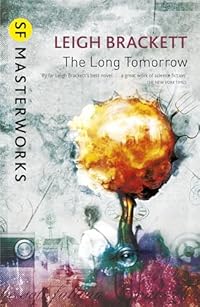
The Long Tomorrow by Leigh Brackett

Gollancz SF Masterworks, 2014, 241 p plus iv p introduction by Pat Cadigan

 The Long Tomorrow cover

The Destruction has come, fire has rained down, civilisation has fallen far. Nearly one hundred years on people scrape by as best they can. Society is now dominated by Neo-Mennonites as in the aftermath of the Destruction only those who did not depend on technology had the means to survive. The thirtieth amendment to the US constitution was enacted to forbid both cities and dense populations. The law is backed up by the strict Old Testament religious mind-set which pervades the agrarian culture.

Len Culter is influenced by his grandma who could not quite forget that the old days were good. He is fascinated by her stories and also by the possibility that remnants of the old times might still exist in a place called Bartorstown, whose location no-one knows and whose proponents risk execution. His only hope of ever finding this chimera is via the traders who ply across the land. He is led astray by his cousin Esau, stealer of old books and purloiner from a summarily executed trader’s wagon of a radio which by accident they manage to get to work. On being discovered and forced to flee from Piper’s Run, he and Esau make it to the Ohio riverside settlement of Refuge where a merchant is pushing against the size laws. His endeavour does not turn out well and Len, with Esau and Amity, the girl whom Esau has got pregnant, are plucked from the vengeful zealots by agents of Bartorstown. After a long discouraging journey Len finally reaches his goal where he finds it is much less but also far more than he had expected. He also finds his childhood indoctrination hard to shake off.

From a twenty-first century perspective the absence of any Native Americans in Brackett’s scenario is glaring. It might be thought that they would be equipped to thrive in a world so stripped down. I suppose that in the 1950s when the book was first published such a consideration might not have occurred and would in any case probably have been rejected by an editor – and readers. (A darker explanation for their absence from a future like this is of course also possible; but Brackett’s attention does not lie in that direction. In this context I note that no black characters appear either.) Even though Brackett was one of the (very) few high-profile women SF writers of the 50s the book’s sexual politics are also of its time, with women being depicted as strictly domestic creatures – or temptresses, who are also nevertheless fated to domesticity. (I would also have thought that the US as a polity could not have survived a Destruction as complete as portrayed here. Doubtless, this is also not a thought which would have been comfortable – or perhaps even imaginable – to mid-twentieth century USians. Pat Cadigan in her introduction suggests that a nuclear war would not have been survivable at all.) Still, take it all as read for purposes of story.

Brackett’s characters are convincingly portrayed, it is easy to believe people would behave in the ways shown given their circumstances; only Julio Gutierrez’s breakdown when Bartorstown’s latest attempt to remove the threat overhanging their project failed seemed in any way unlikely. Despite the intervening years since its first publication The Long Tomorrow still bears reading.

Pedant’s corner:- “Pa. hadn’t noticed it” (no need for the full stop after Pa,) proselyting (apparently the USian form of proselytising,) Harkness’ (Harkness’s,) he had waked (woken, please,) “‘Good-by, Len’” (Goodbye, there was another good-by later,) “Dulinsky wiped his face oil his shirt sleeve” (on his shirt sleeve,) Watts’ (Watts’s,) “trailing of tobacco smoke from a pipe” (no need for “of”,) lay low (lie low,) Gutierrez’ (Gutierrez’s.)

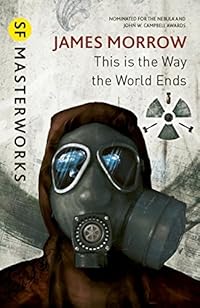
This is the Way the World Ends by James Morrow

Gollancz SF Masterworks, 2013, 312 p, with iv p introduction by Justina Robson.
(Not borrowed from but) returned to a threatened library.

 This is the Way the World Ends  cover

Framed as a tale told by Doctor Michel de Nostradame in Salon-de-Provence, 1554, (that’ll be Nostradamus to you and me) this is the story of George Paxton, a monumental mason, in the late(ish) twentieth century US.

George is approached by a glib salesman to buy a scopas suit (Self-Contained Post-Attack Survival) for his daughter to protect against nuclear attack. It is too expensive and his wife makes him return it. However, soon such suits are commonplace, people wearing them in the course of everyday life. Then George is offered a free suit provided he accepts the condition that he sign a confession of his complicity in the nuclear arms race. He does so, to give the suit as a Christmas present to his daughter. On his way back home his town is obliterated in a Soviet nuclear strike, a response to the US attack which followed the detection of Soviet Spitball missiles heading for Washington. As he heads towards the blast area to try to rescue his family the last thing he sees before losing consciousness is a giant vulture as big as a pterodactyl heading for him.

As it turns out he was taken from the ruins by the crew of a submarine, the City of New York, now headed for Antarctica. The crew are “unadmitted”, humans – with black blood – whose existences were pre-empted when their hypothetical progenitors were annihilated by the war. The survivors they have gathered were all architects of the war in one way or other. After giving them medical treatment – ‘If one had to say something good about acute radiation sickness, it would be this: either it kills you or it doesn’t,’ – the unadmitted put them on trial, Nuremberg-style. This allows Morrow to skewer the through the looking-glass idiocies and contradictions of deterrence theory. The submarine’s captain, dismissing a particular riddle as having no answer, poses one that does, “When is a first strike not a first strike?” is then asked, “When,” and replies, “When it is an anticipatory retaliation.” (Sounds like 1970s Rugby Union doctrine.)

In the course of all this we encounter a MAD Hatter (Mutually Assured Destruction,) a March Hare (Modulated Attacks in Response to Counterforce Hostilities) and Stable talks (Strategic, Tactical, and Anti-Ballistic Limitation and Equalization,) the likelihood that scopas suits contributed to a willingness to accept the possibility of nuclear war, and the thought that, “When you turn the human race into garbage, you also turn history into garbage.”

At the time of writing (1986) the prospect of nuclear annihilation was never far away, in 2015 it has, perhaps, much less resonance. Whether it is this that contributes to the sense of distance throughout the book is difficult to decipher. Whatever the reason, the tone feels somehow off-kilter. Moreover, rather than being rounded characters most of Paxton’s fellow defendants are ciphers there solely to represent points of view and the unadmitted seem like actors inhabiting parts only shallowly instead of true agents. The role the giant vultures had in precipitating the war is a nice touch though.

The blurb mentions Kurt Vonnegut as a comparison but – repetitions of epitaphs “they were better than they knew” and “they never found out what they were doing here” apart – I was more reminded of R A Lafferty, except without his level of utter bonkersness (giant vultures excepted of course.) Despite Vonnegut’s lighter touches the seriousness with which he treated his subjects was always apparent. Morrow approaches this but doesn’t quite get there.

Pedant’s corner:- Paxton is named as Paxman on the back cover! Then an other (another,) as if a rain were felling on its streets (falling,) Jesus’ (Jesus’s,) videocassertes (videocassettes,) liquifying (liquefying.)
In the introduction:- whimsys (whimsies,) the reasoning of the accused make them (reasoning is singular so “makes”.)

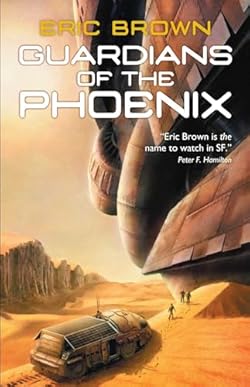
Guardians of the Phoenix by Eric Brown

Solaris, 2010, 350p

 Guardians of the Phoenix cover

In his recent Bengal Station trilogy Brown has been revisiting some of the conventions of Pulp SF. He has also treated us to a Big Dumb Object novel in Helix. In Guardians of the Phoenix, he has turned his attention to the disaster novel, or rather, to the post-Apocalypse tale. Here too, though, there are faint echoes of Pulp SF in the Phoenix of the title.

The Earth is parched, the oceans boiled away. Resource wars and plagues have reduced humanity to dreams – and fears – of the old times. In a handful of small communities sparsely spattered over Europe a few surviving humans cling on, barely scratching a living from the harsh, sun-battered environment.

To begin with there are three main viewpoint narratives. With large animals extinct and plants beyond scarce, Paul traps lizards on the girders of the Eiffel Tower to feed his dying mentor Elise. In Aubenas the locals net bats for food and their leader quietly supplements their diet with a little cannibalism. A band of renegades has kidnapped the daughter of one of the elders of the decimated community in Copenhagen.

The action kicks off when the renegades turn up in Paris to seek out the rumoured food horde in a bank vault. A group from Copenhagen has pursued them. In the resulting gunfight the chief renegade, Hans, escapes and Paul, who had fallen into his clutches, is rescued.

Since Elise has died Paul joins the Copenhagen group’€™s onward trip to drill for water below what had been the Bay of Biscay. Hans returns to his former home in Aubenas just in time to join an expedition to Bilbao to find the remains of an abandoned project designed to save humanity from extinction.

As usual with Brown the focus is mainly on the characters, who are well rounded – the relationship between Dan and Kath from Copenhagen is particularly well laid out and Hans makes a convincing psychopath – though Paul, even given his earlier relative isolation, is perhaps still a little too naïve. Given the above the book’s plot has to follow certain lines but there are twists and turns along the way. The resolution is saved from being a bit of a deus ex machine by very short premonitory chapters featuring members of the Bilbao project, which however give the Phoenix game away somewhat.

As an adventure story the novel works admirably but I found I couldn’€™t quite buy the scenario – an Earth where the water has evaporated from the oceans would admittedly have a consequent runaway Greenhouse Effect but unless all the atmosphere had gone along with them it would surely be more like Venus, constantly overcast, and hence sunburn would be no problem. (I also wondered how in a parched world as depicted would plants be able to photosynthesise and thus keep O2 levels up? Though animals to breathe it in have of course mostly disappeared.) These quibbles aside however Guardians of the Phoenix is fine entertainment.

free hit counter script