Archives » Justina Robson

Heliotrope by Justina Robson

Stories. Ticonderoga Publications, 2011, 345 p, including vi p Introduction by Adam Roberts and i p Acknowledgements.
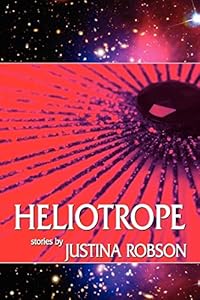
 Heliotrope cover

The lead story Heliotrope is all that has surfaced from the author’s “Massively Unpublishable First Fantasy Epic” and at times the writing betrays its inexperienced origin. In it an artist finishing her apprenticeship is given by her ageing tutor the task of encapsulating the essence of dance master Jalaeka who inspires widespread devotion and can float. He can also drain his followers dry.

The McGuffin in Body of Evidence is a device which lets the wearer know what everyone is really thinking when they are speaking. Our heroine finds this even more excruciating when she meets another person trialling the device.

The Adventurers’ League was first published in an anthology dedicated to the style of Jules Verne. Voyager Lone Star Isol has returned from interstellar space in a manner suggesting it has been able to return faster than the speed of light. The journalist narrator Riba, is sent to investigate. Isol is one of the Forged people and there is the possibility of a war between them and Original humans. Riba is pushed off a transatlantic helium airship to fall oceanward. He is saved from death by the actions of an immense tentacled creature, which turns out to be a floating organism on which he meets avatars of Jules Verne, Captain Nemo, Sinbad, the Mermaid Silene, Ahab, and Sir David Attenborough, Forged people anxious to avoid war. The story has a fair degree of intrusive information dumping.

The Girl Hero’s Mirror Says He’s Not the One is set in Robson’s Mappa Mundi universe. The Girl Hero is sent to assassinate a poet who her mirror assures her will not the one to kill her. Biut he does have a device that resets internal software.

In The Bull Leapers a woman whose husband is in Knossos for an archæological dig encounters three Greeks who practice the old art of bull-leaping. They are also in touch with the Labyrinth, to where they take her for the story’s transforming episode.

Deadhead is narrated by Lois, a fourteen year-old girl. Her six years older sister Clem has Asperger’s and Lois always resents having to looking after her. She and their mother come to a better understanding after Clem communes with a dead horse’s head.

Erie Lackawanna Song starts off at the Hoboken ferry terminal with a man looking at the derelict Erie Lackawanna jetty next door. His journey across the river takes a different turn from usual when his nodding and sometimes speaking acquaintance, Claire Glick, asks him to look at a phial of liquid she has taken from work. It contains a substance that can rewrite brain synapses.

Cracklegrackle sees a man helped by one of the Forged (one who can “see” at all wavelengths) to find his daughter, kidnapped on Mars some time before, on Jupiter, much changed.

In No Man’s Island, on the day she finds she has not got the job at CERN she longed for Mariann Harris consoles herself with her discovery of traces of an alien spaceship having used an Alcbierre warp drive. Meanwhile her husband embarrasses himself with a customer of the shop where he works. Both find solace with their dog, Bing.

Robson’s first published story, Trésor, is understated horror wherein a prostitute has been waiting for her mark.

The Seventh Series is a mythical set of yoga exercises Davey is writing into a computer game. Then he finds that there is a video of that title and goes searching for its origin. The explanation at the story’s end is rather mundane though.

The Little Bear is one of the few SF stories to address the fact that time travel is also space travel and vice-versa. Ronson examines this through a series of vignettes set in different time-lines but with the same characters, each lamenting the human loss they incurred when an experiment involving the teleportation of a bottle of wine changed their world.

In Legolas Does the Dishes an inmate of a mental hospital envisages that the man who doe sthe dishes in the institution is Legolas from Tolkien’s Hobbit universe. Her viewpoint is emphasised when she tells us, “I don’t need to say what might happen if you got a shard in your eye and started to see the world through another lens. Who knows what might be revealed?” It is left open as to whether she is deluded or he really is Legolas.

Dreadnought is the intelligence of a spaceship as mediated through its units which can not exist without a human host.

An Unremarkable Man is the tale of two supernatural women trying to be ordinary, a Viscus Diabolique and the ensuing trade with a non-descript man who materialises from nowhere.

A Dream of Mars is suffered nightly by our narrator who was sent to recover the remains of the dead from a downed cable car in the Martian New South Face Woodlands and destroy the human created Bigfoot who had been intended as a tourist attraction only to form a bond with him instead.

Pedant’s corner:- In Adam Roberts’ Introduction “and both, well, Forged stories” (are both, well, Forged stories,) “of of” (only one ‘of’ required,) “but a tale that understand … are” (understands,) “ontological speaking” (ontologically speaking.) “But another of saying” (But another way of saying,) “knows whats I’m talking about” (what,) “I think that it what her” (that is what her,) a missing full stop, “as a way” (is a way.) “On the contrary the story does is” (what the story does is,) “amply demonstrates” (demonstrated.) Otherwise; “whilst others both showed some degree of chestnut” (both?) Elys’ (x 4, Elys’s.) “‘She dare not breathe’” (the rest of this segment is written in the past tense; ‘dared not’,) bringing her skin up to his awake and. He pinned her down,” (no full stop and subsequent capital needed.) “The paint is so thick that is has” (that it has,) “and Elys’ stops making a noise” (Elys,) “dare not” (again, past tense, dared not,) “like a the funnel” (one or other article, not both,) “sent his Abacand him the time” (either ‘sent his Abacand’, or, ‘sent him’ the time, not both,) “together with in increasing lawlessness” (no ‘in’,) “Jules Verne was a Frenchman of the twentieth century” (only barely; he died in 1905,) “that that” (only one ‘that’ needed,) “your media group have been advocating” (has been advocating,) fit (fitted.) “None of them are interested” (is interested,) “and in just in time to” (and is just in time to,) “its rotor whir softly” (‘its rotors whir’, or, ‘its rotor whirs’,) “I could help but take a sharp breath” (I couldn’t help but, Minos’ (Minos’s,) “It’s comfort” (Its.) “Bishop figure it was for his benefit” (figured,) claimes (claims,) “and sings” (the rest is in past tense, so ‘sang’,) scaned (scanned,) “I dare not” (again past tense; dared,) Mars’ (Mars’s.) “‘Their names is what they are” (Their names are what they are.) “‘and its real, external’” (it’s,) ““Let’s start looking’ Bishop said” (“Let’s start looking,” Bishop said,) iat (at,) “Part sof a” (Parts of a.) “‘may I see it?’” (May,) “much me readily” (much more readily,) “even as it wasn’t part of his concern” (‘even if it wasn’t’ makes more sense,) “all the questions that were hunting him” (haunting him makes more sese,) withy (with,) coudln’t (couldn’t,) “he he” (only one ‘he’ needed,) “those involved Forged” (those involved are Forged,) “less seconds” (fewer seconds,) “for the a regular payment” ( no ‘a’ needed.) “None of them were talking” (None of them was talking,) “(CGPS)was” ((CGPS) was,) a new paragraph taken in the middle of a line when a piece of dialogue is opened (x 2,) “watched the their chosen object” (no ‘the’ I think,) “ ‘still signs himself off “ A Friend of Your Father’s” as if’” (off “A Friend…..) “They stared at the offended item” (the offending item,) Legolas’ (Legolas’s.) “‘I want to see him again,’ She rubbed” (I want to see him again.” She rubbed,) Saclides’ (Saclides’s,) “Laura said ordered a double espresso” (is missing a comma between said and ordered.) “The main criteria is” (the main criterion is,) “the meatl struts of the nearest tower groans and creaks” (the metal struts … groan and creak,) Mars’ (Mars’s,) Raditech were set to lose (Raditech was set to lose.) In the Acknowledgements; Crwther (Crowther.)
The Switch by Justina Robson

Gollancz, 2017. Reviewed for Interzone 271, Jul-Aug 2017.

On Harmony, isolated from the rest of the Diaspora, balance is everything. It is ruled by a theocracy known as the Alchemy. Driven by its founder, Tecmaten, the Alchemy seeks to create, by non-technological manipulation of DNA, the pinnacle of human development; people called Exalted who have special powers. It teaches everything is twofold, arising from twinned energy flows; it preaches light must always be balanced by dark. Consequently it has a sister dark-side city, Chaontium, to which – since rejects must be treated with mercy – they are consigned.

Instead of a tidy sun and moon, one such reject, narrator Nico Perseid, a male homosexual, is composed of two suns. Even in Chaontium consummation of such sexuality is illegal as it would be a meeting of four suns and so burn through the fabric of reality.
We first encounter Nico when he is on trial for the murder of Chaontium gang boss Dashein VanSant, a rap for which he has been promised escape from the death penalty. This is not his first such deliverance. Chapter two flashes back to his childhood in Chaontium’s state orphanage where he met his lifelong friend Twostar Fae. They seized a chance to flee but Nico was hit by a car. Seemingly dead, he was revived by a bystander whom Twostar thinks was an Exalted. Nico, though, doesn’t believe in the theology of the Alchemy or its woo – “spooky bullshit nobody can prove”. In a kind of foreshadowing that is slightly over-egged he also occasionally sees a minotaur.

For Nico and Twostar life in Chaontium is a continual struggle till they are taken in by a gang. He is kidnapped by VanSant for a career in a variety of kickboxing which reads more like lethal cage-fighting. Under the guise of a wetware upgrade to prevent him dying in the ring Nico undergoes an operation to insert a pilot switch – provided by Twostar’s lover Tashin DeKalfu – a piece of Diaspora tech capable of synching with a starship; the only way out of Harmony except death. He wakes up to the murder charge and Tashin’s betrayal, the presence in his head of a Forged Interface, a Chimeric Avatar Switch, a Transhuman converter which can interface with anyone else and allows “Tek or Forged ships to pilot human or other biological avatars”. In other words, telepathy and remote sensing with a gloss of rationalisation.

An awful long time is spent on this set-up but from hereon in the focus is on Tashin’s agenda, the penetration of the Alchemy to try to prove it has been trading illegally offworld. Finally, we have the revelation of where and what Harmony actually is.

Nico is an engaging enough narrator, albeit overfond of expletives, but naturally impatient of the world he inhabits, “Cisnormativity. That isn’t even a word. It shouldn’t even be an idea. It should be destroyed in hellfire.” Despite his disparagement of woo and The Alchemical Wedding (the locus where mysticism, symbolism and reality meet to give rise to a new kind of being,) his encounter with the powers of mind of the Exalted and witnessing an apparent resurrection (or, “reanimation by goldlight intervention”) leads to some musing on the possibility of souls, of energy that exists above and beyond that of body and mind.

There is an idiosyncratic approach to chapter titling (One: is the loneliest number; Seven: sins; Three Threes – the charm; Light the Blue Touchpaper and Count to – Ten; Thirteen. Triskaidekaphobia can kiss my ass,) but these also give a flavour of Nico’s irreverent narrative style. There are times when the information dumping tends to be ad hoc but Robson has deployed a good coinage in the word datmosphere. There are some instances of odd syntactical choices, verb tense anomalies and phrases like “coins down the back of the sofa” and “Defcon One” which hauled me back out of Nico’s frame of reference into our own.

The setting is undeniably Science Fiction but, since the Exalted’s abilities are never truly explained hence might as well be magic, the whole seems an odd blend with outright fantasy and we don’t see enough of Nico’s early relationship with Twostar to make his enduring attachment to her entirely credible.

Fittingly there is a claustrophobic feel to the novel but it all feels rather breathless. Interesting but flawed, The Switch somewhat ironically suffers from a lack of balance.

Pedant’s corner:- a missing comma before a quote, (x 2,) “you do the math” (it’s maths,) ass (arse,) “a host of burning issues were eating him up” (a host was,) Daylus’ (Daylus’s,) “than I would’ve betted he could” (than I would’ve bet.) Dashein spelling varies with Dashain.

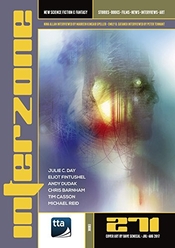
Interzone 271, Jul-Aug 2017

TTA Press

Interzone 271 cover

Roy Gray takes the Editorial and describes a visit to the summer’s Barbican exhibition, Into the Unknown: A Journey Through Science Fiction. Jonathan McCalmont discusses China Miéville’s history of the Russian Revolution October, describing it as the book Miéville was born to write. Nina Allan again reflects on SF’s distinction or otherwise as a genre and the necessity to question and reinvent its tropes. Book Zone1 has appreciative reviews of Nina Allan’s The Rift and Emily B Cattaneo’s collection Speaking to Skull Kings and Other Stories plus author interviews with the pair and also considers novels from Eleanor Lerman, Aliette de Bodard and Taiyo Fuji along with Ex Libris, an anthology of stories set in libraries, not to mention my review of Justina Robson’s The Switch.

In the fiction:-
Julie C Day’s The Rocket Farmer2 has three narrative viewpoints in its 10 pages: the descendant of a long line of Mongolian rocket farmers, her daughter, and one of the rockets. It is the daughter who is the first to truly understand the rockets.
Gods in the Blood (of those who rise)3 by Tim Casson is narrated by a science teacher (who has rather unprofessional biological deterministic views about his charges I must say. But these turn out to be plot related.) The nearby Genomic Innovation Facility is manipulating human epigenetics. All this is tied in with a legend from a Sumerian manuscript.
In If Your Powers Fail You in a City Under Tin4 by Michael Reid a tentacled creature called the God Beast has settled in the sky over the city now called Duolunduo. Some people have developed superpowers as a result.
The titular Chubba Luna5 in Eliot Fintushel’s story is an interplanetary music star in a future where people’s life partners are allotted to them in accord with their biochemistry. This doesn’t turn out any better than choosing them for yourselves.
Chris Barnham’s When I Close My Eyes is a mix of SF and ghost story. It is the tale of the first potholer on Titan, a man who hallucinates his dead wife while encountering extraterrestrial life after being trapped by an ice-fall.
The McGuffin of Cryptic Female Choice6 by Andy Dudak is a spermathecal, a mechanism introduced to the womb by virus which allows women to store various men’s sperm and edit their content to produce a desired genome. The societal backlash is portrayed.

Pedant’s corner:- 1“while allowing they catch up” (allowing them to catch up,) “how do you feel it has effected your life as a writer” (affected,) Goss’ (Goss’s.) 2Written in USian, “so that it spread across the table” (the rest of the story is in present tense, so “spreads”,) practicing (practising.) 3where a bunch of other kids were gathered (a bunch was gathered.) 4Written in USian, ”none of them recognize” (none recognises,) “‘can you come with?’” (with me,) “he shines it on the floor near the figure, trying not to startle them” (not to startle it.) 5Written in USian. 6Written in USian, inside of (inside,) “there used to be hundreds of words for love like Inuit words for snow” (isn’t that snow thing a bit of a myth?)

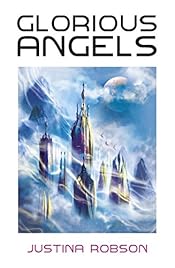
Glorious Angels by Justina Robson

Gollancz, 2015, 512p.

Glorious Angels cover

The last of this year’s BSFA Award nominees for best novel.

The city of Glimshard is ruled by an Empress, a young Empress relatively new to the post. She is telepathically linked to other Empresses some of whom rule other cities. She can also influence the minds of those nearby her. Off to the north a war is being fought against creatures known as Karoo which have both animal and human characteristics and are referred to as bioplastic. The arrival in Glimshard of a Karoo known as Tzaban has piqued the interest of locals. Despite his warning that unless the Empire retreats from its course its forces will inevitably be defeated by the Karoo he is involved in training troops there.

The narrative viewpoint shifts between various characters but the tale is mainly carried by Tralane Huntingore who, despite references to witchlight, mage-bolts etc, is to all intents and purposes a scientist, with a laboratory in her house. We first meet her searching out crystals which have properties suitable for use in recovered machines of various sorts, among them a mysterious pair of goggles and a gun which diffuses entropy. Under the Empress’s orders Tralane is accompanied by Tzaban through a portal to the site of an artefact containing – or being – a prize everyone in power on this world bar the Karoo seems to seek to control.

The text feels oddly balanced, though. Towards the beginning Robson expends a lot of time in describing Glimshard society; there is in particular a scene illustrating an aspect of its sexual mores which doesn’t really illustrate character nor advance the plot. It may be that by that point in the book the norms in Glimshard have not been sufficiently established. Yet it is a strength that Robson eschews any egregious information dumping. Though it is important to this world that women/females are the powers behind it that fact is almost incidental to the narrative and never overtly stressed except for Karoo queens being all powerful with no male able to withstand their influence. The latter parts of the book, though, almost feel like a different novel entirely as plot gallops in and sweeps all before it. Something which may be an invention by Robson (I don’t recall reading of anything similar before, but then my reading of fantasy lags way behind that of SF) is that Karoo assimilate knowledge by eating each other – or humans.

The “magic” is treated matter of factly, in effect as if it were technology: apart from the influencing of minds by the Empresses and the Karoo’s knowledge-gaining attributes it may in fact be technology in our terms. The goggles show a certain star in the sky to be a manufactured object. This points to a science-fictional reading of the text (as does the revelation of the nature of the artefact the fighting was about.) Both suggest a sequel may be forthcoming.

Glorious Angels is good enough to be worthwhile reading; but an award contender? Not for me, I’m afraid.

Pedant’s corner:- The first section uses plural pronouns to describe a certain individual. Granted Robson wishes the person’s identity to be unknown until the viewpoint character finds out who it is – but as I have just demonstrated, what is wrong with using the gender neutral it or its in this context? (It would perhaps have been too far for Robson’s intentions for this scene for her to (re)invent a universal non gender-specific pronoun such as “hir” or “hem”.) Parillus’ (Parillus’s, x 2) “she badly didn’t want to lose the goggles,” (I know what Robson means but the construction is awkward,) betted (bet; several instances,) a missing full stop, (more than once,) Isabeu (Isabeau,) ass (x 2; though arse is used elsewhere,) “one who is making the most of themselves” (himself,) Empress’ (numerous instances; though once we had Empress’s,) ‘“He’s an asshole”’ (arsehole is so much more expressive,) “she laid back” (lay back,) Zarazin (Zharazin,) “where she had laid” (lain,) are are, (one are is enough,) “the Sorority” is treated as a plural noun rather than a singular one, “how many far better woman had surely been here before her” (women,) “either side of the processional carpets were filled with people” (both sides were – or, either side was – filled,) “recognised a lot of faces from the University crowd seated or talking together” (okay, faces is a synecdoche here but the sentence reads very oddly,) dais’ (dais’s,) denoument (denouement,) had known and laid in wait (lain in wait,) “was not without precedence” (precedent,) “This was the minimum cruise height for the landscape, any less ran the risk of damaging structures, and more was profligate, a waste of energy” (optimum cruise height, then,) “his intent distaste of the sound” (intense distaste of?) “she couldn’t hold it in longer” (any longer,) “None were unable to stand against them” (the sense was the complete opposite, ie “none were able to stand against them”,) lay up (lie up,) “where the science team were still working” (the team was,) harness’ (harness’s,) sprung (sprang.)

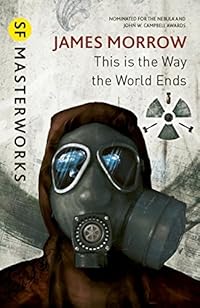
This is the Way the World Ends by James Morrow

Gollancz SF Masterworks, 2013, 312 p, with iv p introduction by Justina Robson.
(Not borrowed from but) returned to a threatened library.

 This is the Way the World Ends  cover

Framed as a tale told by Doctor Michel de Nostradame in Salon-de-Provence, 1554, (that’ll be Nostradamus to you and me) this is the story of George Paxton, a monumental mason, in the late(ish) twentieth century US.

George is approached by a glib salesman to buy a scopas suit (Self-Contained Post-Attack Survival) for his daughter to protect against nuclear attack. It is too expensive and his wife makes him return it. However, soon such suits are commonplace, people wearing them in the course of everyday life. Then George is offered a free suit provided he accepts the condition that he sign a confession of his complicity in the nuclear arms race. He does so, to give the suit as a Christmas present to his daughter. On his way back home his town is obliterated in a Soviet nuclear strike, a response to the US attack which followed the detection of Soviet Spitball missiles heading for Washington. As he heads towards the blast area to try to rescue his family the last thing he sees before losing consciousness is a giant vulture as big as a pterodactyl heading for him.

As it turns out he was taken from the ruins by the crew of a submarine, the City of New York, now headed for Antarctica. The crew are “unadmitted”, humans – with black blood – whose existences were pre-empted when their hypothetical progenitors were annihilated by the war. The survivors they have gathered were all architects of the war in one way or other. After giving them medical treatment – ‘If one had to say something good about acute radiation sickness, it would be this: either it kills you or it doesn’t,’ – the unadmitted put them on trial, Nuremberg-style. This allows Morrow to skewer the through the looking-glass idiocies and contradictions of deterrence theory. The submarine’s captain, dismissing a particular riddle as having no answer, poses one that does, “When is a first strike not a first strike?” is then asked, “When,” and replies, “When it is an anticipatory retaliation.” (Sounds like 1970s Rugby Union doctrine.)

In the course of all this we encounter a MAD Hatter (Mutually Assured Destruction,) a March Hare (Modulated Attacks in Response to Counterforce Hostilities) and Stable talks (Strategic, Tactical, and Anti-Ballistic Limitation and Equalization,) the likelihood that scopas suits contributed to a willingness to accept the possibility of nuclear war, and the thought that, “When you turn the human race into garbage, you also turn history into garbage.”

At the time of writing (1986) the prospect of nuclear annihilation was never far away, in 2015 it has, perhaps, much less resonance. Whether it is this that contributes to the sense of distance throughout the book is difficult to decipher. Whatever the reason, the tone feels somehow off-kilter. Moreover, rather than being rounded characters most of Paxton’s fellow defendants are ciphers there solely to represent points of view and the unadmitted seem like actors inhabiting parts only shallowly instead of true agents. The role the giant vultures had in precipitating the war is a nice touch though.

The blurb mentions Kurt Vonnegut as a comparison but – repetitions of epitaphs “they were better than they knew” and “they never found out what they were doing here” apart – I was more reminded of R A Lafferty, except without his level of utter bonkersness (giant vultures excepted of course.) Despite Vonnegut’s lighter touches the seriousness with which he treated his subjects was always apparent. Morrow approaches this but doesn’t quite get there.

Pedant’s corner:- Paxton is named as Paxman on the back cover! Then an other (another,) as if a rain were felling on its streets (falling,) Jesus’ (Jesus’s,) videocassertes (videocassettes,) liquifying (liquefying.)
In the introduction:- whimsys (whimsies,) the reasoning of the accused make them (reasoning is singular so “makes”.)

Living Next Door To The God Of Love by Justina Robson

Macmillan, 2005

This book begins with a rather startling Herman’s Hermits (or, if you’re younger, a Carpenters) reference, which was promising, as was the zeroth chapter – and I will say that Robson’s descriptive writing is a joy – but I found as time went on I just couldn’t get to grips with it. As with Robson’s Mappa Mundi there is a deal of info-dumping and the subject matter is also complex but the major problem was the multiplicity of viewpoint characters, each of whom got a shot at narration for a short while before another took over. This is not necessarily a severe drawback, it works very well for George R R Martin in his Song Of Ice And Fire volumes, but each character there gets an extended chapter; here it entailed too much disruption to the flow.

The nearest I can summarise the plot is that Earth is no longer alone, entry to other worlds/existences is possible via portals/bridges through which we are taken at different times into these various places. There is also much mention of different dimensional universes, our own familiar one of four and those with seven and eleven. The main character is Jalaeka, a kind of shapeshifter with a colourful past, who seems to be a detached fragment of a higher dimensional entity called Unity which wants him/her/it back. Jalaeka is attractive to humans – especially Francine, the main female lead – and is described, and describes him/her/itself as a kind of God.

I don’t like to give up on a book so I persevered and, yes, it does have things to say about redemption – even if we have to endure some graphic scenes before that becomes apparent – and about the permanence of love, but in the end I found it a chore to read.

The fault is likely mine. After all, Living Next Door To The God Of Love was nominated for several awards. However, for various reasons at time of reading I wasn’t able to give it quite the attention it obviously demands.

In the spirit of fairness here’s a link to a reviewer who made more of it than I did.

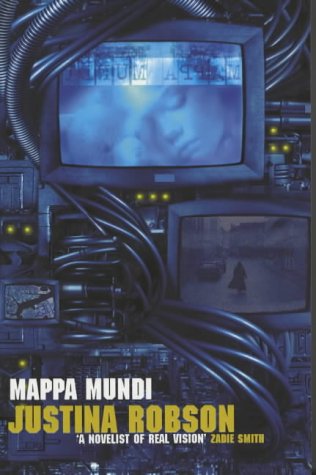
“Mappa Mundi” by Justina Robson

Macmillan, 2001

Mappa Mundi cover

Another doorstopper, 465 pages this time. Just as well I was on holiday.

I’m not quite sure about this book. The characters are not so distinctive as they were in Robson‘s earlier novel Silver Screen. This may be because the plot is rattling along, a factor which unfortunately involves a lot of info dumping, and Robson may have invested more of her efforts in those directions. Also back stories are filled in on occasion, a habit which I dislike, but, hey, she’s up there with Mailer on that one.

The science-fictional element is two-fold; a kind of nanotech virus software (MappaWare) which can affect the brain (“stir its contents with a spoon” – effectively resetting people, then) and a 100% replication delivery system. The possibilities for bad uses of such a technology are obvious but some of the characters see also the good which could result.

Premature testing of all this stuff is the engine which sets the plot off but there are no fewer than seven “false starts” – establishing motivation for some of the characters – where earlier incidents in their lives are recounted, before we get down to the nitty-gritty.

There is plenty of spy story type skullduggery and betrayal (is this a Robson trait? – see my infinity plus review of Keeping It Real) an obligatory bit of sex but, surprisingly, not much violence; in the course of all of which two of the characters transcend humanity in a way which stretches credulity a touch.

It’s not an easy read, the ideas are too dense for that – but they are nevertheless followable. However, the major flaw, in a novel where questions of identity are central, is that the two characters most changed by MappaWare did not behave/read much differently after the change than they did before it.

Still, if you like near future techno-thriller type stuff with reasonable characterisation you won’t be disappointed.

free hit counter script